
In 1980, Fidel Castro opened the port of Mariel and allowed 125,000 Cubans to emigrate to the United States. Most of them settled in Miami. In a single year, Miami’s labor force increased by 7%. Economists had debated for decades whether mass immigration lowers native workers’ wages, but no one had ever been able to run a controlled experiment. Castro, unwittingly, ran one for them.
David Card, then a young labor economist at Princeton, recognized the opportunity. He compared labor market outcomes in Miami before and after the Mariel Boatlift with outcomes in four comparable cities that did not experience the influx: Atlanta, Houston, Los Angeles, and Tampa. His finding, published in 1990, stunned the profession: the massive wave of immigration had virtually no effect on wages or unemployment for Miami’s native workers.
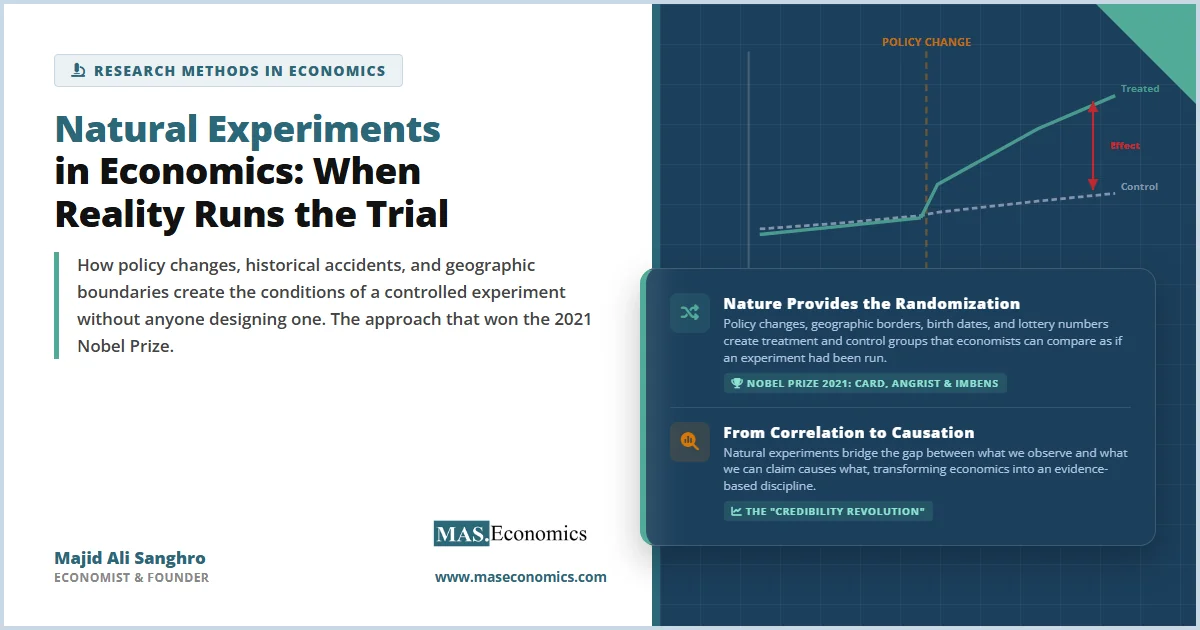
Card’s Mariel Boatlift study is one of the most famous natural experiments in the history of economics. It demonstrated that real-world events, when analyzed carefully, could provide causal evidence as credible as a controlled trial without any researcher having designed the experiment. This insight, developed over three decades by Card, Joshua Angrist, Guido Imbens, and their collaborators, won the 2021 Nobel Prize in Economics and fundamentally changed how empirical research is conducted across the social sciences.
What Is a Natural Experiment?
A natural experiment is a real-world situation in which an external event, a policy change, a natural disaster, a lottery, a geographic boundary, or a historical accident creates conditions that closely resemble those of a controlled experiment. Some group of people, firms, or regions is affected by the event (the treatment group), while a comparable group is not (the control group). The assignment to treatment and control is determined not by a researcher but by circumstances that are effectively random, or at least independent of the factors that determine the outcome of interest.
The key distinction between a natural experiment and a true randomized controlled trial (RCT) is control. In an RCT, the researcher designs the intervention, selects the participants, and randomly assigns them to treatment and control conditions. In a natural experiment, the researcher has no control over any of these elements. The “experiment” has already happened in the real world; the researcher’s task is to recognize it, identify the treatment and control groups, and analyze the data.
This distinction matters because natural experiments arise from events that were not designed for research purposes. A state raises its minimum wage while a neighboring state does not. A draft lottery randomly assigns young men to military service. A school enrollment rule creates sharp cutoffs that determine class size. None of these situations was created to answer an economic question, but each creates the conditions under which a causal question can be credibly answered.
As the Royal Swedish Academy put it when awarding the 2021 Nobel Prize: “Natural experiments are a rich source of knowledge. The laureates’ research has substantially improved our ability to answer key causal questions, which has been of great benefit to society.”
Why Natural Experiments Matter: The Problem They Solve
The fundamental challenge in empirical economics is the problem of causal identification. When we observe that people with more education earn higher salaries, we cannot simply conclude that education causes higher earnings. People who pursue more education may be more motivated, more intelligent, or from wealthier families, all of which independently contribute to higher earnings. The correlation between education and income is real, but the causal relationship is contaminated by these confounding factors.
In medical research, this problem is solved through randomized controlled trials. To test whether a drug works, researchers randomly assign patients to receive the drug or a placebo, ensuring that the two groups are identical on average in every respect except the treatment. But in economics, RCTs are often impractical, unethical, or impossible. We cannot randomly assign countries to different fiscal policies, randomly assign workers to different wages, or randomly force some people to immigrate and others to stay.
Natural experiments provide a way around this obstacle. When an external event creates “as-if random” assignment to treatment and control groups, economists can analyze the resulting data with the same logic as an RCT. The event does the randomization that the researcher cannot. This is why the Nobel Committee described the laureates’ contribution as having “revolutionised empirical research” in the economic sciences.
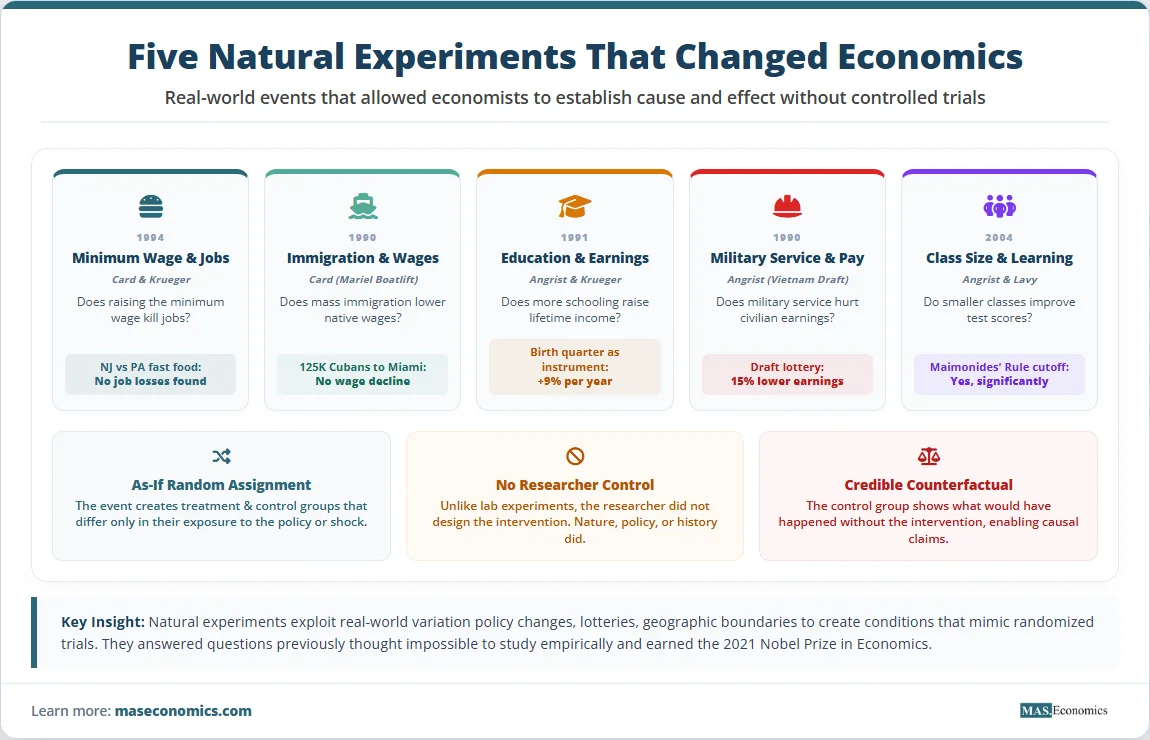
Five Landmark Natural Experiments That Changed Economics
1. Card and Krueger: The Minimum Wage and Employment (1994)
Perhaps the most famous natural experiment in economics. In April 1992, New Jersey raised its minimum wage from $4.25 to $5.05 per hour, while neighboring Pennsylvania’s minimum wage remained unchanged. Card and Krueger surveyed fast-food restaurants in both states before and after the increase, using Pennsylvania as the control group for New Jersey.
Their finding overturned decades of economic orthodoxy: employment in New Jersey’s fast-food industry actually increased relative to Pennsylvania’s after the minimum wage hike. This challenged the textbook prediction that minimum wage increases necessarily reduce employment, and it transformed the policy debate around minimum wages worldwide. The study has been scrutinized, criticized, replicated, and extended by hundreds of subsequent researchers, and the core finding, that moderate minimum wage increases do not necessarily reduce employment, has largely held up.
2. Card: The Mariel Boatlift and Immigration (1990)
As described in the introduction, Castro’s decision to open the port of Mariel in 1980 created a sudden, massive, and entirely unanticipated influx of immigrants into a single US city. Card’s comparison of Miami’s labor market outcomes with those of comparable cities showed that the influx had no significant effect on the wages or unemployment rates of native workers, even those with low levels of education who were most directly in competition with the new arrivals.
This natural experiment was particularly powerful because the timing and scale of the Mariel Boatlift were determined entirely by Cuban politics, not by economic conditions in Miami. The immigrants did not choose to come because Miami’s economy was booming; they came because Castro let them leave. This exogeneity, the fact that the treatment was driven by factors unrelated to the outcome, is what gives the study its causal credibility.
3. Angrist and Krueger: Quarter of Birth and Returns to Education (1991)
How much does an additional year of education actually increase earnings? To answer this, Angrist and Krueger exploited a subtle feature of US compulsory schooling laws. Children born in the first quarter of the year (January to March) typically start school at a slightly older age than those born later, and because compulsory schooling laws require attendance until a specific birthday, children born earlier in the year can legally drop out after completing less schooling.
This means that a person’s quarter of birth, which is effectively random and unrelated to their ability or motivation, creates variation in how much schooling they complete. Angrist and Krueger used this instrumental variable to estimate that each additional year of schooling increases earnings by approximately 9%. Remarkably, this causal estimate was higher than the raw correlation between education and income (about 7%), which was surprising because the correlation was expected to be inflated by ability bias.
4. Angrist: The Vietnam Draft Lottery and Military Service (1990)
Does military service help or hurt civilians’ future earnings? Young men who volunteer for the military differ systematically from those who do not, making simple comparisons unreliable. Angrist exploited the fact that during the Vietnam era, the US military draft was determined by a lottery based on birth date. Men with low lottery numbers were drafted; those with high numbers were not. Because lottery numbers were randomly assigned, comparing the future earnings of men with low versus high numbers provided a clean estimate of the causal effect of military service.
Angrist found that Vietnam-era military service reduced subsequent civilian earnings by approximately 15%. This study was seminal not only for its findings but for demonstrating how a lottery, a source of genuinely random variation, could be used as an instrument to identify causal effects in observational data.
5. Angrist and Lavy: Class Size and Student Achievement (1999)
Does reducing class size improve student learning? This question is expensive to answer with an RCT because it requires building additional classrooms and hiring teachers. Angrist and Lavy found an elegant natural experiment in Israel’s “Maimonides’ Rule,” which caps class size at 40 students. When a grade cohort exceeds 40 students, the school must split into two smaller classes. This creates a sharp discontinuity: a school with 40 students has one class of 40, but a school with 41 students has two classes of roughly 20.
By comparing outcomes for students in cohorts just above and below these cutoffs, Angrist and Lavy estimated that smaller classes significantly improved test scores, particularly for disadvantaged students. This study combined elements of a natural experiment with a regression discontinuity design, illustrating how different quasi-experimental methods can complement each other.
| Study | Question | Natural Experiment | Key Finding |
|---|---|---|---|
| Card & Krueger (1994) | Does the minimum wage reduce employment? | NJ raised minimum wage; PA did not | No employment loss in NJ fast food |
| Card (1990) | Does immigration lower native wages? | Mariel Boatlift: 125K Cubans to Miami | No significant effect on Miami wages |
| Angrist & Krueger (1991) | What is the return to education? | Quarter of birth affects school-leaving age | +9% earnings per additional year |
| Angrist (1990) | Does military service affect earnings? | Vietnam draft lottery (random numbers) | ~15% reduction in civilian earnings |
| Angrist & Lavy (1999) | Do smaller classes improve test scores? | Maimonides’ Rule (class size cap at 40) | Significant improvement, especially for disadvantaged |
 |
|||
What Makes a Good Natural Experiment?
Not every policy change or historical event qualifies as a natural experiment. Three conditions must be met for a natural experiment to provide credible causal evidence.
1. As-If Random Assignment
The event must create treatment and control groups that differ only in their exposure to the intervention. If people can choose whether to be in the treatment group, the assignment is not as-if random, and the estimates will be biased by self-selection. The Mariel Boatlift works because the immigrants’ decision to leave Cuba was driven by Castro’s politics, not by conditions in Miami. The Vietnam draft lottery worked because lottery numbers were genuinely random. The NJ/PA minimum wage comparison works because Pennsylvania workers could not easily switch to New Jersey to benefit from higher wages.
2. A Credible Control Group
There must be a comparison group that plausibly represents what would have happened to the treated group in the absence of the intervention. This is the counterfactual. In Card and Krueger’s study, eastern Pennsylvania serves as the counterfactual for New Jersey because the two areas share a border, a labor market, and an economy. If Card had compared New Jersey to Alaska, the study would not be credible because the control group would be too different from the treatment group.
3. Sufficient Variation and Data
The event must create enough variation to detect an effect. If the minimum wage increase was tiny or the immigration inflow was small, the study might lack the statistical power to distinguish a real effect from random noise. Researchers must also have access to reliable data on outcomes for both treatment and control groups before and after the event.
Modern Applications
The natural experiment approach has spread far beyond its origins in labor economics. Today, it is the dominant empirical strategy across virtually every subfield of economics and increasingly in other social sciences.
In health economics, researchers have used the random assignment of judges to criminal cases (some judges are systematically harsher than others) to study how incarceration affects future employment and recidivism. In development economics, researchers have exploited droughts, floods, and commodity price shocks as natural experiments to study the effects of income shocks on child health, education, and migration.
In public finance, changes in tax policy across state borders create natural experiments for studying the effects of taxation on labor supply, business location, and consumer behavior. In environmental economics, the accidental shutdown of industrial plants has been used to estimate the health effects of air pollution. And during the COVID-19 pandemic, researchers used the staggered timing of lockdowns, school closures, and mask mandates across states and countries as natural experiments to study the effects of these interventions on economic activity, health outcomes, and educational achievement.
The approach has also been adopted by technology companies. Amazon, Meta, and other firms routinely run quasi-experimental analyses alongside their A/B tests, using natural variation in product rollouts and algorithm changes to estimate causal effects on user behavior and revenue.
Source: Author estimates based on Google Scholar citation data and Imbens (2024) survey of empirical methods | MASEconomics.com
The chart illustrates the explosive growth of natural experiments in the economics literature. Before 1990, the approach was almost nonexistent in mainstream economics. Card, Angrist, and Krueger’s pioneering studies in the early 1990s launched a movement that has grown exponentially ever since. Today, natural experiments are used in roughly half of all empirical economics papers published in top journals, a remarkable transformation in how the discipline produces knowledge.
Strengths and Limitations
The primary strength of natural experiments is their credibility. Because the source of variation is external and often verifiable, researchers and readers can assess the plausibility of the causal claim by examining whether the assignment to treatment was truly as-if random. This transparency, which Imbens and Angrist made central to their methodological framework, has raised the standard of evidence in economics and earned the approach its reputation as the gold standard among observational methods.
The primary limitation is external validity. Natural experiments identify causal effects for specific populations, in specific contexts, at specific times. Card and Krueger’s findings about minimum wages in New Jersey fast-food restaurants may not generalize to other industries, other states, or other time periods. Angrist’s finding about the Vietnam draft lottery applies to men in the 1960s and 1970s, not necessarily to modern military service. Each natural experiment provides a credible answer to a narrow question; building broader knowledge requires accumulating evidence from multiple natural experiments in different settings.
A second limitation is that natural experiments are found, not made. Researchers cannot create a natural experiment; they can only recognize one when it occurs. This means that the questions economists can answer with this method are limited by the historical events and policy changes that happen to generate useful variation. Some important questions may never have a suitable natural experiment, which is why the method complements rather than replaces other approaches such as regression analysis, structural modeling, and machine learning.
MASEconomics Explains
Four concepts essential to understanding natural experiments
Natural Experiment
A real-world event, such as a policy change, lottery, or historical accident, that creates treatment and control groups in a way that resembles a randomized trial. The researcher does not design the intervention but recognizes and analyzes it. This approach earned the 2021 Nobel Prize in Economics.
As-If Random Assignment
The condition where the event that creates treatment and control groups assigns individuals to each group in a manner that is independent of the factors affecting the outcome. Draft lotteries, birth dates, and arbitrary policy boundaries are common sources of as-if random variation in economics.
External Validity
The degree to which findings from one study generalize to other populations, settings, or time periods. Natural experiments often provide high internal validity (credible causal evidence for the studied group) but limited external validity (uncertain applicability to other contexts).
The Credibility Revolution
The transformation of empirical economics since the 1990s, driven by the adoption of natural experiments and related quasi-experimental methods. By demanding transparent identification strategies and verifiable assumptions, the credibility revolution raised the standard of evidence in economics to levels approaching those of clinical trials in medicine.
Key Takeaway and Conclusion
Natural Experiments in Economics have transformed the discipline from one that could describe patterns in data to one that can credibly identify what causes what. By exploiting the random or quasi-random variation that policy changes, lotteries, historical events, and geographic boundaries create in the real world, economists have answered questions that decades of traditional empirical work could not resolve.
The five landmark studies described in this article, covering minimum wages, immigration, education, military service, and class size, demonstrate the power and versatility of the approach. Each study took an event that was not designed as an experiment and used it to produce evidence so credible that it changed how policymakers, businesses, and researchers think about the question at hand.
The 2021 Nobel Prize recognized that Card, Angrist, and Imbens did not just produce individual studies. They built a framework, a way of thinking about empirical evidence, that has permanently raised the bar for what counts as credible causal research in economics. Their legacy is a discipline that is more honest about what it knows, more transparent about how it knows it, and more useful for the policymakers and citizens who depend on economic evidence to make decisions that affect millions of lives.
Did you find this article helpful? Share it with someone who loves economics. And remember, at MASEconomics, we make complex ideas simple.