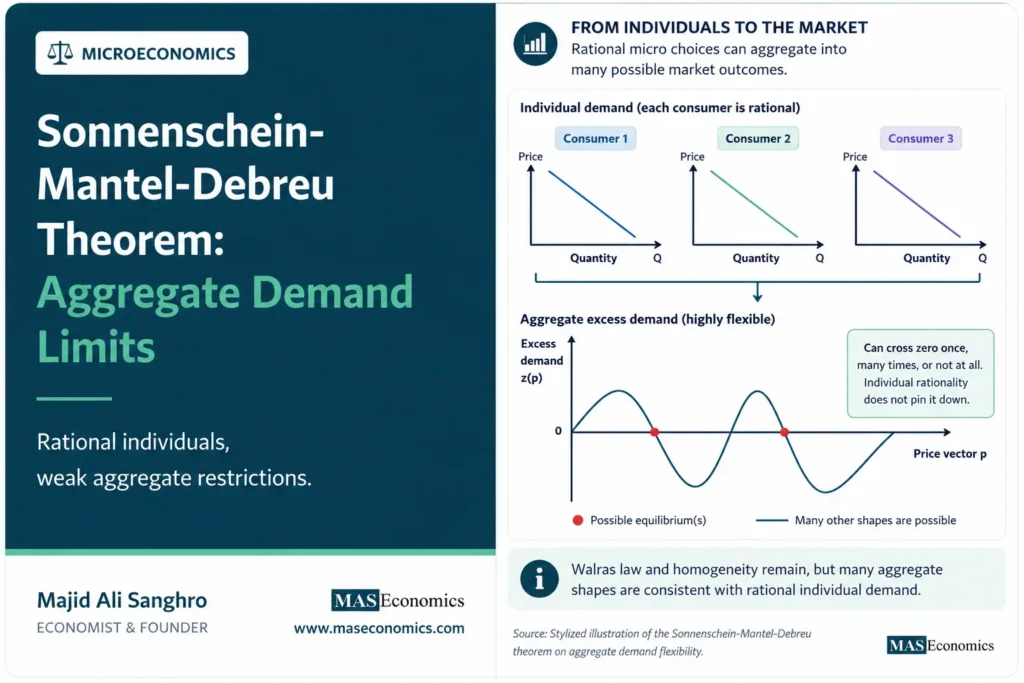
A single consumer with ordinary convex preferences has a demand curve with clear discipline, but an economy made of many such consumers can produce aggregate demand that behaves far less predictably. The Sonnenschein-Mantel-Debreu theorem shows that market-level excess demand can take many shapes even when each individual behaves according to standard rational choice assumptions.
The result is one of the most important cautionary findings in modern microeconomic theory. It does not say general equilibrium is useless. It says that aggregation is powerful enough to erase much of the structure found in individual demand.
This matters for general equilibrium because equilibrium analysis depends on aggregate excess demand functions. If those functions can behave in many possible ways, then uniqueness, stability, and clean comparative statics cannot be assumed from individual rationality alone.
Individual demand has strong discipline
Standard consumer theory begins with a single agent. The consumer has preferences, faces prices, holds income or endowments, and chooses the most preferred affordable bundle. Under familiar assumptions, individual demand has useful structure.
For one consumer, demand responds to prices through substitution and income effects. A rise in the price of one good changes relative prices and may reduce the quantity demanded of that good, although income effects can complicate the pattern. Individual choice remains tied to a budget constraint and to a preference ordering.
In an exchange economy, individual excess demand can be written as:
Individual Excess Demand
Here, \(x^h(p)\) is the bundle chosen by agent \(h\) at price vector \(p\), and \(\omega^h\) is that agent’s initial endowment. The budget constraint requires the value of the chosen bundle to equal the value of the endowment when preferences are locally nonsatiated:
This individual discipline might suggest that aggregate demand should also be tightly disciplined. The Sonnenschein-Mantel-Debreu result shows why that expectation is too strong.
Aggregation weakens demand structure
Aggregate excess demand adds individual excess demands across all consumers:
Aggregate Excess Demand
The aggregation step looks harmless. Each individual excess demand comes from rational choice. Each individual respects a budget constraint. Each individual may have continuous, convex, well-behaved preferences. Yet the sum can lose much of the clean structure associated with individual demand.
The reason is that aggregation combines different endowments, different preferences, and different income effects. A price change does not affect everyone in the same way. It changes relative prices, but it also redistributes real wealth across agents depending on what they own and what they buy.
One household may demand more of a good when its relative price falls. Another may reduce demand because the same price change lowers the value of an endowment and tightens the budget. A third may switch toward a substitute. When these responses are added, the aggregate pattern can become highly flexible.
This is the central lesson. Rational individual behavior does not automatically create a simple aggregate demand curve. The market demand system can be much less orderly than its individual components.
The theorem states an aggregation limit
The Sonnenschein-Mantel-Debreu theorem is a family of results associated with Hugo Sonnenschein, Rolf Mantel, and Gérard Debreu. Sonnenschein’s 1972 paper “Market Excess Demand Functions”, Mantel’s 1974 paper “On the Characterization of Aggregate Excess Demand”, and Debreu’s 1974 paper “Excess Demand Functions” formalized the result in related ways.
The core message is that aggregate excess demand functions can have almost any shape consistent with a few general restrictions. Those restrictions are important, but they are much weaker than many economists might expect from individual optimization.
In a standard exchange economy, aggregate excess demand normally satisfies:
Basic Restrictions
The first condition is Walras law. The value of aggregate excess demand must equal zero because budget constraints balance planned purchases and planned sales in value terms. The second condition is homogeneity of degree zero. Multiplying all prices by the same positive number does not change real demands because only relative prices matter.
The theorem says that these restrictions, plus continuity and boundary conditions in standard formulations, are close to the only general restrictions on aggregate excess demand. Individual rationality alone does not force aggregate excess demand to slope downward, cross zero only once, or generate stable price adjustment.
Key insight. The Sonnenschein-Mantel-Debreu theorem shows that rational individual demand does not guarantee well-behaved aggregate excess demand. Market demand can be highly flexible even when every consumer is individually rational.
Walras law still survives
The theorem does not mean aggregate demand is completely unconstrained. Walras law remains central:
Walras Law
This condition says that the total value of excess demand across markets is zero. If the economy has excess demand for some goods, it must have excess supply of other goods, assets, or claims in value terms. Aggregate demand cannot create purchasing power outside the budget system.
Walras law matters because it preserves accounting consistency. The theorem does not overturn the budget logic of general equilibrium. It says that accounting consistency is not enough to generate strong behavioral restrictions at the aggregate level.
For example, Walras law can rule out an aggregate excess demand vector with positive value in every market at the same price vector. But it cannot rule out multiple crossings, irregular substitution patterns, or unstable adjustment paths. The aggregate function can satisfy the value-balance condition while still behaving in a complicated way.
This is why the theorem is not a rejection of general equilibrium. It is a warning about what general equilibrium can prove without stronger assumptions.
Homogeneity preserves relative prices
Another surviving restriction is homogeneity of degree zero:
Relative Price Invariance
This means that only relative prices matter. If all prices double, the aggregate excess demand vector does not change, provided incomes and endowments are valued at the same doubled prices. The economy has a different money scale, but the same real trade-offs.
This property supports the usual price normalization in general equilibrium. One price can be used as a numeraire, or prices can be scaled so that their sum equals 1. The real problem is not the absolute level of all prices, but the relative price vector.
The Sonnenschein-Mantel-Debreu theorem accepts this. Its force lies elsewhere. Even after price normalization, even after Walras law, and even after individual rationality, the aggregate excess demand function can still have many possible shapes.
That makes the result more precise than a loose claim that “aggregate demand is complicated.” It identifies which restrictions survive aggregation and which stronger restrictions do not.
Uniqueness is not automatic
A competitive equilibrium is a price vector \(p^*\) where aggregate excess demand equals zero:
Equilibrium Condition
If \(z(p)\) can take many shapes, there may be one equilibrium, several equilibria, or a continuum of equilibria. The theorem does not say multiple equilibria must exist in every economy. It says that standard individual rationality does not generally rule them out.
This weakens a common intuition. In a single market with a downward-sloping demand curve and upward-sloping supply curve, equilibrium often appears unique. General equilibrium cannot rely on that simple geometry. The aggregate excess demand system may cross zero more than once.
Multiple equilibria create an interpretation problem. If more than one price vector clears markets, the model needs additional structure to explain which one becomes relevant. Initial conditions, institutions, adjustment rules, expectations, or policy regimes may matter.
In this sense, the theorem separates existence from uniqueness. Existence results show that at least one equilibrium may exist under suitable assumptions. The Sonnenschein-Mantel-Debreu theorem shows why uniqueness requires more than the ordinary assumptions of consumer optimization.
Stability is not guaranteed
The theorem also affects stability analysis. Price adjustment is often written as a response to excess demand:
Tatonnement-Style Adjustment
If aggregate excess demand has a simple shape, prices may move toward equilibrium. If the function bends, twists, or crosses zero several times, the same adjustment rule may fail to converge. Prices can cycle, diverge, or converge only from some starting points.
The Sonnenschein-Mantel-Debreu theorem does not prove that markets are unstable. It says that stability cannot be inferred from individual rationality alone. A model needs stronger restrictions on aggregate excess demand, substitution patterns, or adjustment rules to establish convergence.
This is why stability analysis in general equilibrium is a separate field of inquiry. An equilibrium can exist and still be dynamically fragile under a given price-adjustment process. The theorem explains one reason: the aggregate excess demand function may not have the disciplined shape needed for convergence.
For policy interpretation, the point is conceptual rather than mechanical. Equilibrium models can still be useful, but claims about self-correction need explicit dynamics. The existence of rational consumers is not enough.
Representative agents hide the problem
One way to avoid aggregation difficulty is to use a representative agent. The model treats the economy as if one household or one planner stands in for the whole population. This can make aggregate demand appear as disciplined as individual demand.
The Sonnenschein-Mantel-Debreu theorem explains the cost of that simplification. If heterogeneous consumers aggregate into a flexible excess demand function, then replacing them with one representative agent imposes structure that may not come from the underlying economy.
A representative-agent model can be useful for some questions. It can simplify analysis and isolate mechanisms. But it cannot automatically claim to represent the aggregate behavior of many different households with different endowments, preferences, and exposures to price changes.
The aggregation problem is especially important when distribution matters. A price change that raises the wealth of one group and lowers the wealth of another can shift aggregate demand in ways that a representative-agent model cannot capture. The theorem gives formal support to the idea that heterogeneity is not merely a detail.
Comparative statics need caution
Comparative statics studies how equilibrium changes when an outside parameter changes. In a simple model, a tax, endowment shift, or preference change may move equilibrium in a predictable direction. The Sonnenschein-Mantel-Debreu theorem warns that aggregate general equilibrium responses may not be so tidy.
If aggregate excess demand has few general restrictions, then changing a parameter can produce several possible patterns. A shift may move one equilibrium, create another, remove an old one, or alter stability. The direction of change depends on the structure added to the model.
This does not eliminate comparative statics. It means comparative statics must be grounded in specific assumptions. Models with gross substitutes, special utility forms, representative agents, or strong distributional restrictions can deliver clearer results. Those results then come from the extra structure, not from individual rationality alone.
The theorem therefore improves interpretation. It prevents overly broad conclusions from being drawn out of narrow assumptions. When a model produces a clean aggregate prediction, the reason should be visible in the model’s structure.
Market demand remains useful
The theorem is sometimes misunderstood as a destructive result. That reading goes too far. Economists still use aggregate demand, excess demand, and general equilibrium models because many environments have enough structure to produce useful predictions.
The theorem does not say every aggregate demand curve is erratic. It says that standard microfoundations alone do not guarantee a well-behaved aggregate curve. Additional assumptions can still impose structure, and empirical patterns can still be measured.
For example, some markets display stable aggregate relationships because preferences, technologies, institutions, and income distributions are sufficiently regular over the relevant range. In such cases, aggregate models can be informative. The theorem simply blocks the inference that regularity must follow from rational choice by itself.
This distinction matters for good economic modeling. The right response is not to abandon aggregation. It is to state clearly which assumptions, data patterns, or institutional facts make aggregation reliable in the case being studied.
The theorem limits microfoundations
Microfoundations aim to derive aggregate behavior from individual behavior. The Sonnenschein-Mantel-Debreu theorem shows that this project has limits. Individual rationality is necessary for many micro-founded models, but it may not be sufficient to deliver strong aggregate conclusions.
The theorem is especially relevant for models that infer macro or market-level discipline from optimizing agents. A model can contain rational individuals and still need strong additional restrictions to generate a stable, unique, well-behaved aggregate equilibrium.
Those restrictions are not automatically wrong. They may be justified by the research question, the data, or the institutional setting. The theorem simply requires transparency. If aggregate demand behaves neatly, the model must explain why.
In that sense, the theorem strengthens rather than weakens careful economics. It forces a separation between what follows from individual choice and what follows from extra assumptions about aggregation.
Explains
Three concepts behind aggregate demand limits
Related equilibrium concepts are developed across the MASEconomics microeconomics library.
Explore the MASEconomics BlogConclusion
Sonnenschein-Mantel-Debreu theorem analysis shows that aggregate excess demand can be far less disciplined than individual demand. Even when consumers behave rationally and satisfy standard assumptions, the aggregate market demand system can take many shapes consistent with Walras law and homogeneity.
The theorem matters because it limits what can be inferred from microfoundations alone. Equilibrium existence does not imply uniqueness. Individual optimization does not imply stable price adjustment. Clean comparative statics require stronger assumptions than rational choice by itself.
The result does not make general equilibrium theory irrelevant. It clarifies its boundaries. Aggregate demand can be useful, but its structure must come from explicit assumptions, institutional details, or empirical evidence, not from the mere fact that individuals optimize.
Frequently Asked Questions
What is the Sonnenschein-Mantel-Debreu theorem?
The Sonnenschein-Mantel-Debreu theorem says that aggregate excess demand can take many shapes even when individual consumers have standard rational preferences. It shows that individual demand discipline does not automatically survive aggregation.
What does the theorem imply for general equilibrium?
It implies that general equilibrium models need extra structure to guarantee uniqueness, stability, or clear comparative statics. These properties do not follow from individual rationality alone.
Does the theorem reject rational choice theory?
No. The theorem assumes rational individual behavior. Its point is that rational individual behavior can aggregate into market demand with weak restrictions.
Why does aggregation weaken demand structure?
Aggregation combines different preferences, endowments, and income effects. A price change redistributes wealth and changes substitution patterns across many agents, so the market-level response can be flexible.
Does the theorem mean aggregate demand is useless?
No. Aggregate demand remains useful when the model or data provide additional structure. The theorem says that this structure must be justified rather than assumed from individual rationality alone.
Thanks for reading! If you found this helpful, share it with friends and spread the knowledge. Happy learning with MASEconomics