A country can produce more, export more, and still become worse off if the expansion pushes its export prices down sharply enough. Immiserizing growth describes this paradox: economic growth reduces national welfare because the terms-of-trade loss outweighs the direct gain from higher output.
The idea is associated with Jagdish Bhagwati’s 1958 paper “Immiserizing Growth: A Geometrical Note”. The result is not a normal prediction of trade theory. It is a limiting case that shows why output growth and welfare improvement are not identical when a country is large enough to move world prices.
The mechanism depends on comparative advantage, export expansion, and the terms of trade. Growth raises productive capacity, but if it expands the export good so much that the export price collapses relative to import prices, national purchasing power can fall.
Growth normally raises welfare
In standard trade theory, economic growth expands a country’s production possibilities. More labor, capital, land productivity, technology, or human capital allows the economy to produce more goods and services. With unchanged world prices, this expansion normally improves welfare because the country can reach a higher consumption possibility.
The welfare gain is especially clear when growth is balanced. If productive capacity rises across sectors, the economy can produce more export goods and more import-competing goods. It can also trade from a stronger production base. Higher output then supports higher consumption.
Even export-biased growth usually raises welfare. If a country becomes more productive in the good it already exports, it can sell more abroad and buy more imports. The direct production gain is positive. Under small-country assumptions, world prices are fixed, so the country receives the same terms of trade while producing more.
Immiserizing growth begins where that small-country logic fails. If the country is large in the market for its export good, extra export supply can lower the world relative price of that export. Growth still creates a production gain, but it also creates a price loss.
Terms of trade carry the risk
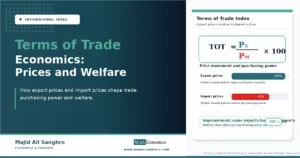
The terms of trade measure export prices relative to import prices:
Terms of Trade
An improvement in the terms of trade means exports buy more imports. A deterioration means exports buy fewer imports. Immiserizing growth requires a severe deterioration in this ratio.
Suppose a country exports coffee and imports machinery. If productivity in coffee production rises, coffee output expands. If the country is a major supplier and foreign demand is not very elastic, the world price of coffee may fall. The country ships more coffee but receives fewer units of machinery per bag of coffee.
The welfare result depends on the balance between the output gain and the price loss. If the country produces much more and the export price falls only slightly, welfare rises. If the export price falls sharply enough, the loss in import purchasing power can dominate.
Export-biased growth creates pressure
The classic immiserizing-growth case requires export-biased growth. Growth must expand the country’s capacity to produce its export good more than its import-competing good. This can happen through factor accumulation, technical change, resource discoveries, or productivity gains concentrated in the export sector.
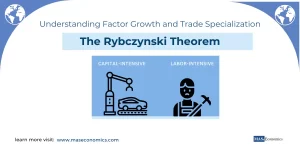
The Rybczynski theorem gives one route. In a two-good, two-factor model with fixed goods prices, growth in one factor expands output of the good that uses that factor intensively and contracts output of the other good. If the expanding good is the export good, national output becomes more export-biased.
The risk is not the export expansion by itself. Export expansion is normally beneficial. The risk appears when the country’s additional exports are large enough to move world prices against it. The country becomes a victim of its own market impact.
This is why immiserizing growth is mainly a large-country or market-power result. A small country can expand exports without affecting world prices. A large exporter can expand supply and worsen the price at which all its export units are sold.
The welfare condition is severe
The core condition is simple in words. The welfare loss from the terms-of-trade deterioration must exceed the welfare gain from growth:
Immiserizing Growth Condition
The condition is demanding. Growth raises real productive capacity, so the direct effect is positive. For welfare to fall, the export-price decline must be large enough to reduce national purchasing power by more than the growth gain.
A simple welfare decomposition can be written as:
Welfare Decomposition
Immiserizing growth occurs only when \(T > G\). If \(G > T\), growth still raises welfare, even though the terms of trade deteriorate. This distinction matters because many export booms worsen trade prices without making the country worse off overall.
The mechanism appears visually
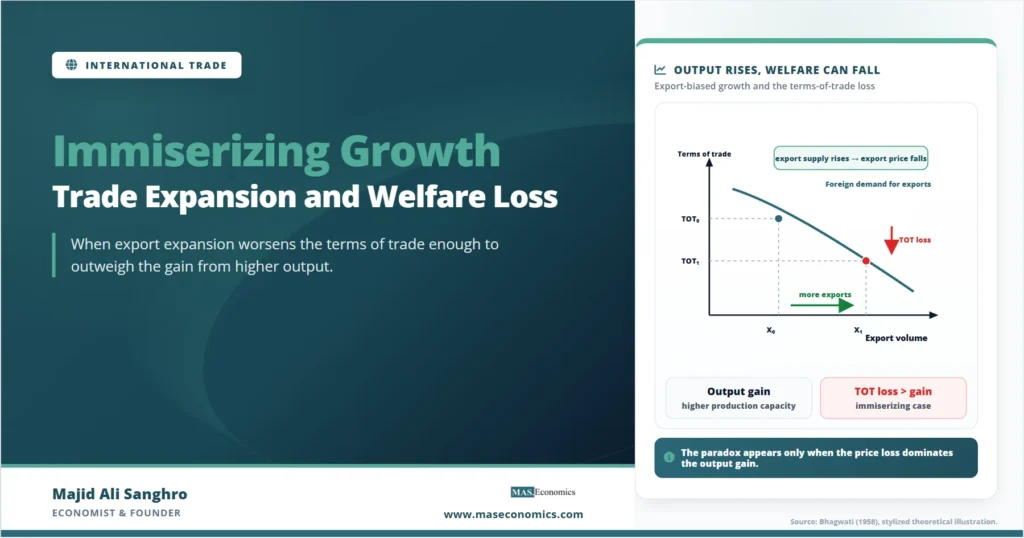
The intuition is best read as a sequence. Growth expands export supply. Export supply lowers the export price when world demand is not elastic enough. The country then receives fewer imports per unit of exports. Welfare falls only if that price loss is larger than the direct production gain.

The diagram is stylized, not a real dataset. It shows export volume rising from \(X_0\) to \(X_1\), while the terms of trade fall from \(TOT_0\) to \(TOT_1\). The growth is immiserizing only when the loss from the lower trade price is larger than the welfare gain from expanded output.
Large-country power is necessary
Immiserizing growth requires the growing country to influence world prices. A small country takes world prices as given. It can export more without changing the international price of its export good. In that case, export-biased growth raises output and normally improves welfare.
A large exporter faces a different situation. Its additional supply can move the world price. If foreign demand for the export good is inelastic, a large increase in export supply can cause a large fall in the export price. The country then receives a lower price not only on the extra exports, but also on the exports it was already selling.
This is the key terms-of-trade externality. Individual producers see the market price and expand production when growth raises productivity. But the country as a whole may suffer if the combined export expansion pushes the world price down sharply.
The result is especially relevant in theory for countries that dominate a narrow export market. It is less relevant for diversified economies whose export expansion is spread across many goods and services.
Foreign demand must be inelastic
The elasticity of foreign demand is central. If foreign buyers respond strongly to lower prices by buying much more, the export-price decline may be mild relative to the increase in quantity. Export revenue and import purchasing power may still rise.
If foreign demand is inelastic, the same increase in export supply can cause a sharper price fall. Quantity rises, but the price falls enough to reduce the value of exports. The country may have more physical output but less command over imports.
This is one reason primary-commodity examples are often used to teach the concept. A country that exports a large share of a commodity with limited short-run demand responsiveness may face a steep price decline after supply expands. The example is theoretically useful, though real commodity markets also involve inventories, futures markets, contracts, policy intervention, and exchange-rate effects.
The lesson is not that commodity growth is bad. The lesson is that market structure and demand elasticity determine whether export expansion improves or weakens the country’s trade purchasing power.
Export dependence raises exposure
A country with a narrow export base is more exposed to immiserizing-growth logic than a diversified exporter. If most export earnings come from one commodity or one product group, a fall in that product’s relative price can have a large effect on national purchasing power.
Diversification reduces the risk because export-price declines in one sector can be offset by gains elsewhere. It also gives the country more ways to convert growth into welfare: higher productivity can raise domestic consumption, expand new export sectors, or reduce import dependence.
Export dependence also affects public finance. If government revenue relies heavily on export taxes, royalties, or state-owned commodity enterprises, a terms-of-trade decline can reduce fiscal space even while physical output rises. The welfare loss then appears through lower import capacity, weaker public revenue, and less favorable external balances.
This does not make export specialization irrational. Specialization can still be efficient when a country has strong comparative advantage. The risk appears when specialization leaves the country heavily exposed to an adverse price response in world markets.
Growth bias determines the outcome
Not all growth creates the same trade-price effect. Growth can be export-biased, import-biased, or roughly neutral. The welfare outcome depends partly on this bias.
Export-biased growth expands the production of the export good. This is the case most associated with immiserizing growth because it can worsen the terms of trade by increasing world supply of the export.
Import-biased growth expands the production of the good the country previously imported. This can improve welfare by reducing import demand and improving the terms of trade, especially for a large country. Neutral growth expands productive capacity more evenly and is less likely to generate a sharp terms-of-trade movement.
| Growth pattern | Main trade effect | Welfare implication |
|---|---|---|
| Export-biased growth | Export supply expands strongly | Can worsen terms of trade in a large country |
| Import-biased growth | Import demand may fall | Can improve terms of trade |
| Neutral growth | Capacity expands across sectors | Usually raises welfare unless price effects dominate |
| Diversified export growth | Supply expands across several goods | Reduces exposure to one export-price collapse |
| Central condition | Price loss must exceed output gain | Immiserizing growth is a severe special case |
|
Source: MASEconomics editorial synthesis based on standard trade-growth theory.
|
||
The table shows why the theory is narrower than a simple warning against exports. The problem is not trade expansion by itself. The problem is export-biased growth in a large country facing unfavorable world demand conditions.
Offer curves show the geometry
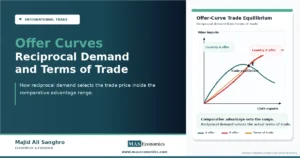
The classic trade-theory geometry can be shown with offer curves. An offer curve traces how much of one good a country is willing to export for different amounts of imports at alternative terms of trade. The intersection of two offer curves determines the international exchange ratio.
In an immiserizing-growth case, export-biased growth shifts the growing country’s offer curve outward. The country offers more exports at many possible trade prices. If the partner country’s reciprocal demand is weak, the new intersection can occur at much worse terms of trade for the growing country.
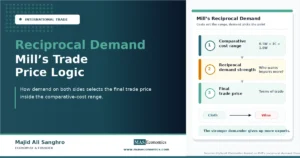
This is the link between reciprocal demand and immiserizing growth. A country can become more capable of producing exports, but the world may not value those additional exports enough to preserve the old exchange ratio. The new equilibrium can involve more trade volume and lower welfare.
The offer-curve interpretation is useful because it keeps quantity and price together. Immiserizing growth is not just an output story. It is an equilibrium trade-price story.
National income can mislead
Physical output measures can mislead when terms of trade change. A country may produce more export goods, employ more resources in the export sector, and record higher production volume. Yet its real command over imports may fall.
This distinction matters because welfare is not measured by tons exported. Welfare depends on what the country can consume. If additional exports buy fewer imports than before, the country may have more output but less consumption opportunity.
The purchasing-power expression makes the point:
Import Purchasing Power
The expression rises when export volume rises enough or when export prices improve. It falls when the terms-of-trade deterioration is large enough to dominate the quantity increase.
Policy can reduce the paradox
Bhagwati later connected the result to optimal policy. If a country has market power in trade, it may be able to reduce the terms-of-trade loss by restraining export expansion or using trade policy. The basic idea is that a country should not ignore the price effect of its own export supply when it is large enough to influence the world market.
This does not mean protection is automatically desirable. Trade policy can create domestic distortions, invite retaliation, and reduce world welfare. An export tax, production restraint, or optimal tariff can improve national terms of trade in theory, but it can also misallocate resources and damage trading relationships.
The more general policy lesson is broader. Countries exposed to immiserizing-growth risk may benefit from export diversification, moving into higher-value products, improving domestic demand channels, investing in productivity across sectors, and building institutions that reduce dependence on one volatile export price.
For small countries, the policy implication is different. Since they cannot move world prices, the main focus is not optimal manipulation of the terms of trade. It is resilience: diversification, fiscal stabilization, exchange-rate flexibility, and productivity growth outside the narrow export sector.
The result remains rare
Immiserizing growth is a theoretical possibility, not the usual outcome of trade expansion. The conditions are strict. Growth must be strongly export-biased. The country must be large enough to affect the world price. Foreign demand must be inelastic. The terms-of-trade loss must exceed the direct gain from higher productive capacity.
Most growth episodes do not satisfy all of these conditions. Even when export growth worsens the terms of trade, the country may still gain overall because the output effect is larger than the price effect. The paradox should therefore be used carefully.
The value of the theory is not that it describes the normal case. Its value is that it prevents a mechanical equation between growth and welfare. More production is not always more welfare when international prices move against the producer.
Caveat. Immiserizing growth is a special case. It requires a large country, export-biased growth, weak foreign demand, and a terms-of-trade deterioration large enough to outweigh the production gain.
Modern relevance is selective
The concept remains useful for thinking about commodity dependence, export-led development, and market power in trade. It is especially relevant when a country or group of countries expands supply in a market where demand grows slowly.
Commodity exporters can face related pressures when global supply expands faster than demand. Agricultural products, minerals, and fuels can experience sharp price swings. A country may increase production but see export revenue weaken if the price response is unfavorable.
Modern trade also complicates the simple model. Countries export differentiated goods, services, intermediate inputs, intellectual property, and tasks. Firms differ in productivity. Global value chains spread production across borders. Exchange rates, contracts, inventories, and financial markets affect the path from export volume to export prices.
These complications do not erase the mechanism. They narrow where it applies. Immiserizing growth is most useful as a warning about export dependence and adverse price effects, not as a general claim that trade-led growth harms welfare.
Explains
Three concepts behind immiserizing growth
Related trade theory concepts are developed across the MASEconomics international trade library.
Explore the MASEconomics BlogConclusion
Immiserizing growth shows that economic growth can reduce welfare when export expansion causes a severe deterioration in the terms of trade. The country produces more, but the world price of its export falls so much that the country’s command over imports declines.
The theory is powerful because it separates output from welfare. Growth creates a direct production gain, but international price movements can redistribute or even reverse that gain for a large exporter facing inelastic foreign demand. The result is most plausible when growth is strongly export-biased and the country has market power in a narrow export market.
The paradox is not the normal case. Most growth raises welfare, and most export expansion does not make a country poorer. The lasting lesson is narrower and more precise: trade expansion should be judged by real purchasing power and welfare, not by export volume alone.
Frequently Asked Questions
What is immiserizing growth?
Immiserizing growth is a case where economic growth lowers national welfare because the resulting deterioration in the terms of trade is larger than the direct gain from higher output.
Who developed the idea of immiserizing growth?
The idea is most closely associated with Jagdish Bhagwati’s 1958 paper “Immiserizing Growth: A Geometrical Note” in The Review of Economic Studies.
Why can export growth reduce welfare?
Export growth can reduce welfare if a large country expands export supply so much that its export price falls sharply relative to import prices. Welfare falls only if that price loss exceeds the output gain.
Is immiserizing growth common?
No. It is a special theoretical case. It requires export-biased growth, large-country price influence, inelastic foreign demand, and a severe terms-of-trade deterioration.
How are terms of trade related to immiserizing growth?
Terms of trade are central because they measure export prices relative to import prices. Immiserizing growth occurs only when this ratio worsens enough to offset the benefits of higher production.
Thanks for reading! If you found this helpful, share it with friends and spread the knowledge. Happy learning with MASEconomics