Why does Germany export luxury cars while Bangladesh exports textiles? Why does Saudi Arabia sell oil to the world but import almost everything else? For decades, economists have turned to a powerful idea to answer such questions: the Heckscher-Ohlin model.
Born in Sweden nearly a century ago, this theory promised to explain the very foundation of international trade. It was elegant, logical, and seemed to make perfect sense. Countries export what they have in abundance. Simple, right?
But then the data fought back. A curious paradox emerged from the United States, the most capital-rich nation on earth, that seemed to turn the theory upside down. And today, as production fragments across borders, artificial intelligence reshapes what “capital” and “labor” even mean, and global value chains weave complex webs around the planet, we must ask: Does Heckscher-Ohlin still explain anything at all?
Heckscher and Ohlin: A Revolutionary Idea
Before the 20th century, trade theory belonged to David Ricardo. His law of comparative advantage, published in 1817, showed that countries trade because they have different productivity levels. Portugal made wine more efficiently; England made cloth more efficiently. So they traded. Simple.
But Ricardo left a gaping question unanswered: Why did productivity differ? Why was Portugal better at wine? Why was England better at cloth? He never said.
Enter two Swedish economists. In 1919, Eli Heckscher published a paper (in Swedish, no less) that planted the seed of a new idea. His student, Bertil Ohlin, nurtured that seed into a full-blown theory in his 1933 book Interregional and International Trade. Together, they shifted the focus from productivity to resources, which a country actually possesses.
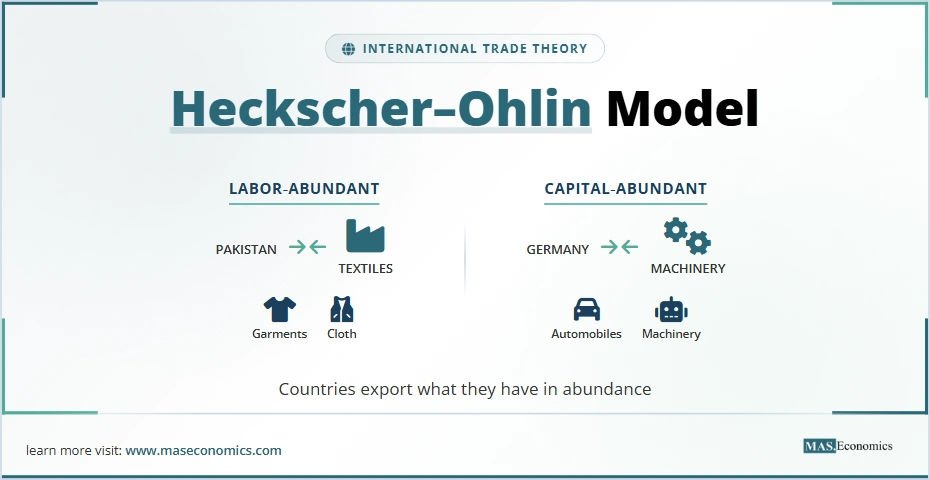
The Heckscher-Ohlin (H-O) model proposed a simple, intuitive idea: Countries export goods that use their abundant factors of production intensively.
Let’s unpack that.
What a Country Has: Factors of Production
Think of a country’s economic toolkit. It has three broad categories:
- Labor: Its workers, from the factory floor to the office desk.
- Capital: Its machines, factories, infrastructure, and now, data and algorithms.
- Land/Natural Resources: Its fields, minerals, oil, and rivers.
Every country has a different mix. Pakistan, for example, has abundant labor and a large, young workforce. The United States has abundant capital, advanced machinery, technology, and deep financial markets. Saudi Arabia has abundant natural resources, including oil.
What Goods Need: Factor Intensity
Now think about goods. Some need lots of labor: textiles, footwear, assembled electronics. These are labor-intensive. Others need lots of capital: automobiles, aircraft, heavy machinery. These are capital-intensive. Still others need land: wheat, cotton, timber. These are land-intensive.
The H-O model connects these two ideas. A country will specialize in and export goods that use its abundant factor. So:
- Pakistan (labor-abundant) should export textiles and garments.
- USA (capital-abundant) should export machinery and advanced technology.
- Saudi Arabia (land/oil-abundant) should export petroleum.
This became known as the Heckscher-Ohlin theorem, the core of a much larger family of ideas.
A Simple Example: Textilia and Machinia
Let’s make this concrete with an example you’ll remember. Take two economies: Textilia and Machinia.
- Textilia has abundant labor but scarce capital.
- Machinia has abundant capital but scarce labor.
Both countries can produce two goods: cloth (labor-intensive) and cars (capital-intensive). According to H-O:
- Textilia will specialize in cloth, using its cheap labor to produce efficiently. It exports cloth to Machinia.
- Machinia will specialize in cars, using its abundant capital. It exports cars to Textilia.
Both countries trade, both benefit, and resources are used efficiently. This is the H-O model in its purest form: an elegant explanation of trade patterns based on what countries have, not just what they do.
The Four Core Theorems
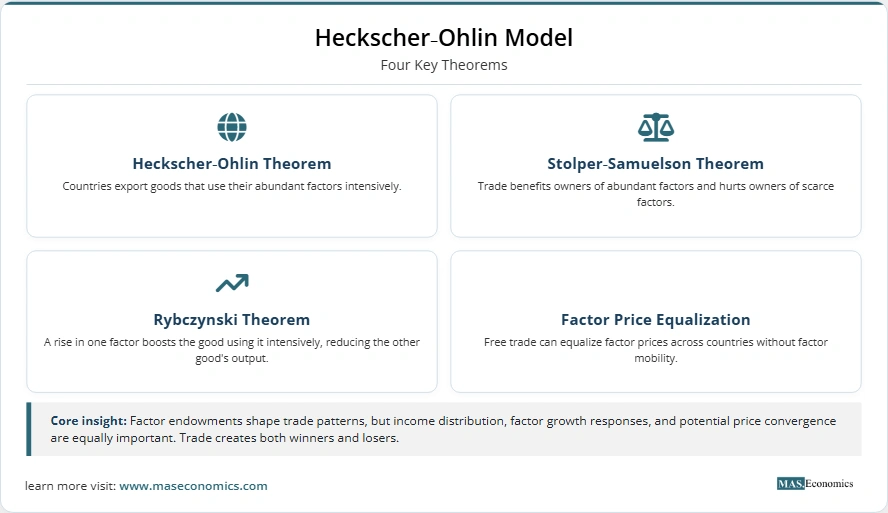
The H-O model grew beyond its core theorem. Economists extended it into a family of four interconnected ideas, each making bold predictions about trade, wages, and production.
1. The Heckscher-Ohlin Theorem (The Core)
We’ve covered this: countries export goods that use their abundant factors. It’s the foundation.
2. The Stolper-Samuelson Theorem (1941)
This theorem, named after Wolfgang Stolper and Paul Samuelson, looked at who wins and who loses from trade.
The idea: When a country opens to trade, the price of the good that uses its abundant factor rises. That benefits the owners of that factor. But the price of the other good falls, hurting the owners of the scarce factor.
Example: When labor-abundant Pakistan opens to trade, its textile exports boom. Textile prices rise. Demand for labor increases. Wages go up. Workers gain. But what about capital owners? They might lose, as returns to capital could fall.
Conversely, in the capital-abundant USA, trade benefits capital owners but may put downward pressure on wages for less-skilled workers. This theorem has fueled decades of debate about trade and inequality.
3. The Rybczynski Theorem (1955)
T.M. Rybczynski asked: What happens when a country’s factor supply changes?
The idea: If the supply of one factor grows (say, more capital from foreign investment), production will shift toward the good that uses that factor intensively. The other good’s output will actually decline, absolutely.
Consider a scenario where China receives massive capital inflows, and its capital stock grows. According to Rybczynski, China should produce even more capital-intensive goods (like machinery) and produce less labor-intensive goods (like textiles), even if total resources have grown. This seems counterintuitive, but it’s a logical outcome of full employment and fixed prices.
4. The Factor Price Equalization Theorem (Samuelson, 1948)
This is the most ambitious and controversial of the four.
The idea: Under strict assumptions (identical technology, no trade barriers, both countries produce both goods), free trade in goods alone will equalize factor prices across countries. Wages for similar workers will converge. Returns to capital will converge. All without a single worker or machine crossing a border.
Consider trade between Pakistan and the USA. According to the theorem, this should, over time, make Pakistani textile workers’ wages rise toward US levels, while US capital returns fall toward Pakistani levels. Trade replaces factor mobility.
In reality, this hasn’t happened, not even close. But the theorem highlights a profound implication: trade can be a powerful force for global income convergence, at least in theory.
The Leontief Paradox: When Data Shook the Theory
By the 1950s, the H-O model had become textbook orthodoxy. It was elegant, logical, and taught in every economics department. Then came Wassily Leontief with a wrecking ball.
Leontief, a Russian-born American economist, had developed something revolutionary: input-output analysis, a way to track how industries buy from and sell to each other. In 1953, he used this tool to test the H-O model on the United States, the world’s most capital-rich economy.
The Prediction
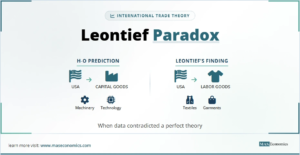
The H-O model made a clear prediction: The United States, with its abundant capital and relatively scarce labor, should export capital-intensive goods and import labor-intensive goods. Simple.
The Test
Leontief calculated the capital and labor required to produce $1 million worth of US exports and $1 million worth of US imports (the goods America would produce at home if it didn’t import them). He used 1947 data, the best available.
The Result
What Leontief found was shocking. US exports were actually more labor-intensive than its imports. The capital-rich United States was exporting labor-intensive goods and importing capital-intensive goods. It was the exact opposite of what H-O predicted.
This became known as the Leontief Paradox, and it sent economists scrambling for explanations.
Why Did This Happen?
Leontief himself offered a possible explanation: US labor was far more productive than foreign labor. One American worker might equal three foreign workers. If you multiply the US labor force by three to account for this productivity advantage, the US suddenly looks labor-abundant relative to capital. Problem solved, sort of.
Other explanations emerged:
- Natural resources: The US was scarce in certain resources (like petroleum), so it imported capital-intensive resource goods (like oil refining equipment).
- Human capital: Perhaps the H-O model missed the most important factor: skilled labor. The US was abundant in human capital (educated, skilled workers), and its exports reflected that.
- Technology differences: The model assumed identical technology across countries, but the US had a technological edge in many industries.
- Tariffs and trade barriers: US trade policy protected labor-intensive industries, skewing the trade pattern.
The Leontief Paradox didn’t kill the H-O model, but it showed that reality was far messier than theory. The elegant 2x2x2 world of textbooks was not the real world.
The Modern Challenge: Fragmentation, Global Value Chains, and AI
If Leontief shook the H-O model in the 1950s, the 21st century has delivered body blows. The nature of trade has transformed. Goods are no longer made in one country; they are made in the world.
What is Fragmentation?
Think about an iPhone. It’s designed in California. Its chips come from Taiwan. Its screen might be made in South Korea. It’s assembled in China. Then it’s sold everywhere.
This is fragmentation, the splitting of production into tasks performed across multiple countries. Economists call it by many names: global value chains, offshoring, outsourcing, trade in tasks. But the core idea is the same: production is no longer vertically integrated within one nation.
Why Fragmentation Challenges H-O
The H-O model assumed countries trade finished goods made entirely at home. But fragmentation means countries trade intermediate goods: components, parts, designs, and services. This creates several problems for the theory.
Enter Gabriel Brondino. In a 2021 paper published in the Review of Political Economy, Brondino delivers a sharp critique of attempts to extend H-O to explain fragmentation. His arguments are worth understanding.
Assumption 1: Finished vs. Intermediate Goods
H-O models, even modern ones, typically assume a strict distinction between intermediate and finished goods. But in reality, this distinction blurs. A car engine is an intermediate good for an automaker but a finished good for an engine manufacturer. The circularity of production, goods used to make other goods, complicates the neat H-O framework.
Assumption 2: No Self-Input
Many H-O models assume intermediates do not enter their own production. Steel is used to make cars, but cars aren’t used to make steel. This simplifies the math but ignores real-world complexity. In modern economies, sectors buy from and sell to each other in intricate loops.
Assumption 3: The Neglected Interest Rate
Here’s where Brondino makes his strongest point. H-O models typically ignore the interest rate on the value of inputs advanced during production. But when production spans multiple stages and countries, the time between input purchase and final sale matters. Capital tied up in work-in-progress carries a cost. When you introduce international capital mobility, the comparative advantage chain breaks down. Trade patterns become indeterminate.
Brondino’s conclusion is stark: “The Heckscher-Ohlin theory is incompetent to explain fragmentation and modern trade patterns.”
The AI Twist
Now add artificial intelligence to this already complex picture.
AI is doing something profound: it’s redefining factor endowments themselves.
- Capital now includes data. A country with vast data resources (like China or the USA) has a new form of capital that didn’t exist when Ohlin wrote.
- Algorithms are capital too. Machine learning models, trained on data, are productive assets. They can be deployed anywhere instantly.
- Labor is being transformed. Some tasks are automated entirely; others are augmented. A “labor-abundant” country might find its advantage eroded if AI automates the tasks its workers perform.
- Reshoring becomes possible. Tasks that were offshored for cheap labor (call centers, data entry) are now being automated, potentially bringing production back to high-wage countries.
What does H-O say about a world where Pakistan’s labor advantage is challenged by AI-powered automation in the USA? Where China’s data advantage rivals its manufacturing muscle? The theory offers little guidance.
Pakistan, China, and the USA: A Modern Example
Let’s bring this home with an example you’ll recognize.
- Pakistan remains labor-abundant. Its textile industry employs millions. According to H-O, it should export textiles.
- China was labor-abundant, but its demographics are shifting. It’s now accumulating capital rapidly and investing heavily in AI. It exports both labor-intensive goods (still) and increasingly capital-intensive ones (machinery, electronics).
- USA is capital-abundant and technologically advanced. It exports aircraft, software, and financial services.
Now add fragmentation. An “American” smartphone might use a Chinese-designed chip, assembled in Vietnam with Malaysian components, running software developed in India. Which country’s factor endowments determine the trade pattern? All of them, and none of them. The neat H-O predictions dissolve into complexity.
So, Does Heckscher-Ohlin Still Matter?
After all this, the paradoxes, the critiques, the complexity, you might wonder: Should we just throw H-O in the trash?
No. But we must use it wisely.
As a First Approximation
The H-O model still offers a powerful first cut at understanding trade. Countries’ resources do shape their trade patterns. Saudi Arabia exports oil, not software. Bangladesh exports garments, not aircraft. Pakistan’s textile exports reflect its labor abundance. These basic facts still hold.
As a Cautionary Tale
The Leontief Paradox and Brondino’s critique teach us something valuable: theories are tools, not truths. The H-O model works best when its assumptions roughly hold: similar technology, no fragmentation, simple production structures. When those assumptions break down, the model breaks down with them.
As a Foundation for Richer Models
Modern trade economics has moved beyond H-O. We now have models that incorporate scale economies, product differentiation, firm heterogeneity, and global value chains. But many of these models build on H-O’s insights or define themselves in contrast to it. You can’t understand where trade theory is today without knowing where it came from.
The Bottom Line
The Heckscher-Ohlin model still matters because it asks the right questions: What does a country have? What does it produce? Who gains and who loses from trade? Even when its answers fall short, its questions remain essential.
But in a world of fragmented production, artificial intelligence, and global value chains, we need more. We need theories that can handle circular production, account for interest rates and capital mobility, and adapt to a world where factors of production themselves are evolving.
That work is ongoing. And perhaps, in a future “Research Explained” article, we’ll explore those newer theories too.
Did you find this article helpful? Share it with someone who loves economics. And remember, at MASEconomics, we make complex ideas simple.