Put yourself in the position of an economist in 1953. You have just published a paper that seems to prove the most famous trade theory of your time is wrong. Not just a little wrong, spectacularly, head-scratchingly, upside-down wrong.
That was Wassily Leontief’s reality. And the paradox he discovered would haunt trade economists for decades.
The Theory That Everyone Believed
To understand why Leontief’s findings were so shocking, we need to step back into the 1940s. The Heckscher-Ohlin model had become gospel. It was elegant, intuitive, and taught in every economics classroom.
The logic was simple:
- The United States was the world’s most capital-rich country. It had factories, machines, and infrastructure that dwarfed every other nation.
- It was relatively labor-scarce compared to its massive capital stock.
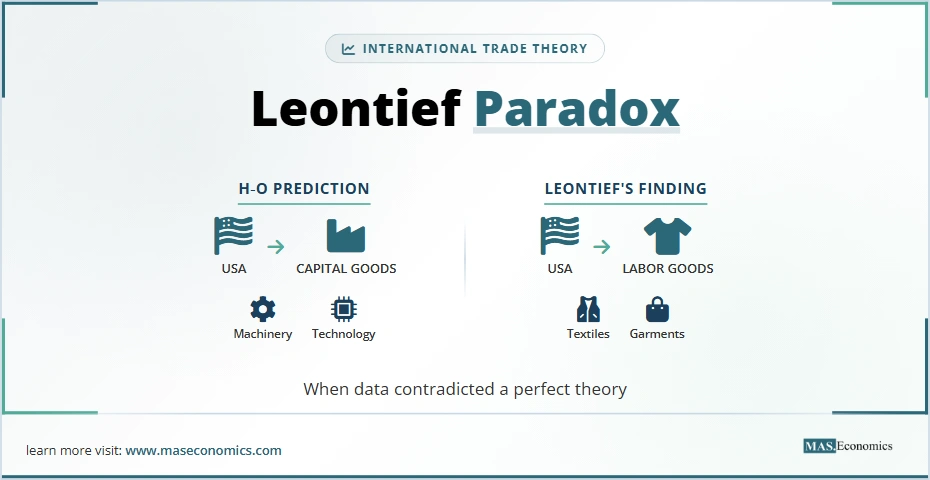
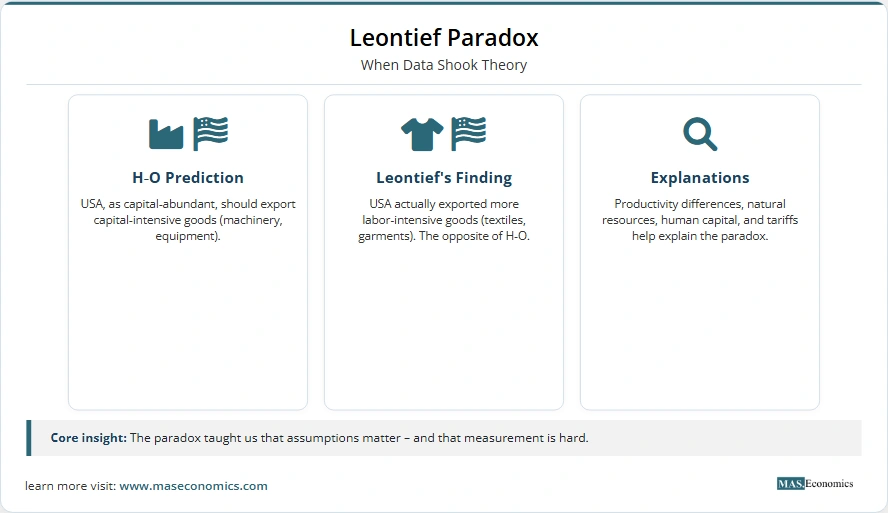
- Therefore, America should export capital-intensive goods (things made with lots of machinery) and import labor-intensive goods (things made with lots of workers).
This wasn’t controversial. It was obvious. Like predicting that Saudi Arabia exports oil or that Bangladesh exports textiles. The theory and common sense aligned perfectly.
Wassily Leontief and His New Tool
Leontief was no ordinary economist. Born in Russia in 1905, he had fled the Soviet Union, earned a PhD in Berlin, and eventually landed at Harvard. There, he developed something revolutionary: input-output analysis.
Think of input-output analysis as an economic MRI. It tracks how every industry buys from and sells to every other industry. Steel buys coal. Coal buys mining equipment. Mining equipment buys steel. These circular flows had always been invisible. Leontief made them visible.
For this work, he would eventually win the Nobel Prize in 1973. But in 1953, he used his new tool to ask a simple question: Does the Heckscher-Ohlin model actually describe American trade?
The Test
Leontief gathered data from 1947, the best available. He calculated two numbers:
- The capital and labor required to produce $1 million worth of American exports.
- The capital and labor that would be required to produce $1 million worth of American imports if they were made at home instead of bought from abroad.
This second calculation was crucial. To understand what trade saves you, you must know what you would need if you made those goods yourself.
Leontief expected clear results. The US should export goods that require lots of capital and little labor. Its imports, if produced domestically, would require lots of labor and little capital.
He ran the numbers. He checked them twice. He probably rubbed his eyes.
The Shocking Result
Here is what Leontief found, expressed in 1947 dollars:
| Capital Required | Labor Required | Capital per Worker | |
|---|---|---|---|
| For $1 million of US exports | $2,550,780 | 182,313 man-years | $13,991 per worker |
| For $1 million of US import replacements | $3,091,339 | 170,004 man-years | $18,184 per worker |

|
|||
The United States was importing goods that required MORE capital per worker than its exports.
This was the exact opposite of what H-O predicted. The most capital-rich country on earth was effectively exporting labor-intensive goods and importing capital-intensive goods.
Economics had its first major paradox.
Why Did This Happen? The Great Debate
Leontief’s finding sent shockwaves through the profession. How could the theory be so wrong? Several explanations emerged.
Explanation 1: American Labor Was Super-Productive
Leontief himself offered this explanation. Perhaps American workers were three times as productive as foreign workers. If so, multiplying the US labor force by three would make America labor-abundant relative to capital. The paradox would vanish.
But this explanation raised its own questions. Why were American workers so productive? Was it better education? Better management? Better technology? And if technology differed, the H-O assumption of identical production methods across countries was false.
Explanation 2: The Missing Factor – Natural Resources
Maybe the H-O model’s two-factor framework (capital and labor) missed something crucial: natural resources.
The United States imported many resource-intensive goods, including petroleum, minerals, and tropical products. Producing these at home would require enormous capital investment (think oil refineries, mining equipment). These imports looked “capital-intensive” in Leontief’s calculations because of their resource-processing requirements, not because of pure capital abundance.
When you accounted for this, the paradox softened.
Explanation 3: Human Capital
Perhaps the problem was how we measured “capital.” The H-O model treated capital as physical stuff, machines, buildings, and infrastructure. But what about human capital, the skills, education, and training embedded in workers?
The United States was abundant in skilled labor. Its exports reflected this: aircraft, machinery, chemicals, all produced by highly educated workers. If you counted skilled labor as a form of capital, the paradox might reverse.
Explanation 4: Technology Differences
The H-O model assumed identical technology across countries. But in 1947, the United States had a massive technological advantage. It could produce many goods more efficiently than anyone else. This technological edge, not factor endowments, might explain trade patterns.
Explanation 5: Tariffs and Trade Policy
Perhaps the paradox was not about endowments at all. It was about policy. The United States protected its labor-intensive industries with tariffs. This artificially reduced imports of labor-intensive goods and skewed the trade pattern.
A Deeper Lesson: What Is Capital, Really?
The Leontief Paradox forced economists to ask uncomfortable questions. If the most basic prediction of a major theory fails, something is wrong, but what?
Was the theory wrong? Were the measurements wrong? Or was the world more complicated than the theory admitted?
The answer, as it turned out, was all three.
Measurement Problems
Leontief’s 1947 data captured a unique moment. Europe and Japan were still recovering from World War II. American industry stood alone, unmatched. A different year might have produced different results.
Later studies found that when you use multiple years and better data, the paradox weakens, but it does not entirely disappear.
Theory Problems
The H-O model assumed:
- Identical technology everywhere
- No transportation costs
- No trade barriers
- Perfect competition
- Full employment
- Two factors, two goods, two countries
Real life violates every single assumption.
The World Is Complicated
Trade is not just about factor endowments. It is about technology, scale, history, policy, and luck. The H-O model captured one piece of reality and pretended it was the whole picture. Leontief showed that the other pieces matter too.
The Leontief Paradox Today: Still Haunting Us
Fast forward to the 21st century. Does the paradox still matter? Yes, and in surprising ways.
China and the Paradox Reversed
Consider China today. It is often described as labor-abundant, exporting labor-intensive goods. But China also exports sophisticated electronics, machinery, and increasingly, high-tech products. By some measures, Chinese exports are more capital-intensive than its imports, a reverse Leontief paradox for the modern era.
What explains this? Global value chains. An iPhone is “made in China” but uses Japanese screens, American chips, and German engineering. The final export’s factor content reflects the world, not just China.
Pakistan’s Textiles
Think about Pakistan’s textile industry. It is labor-intensive, yes, exactly what H-O would predict. But the machinery in those textile factories? Mostly imported from Germany, Japan, or China. The cotton? Grown in Pakistan’s fields. The dyes? Perhaps from multinational suppliers.
What is the “factor content” of a Pakistani shirt? It is complicated. Labor from Pakistan. Capital from multiple countries. Technology from everywhere. The neat H-O categories dissolve.
AI and the Future of the Paradox
Now add artificial intelligence. AI is a new factor of production, but what kind? Is it capital? Software and algorithms require investment, so yes. But AI also embodies human knowledge, making it a form of human capital. And AI can automate labor, effectively multiplying a country’s workforce.
Suppose AI writes code, designs products, and manages supply chains. The distinction between capital and labor blurs. The H-O framework, already strained by Leontief’s paradox, faces an entirely new challenge.
What the Leontief Paradox Taught Us
Almost seventy years later, the Leontief Paradox offers lessons that go far beyond trade theory.
Lesson 1: Theories Are Tools, Not Truths
Every economic model simplifies. That is its job. But simplification becomes dangerous when we forget we are simplifying. The H-O model captured something real: resources shape trade, but it missed everything else. Leontief reminded us that the map is not the territory.
Lesson 2: Data Matters
Leontief did not defeat the H-O model with clever logic. He defeated it with numbers. He built a new tool, gathered data, and let the facts speak. In economics, as in life, intuition is not enough. Test everything.
Lesson 3: Paradoxes Drive Progress
The Leontief Paradox did not kill trade economics. It revitalized it. Economists developed new theories to explain what H-O missed: the Linder hypothesis (demand matters), the gravity model (distance matters), and the new trade theory (scale and variety matter). Each paradox forces us to think harder.
Lesson 4: The World Changes
The 1947 economy was not the 2025 economy. Manufacturing has fragmented. Services have grown. Data has become a factor of production. The Leontief Paradox reminds us that theories must evolve with their subject.
So, Does the Leontief Paradox Still Matter?
Absolutely. Not as a puzzle to be solved, but as a warning to be remembered.
Every time you hear a simple explanation for complex trade patterns, remember Leontief. Every time a politician claims to know exactly who wins and loses from trade, remember Leontief. Every time a model seems too elegant, too perfect, too clean, remember the man whose data destroyed a perfect theory.
The Leontief Paradox teaches us humility. Economics is hard. Trade is complicated. And the best theories are not the perfectly true ones, but the ones that help us ask better questions.
Did you find this article helpful? Share it with someone who loves economics. And remember, at MASEconomics, we make complex ideas simple.