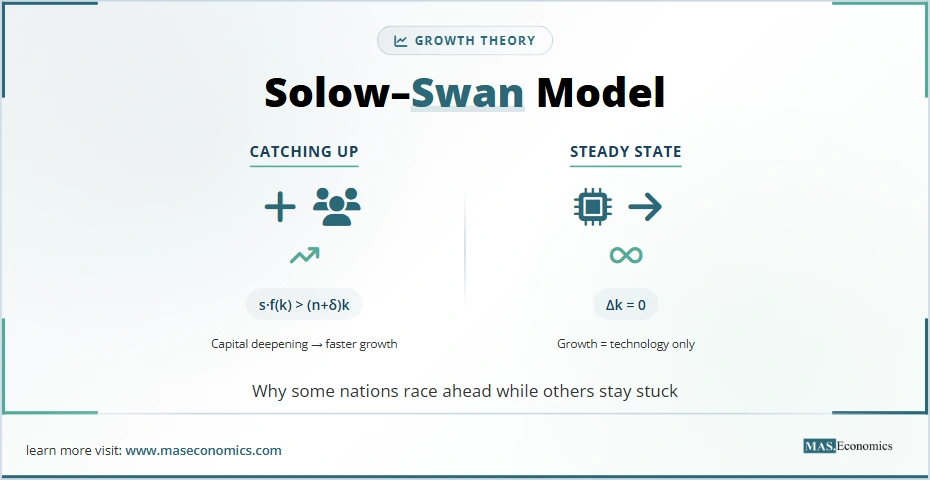
Why has South Korea, once poorer than Pakistan, become a rich country while others remain stuck? Why do some nations race ahead while others barely move? Why does capital flow from rich countries to poor ones in theory, but not always in practice?
These questions have haunted economists for centuries. Then, in 1956, two economists, one American, one Australian, independently provided a framework that would become the foundation of all modern growth economics. Their names were Robert Solow and Trevor Swan, and their model remains essential reading for anyone who wants to understand why nations prosper or stagnate.
The Before Solow: Why Growth Seemed Impossible
To understand why Solow and Swan’s work was revolutionary, we need to see the intellectual landscape before 1956.
The Harrod-Domar Nightmare
In the 1940s, economists Roy Harrod and Evsey Domar developed models suggesting that capitalist economies were inherently unstable. Their framework predicted a “knife-edge” problem: if the actual growth rate deviated even slightly from the “warranted” rate, the economy would either spiral into depression or explode into inflation. Sustained, stable growth seemed almost impossible.
This was deeply pessimistic. It suggested that market economies could not achieve steady growth without constant government intervention. And it left a crucial question unanswered: what actually determines long-run prosperity?
The Classical Legacy
Earlier economists, Adam Smith, David Ricardo, and Karl Marx, had focused on how economies grow, but their analyses lacked mathematical precision. Ricardo believed economies would eventually reach a stationary state. Marx predicted capitalism’s collapse. None offered a rigorous framework for understanding sustained growth.
Enter Robert Solow and Trevor Swan.
The Two Minds Behind the Model
Robert Solow (1924–2023)
Born in Brooklyn to Jewish immigrant parents, Solow served in the U.S. Army during World War II before studying at Harvard under Wassily Leontief, the same Leontief whose paradox we explored in our previous article. Solow spent most of his career at MIT, where he became known for combining mathematical rigor with a deep commitment to empirical testing. He would later win the Nobel Prize in 1987.
Trevor Swan (1918–1989)
Swan was an Australian economist who developed his model independently while working at the Australian National University. A Rhodes Scholar who studied at Oxford, Swan brought a unique blend of theoretical elegance and practical policy insight. His work was less known than Solow’s for years, but economists now recognize their contributions as equal and simultaneous.
The fact that two economists on opposite sides of the world arrived at virtually the same model in 1956 tells us something: the time was right for a new way of thinking about growth.
The Solow-Swan Model: Core Ideas
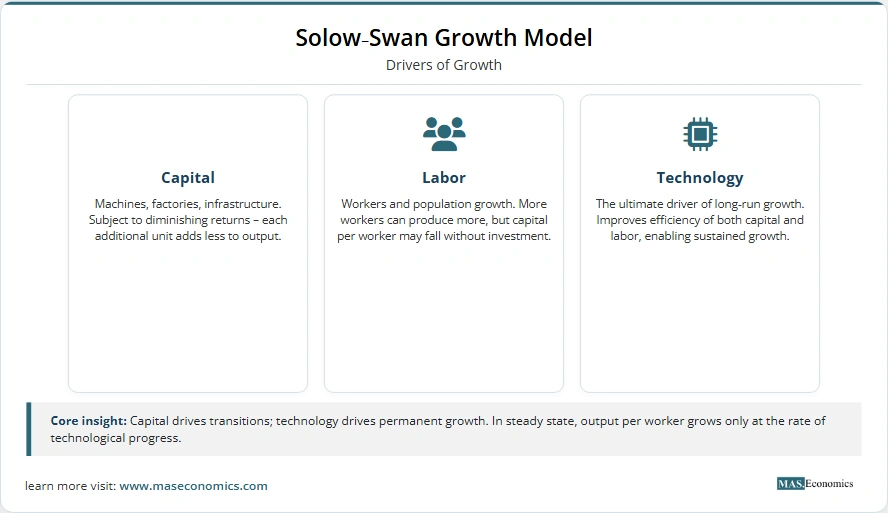
At its heart, the Solow-Swan model is beautifully simple. It asks: What determines a country’s output over time? And it answers: three things.
The Three Drivers of Growth
- Capital (K) – The machines, factories, infrastructure, and equipment that workers use.
- Labor (L) – The number of workers.
- Technology (A) – The knowledge and efficiency that multiplies the effectiveness of both capital and labor.
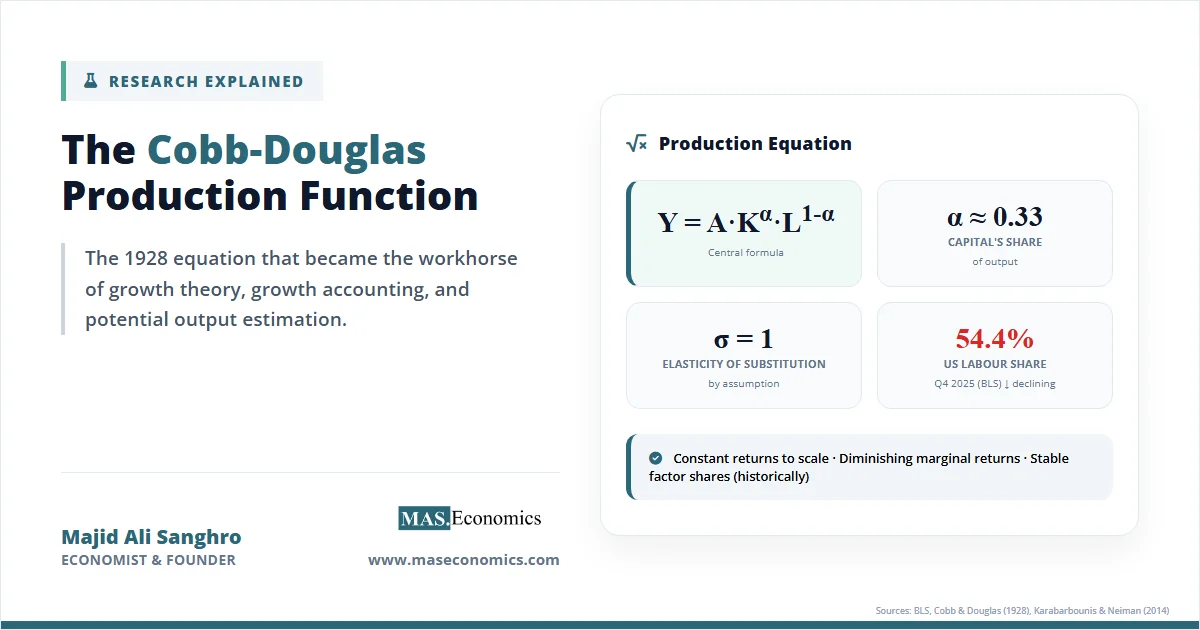
The model expresses this relationship through a production function:
In its most common form, using a Cobb-Douglas production function:
Where \(\alpha\) (alpha) is a number between 0 and 1 representing capital’s share of output, typically around one-third in most economies.
A MASEconomics Example: Textilia and Machinia Revisited
Remember our two countries from the Heckscher-Ohlin article? Let’s bring them back.
- Textilia has abundant labor but limited capital.
- Machinia has abundant capital but limited labor.
Both want to grow. According to Solow-Swan, their growth depends on:
- How much they save and invest (turning output into new capital)
- How fast their population grows
- How quickly technology improves
But here is the crucial insight: capital alone cannot drive growth forever.
The Diminishing Returns Principle
This is perhaps the model’s most important idea. Consider Textilia, which starts with very little capital, just a few simple tools. Adding more tools dramatically increases output. This is the power of capital accumulation.
But as Textilia keeps adding capital, more machines, more factories, each new unit adds less to output than the previous one. This is diminishing returns to capital.
Eventually, Textilia reaches a point where new investment just barely replaces worn-out machines and equips new workers. At this point, capital per worker stops growing. The economy reaches a steady state.
Here is the stunning implication: without technological progress, growth eventually stops.
Per capita income becomes constant. The economy keeps producing, but living standards do not rise. This was a revolutionary conclusion, and it pointed directly to technology as the ultimate driver of long-run prosperity.
The Fundamental Equation
The model’s dynamics are captured by one key equation that describes how capital per effective worker (\(k = K/AL\)) changes over time:
Let’s translate this into plain language:
Symbol — Meaning
\(\Delta k\) — Change in capital per worker
\(s\) — Savings rate (fraction of income saved)
\(f(k)\) — Output per worker
\(n\) — Population growth rate
\(g\) — Technological progress rate
\(\delta\) — Depreciation rate (machines wearing out)
The equation says: Capital per worker grows when investment (saving) exceeds the amount needed to equip new workers, replace worn machines, and keep up with technology.
When these two forces balance, when saving exactly equals what’s needed to maintain capital per worker, the economy reaches its steady state.
The Steady State: Where Growth Ends (Without Technology)
In a steady state, capital per worker stops growing. But what does this mean for living standards?
Remember that output per worker is Y/L = A·f(k). In a steady state, k is constant, but A technology can still grow. Therefore:
In a steady state, output per worker grows only at the rate of technological progress.
This is Solow’s central insight: capital accumulation drives growth during the transition to steady state, but only technological progress drives growth permanently.
A country can raise its savings rate, invest more, and grow faster for a while. But eventually, diminishing returns set in, and growth returns to the rate of technological progress. The savings rate affects the level of income, not its long-run growth rate.
The Golden Rule
If higher savings lead to higher income in the steady state, should countries save as much as possible? Not necessarily.
Edmund Phelps (1961) asked: What savings rate maximizes consumption per person in a steady state? The answer became known as the golden rule.
Think of it this way: saving more means investing more, which raises future output. But saving also means consuming less today. The golden rule finds the balance, the savings rate where the marginal product of capital exactly equals the sum of population growth, technological progress, and depreciation.
At this point, consumption per person is maximized forever. Save more, and you are sacrificing current consumption for future consumption that never quite compensates. Save less, and you are not building enough capital to support future consumption.
The golden rule remains a powerful benchmark for thinking about intergenerational equity.
The Convergence Debate
One of the model’s most famous predictions is convergence: poorer countries should grow faster than richer ones, given similar savings rates, population growth, and technology.
Why? Because poor countries have less capital per worker, the marginal return on investment is higher. Capital should flow from rich to poor countries, and poor countries should grow faster as they build their capital stocks.
Does It Happen?
The evidence is mixed and fascinating.
- Absolute convergence (all countries converging to the same income level) does not hold globally. Many poor countries remain poor.
- Conditional convergence (countries converging to their own steady states) does seem to hold. Countries that save more, invest in education, and adopt technology grow faster.
The Convergence Clubs
A 2023 study by Sedat Alataş examined 72 countries from 1960 to 2010 using multiple convergence concepts. The findings reveal a nuanced picture:
- Conditional β-convergence exists. Poorer countries do grow faster, but only when you account for differences in savings, population growth, and other factors.
- σ-convergence (reducing income dispersion) is weak. The gap between the rich and the poor is not closing significantly.
- Stochastic convergence is not found. Shocks to relative incomes persist; countries do not automatically return to a common trend.
- Five distinct convergence clubs emerge, groups of countries that converge within themselves but not with others.
This last finding is crucial. Pakistan, for instance, might be converging with other countries in its club, perhaps other South Asian or lower-middle-income nations, but not with the United States or Western Europe. The world is not becoming one giant convergence story. It is forming clubs of countries with similar characteristics.
A MASEconomics Example: Pakistan and South Korea
In 1960, Pakistan and South Korea had similar income levels. Both were poor, agrarian economies. Today, South Korea’s income per capita is nearly 20 times Pakistan’s.
Why? The Solow model points to differences in:
- Investment rates – South Korea saved and invested massively, building capital.
- Education – South Korea invested in human capital, increasing the effectiveness of labor.
- Technology adoption – South Korea absorbed and adapted global technology.
- Institutions – Stable, growth-oriented policies created the right environment.
The Solow model does not explain why these differences emerged. That is a question for political economy, history, and institutional analysis. But it tells us what matters, and where to look.
The Missing Piece
The Solow model’s greatest strength is also its greatest weakness: it treats technology as exogenous, coming from outside the model, like manna from heaven.
Solow himself knew this. In his 1957 paper, he estimated that about 80% of U.S. productivity growth came from technological progress, not capital accumulation. But he did not explain where technology comes from.
This “black box” bothered many economists. If technology drives long-run growth, should we not understand what creates it?
Enter Endogenous Growth Theory
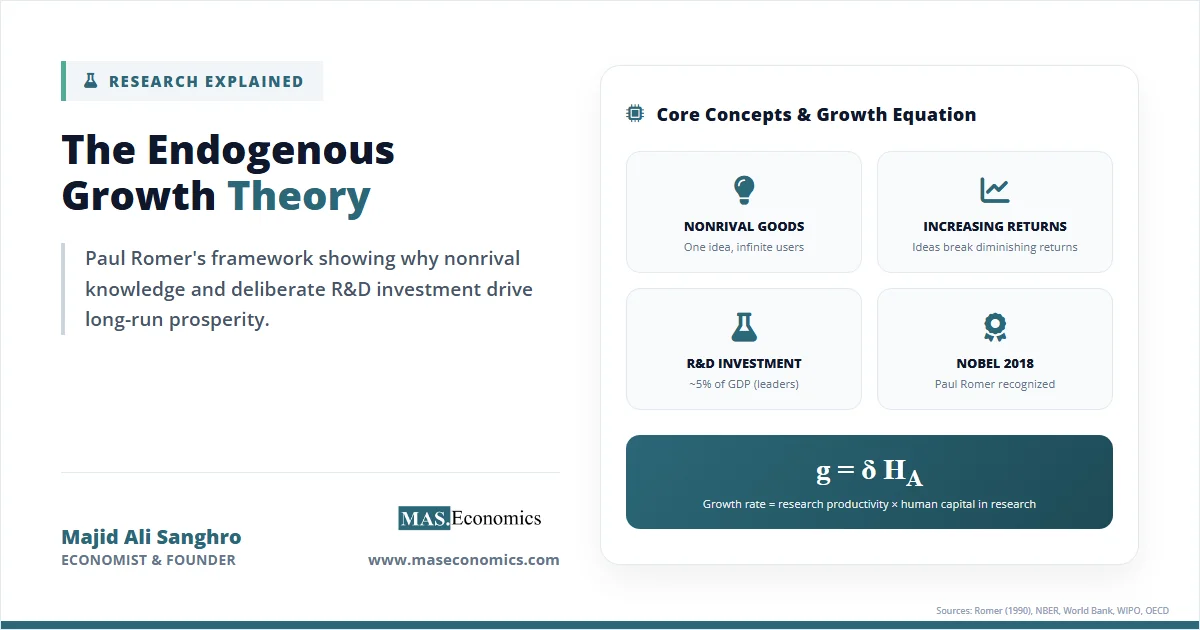
In the 1980s and 1990s, economists like Paul Romer and Robert Lucas developed endogenous growth models that tried to explain technology within the economic system. They focused on:
- Research and development – firms invest in innovation for profit.
- Human capital – education and skills create knowledge.
- Spillovers – ideas spread, benefiting everyone.
These models showed that policies matter for long-run growth, not just for the transition to steady state. Subsidies for R&D, education funding, and patent protection could all permanently raise growth rates.
But the Solow model remains the foundation. Endogenous growth theory, built on Solow, did not replace it.
Time Delays and Complex Dynamics
The basic Solow model assumes investment transforms instantly into productive capital. But in reality, building a factory takes years. Training workers takes time. These delays matter.
Recent research by Massimiliano Ferrara (2025) explores what happens when you introduce time delays into the Solow framework. The results are fascinating:
- Small delays – The economy still converges to a steady state, but the path becomes oscillatory. It might overshoot, then correct, like a pendulum gradually coming to rest.
- Larger delays – The economy can enter persistent cycles, with growth rates fluctuating endogenously. Business cycles emerge from the model without any external shocks.
- Critical thresholds – Beyond certain delay lengths, the economy can become unstable or even chaotic.
This research connects growth theory with business cycle analysis, showing how investment lags can generate the booms and recessions we observe.
Policy Implications
If time delays matter, then policies that reduce implementation lags, streamlining regulations, improving project management, and accelerating infrastructure delivery can enhance stability and growth. Countries that build faster do not just grow more; they grow more smoothly.
The Solow Model’s Lasting Legacy
More than six decades after its introduction, the Solow-Swan model remains central to economics for several reasons.
1. It Shifted Focus to the Long Run
Before Solow, macroeconomics focused on business cycles, the short-run ups and downs. Solow redirected attention to the forces that shape living standards over generations.
2. It Identified Technology as Key
By showing that capital accumulation eventually runs into diminishing returns, Solow pointed to technological progress as the ultimate source of sustained growth. This insight shapes all modern growth policy.
3. It Created Growth Accounting
Solow’s method for decomposing growth into contributions from capital, labor, and technology remains a standard tool. When economists say “total factor productivity,” they are building on Solow’s foundation.
4. It Framed the Convergence Debate
The question of whether poor countries catch up, and why some do while others do not, remains central to development economics. The Solow model provides the framework for asking these questions.
5. It Established a Methodological Standard
Solow combined elegant theory with careful empirical testing. This combination, theoretical rigor plus empirical relevance, became the gold standard for economic research.
Critiques and Limitations
No model is perfect, and the Solow-Swan framework has faced substantial critiques.
| Critique | Explanation | Response |
|---|---|---|
| Exogenous technology | The model doesn’t explain where growth ultimately comes from. | Endogenous growth theory addresses this, building on Solow’s foundation. |
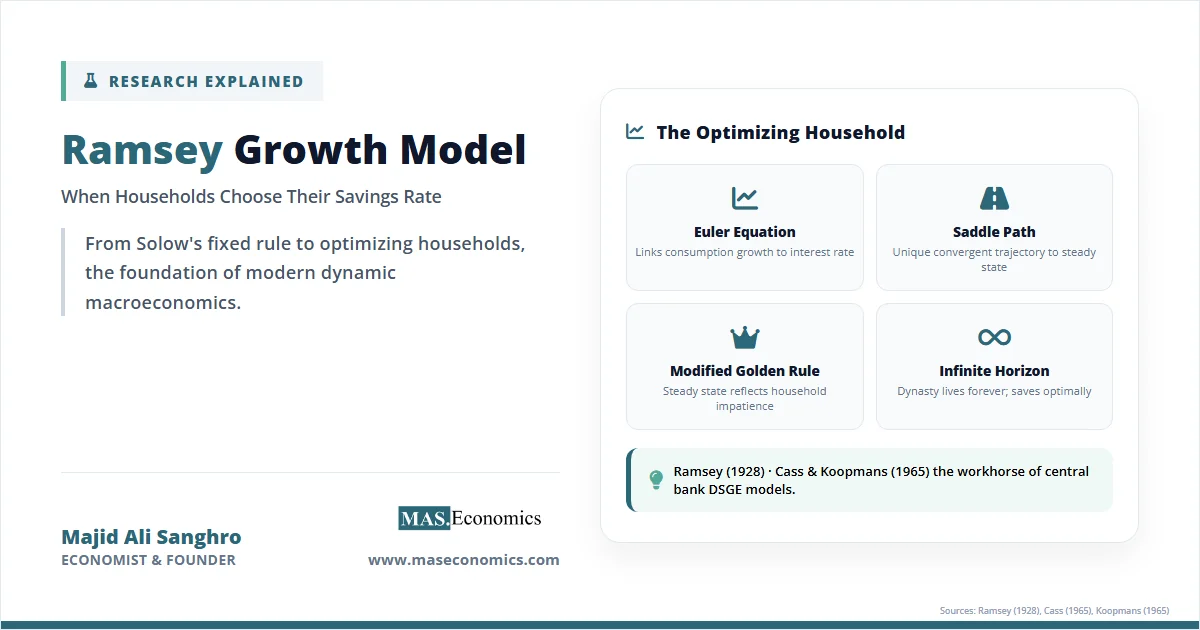
| Constant savings rate | Savings are assumed, not derived from optimizing behavior. | Ramsey-Cass-Koopmans models make savings endogenous. |
| Single sector | The model aggregates the entire economy into one good. | Multi-sector models capture structural transformation. |
| No role for institutions | The model abstracts from politics, governance, and social factors. | Institutional economics explains why some countries use capital and technology better. |
| Convergence failures | Many poor countries don’t converge as predicted. | Conditional convergence and club convergence refine the prediction. |

|
||
These critiques don’t invalidate the model, they enrich it. Each limitation has inspired new research, deepening our understanding of growth.
So, Does the Solow Model Still Matter?
After all these critiques and extensions, you might wonder: should we still teach the Solow model? Absolutely. Here’s why.
As a Foundation
Every growth model since 1956 builds on Solow-Swan, whether by extending it, modifying it, or reacting against it. You cannot understand modern growth economics without understanding Solow.
As a Diagnostic Tool
The model tells policymakers what to look at: savings rates, population growth, and technological adoption. It provides a framework for diagnosing why a country grows slowly and what might accelerate growth.
As a Reality Check
The model’s predictions about convergence, diminishing returns, and the limits of capital accumulation remain essential correctives to simplistic growth policies. It reminds us that there’s no shortcut to prosperity; sustained growth requires technological progress, not just investment.
As an Inspiration
The Solow model shows how a simple, elegant framework can illuminate complex realities. It’s a testament to the power of economic reasoning and a challenge to future economists to build on its insights.
The Road Ahead
The Solow-Swan model opened a door. Through that door, economists have explored:
- Human capital – education, skills, and health as drivers of growth.
- Endogenous technology – how innovation emerges from economic activity.
- Institutions – why some countries create environments conducive to investment and innovation.
- Geography and history – how location and path dependence shape development.
- Climate and sustainability – how growth interacts with planetary boundaries.
Each of these explorations builds on Solow’s foundation. The work is ongoing, and in future “Research Explained” articles, we’ll explore these extensions from the augmented Solow model with human capital to the latest research on growth and climate change.
Did you find this article helpful? Share it with someone who loves economics. And remember, at MASEconomics, we make complex ideas simple.