In the final week of the 2024 US presidential campaign, both major candidates spent more time talking about middle-class tax cuts than about their parties’ base voters. In the United Kingdom’s 2024 general election, Labour’s manifesto pledged fiscal rules indistinguishable from the Conservative framework it replaced. In Germany’s 2025 federal election, the CDU and SPD competed over nearly identical positions on debt brake reform. These convergences are not coincidences. They are predictions of the median voter theorem, an economic model that explains why two candidates in a democracy often sound alike on the eve of an election.
And yet, the theorem also fails. Donald Trump won the 2024 election running on positions far from the statistical centre. France’s 2024 parliamentary elections produced a fractured legislature with no centrist majority. Argentina elected Javier Milei, a self-described anarcho-capitalist, in 2023. The same theory that explains convergence also explains divergence, once its assumptions are made explicit.
The model was first formalised by Duncan Black in 1948 and extended by Anthony Downs in 1957. It remains one of the most cited results in political economy, public choice, and industrial organisation. The theorem’s logic reaches well beyond politics, shaping how economists think about firm location, product positioning, and media competition.
The Logic of the Median Voter
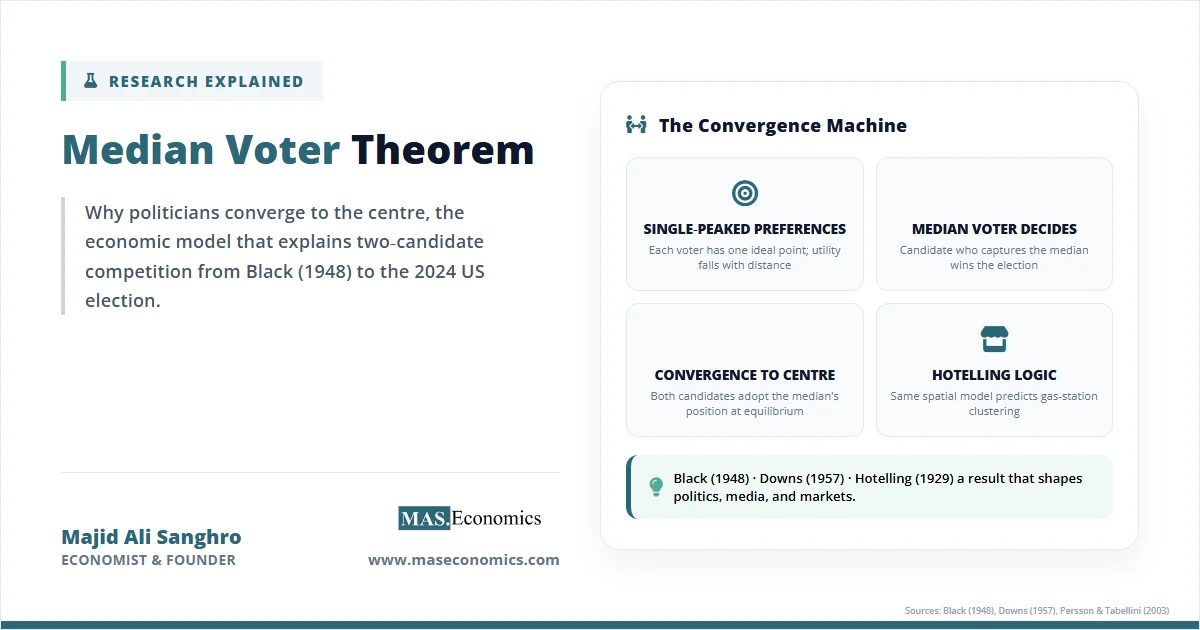
Black’s 1948 paper, “On the Rationale of Group Decision-making,” proved a result that seemed almost too clean to be true. Suppose voters must choose between policy positions arranged along a single line, such as a tax rate from 0% to 100%. Each voter has an ideal point and prefers positions closer to that ideal over positions further away. If preferences have this single-peaked structure, majority rule will select the position preferred by the median voter, the one whose ideal point sits exactly in the middle of the distribution.
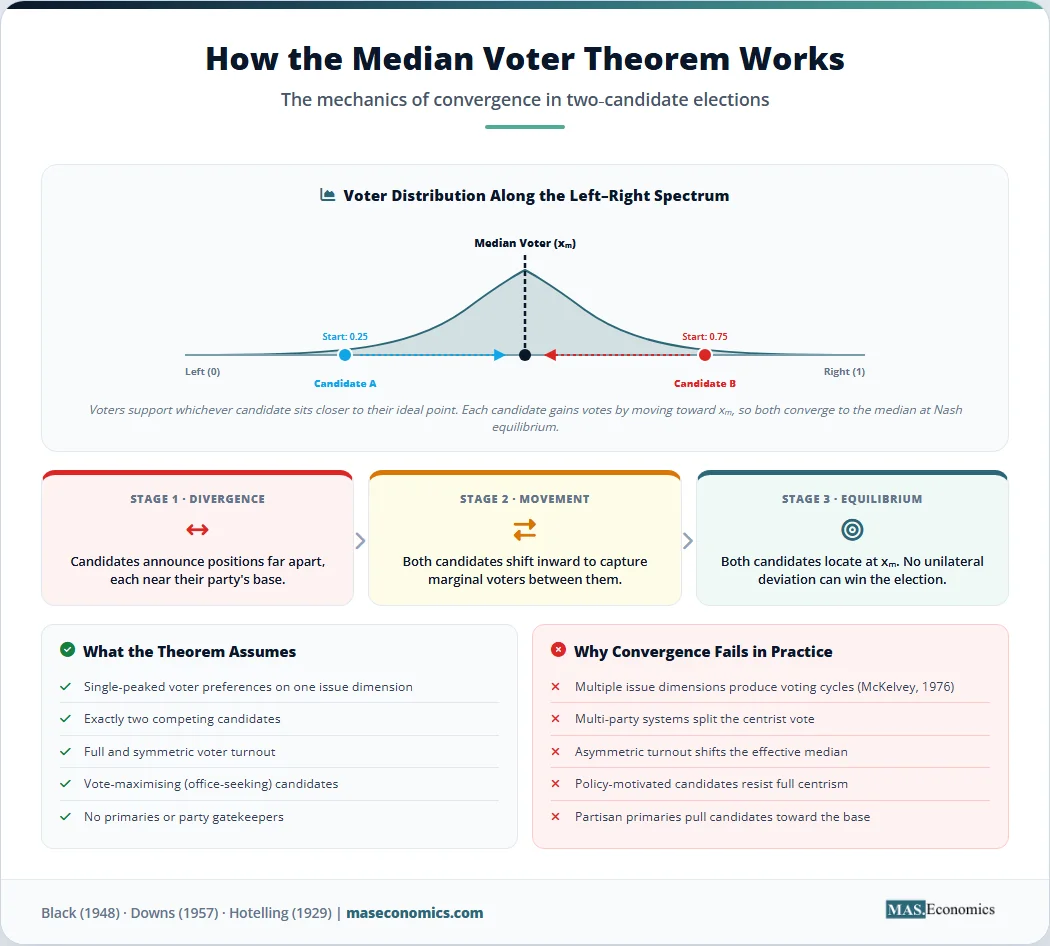
The intuition runs through a two-candidate competition. Suppose candidate A proposes a tax rate of 35% while candidate B proposes 25%. If the median voter prefers 30%, candidate B can shift to 31% and capture every voter to the left of that point plus the median, winning the election. Candidate A, anticipating this, also shifts toward the centre. The process continues until both candidates announce policies indistinguishable from the median voter’s ideal point. Any deviation by either side hands victory to the opponent.
Anthony Downs extended this logic in An Economic Theory of Democracy (1957), applying the model to platform competition between political parties. Downs argued that parties behave like firms competing for market share, with the policy space replacing the product space. The result became known as the Hotelling-Downs convergence theorem, linking political competition to Harold Hotelling’s 1929 spatial model of duopolistic firm location.
The model’s power comes from how little it assumes. Voters need not be sophisticated, informed, or strategic. They simply rank policies by distance from their preferred outcome. Candidates need not be ideological, ethical, or consistent. They simply want to win. From these minimal ingredients, the theorem predicts a strong and testable outcome: convergence to the centre.
Median Voter Theorem in Equations
Consider a continuum of voters indexed by their ideal points \( x_i \) on the real line, distributed according to a density function \( f(x) \). Each voter’s utility from a policy \( p \) is decreasing in the distance between the policy and her ideal point. A common functional form is quadratic loss:
Two candidates, \( A \) and \( B \), simultaneously announce policy positions \( p_A \) and \( p_B \). Each voter casts a ballot for the candidate whose policy is closer to her ideal. Voter \( i \) supports candidate \( A \) when:
Candidate \( A \) wins the election if she captures more than half the electorate. Define the median ideal point \( x_m \) as the value satisfying:
The Nash equilibrium of this game is \( p_A^* = p_B^* = x_m \). The proof works by elimination. Suppose \( p_B = x_m \) and candidate \( A \) considers a deviation to some \( p_A \neq x_m \). Without loss of generality, take \( p_A > x_m \). Every voter with \( x_i < x_m \) strictly prefers \( p_B \), and the median voter herself is indifferent. Candidate \( A \) loses at least half the vote, contradicting any incentive to deviate. The same argument applies symmetrically to candidate \( B \), so neither can profitably move away from \( x_m \).
The result generalises beyond quadratic loss. Any utility function that is symmetric and single-peaked around the voter’s ideal point produces the same equilibrium. The single-peaked condition requires that for each voter, utility rises monotonically toward \( x_i \) and falls monotonically away from it on each side. This rules out preferences like “I prefer extremes to compromise,” which would generate non-convergent dynamics.
The variables that drive the model are summarised below.
| Symbol | Definition | Role in Model |
|---|---|---|
| \( x_i \) | Ideal point of voter \( i \) | Determines voter’s preferred policy |
| \( f(x) \) | Density of voter ideal points | Describes the distribution of preferences |
| \( x_m \) | Median voter’s ideal point | Equilibrium policy outcome |
| \( p_A, p_B \) | Policy positions of candidates | Strategic choice variables |
| \( u_i(p) \) | Voter \( i \)’s utility from policy \( p \) | Single-peaked, decreasing in \( |p – x_i| \) |
| \( p^* \) | Nash equilibrium policy | Equals \( x_m \) under standard assumptions |

|
||
The equilibrium concept is the standard Nash equilibrium applied to a two-player game with a continuous strategy space. Both candidates are located at the median because any unilateral deviation reduces vote share. The model’s elegance lies in producing a determinate, point-valued prediction from a one-dimensional setup with minimal informational requirements.
Assumptions of the Median Voter Model
The clean prediction depends on five strong assumptions, each of which can be relaxed.
The first assumption is single-dimensionality. Voters and candidates must agree on what the issue is, even if they disagree on the answer. Real elections rarely fit this picture. A voter may rank candidate A higher on economic policy and candidate B higher on social policy. Once the issue space becomes two-dimensional, Charles Plott (1967) and later Richard McKelvey (1976) proved that majority rule generally produces no equilibrium at all. Cycles emerge in which any proposed policy can be defeated by some alternative, which in turn can be defeated by another, and so on indefinitely. This is the chaos theorem, and it shows the median voter result is fragile to dimensionality.
The second assumption is two candidates. With three or more candidates, convergence breaks down. A third entrant can locate near the median, splitting the centrist vote and allowing extremists on either side to win. Duverger’s law, which links plurality voting to two-party systems, partly explains why the theorem applies more cleanly in the United States and the United Kingdom than in multiparty parliamentary systems.
The third assumption is full turnout. The model assumes every voter casts a ballot. In reality, turnout varies systematically. If voters near the extremes are more motivated than centrists, the effective median shifts away from the population median. Osborne and Slivinski (1996) and Besley and Coate (1997) developed citizen-candidate models in which the threat of abstention pulls candidates toward their base.
The fourth assumption is that of vote-maximising candidates. The Downsian candidate wants to win and nothing else. If candidates have policy preferences of their own, equilibrium positions can lie strictly between the median and the candidate’s ideal. Wittman (1983) and Calvert (1985) showed that policy-motivated candidates only converge to the median when uncertainty about the median’s location is zero, an unrealistic limit case.
The fifth assumption is the absence of primaries. American presidential candidates must first win their party’s nomination, which is selected from a more ideologically homogeneous electorate than the general population. The optimal strategy in the primary is to locate near the party’s median, not the national median. After winning the nomination, candidates face a credibility constraint when pivoting toward the centre. Polarisation is partly a product of this two-stage selection process.
These violations explain why contemporary US politics shows divergence rather than convergence. The combination of partisan primaries, multidimensional issue spaces, geographic sorting, and gerrymandered districts creates an environment where the median voter theorem’s predictions fail systematically. The theorem still works as a baseline, but the deviations from it are now the more interesting object of study.
Empirical Tests of the Theorem
Empirical work on the median voter theorem falls into three traditions: roll-call analysis of legislative voting, cross-country institutional comparisons, and primary-to-general election studies.
The most influential roll-call work comes from Keith Poole and Howard Rosenthal, whose DW-NOMINATE scores place every member of the US Congress on a left-right scale based on observed votes. Their data, covering every Congress since 1879, shows that the median legislator’s position predicts policy outcomes well in most periods. The model breaks down precisely when polarisation rises. Between 1947 and 2023, the ideological distance between the median Republican and median Democrat in the US House more than doubled, and the share of moderate legislators fell from roughly 30% to under 5%.
Cross-country evidence compares electoral systems. Persson and Tabellini (2003) find that majoritarian systems with two-party competition produce policy outputs closer to the median voter than proportional representation systems with multiparty coalitions. The mechanism is direct: with more parties, the median legislator in a coalition government is no longer the median voter in the population.
Studies of primary-to-general election movement provide some of the cleanest tests. Burden (2004) tracked Senate candidates’ positions and found measurable centrist shifts after primaries, though the shifts are smaller than the theorem predicts. The credibility cost of repositioning, combined with informed primary voters who punish flip-flopping, limits how far candidates can move.
Distribution of voter ideal points and party positions, US 2024
A simulated normal distribution of voter ideology with major-party platform positions marked. The Republican platform sits roughly one standard deviation right of the median; the Democratic platform sits roughly half a standard deviation left.
Source: Stylised distribution based on American National Election Studies (ANES) 2024 ideology self-placement data and party platform analysis.
The chart shows the structural problem with applying the basic theorem to current US politics. Party platforms sit measurably away from the population median, and the gap has widened. Recent work by Gentzkow, Shapiro, and Taddy (2019) using congressional speech data finds that partisan polarisation in language has more than doubled since 1990. The basic Downsian model cannot accommodate this pattern without auxiliary mechanisms.
Cross-national tests give similarly mixed results. Switzerland’s referendum-driven democracy approximates the median voter outcome in many policy areas. Westminster systems show partial convergence on macroeconomic policy but persistent divergence on identity-linked issues such as immigration and constitutional questions. Multiparty European democracies show the weakest convergence, consistent with the theorem’s two-candidate restriction.
From Blackboard to Polling Booth
The theorem still shapes how political scientists, economists, and strategists think about competition, even where its strict predictions fail. Three contemporary applications show its continuing influence.
The first is the analysis of gerrymandering. When district boundaries are drawn to pack opposition voters into a small number of safe seats, the median voter in the remaining districts shifts toward the dominant party. Candidates in those districts no longer face a centrist constraint; they face a partisan one. Studies of US state legislatures by Stephanopoulos and McGhee (2015) show that the efficiency gap between vote share and seat share has widened in gerrymandered states. The theorem predicts moderation only when the relevant median is the population median. Gerrymandering replaces it with a partisan median, and divergence follows.
The second is the design of primary systems. California and Washington have adopted top-two primaries, in which the two highest vote-getters advance to the general election regardless of party. The reform is explicitly motivated by Downsian logic. By replacing closed partisan primaries with an open race, the system aims to make the relevant median in the primary closer to the population median. Grose (2020) finds modest moderating effects on legislative voting behaviour, though smaller than reform advocates expected. The institutional design is a direct response to the theorem’s prediction that primaries pull candidates away from the centre.
The third is campaign finance. When small donors are concentrated at the ideological extremes, candidates dependent on grassroots fundraising face an effective electorate that is more polarised than the voting electorate. Bonica (2014) documents that contributors to US congressional campaigns are systematically more ideologically extreme than primary voters, who are themselves more extreme than general election voters. The fundraising stage selects on ideology before the primary stage selects on it again, and both stages move the equilibrium away from the population median.
The same logic applies outside politics. Hotelling’s 1929 paper used the spatial model to explain why two ice-cream sellers on a beach end up positioned next to each other in the middle. The argument scales to any duopoly where consumers are distributed along a relevant dimension and choose the closest provider. Why do gas stations cluster on opposite corners of an intersection rather than spreading out? Why do Coca-Cola and Pepsi taste similar? Why do news networks compete for the same centrist viewers while leaving niche audiences underserved? Each is a Hotelling-Downs result. The theorem describes a general property of competition under symmetric preferences, not just an artefact of voting.
Media markets show particularly clear examples. Mullainathan and Shleifer (2005) apply the spatial model to news, predicting that mainstream outlets converge to the median consumer’s preferences while fringe outlets capture extremes. Cable news in the United States, with the centrist mainstream networks bracketed by Fox News on the right and MSNBC on the left, fits the model’s two-tier prediction reasonably well. Streaming services, music platforms, and software products all show similar competitive dynamics.
The theorem also connects to public choice theory, which uses microeconomic tools to study political behaviour. The Downsian framework is the workhorse model of that tradition, and its predictions form a baseline against which real-world deviations are measured. The theorem’s relationship to Arrow’s impossibility theorem is closer than it appears: Black’s single-peakedness condition is one of the few restrictions on preferences that escapes Arrow’s negative result. By assuming voters care only about distance on a single dimension, the model sidesteps the cycling problems that Arrow proved are otherwise unavoidable.
Connections also run to game theory and strategic behaviour, since the candidate competition is a textbook two-player game with a clean equilibrium. Mechanism design extensions, such as the Vickrey-Clarke-Groves mechanism, address situations where the median voter result is no longer optimal because preferences must be elicited rather than observed. Each of these connections shows the theorem’s central place in the architecture of modern economic theory.
Recent applications include AI-driven political advertising, where micro-targeting allows candidates to project different platforms to different voters. The model predicts that perfect targeting would dissolve the convergence result entirely, since each voter would receive a message tailored to her ideal point. Empirical work on the 2024 US election by the Pew Research Center documented unprecedented divergence in voter perceptions of candidate positions, consistent with this prediction.
MASEconomics Explains
Four economic concepts behind the median voter theorem
Conclusion
The median voter theorem remains the cleanest theoretical bridge between economic reasoning and democratic politics. Its core prediction, that two candidates competing on a single issue will converge to the position of the median voter, holds well in environments that satisfy its assumptions and breaks down predictably when those assumptions fail. The theorem’s value is not its accuracy in every election but its diagnostic power: each empirical deviation from convergence points to a specific assumption violation, whether multidimensional issues, primary systems, asymmetric turnout, policy-motivated candidates, or geographic sorting through gerrymandering.
Roll-call evidence from the US Congress, cross-national comparisons of electoral systems, and primary-to-general election studies all show partial convergence consistent with the model’s logic. The same evidence shows polarisation rising as institutional features push the operative median away from the population median. Applications outside politics, from gas station clustering to cable news positioning, confirm that the underlying spatial logic captures something general about competitive equilibria. Black’s 1948 result stands as the foundation for a research programme that continues to generate testable predictions seventy-eight years later.
Did you find this article helpful? Share it with someone who loves economics. And remember, at MASEconomics, we make complex ideas simple.