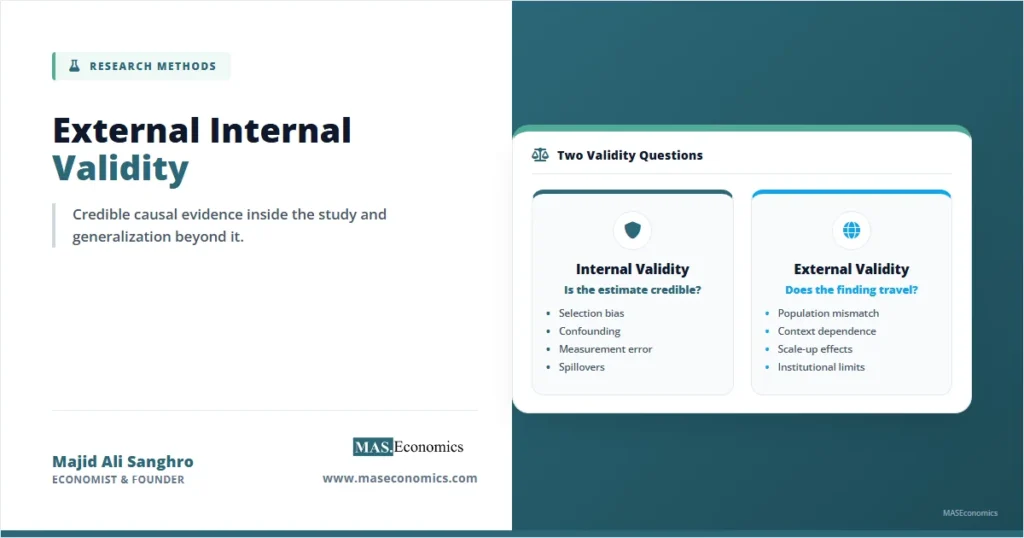
A study can estimate a policy effect with great precision and still answer the wrong question if its comparison is biased or its setting is too narrow. External validity is the research-design framework economists use to judge whether a study is credible inside its sample and informative beyond it.
Internal validity asks whether the estimated relationship is believable within the study. External validity asks whether the finding travels to other populations, markets, institutions, and time periods. Both matter because economics often studies real policies under imperfect measurement, incomplete assignment, and changing institutional conditions.
The trade-off is not mechanical. Some designs have strong internal validity but limited generalizability. Other studies cover broad populations but have weak causal leverage. Good research states which kind of validity it has, which threats remain, and what later evidence must still be tested.
Internal Versus External Validity
Internal validity concerns whether the study identifies the relationship it claims to identify. In causal economics, this means the estimated effect should not be driven by selection bias, omitted variables, reverse causality, measurement error, attrition, non-compliance, or spillovers. A study with high internal validity gives a credible answer for the sample, setting, and comparison used in the research design.
External validity concerns whether the answer generalizes. A study may be internally credible for one city, one school system, one labour market, or one policy year, but the same result may not hold elsewhere. External validity depends on population, context, treatment implementation, institutions, timing, and market structure.
The What Works Clearinghouse distinguishes causal validity within the study sample from the extent to which findings might be replicated in other settings. Its standards focus mainly on internal causal validity, while external validity requires further judgment about settings and populations. What Works Clearinghouse Procedures and Standards Handbook
This distinction explains why a single study rarely settles an economic question. A randomized evaluation may identify the effect of a tutoring programme in one school district. It does not automatically prove that the same programme will work in another country, under another budget, with different teachers, or during another macroeconomic environment.
Internal validity is about whether the estimate is right for the study. External validity is about whether the estimate is useful beyond the study. Strong economic research treats both as separate claims.
The Four-Way Threat Inventory
Validity threats can be organized into four broad groups: assignment threats, measurement threats, behavioural threats, and generalization threats. This structure keeps the discussion practical. Instead of treating validity as an abstract label, it asks where the evidence can break.
Assignment threats affect whether the treatment and comparison groups are comparable. Measurement threats affect whether the study records the right outcome, treatment, or covariate. Behavioural threats arise when participants, firms, or institutions react to the study or treatment in ways that change the comparison. Generalization threats limit whether the result applies outside the original sample.
| Threat | Validity Type | Definition | Economic Example | Research Design Response |
|---|---|---|---|---|
| Selection bias | Internal validity | Treated and untreated units differ before treatment in ways that affect the outcome. | More motivated workers choose a job-training programme. | Use random assignment, credible quasi-experimental variation, or strong balance checks. |
| Confounding | Internal validity | A third factor affects both the explanatory variable and the outcome. | School quality affects both education and earnings. | Use theory, controls, fixed effects, instruments, or design-based comparison. |
| Reverse causality | Internal validity | The outcome affects the explanatory variable rather than the other way around. | Police presence and crime may influence each other. | Use timing, natural experiments, instruments, or lagged design logic. |
| Measurement error | Internal validity | The treatment, outcome, or control variable is recorded imprecisely. | Self-reported income differs from administrative tax records. | Use validated measures, multiple sources, administrative records, or sensitivity checks. |
| Attrition | Internal and external validity | Units leave the sample in non-random ways before outcome measurement. | Migrant households are harder to follow in a panel survey. | Track attrition, test differential loss, use bounds, and report follow-up rates. |
| Non-compliance | Internal validity | Assigned units do not receive or follow the treatment as planned. | Firms offered a tax advisory service do not attend the sessions. | Report intention-to-treat estimates and define treatment-on-treated assumptions. |
| Spillovers | Internal validity | Treatment affects units assigned to the comparison group. | Information given to treated farmers spreads to nearby control farmers. | Randomize at the cluster level, measure networks, or model spillover exposure. |
| Context dependence | External validity | The effect depends on institutions, prices, norms, or implementation capacity. | A labour-market programme works in a tight labour market but not in a recession. | Replicate across settings and state the institutional scope of the result. |
| Population mismatch | External validity | The study sample differs from the target population. | A survey experiment on urban households is used to infer rural behaviour. | Use representative sampling, reweighting, subgroup analysis, or new field evidence. |
| Scale-up effects | External validity | The treatment effect changes when a small intervention becomes a large programme. | A pilot subsidy changes local prices after national rollout. | Study equilibrium effects, implementation constraints, and market feedback. |

|
||||
The inventory shows why validity is not a single checklist item. A study can solve selection bias but still face spillovers. It can measure outcomes well but fails to generalize. It can cover a national population but has weak causal identification. The credibility of the claim depends on the specific threat.
Selection Bias and Confounding
Selection bias is one of the most common threats in applied economics. It occurs when treated and untreated units differ before treatment in ways that also affect the outcome. If workers choose whether to enter a training programme, participants may differ from non-participants in motivation, prior experience, search effort, and access to information. A simple comparison of later wages would mix the programme effect with pre-existing differences.
Confounding is closely related. A confounder is a variable that affects both the explanatory variable and the outcome. In education research, family background may affect years of schooling and earnings. In health economics, income may affect both medical treatment access and health outcomes. In trade research, firm productivity may affect both exporting and later growth.
Design-based methods try to break this link. Randomized controlled trials assign treatment independently of potential outcomes when implemented correctly. Natural experiments use real-world variation that can mimic random assignment under defensible assumptions. Instrumental variables use a source of variation that affects treatment but is excluded from the outcome equation except through treatment.
J-PAL notes that randomized evaluations can still face threats to internal validity, including spillovers, attrition, and partial non-compliance, even though random assignment strengthens the comparison. J-PAL elements of a randomized evaluation. This is a useful warning. Randomization helps with selection bias at baseline. It does not automatically solve every later validity problem.
Econometric tools also matter. Multiple regression models can adjust for observable confounders. Instrumental variables can address some forms of endogeneity when the instrument is credible. Panel data methods can remove time-invariant unit differences under specific assumptions. The Research Methods question comes first: whether the identifying comparison is believable.
Measurement and Attrition Problems
Measurement error can weaken both internal and external validity. An outcome may be measured imprecisely, a treatment may be recorded incorrectly, or a key covariate may be missing. In economics, this is common because many variables are difficult to observe directly. Income, informal employment, expectations, risk attitudes, firm productivity, and household assets are often measured with error.
Classical measurement error in an explanatory variable can attenuate estimated relationships. Non-classical error can bias estimates in less predictable directions. If income is underreported more often by high-income households, distributional analysis becomes distorted. If firms misclassify informal workers, labour-market estimates may misstate the size of the informal sector.
Attrition creates a related problem. A panel study may start with a representative sample but lose respondents over time. If attrition is random, it mainly reduces precision. If attrition is related to treatment or outcome potential, it can bias the result. A microcredit evaluation that loses the most mobile households may no longer estimate the effect on the original population.
Measurement and attrition problems also affect external validity. A study based on a highly trackable group may not represent harder-to-follow populations. A study using administrative data from formal firms may not generalize to informal firms. The article on data collection in economics develops these measurement issues in more detail.
Spillovers and Behavioural Responses
Economic units react to policies, incentives, and information. This makes behavioural responses a central validity threat. A treated household may share information with untreated neighbours. A firm may change hiring because competitors received a subsidy. A control village may be affected by market prices changed by treated villages nearby.
Spillovers are especially common in development, education, health, trade, and labour-market research. They can bias treatment estimates if the comparison group is indirectly treated. They can also be the object of interest if the researcher wants to study social learning, network effects, market feedback, or general equilibrium effects.
The correct response depends on the question. If spillovers threaten the main comparison, the design may randomize at a higher cluster level or separate treatment and control areas geographically. If spillovers are part of the mechanism, the design should measure exposure and estimate direct and indirect effects separately.
Behavioural responses also include Hawthorne effects, anticipation effects, and substitution. Households may change behaviour because they know they are observed. Firms may act before a policy begins if they anticipate the rule change. Consumers may substitute across products when a tax affects one good but not another. These responses do not make economic research impossible. They mean the treatment being estimated may include behavioural adjustment, not only the policy rule itself.
External Validity Across Settings
External validity is often described as generalizability, but in economics, it is more precise to ask what changes across settings. A result may depend on baseline income, market competition, state capacity, financial access, legal enforcement, social norms, macroeconomic conditions, or programme implementation quality.
For example, a training programme may work when employers are hiring and fail when demand is weak. A tax-compliance message may work in a country with strong enforcement but fail where tax administration is limited. A fertilizer subsidy may raise yields when credit constraints are binding, but not when farmers already use optimal inputs.
External validity is not solved by a larger sample alone. A large sample from one institution may still be narrow. A small study across many contexts may reveal more about heterogeneity than a large study in one location. The right external validity strategy depends on the target claim.
Systematic reviews and meta-analyses help with external validity because they compare findings across studies, samples, and contexts. The article on systematic literature reviews in economics explains how evidence synthesis can identify whether results are stable across the literature or concentrated in a narrow setting.
Decision Tree for Validity Threats
A validity diagnosis should begin with the claim being made. If the claim is causal, the first concern is internal validity. If the claim is about general policy relevance, external validity becomes central. A decision tree helps separate the main validity threats before selecting a design response.
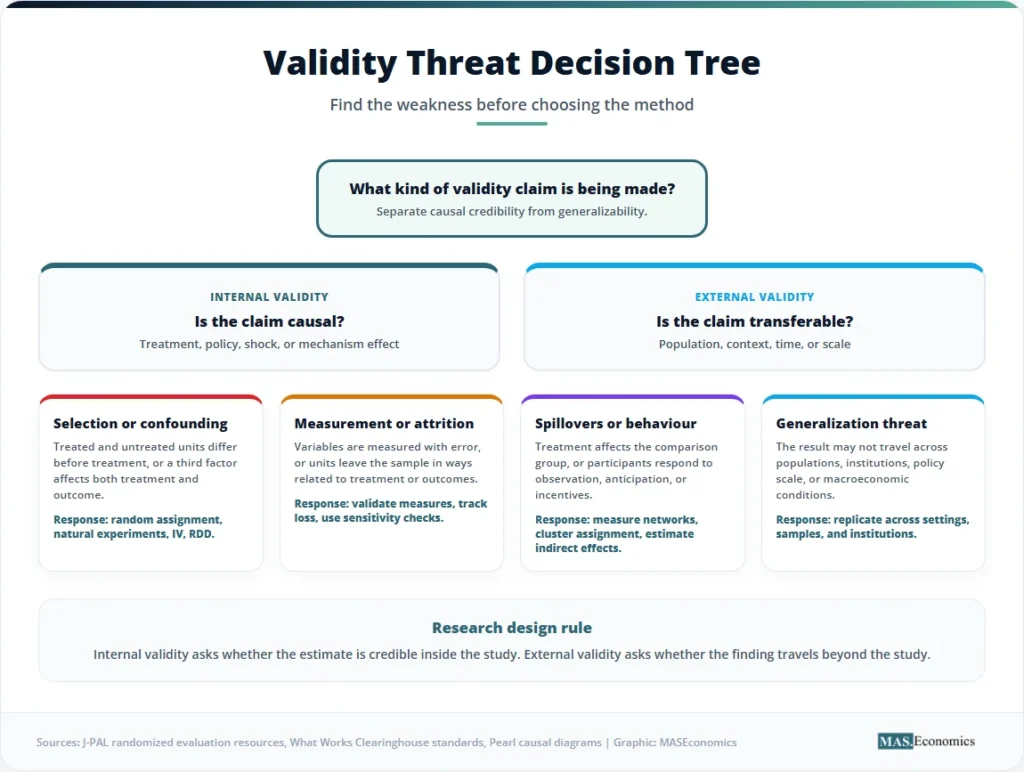
The decision tree is a diagnostic tool. If selection, confounding, measurement error, attrition, spillovers, or non-compliance threaten the estimate, the problem is mainly internal validity. If the result may not travel across populations, implementation settings, or time periods, the problem is mainly external validity. Many economics studies face both.
Natural Experiments and Validity
Natural experiments are valuable because they can improve internal validity when real-world rules create credible comparison groups. A policy cutoff, geographic border, eligibility rule, lottery, or institutional shock may generate variation that is less contaminated by selection than ordinary observational data.
The existing article on natural experiments in economics explains how economists use real-world variation when controlled assignment is not possible. The validity question is whether the variation is as good as random for the outcome being studied. If the answer is yes, internal validity improves. If units can manipulate assignment or anticipate the policy, internal validity weakens.
Natural experiments also raise external validity questions. A policy border may identify an effect near one location. A cutoff may identify effects near the threshold. A historical shock may identify effects in one time period. Those estimates can be credible and still local.
This is why research-methods articles should cross-link to Econometrics without duplicating it. Research Methods asks whether the comparison is credible and what scope the estimate has. Econometrics explains the estimator, standard errors, and formal testing. The article on advanced difference-in-differences methods is a useful companion for readers who need the estimation mechanics after the design logic is clear.
Causal Diagrams Clarify Threats
Causal diagrams help researchers state what they believe about the relationship between treatment, outcome, confounders, mediators, and colliders. A diagram does not prove the assumptions are true. It makes the assumptions visible.
Pearl’s work on causality formalized how graphical models can represent causal relationships and identify adjustment strategies under assumptions such as the backdoor criterion. Pearl, Causality In applied economics, directed acyclic graphs can help reveal whether a control variable blocks confounding, opens a collider path, or controls away part of the mechanism.
The planned MASEconomics article on Causal Diagrams for Research Design should later be linked from this section once published. It will provide the dedicated treatment of DAG elements, backdoor paths, colliders, and variable-selection logic. For the present article, the main point is that diagrams can sharpen validity discussions before estimation begins.
A well-drawn causal diagram can show why a simple regression is biased, why an instrument may fail, or why controlling for a post-treatment variable can damage internal validity. It can also clarify external-validity assumptions by showing which mechanisms may vary across settings.
When Validity Trade-Offs Matter
Validity trade-offs often appear in applied economics. A lab experiment may isolate a behavioural mechanism with high control, but the setting may be artificial. A national survey may have broad coverage, but weak causal leverage. A randomized field experiment may identify a programme effect in one setting, but not predict how the effect changes at the national scale.
The right response is not to rank one research type above all others. It is to match the design to the claim. If the claim is causal, internal validity must be defended first. If the claim is about policy transfer, external validity must be discussed explicitly. If the claim is both causal and general, the evidence base usually needs more than one study.
Replication is one route to stronger external validity. Replicating a design across regions, institutions, and time periods can show whether the effect is stable or context-dependent. Meta-analysis and systematic reviews can then summarize whether the literature points to a general pattern or a set of local findings.
Pre-registration can also help. It does not solve validity by itself, but it clarifies which outcomes, subgroups, and hypotheses were planned before seeing the data. The article on pre-registration economics explains how pre-analysis plans reduce hidden flexibility in research design.
Reading Validity in Published Papers
A validity assessment should read a paper’s design before reading its estimates. The first question is what comparison supports the claim. The second is what could make that comparison wrong. The third is how far the result can travel.
In a regression paper, check whether the controls address the main confounders or only make the table look complete. In a difference-in-differences paper, check whether the comparison group is plausible and whether pre-treatment trends support the design. In an instrumental-variables paper, check whether the instrument affects the outcome only through the treatment. In a randomized evaluation, check whether attrition, non-compliance, and spillovers are handled transparently.
Validity is also visible in the writing. Strong papers state the identifying assumption plainly. They report balance, attrition, robustness checks, and alternative explanations. They avoid claiming broad policy relevance from a narrow sample unless the mechanism and context support that claim.
The article on causal inference in economics provides the broader framework for potential outcomes, counterfactuals, and causal design. Validity is the credibility test applied to those claims.
MASEconomics Explains
4 economic concepts behind validity
These concepts are explored in depth across our educational articles library.
Explore the MASEconomics BlogConclusion
External validity is the framework that separates credible evidence inside a study from evidence that can travel beyond it. Internal validity protects the causal comparison. External validity protects the scope of interpretation.
Economics needs both standards because policy evidence often moves from a specific sample to a broader claim. A strong research design states the validity threat, chooses the method that addresses it, and limits the conclusion to the evidence the design can support.
Frequently Asked Questions
What is internal validity in economics?
Internal validity in economics means that the estimated relationship is credible within the study. In causal research, it asks whether the design separates the treatment effect from selection bias, confounding, reverse causality, and measurement error.
What is external validity in economics?
External validity means that a finding can generalize beyond the original study sample, setting, institution, or time period. It is strongest when the population, context, treatment, and mechanism are relevant to the broader claim.
What is the difference between internal and external validity?
Internal validity asks whether the study’s estimate is credible for the sample and design used. External validity asks whether the finding applies beyond that study. A randomized trial can have strong internal validity but still limited external validity if the setting is narrow.
Why does validity matter in economic research?
Validity matters because economic evidence often supports claims about policy, markets, and behaviour. Without internal validity, a study may estimate a biased relationship. Without external validity, a credible estimate may be overextended to settings where it does not apply.
Can a study have internal validity but not external validity?
Yes. A tightly controlled study may estimate a credible effect for its own sample while saying little about other populations or institutions. This is common in field experiments, lab experiments, and local quasi-experimental designs.
Thanks for reading! If you found this helpful, share it with friends and spread the knowledge. Happy learning with MASEconomics