
The lighthouse off the coast of nineteenth-century England became the textbook example of a problem markets cannot solve. A ship passing in the night uses the beam, but the lighthouse keeper cannot send an invoice. A second ship behind it uses the same beam at no extra cost. If every captain reasons that someone else will fund the light, no one funds it, and the rocks claim every ship in the dark. The contrast with a loaf of bread is exact. One household eats the loaf, and no one else can. The baker collects payment before the bread leaves the counter. The choice between public goods vs private goods turns on two questions about consumption, and the answers determine whether markets can supply the good at all, or whether some other institution has to step in.
Economists organize this distinction with two properties: rivalry and excludability. A good is rival if one person’s use reduces what is left for others. A good is excludable if the seller can prevent non-payers from using it. Bread is rival and excludable. The lighthouse beam is neither. National defense, clean air, basic research, and a stable legal system fall on the same side as the lighthouse, and the inability to charge for them is the reason governments, not firms, usually pay the bill.
What Rivalry Means in Consumption
Rivalry describes whether one person’s consumption diminishes the quantity or quality available to everyone else. The test is whether the good gets used up.
When a household buys a kilogram of rice, that kilogram is no longer available to other buyers. The rice market clears partly through this property: scarcity forces a price, and the price rations the good among competing users. Most physical commodities behave this way. So do most services with limited capacity. A seat on a flight, a slot at a doctor’s surgery, a restaurant table at peak hour, all carry the same rival structure. If you have it, I cannot.
Other goods do not behave that way. A radio broadcast reaches one listener and a million listeners at the same cost. A digital file is copied without depleting the original. A national defense system that deters an aggressor does so for every resident at once, regardless of how many people are inside the border. These are non-rival goods. The marginal cost of adding one more user is essentially zero, which means market pricing cannot signal scarcity in the usual way, because no scarcity arises with additional users.
Rivalry is a property of consumption, not a property of the good itself in some abstract sense. A road is rival when congested and non-rival when empty. A fishery is non-rival when the stock is large relative to extraction and becomes sharply rival as it approaches depletion. The distinction matters because the policy response shifts with the underlying condition.
Excludability in Practice
Excludability asks whether the supplier can prevent people who do not pay from consuming the good. The test is technological, legal, or institutional rather than physical.
A cinema is excludable because the door has a ticket check. A subscription database is excludable because access requires a login. A patented drug is excludable because the law protects the producer’s right to charge. These goods can be sold through ordinary market transactions because non-payers can be kept out, and that creates the price mechanism that funds production.
Other goods cannot easily exclude non-payers. Once a flood barrier protects a coastline, every property behind it is protected, regardless of whether the owner contributed to the cost. Once a vaccine drives a disease to near-extinction in a population, even unvaccinated residents enjoy the herd-immunity benefit. Once a streetlight illuminates a road, every passerby sees the same light. The supplier has no mechanism to charge those who use the good without contributing.
Excludability is also context-dependent. Cable television used to be non-excludable in practice, then became excludable when scrambling technology improved. Roads used to be largely non-excludable, then became partially excludable through electronic tolling. Knowledge is non-excludable in its pure form, and then becomes partially excludable through patents and copyrights. The institutions that create excludability are themselves economic decisions, and the choice between excludable and non-excludable provision is often the central policy question.
Two-by-Two Typology of Goods
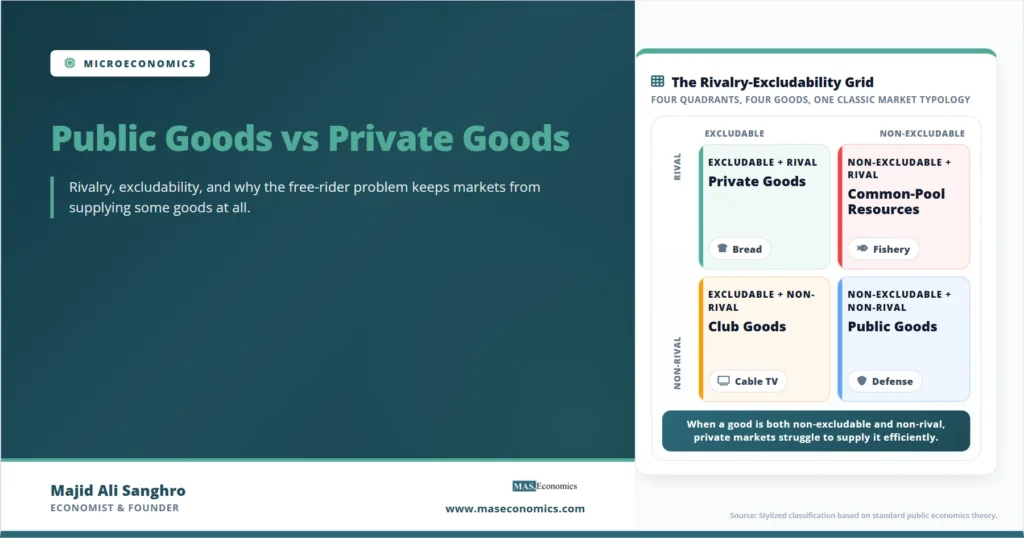
Combining rivalry and excludability produces four categories, and the standard textbook 2×2 sits behind a large share of microeconomic policy debate. The differences between public goods vs private goods become sharper once the two intermediate categories are also placed in view.

Private goods sit in the top-left cell. They are rival and non-excludable. A loaf of bread, a pair of shoes, and a seat on a flight all fit. The seller controls access, and consumption by one buyer ends consumption by another. Most of conventional supply-and-demand analysis assumes this case, and the institutions of property rights, contract enforcement, and competitive pricing are built to handle it.
Public goods sit in the opposite corner. They are non-rival and non-excludable. National defense, a stable legal system, clean air, basic scientific research, and a network of lighthouses share both properties. Once supplied, the good benefits everyone in the relevant population, and the supplier cannot collect a fee from individual users. The market mechanism that funds private goods does not work, which is why these goods are typically funded through taxation and provided by governments.
Common-pool resources are rival but non-excludable. Open-ocean fish stocks, groundwater aquifers, an unmetered grazing commons, and congested urban roads all fit. Use depletes the stock, but excluding additional users is hard. This combination produces the overuse pattern that Garrett Hardin described, and that Elinor Ostrom later showed could sometimes be solved by collective institutions short of formal government. The mechanics are explored in the article on the tragedy of the commons.
Club goods are non-rival but excludable. Cable television, a private gym, a toll motorway at low traffic, and a subscription database all sit here. Up to a capacity limit, one user’s consumption does not reduce what is available to others. The fee at the door is what makes private provision work. James Buchanan’s 1965 theory of clubs showed that goods in this category can be supplied through voluntary membership organizations rather than through either pure markets or pure government.
Market Undersupply of Public Goods
The market problem with public goods follows directly from the two definitional properties. If a good is non-excludable, the producer cannot prevent non-payers from consuming it. If the good is also non-rival, the marginal cost of letting another user consume is roughly zero. Neither property by itself defeats the market, but the combination does.
Consider what a private firm would face if asked to supply national defense. The firm cannot charge individual residents, because the defense benefit accrues to everyone inside the border, whether they pay or not. The firm cannot use a subscription model because excluding non-subscribers from the protection of a missile-defense system is technologically and politically impossible. The firm, therefore, has no revenue mechanism. No firm will supply the goods at scale.
The same logic applies, in weaker form, to basic research, to mosquito-control programs, to herd-immunity vaccination, and to the protection of biodiversity. Each one delivers benefits that spill across the entire population, and each one resists the access controls that private supply requires. Where private supply does occur, it is usually because the supplier captures some adjacent excludable benefit. A pharmaceutical company will fund research on a patentable molecule because the patent creates exclusivity around the eventual drug. The same company will not fund equivalent research on a non-patentable molecule, even when the public-health value is higher, because the excludability is missing.
This is the central reason public goods feature so heavily in the analysis of market failure. Markets work well when prices can signal scarcity and when sellers can collect payment. Public goods strip the second leg out from under the price mechanism.
The Free-Rider Problem
The free-rider problem is the strategic structure that emerges when individuals can benefit from a non-excludable good without contributing to its cost. Each person, reasoning individually, prefers that someone else pay. If everyone reasons that way, no one pays, and the good is not supplied, or is supplied at far below the level that would maximize aggregate welfare.
Consider a community of one hundred households being asked to fund a flood barrier through voluntary contributions. Each household values the barrier at $5,000. The barrier costs $300,000. Total value to the community is $500,000, well above the cost. Building it is socially efficient. But each household reasons: if the other ninety-nine contribute, the barrier is built whether I contribute or not. If the others do not contribute, my single $3,000 contribution is wasted. Either way, contributing is worse than not contributing. The dominant strategy for each household is to wait. The barrier is not built.
This is the same logical structure as the prisoner’s dilemma, and it carries the same uncomfortable conclusion: the equilibrium that emerges from individual rationality is worse for everyone than the cooperative outcome. The link to the broader study of strategic equilibria is direct, as covered in the article on the Nash equilibrium. Free-riding is not a moral failure on the part of selfish individuals. It is the predicted outcome of standard rational choice given the incentive structure of a non-excludable good.
The free-rider problem also explains why voluntary contributions to public radio, open-source software, charitable foundations, and Wikipedia tend to be sustained by a small minority of contributors rather than by a representative cross-section of users. Most beneficiaries free-ride, and the system survives only because a subset of users values contributing for reasons that go beyond narrow consumption benefits.
Pure and Impure Public Goods
A pure public good is fully non-rival and fully non-excludable. National defense and the deterrent effect of a credible criminal-justice system come close. So does the protection that a clean atmosphere provides against ultraviolet radiation, once the stratospheric ozone layer is intact.
Most goods that are described as public goods in policy debate are impure public goods. They are partly rival, partly excludable, or both. A public library is non-rival up to capacity, then becomes rival as users compete for the same books or reading rooms. A national park is non-rival when uncrowded and rival when congested. Basic research is non-rival in principle, then becomes partially excludable when results are published in subscription journals.
The distinction matters because impure public goods admit a wider range of provision mechanisms. A library can charge a small fee without destroying its public-good character. A national park can use entry permits to manage congestion. Open-source software can be supported by donations, sponsorship, or paid support contracts wrapped around the free core. Pure public goods leave fewer options. They sit closer to the case where only public provision through taxation can work at scale.
Many goods drift across the typology over time. Digital content is the clearest modern example. A piece of music, once recorded, is non-rival, and the cost of streaming an additional listener is close to zero. The legal and technological systems around copyright create the excludability that supports a market price. The economics of these goods, and the way non-rivalry interacts with strategic pricing and data accumulation, run through the discussion of data as a non-rival resource.
How Societies Solve the Public-Good Problem
Where private markets cannot supply a good that society needs, several institutional alternatives are available. Each one trades off different problems.
Government provision through taxation is the dominant solution for pure public goods. National defense, the legal system, basic infrastructure, public health surveillance, and basic research are funded this way in virtually every developed economy. Taxation solves the free-rider problem by removing the voluntary element from the contribution. Everyone pays, whether they value the good highly or not. The trade-off is that the government must decide how much to supply, and democratic political processes for revealing willingness to pay are imperfect substitutes for the price mechanism. The way these political processes interact with economic incentives is covered in the article on public choice theory.
Private provision with public subsidy works when the activity can be carried out by private actors, but the social benefit exceeds the private return. Research grants, vaccination subsidies, and tax credits for energy-efficiency investment all follow this pattern. The subsidy closes the gap between private incentives and social value without requiring the state to provide the good directly.
Assignment of property rights can convert a common-pool problem into a private-good problem in some settings. Individual transferable fishing quotas turn an open-access fishery into a set of private extraction rights. Carbon emission permits do similar work in reverse, by creating excludable rights to a previously non-excludable atmospheric sink. The conditions under which private bargaining can solve these problems, and the conditions under which it cannot, are the subject of the article on the Coase theorem.
Community governance is the fourth option, and it works in more cases than economists once believed. Elinor Ostrom’s fieldwork on fisheries, irrigation systems, and grazing commons documented dozens of cases where local communities solved free-rider problems through monitoring, reputational sanctions, and graduated penalties, without either privatization or central state control. These solutions tend to work best when the user community is small enough that monitoring is feasible and when the resource boundary is well defined.
Voluntary association and philanthropy sustain a smaller class of public goods, including charitable foundations, religious institutions, and large parts of the open-source software ecosystem. The free-rider problem is real in these settings, but motivations beyond narrow consumption benefit, such as reputation, identity, or genuine altruism, sustain contribution from a committed minority.
Distinction and Policy Choice
The classification of a good determines what kind of institution can supply it well. Misdiagnosis is expensive in both directions.
Treating a private good as a public good leads to over-provision and waste. When governments supply goods that private markets could handle through ordinary pricing, the typical result is queues, rationing, and quality problems that price competition would have resolved. The history of food rationing, of public housing built and run as one undifferentiated stock, and of nationalized industries in sectors where private competition was feasible, all illustrate the cost of classifying private goods as public.
Treating a public good as a private good leads to under-provision. When activities with strong public-good character are left entirely to private markets, the supply falls far below the level that would maximize welfare. Basic research funded only by firms that can patent the output skews toward applied work with short payback periods. Infectious-disease surveillance funded only by hospitals that bill individual patients fails to cover the population-level externality that gives the activity its value. The history of public-health failures in countries that under-invest in surveillance reflects this misclassification.
The classification is rarely clean in practice, and the right answer often requires choosing the institution that best handles the dominant character of the good while compensating for the secondary character. A vaccine has both private-good elements, the protection of the individual receiving the shot, and public-good elements, the herd immunity that protects unvaccinated others. The standard institutional response combines private provision with public subsidy, capturing both elements with neither pure market supply nor pure state production.
Limits of the Typology
The rivalry-excludability framework is a starting point, not a complete theory. Three limits matter for practical use.
First, the categories are not fixed. Technology shifts the boundary between excludable and non-excludable. Roads moved from non-excludable to partially excludable when electronic tolling became cheap. Knowledge can be made more or less excludable through patent and copyright policy. The boundary is a policy choice in many cases, not a natural fact.
Second, the framework treats rivalry as binary when it is often a matter of degree. A road is fully non-rival when empty, partially rival as traffic builds, and sharply rival in congestion. A library is non-rival in quiet hours and rival at peak demand. The right policy response depends on the degree of rivalry, not on a binary label, and good policy often involves managing congestion rather than choosing between public and private supply.
Third, the framework is silent on the political economy of provision. Even when a good is correctly classified as a pure public good, the question of how much to supply, who decides, and who pays is shaped by political institutions, by interest-group pressure, and by the incentives of political decision-makers. The technical economics of public-good supply has to be combined with the analysis of welfare economics and political institutions before a recommendation becomes useful in practice.
Explains
Three concepts that sharpen the public-private distinction
Continue building your microeconomics toolkit.
Explore the MASEconomics BlogConclusion
The distinction between public goods vs private goods turns on two questions about consumption: whether one person’s use diminishes what is available to others, and whether non-payers can be excluded from the good. Private goods are rival and excludable, and ordinary markets handle them well. Public goods are non-rival and non-excludable, and the combination strips the price mechanism of both its rationing role and its revenue role. Between these two corners sit common-pool resources, prone to overuse, and club goods, suitable for membership-based supply. The 2×2 typology is one of the most reliable diagnostic tools in microeconomics because it tells you, before any policy is proposed, what institutional form is likely to work.
The free-rider problem is the mechanism that converts the abstract definition of a public good into a concrete prediction about under-supply. When individuals can consume a good without contributing to its cost, the dominant strategy for each person is to wait for someone else to pay. The aggregate result is too little of the good, even when total willingness to pay exceeds the cost. This is not a moral failure. It is the predictable equilibrium of a non-excludable incentive structure, and it is why national defense, basic research, and public-health surveillance are funded through taxation rather than through voluntary contributions.
The institutions that solve the public-good problem, including government provision, subsidized private supply, redefinition of property rights, community governance, and philanthropic association, each work in some settings and fail in others. The skill in applied policy is matching the institution to the structure of the good. Misclassification in either direction, treating a private good as public or a public good as private, generates costs that compound over time. The typology is the first step in avoiding those costs, and the analysis of market structures builds on it to handle the cases where the categories blur.
Frequently Asked Questions
What is the simplest difference between a public good and a private good?
A private good is rival and excludable: one person’s consumption uses it up, and the seller can prevent non-payers from accessing it. A public good is non-rival and non-excludable: many people can consume it at once, and the supplier cannot keep non-payers out. Bread is a private good. National defense is a public good.
Why can’t markets supply public goods?
A producer of a non-excludable good cannot prevent non-payers from consuming it, which removes the revenue mechanism that funds private production. Without a way to charge users, no firm can sustain supply at scale. This is why pure public goods are typically funded through taxation rather than through market prices.
What is the free-rider problem?
The free-rider problem arises when individuals can benefit from a non-excludable good without contributing to its cost. Each person, reasoning rationally, prefers that others pay. If everyone reasons that way, contributions collapse and the good is supplied at far below the socially efficient level. The result is not a failure of morality; it is the predicted equilibrium of the incentive structure.
Are there goods that are neither pure public nor pure private?
Yes. Common-pool resources, such as fisheries and groundwater, are rival but non-excludable, which makes them vulnerable to overuse. Club goods, such as cable television or a private gym, are non-rival up to capacity but excludable through a fee. These two intermediate categories cover a large share of real-world goods and require different institutional responses than either pure case.
Is a lighthouse really a public good?
The textbook treatment of lighthouses as a classic public good is partly historical convention. Ronald Coase’s 1974 study of British lighthouses showed that they were often funded privately through port dues, since ships entering a port could be charged regardless of whether they used the light. The example survives because the physical good itself is non-rival and effectively non-excludable on the open sea; what made private provision feasible was the adjacent excludable transaction at the port.
How does the government decide how much of a public good to supply?
Because there is no market price to reveal willingness to pay, governments rely on imperfect substitutes: cost-benefit analysis, surveys of valuation, political bargaining, and the revealed preferences of voters. The theoretical benchmark is the Samuelson condition, which says the sum of individual marginal benefits should equal the marginal cost of supply, but measuring those marginal benefits in practice is difficult, which is why public-good provision is often contested.
Thanks for reading! If you found this helpful, share it with friends and spread the knowledge. Happy learning with MASEconomics