A copper exporter can ship more tons abroad and still become worse off if copper prices fall sharply relative to the price of imported machinery, fuel, and consumer goods. Terms of trade economics studies this exchange ratio between export prices and import prices, and explains why trade welfare depends on prices as well as quantities.
The terms of trade measure how many imports a country can buy with a given amount of exports. When export prices rise relative to import prices, the country’s purchasing power improves. When import prices rise relative to export prices, the same export volume buys fewer foreign goods.
This concept is central to international trade because comparative advantage explains why countries trade, but the terms of trade help explain how the gains from trade are divided.
Trade prices determine purchasing power
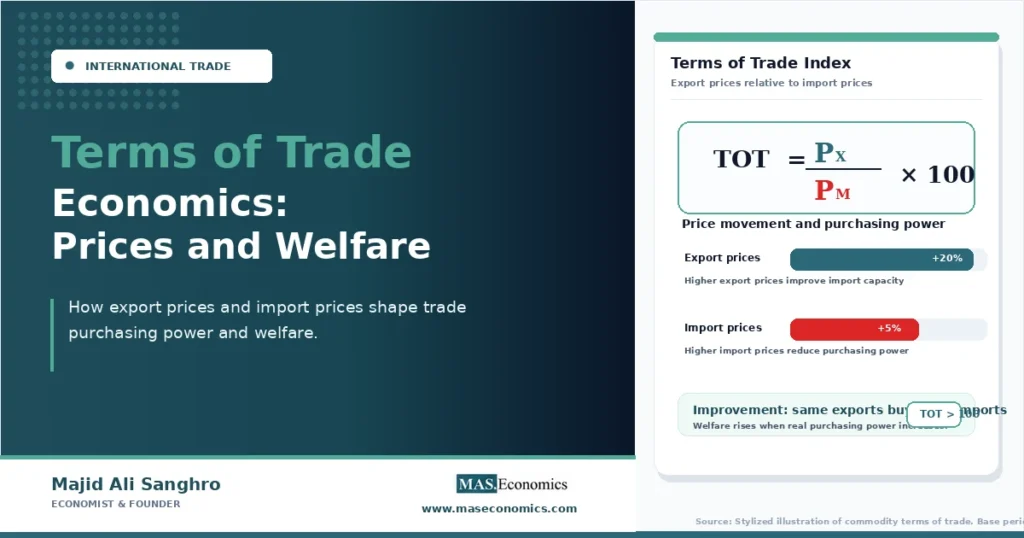
The basic terms-of-trade index compares export prices with import prices. The most common version is the commodity terms of trade:
Commodity Terms of Trade
If the index rises, export prices have increased relative to import prices. A country can obtain more imports for the same export value. If the index falls, import prices have risen relative to export prices. The country must export more to buy the same amount of imports.
The interpretation is direct. A terms-of-trade index of 120 means export prices are 20 percent higher relative to import prices than in the base period. An index of 80 means export prices are 20 percent lower relative to import prices than in the base period. The index is not a complete welfare measure, but it captures an important price channel.
The formula also clarifies why export growth alone can mislead. A country can export more goods and still face lower trade purchasing power if export prices fall faster than export quantities rise. Trade welfare depends on both volume and price.
The index separates price from volume
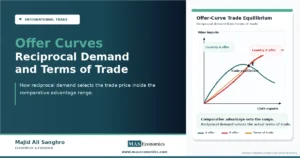
Terms of trade are a price concept, not a quantity concept. They do not measure how much a country exports or imports. They measure the relative prices at which exports exchange for imports. Where that price settles is shown by the intersection of two offer curves.
This distinction matters because trade values combine price and quantity. Export revenue can rise because export prices rise, export quantities rise, or both. Import bills can rise because import prices rise, import quantities rise, or both. The terms of trade isolate the relative price part of the story.
Consider a country that exports wheat and imports machinery. If the world price of wheat rises while machinery prices stay constant, the country’s terms of trade improve. The same quantity of wheat exports can buy more machines. If machinery prices rise while wheat prices stay constant, the country’s terms of trade deteriorate. The same wheat exports buy fewer machines.

The diagram shows the price logic. A line above the base index means export prices have improved relative to import prices. A line below the base means imports have become more expensive relative to exports. The welfare implication depends on how these price movements interact with quantities, income, and production structure.
Welfare changes through real income
The welfare channel is real purchasing power. When the terms of trade improve, a country can buy more imports for a given amount of exports. This raises real income because the same productive effort commands more foreign goods.
When the terms of trade deteriorate, the country must give up more exports to buy the same imports. Real income falls, unless higher export volume, productivity gains, or other income sources offset the price loss.
This is why terms of trade are especially important for countries dependent on a narrow export base. A commodity exporter may face large swings in national income when export prices move sharply. An oil importer may face a real income squeeze when energy import prices rise faster than export prices.
The welfare effect can be summarized as:
Purchasing-Power Logic
Here, \(X\) is export quantity. The expression shows that import purchasing power can rise through higher export prices, higher export volume, or lower import prices. It can fall when import prices rise faster than export prices or when export volume weakens.
Comparative advantage gives the range
Comparative advantage explains why trade can create gains. If countries have different opportunity costs, each can specialize in the good it produces relatively cheaply and exchange for the other good. The terms of trade determine how those gains are split.
For two goods, the world relative price must lie between the two countries’ domestic opportunity-cost ratios:
Trade-Gain Range
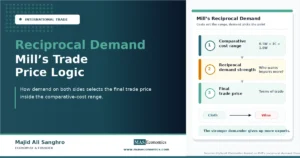
The range tells whether trade can make both countries better off. It does not determine the exact international price inside the range. That price depends on reciprocal demand, supply conditions, country size, market power, and trade costs.
If the world price moves closer to a country’s domestic opportunity cost, that country captures less of the gain from trade. If it moves farther from the domestic opportunity cost in a favorable direction, that country captures more. This is why terms of trade are central to the distribution of trade gains.
Trade theory therefore separates two questions. Comparative advantage explains the possibility and direction of trade. Terms of trade economics explains the international price at which the exchange occurs and the welfare consequences of that price.
Demand strength moves trade prices
The terms of trade are not determined by production costs alone. They are also shaped by demand. If foreign demand for a country’s exports strengthens, its export prices may rise relative to import prices. Its terms of trade improve. If domestic demand for foreign goods strengthens while export demand is weak, its terms may deteriorate.
In classical trade theory, this is the role of reciprocal demand. Each country’s willingness to offer exports reflects its demand for imports. The country with stronger demand for the other country’s good tends to accept less favorable terms of trade.
For example, if a country urgently needs imported fuel and has few substitutes, it may have to offer more exports to obtain that fuel when prices rise. Its terms of trade deteriorate. If another country sells a scarce export with strong global demand, its export price may rise, improving its terms.
This mechanism matters because trade prices are not neutral. They affect national purchasing power, the division of trade gains, and sometimes domestic income distribution.
Factor endowments shape exposure
The Heckscher-Ohlin model links trade patterns to factor abundance. A country tends to export goods that use its abundant factor intensively and import goods that use its scarce factor intensively, under the model’s assumptions.
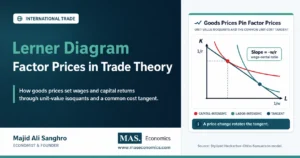
Terms-of-trade changes matter in that setting because they change the relative price of export goods and import-competing goods. If a labor-abundant country exports labor-intensive goods, an improvement in the price of those exports can raise returns connected to labor-intensive production. If export prices fall, the pressure can move the other way.
This connects terms of trade to distribution. A national terms-of-trade improvement can raise real income overall, but not every group gains equally. Owners of factors used intensively in expanding export sectors may benefit more than workers or owners tied to import-competing sectors.
The Stolper-Samuelson theorem sharpens this point by showing how changes in goods prices can affect factor incomes. A change in the terms of trade is therefore not only an external-price event. It can also reshape domestic income distribution.
Small countries usually take prices
Country size affects whether the terms of trade are taken as given or influenced by national behavior. A small country is usually a price taker in world markets. Its export supply or import demand is too small to shift the world relative price. For that country, the terms of trade are largely external.
A large country can influence world prices. If it expands export supply significantly, the world price of its export may fall. If it restricts import demand, the world price of that import may decline. These price effects create a terms-of-trade channel in trade policy.
This is the logic behind the large-country tariff argument. A tariff can reduce import demand and push down the foreign export price, improving the tariff-imposing country’s terms of trade. But the same tariff also creates domestic efficiency losses, reduces world welfare, and can trigger retaliation.
The distinction is important. A policy that appears to improve one country’s terms of trade may shift costs onto trading partners. Terms-of-trade gains are not the same as global welfare gains.
Commodity exporters face volatility
Terms-of-trade movements are especially visible in commodity-dependent economies. Export prices for oil, gas, copper, wheat, coffee, and other primary products can swing sharply. Import prices for machinery, fuel, medicines, and manufactured goods can also move in ways that affect real income.
When export commodity prices rise, the exporting country’s terms of trade can improve quickly. Government revenues may increase, foreign exchange inflows may rise, and imports become easier to finance. When export prices fall, the same channels reverse.
This volatility can create macroeconomic pressure. A terms-of-trade deterioration can reduce national income, weaken the exchange rate, tighten public finances, and raise the domestic cost of imported goods. For import-dependent countries, an import-price shock can have similar effects even when export prices are stable.
The connection with exchange rates is direct. A depreciation can raise the domestic-currency price of imports, while export prices may or may not rise enough to compensate. The real terms of trade depend on export and import prices in common units, not only on the nominal exchange rate.
Growth can worsen trade prices
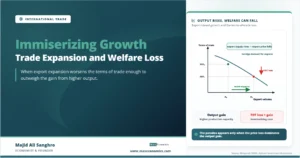
Economic growth normally raises productive capacity and potential welfare, but terms-of-trade effects can complicate the result for large exporters. If growth expands export supply in a market with limited foreign demand, the world price of the export may fall.
The Rybczynski theorem explains how factor growth can expand output of one good and contract another in a two-good, two-factor model. If that expansion is concentrated in the export good, the country may offer more exports to the world market.
For a small country, this extra supply usually does not affect world prices. For a large country, it can lower the relative price of the export good. The result is a terms-of-trade deterioration. The country produces more, but each unit of export buys fewer imports.
This is the theoretical channel behind immiserizing growth. The case is not common, and it requires strong conditions. But the possibility shows why welfare cannot be inferred from production growth alone when international prices move against the growing country.
Policy can shift welfare channels
Trade policy can change the terms of trade, especially for large countries. Tariffs, export taxes, quotas, and other restrictions can affect import demand or export supply, which can alter world prices. The welfare result depends on both the terms-of-trade gain and the domestic distortions created by the policy.
A tariff may improve a large country’s terms of trade by lowering the foreign price of imports. But it also raises the domestic price paid by consumers, reduces consumption efficiency, and distorts production. If retaliation follows, the original gain can disappear.
An export tax can improve world prices in some settings by restricting export supply, but it reduces domestic producer incentives and may shift income toward the government or consumers depending on market structure. It can also weaken long-run investment in the export sector.
For this reason, terms-of-trade policy is not a simple argument for protection. It is a framework for separating external price effects from domestic efficiency costs and trading-partner losses.
The measure has clear limits
Terms of trade are useful, but they are not a full welfare index. They do not show how many goods are exported or imported. They do not measure employment, productivity, income distribution, debt service, or the quality of traded goods. They also do not show whether export revenue is stable or volatile.
A country can experience an improving terms-of-trade index while export volume falls sharply. In that case, the price ratio improves, but total export earnings may still decline. A country can also face worsening terms of trade while export volume rises enough to keep import capacity stable.
The index also depends on measurement. Export and import price indexes must adjust for changes in product composition, quality, currency valuation, and data coverage. For economies with complex global value chains, distinguishing export prices from imported-input costs can be difficult.
Caveat. Terms of trade measure relative trade prices, not total welfare. A complete welfare assessment also needs trade volumes, income distribution, employment, productivity, fiscal effects, and external financing conditions.
External accounts complete the picture
The terms of trade affect the external balance, but they are not the same as the trade balance. A country can have improving terms of trade and still run a trade deficit if import quantities are large. It can have deteriorating terms of trade and still run a surplus if export volumes are strong.
The balance of payments records the broader external accounts, including trade in goods and services, income flows, transfers, and financial transactions. Terms of trade influence those accounts by changing the price at which exports exchange for imports.
The link is especially important during shocks. A rise in import prices can widen the trade deficit if import demand is slow to adjust. A rise in export prices can improve the current account if export volumes hold up. Over time, exchange rates, contracts, and demand elasticities shape the adjustment.
Terms of trade therefore belong inside a wider external-sector analysis. They explain one powerful price channel, while the balance of payments shows how that channel interacts with quantities and financing.
Explains
Three concepts behind terms of trade
Related trade theory concepts are developed across the MASEconomics international trade library.
Explore the MASEconomics BlogConclusion
Terms of trade economics explains how export prices and import prices shape the real gains from international trade. When export prices rise relative to import prices, a country’s exports command more foreign goods. When import prices rise relative to export prices, trade purchasing power weakens.
The concept matters because trade welfare depends on more than specialization and trade volume. Comparative advantage explains why trade can be mutually beneficial, while the terms of trade influence how those gains are divided across countries and across groups within countries.
The index is powerful but limited. It captures relative trade prices, not the entire welfare outcome. A full assessment also requires production, consumption, distribution, trade volumes, exchange rates, and external financing. Terms of trade are therefore best read as a central price signal inside a broader trade-welfare framework.
Frequently Asked Questions
What does terms of trade mean in economics?
Terms of trade measure the price of a country’s exports relative to the price of its imports. They show how many imports can be bought with a given amount of exports.
How are terms of trade calculated?
The standard commodity terms-of-trade index is calculated as the export price index divided by the import price index, multiplied by 100.
What is an improvement in terms of trade?
An improvement occurs when export prices rise relative to import prices. The country can obtain more imports for the same value of exports.
Can worsening terms of trade reduce welfare?
Yes. Worsening terms of trade can reduce real income because the country must give up more exports to obtain the same imports. The final welfare effect also depends on trade volumes and domestic adjustment.
Are terms of trade the same as trade balance?
No. Terms of trade measure relative prices. The trade balance measures the value of exports minus imports. Price changes and quantity changes both affect the trade balance.
Thanks for reading! If you found this helpful, share it with friends and spread the knowledge. Happy learning with MASEconomics