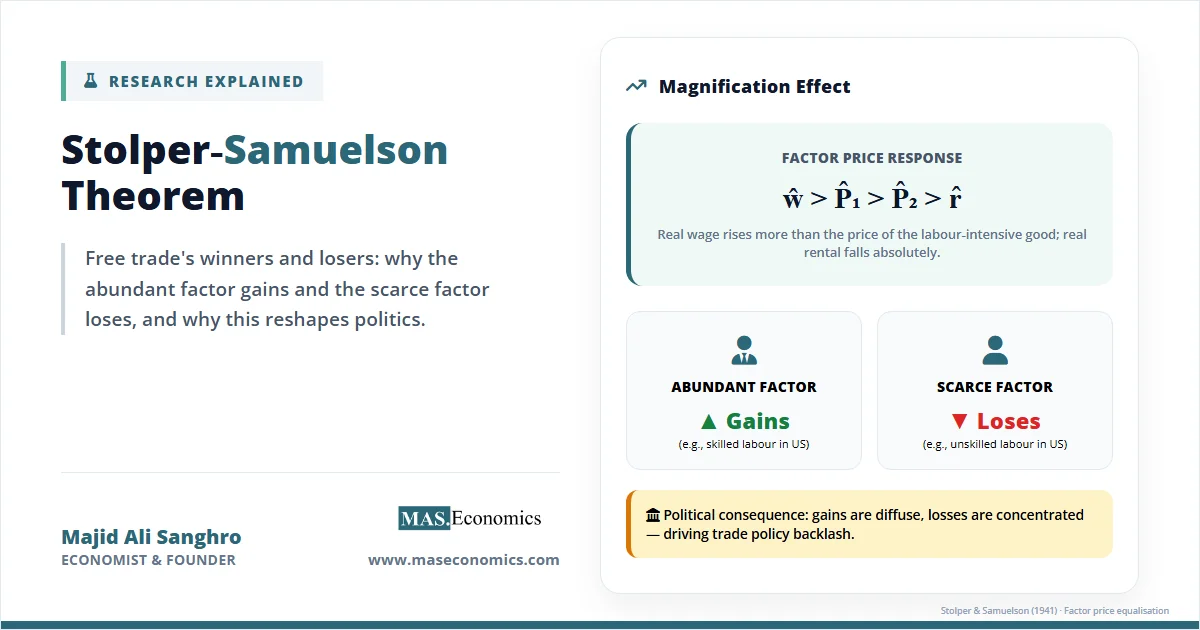
The Stolper-Samuelson theorem is one of the most politically consequential results in international economics. First published in 1941 by Wolfgang Stolper and Paul Samuelson, it established a precise link between changes in the price of traded goods and the real returns to factors of production. In simple terms, when a country opens to trade, the factor used intensively in the export sector gains, while the factor used intensively in the import-competing sector loses. The gains and losses are not small adjustments at the margin. There are changes in real income, large enough to reshape the political economy of trade policy.
The theorem provides the analytical foundation for understanding why free trade, even when it raises national income in aggregate, creates sharp distributional conflicts within countries. It explains why factory workers in high-income economies have grown hostile to trade agreements while capital owners and skilled professionals have often supported them. And it helps make sense of the political backlash against globalisation that has reshaped electoral politics across the advanced world since the mid-2010s.
The Core Idea
The Stolper-Samuelson theorem states that an increase in the relative price of a good raises the real return to the factor used intensively in producing that good and lowers the real return to the other factor. The operative word is real: the theorem does not merely describe nominal wage or rental rate changes but changes in purchasing power across all goods in the economy.
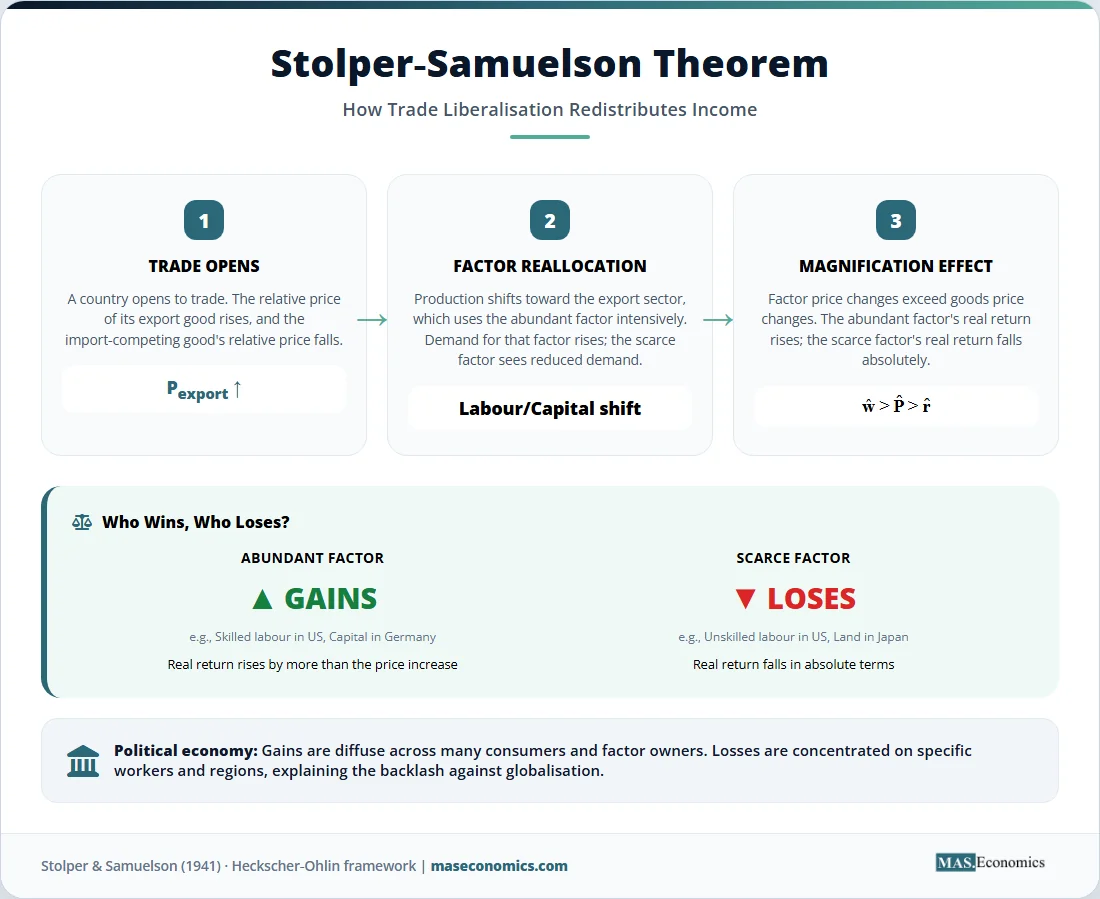
Consider a country with two factors of production, say capital and labour, producing two goods, say manufactures and food. Suppose manufactures are capital-intensive and food is labour-intensive. If the relative price of manufactures rises, the real return to capital rises by more than the price increase, while the real wage falls in absolute terms. This is the magnification effect, and it is the feature that gives the theorem its force.
The intuition runs through factor reallocation. A higher relative price for manufactures induces producers to expand manufacturing and contract food production. Manufacturing demands more capital per worker than food does, so the shift releases more labour than capital relative to what the expanding sector needs. The relative scarcity of capital rises, the relative abundance of labour rises, and factor prices adjust accordingly. The rental rate on capital rises, the wage falls.
The connection to trade arises directly. In the Heckscher-Ohlin framework, countries export goods that use their abundant factor intensively. Trade liberalisation raises the relative price of the exportable good in the domestic economy. According to Stolper-Samuelson, this raises the real return to the abundant factor and lowers the real return to the scarce factor. A country abundant in skilled labour sees skilled wages rise and unskilled wages fall when it opens to trade with a country abundant in unskilled labour. The theorem is thus the missing distributional chapter of classical trade theory.
Mathematical Formulation
The theorem is derived from the zero-profit conditions that must hold in competitive equilibrium. In a two-good, two-factor model, the price of each good equals its unit cost of production. Formally:
where \( P_i \) is the price of good \( i \), \( w \) is the wage, \( r \) is the rental rate on capital, and \( a_{Ji} \) is the amount of factor \( J \) required to produce one unit of good \( i \). Totally differentiating and expressing in proportional changes (denoted with a hat, \( \hat{} \)), the system becomes:
where \( \theta_{Ji} \) is the cost share of factor \( J \) in good \( i \). Solving this system for factor price changes yields the central result. If good 1 is labour-intensive (\( \theta_{L1} > \theta_{L2} \)) and its price rises relative to good 2, then:
The wage rises by more than the price of the labour-intensive good, and the rental rate falls in absolute terms. This ordering is the magnification effect. The real wage measured against either good rises; the real rental measured against either good falls. Distributional consequences are unambiguous and large.
Table 1 below summarises the notation used in the model.
| Symbol | Name | Economic Meaning |
|---|---|---|
| \( P_i \) | Goods price | Market price of good \( i \) (\( i = 1, 2 \)), set by world markets under free trade. |
| \( w \) | Wage | Nominal return to labour per unit of time. |
| \( r \) | Rental rate | Nominal return to capital per unit of time. |
| \( a_{Ji} \) | Unit input coefficient | Units of factor \( J \) required to produce one unit of good \( i \). |
| \( \theta_{Ji} \) | Factor cost share | Share of factor \( J \) in total cost of good \( i \); \( \theta_{L1} + \theta_{K1} = 1 \). |
| Hat notation (\( \hat{} \)) | Proportional change | \( \hat{X} \) denotes \( dX/X \), the percentage change in variable \( X \). |

|
||
The derivation assumes perfect competition, constant returns to scale, full employment of both factors, and incomplete specialisation. Under these conditions, the link between goods prices and factor prices is tight and invertible: a change in relative goods prices uniquely determines the change in real factor returns.
Assumptions & Limitations
The theorem’s clean predictions depend on a restrictive set of assumptions, and its real-world application requires careful attention to where those assumptions fit and where they break down. The model assumes two goods and two factors, perfect competition in all markets, constant returns to scale, identical production technologies across countries, and perfect factor mobility within countries, combined with perfect factor immobility across countries. It also assumes that both countries produce both goods after trade, ruling out complete specialisation.
Several limitations matter for practical application. The Leontief paradox demonstrated that the factor content of US trade did not conform to simple Heckscher-Ohlin predictions, raising doubts about the empirical relevance of the whole framework within which Stolper-Samuelson sits. When trade flows do not cleanly reflect factor endowment differences, the distributional predictions become fuzzier.
The two-factor assumption is restrictive. With many factors, the theorem’s predictions become indeterminate in general: a price change might raise some factor prices and lower others without a clean magnification result. Specific-factors models, in which some factors are tied to particular sectors in the short run, generate different distributional predictions: owners of factors specific to the import-competing sector lose, those specific to the export sector gain, while the mobile factor experiences ambiguous real income changes.
Short-run versus long-run matters. The theorem is a long-run result, derived under the assumption that factors move freely between sectors. In the short run, workers displaced from import-competing industries face adjustment costs, retraining requirements, and geographic immobility that can turn a nominal wage gain for labour as a class into catastrophic income losses for specific workers in specific places. The China shock literature has documented exactly this kind of long-lasting local labour market damage.
Finally, the assumption of incomplete specialisation can fail in practice. When a country ceases to produce a good altogether under trade, the link between its price and the domestic factor returns is broken. Goods prices can then change without affecting domestic factor prices, and the theorem’s sharp predictions no longer apply.
Empirical Evidence
Empirical work testing the Stolper-Samuelson theorem has produced mixed but instructive results. The theorem’s strongest empirical support comes from episodes where developing countries liberalised trade and observed rising wage inequality, contrary to what a simple reading of Stolper-Samuelson would predict for labour-abundant economies but consistent with more nuanced multi-factor extensions that distinguish skilled from unskilled labour.
Mexico’s liberalisation in the mid-1980s and entry into NAFTA in 1994 provide a well-studied case. Feenstra and Hanson (1996) documented rising skill premia in Mexican manufacturing during liberalisation, attributed to offshoring of skill-intensive tasks from the US that were skill-intensive by Mexican standards. Results from the China shock literature for the United States, particularly Autor, Dorn, and Hanson (2013, 2016), showed sustained real wage declines for workers in manufacturing-exposed local labour markets after the acceleration of Chinese import competition from 2001 onwards.
Figure 1 summarises real wage changes for skilled and unskilled workers across selected trade liberalisation episodes.
Figure 1. Real wage changes for skilled versus unskilled workers following trade liberalisation episodes (cumulative % change over 10 years post-liberalisation). Sources: Feenstra and Hanson (1996), Goldberg and Pavcnik (2007), Autor, Dorn and Hanson (2016), OECD Employment Outlook.
The pattern is revealing. Skilled workers gained in every episode shown, while unskilled workers lost in most advanced-economy and some developing-economy cases. The simple two-factor Stolper-Samuelson prediction, namely that unskilled labour in labour-abundant developing countries should gain from liberalisation, holds cleanly only in India and partially in a few other cases. The more general lesson is that the theorem’s mechanism, the link between trade-induced price changes and factor returns, operates in the data, but the relevant factor distinction is often skill rather than simple labour versus capital.
More recent work integrates natural experiments in trade policy with administrative wage data to identify Stolper-Samuelson effects at the local labour market level. Autor et al. (2013) showed that commuting zones more exposed to Chinese import competition experienced larger declines in manufacturing employment and wages, with effects persisting for more than a decade. These results confirm the theorem’s central insight while revealing that adjustment is slower and more painful than the frictionless model assumes.
Why It Matters
The Stolper-Samuelson theorem matters because it identifies a structural source of political conflict over trade policy. When trade raises national income but redistributes it sharply, the economic case for trade depends on a political mechanism to compensate losers. Without such compensation, majorities of voters in the losing factor can rationally oppose trade liberalisation even when the country as a whole gains. This is not a failure of understanding or a lapse of economic logic; it is a direct prediction of the theorem.
In the United States, the Trade Adjustment Assistance programme, established in 1962, was designed to compensate workers displaced by trade. Evaluations by the Department of Labor and academic researchers have documented that the programme has been chronically underfunded and that participation rates have been low relative to the scale of trade-induced dislocation. The mismatch between the scale of distributional effects predicted by Stolper-Samuelson and the scale of compensation actually provided helps explain why trade politics in the US has turned increasingly hostile since the early 2000s. When the Trump administration imposed tariffs in 2018 and again in 2025, exit polling showed the strongest support in manufacturing-heavy regions of the Midwest. The theorem predicts exactly this geography of political resistance.
In the United Kingdom, the Brexit vote in 2016 revealed similar patterns. Analysis by Dhingra et al. (2017) and others showed that regions with larger shares of employment in industries exposed to EU trade competition voted more heavily to leave. The EU single market had produced aggregate gains for the UK economy, but the distributional effects predicted by the theorem, concentrated on particular factors in particular places, generated the political coalition that ended UK membership.
Canadian and Australian experiences have been different, in part because their export profiles are dominated by resource industries that employ relatively few workers relative to the value they generate. In these economies, the Stolper-Samuelson prediction runs through land and natural resource rents rather than through the skilled-unskilled wage gap. Australia’s mining boom from 2003 to 2013, detailed in Reserve Bank of Australia research, raised returns to capital and land in mining regions sharply while compressing returns to manufacturing labour in the south-east, producing exactly the kind of sectoral and regional income redistribution the theorem predicts.
The theorem also informs the modern debate over industrial policy. If trade liberalisation produces large, persistent losses for specific factors in specific places, as empirical evidence suggests, then policies that slow the adjustment, such as tariffs, subsidies, or place-based investment, can be defended on distributional grounds even when they reduce aggregate efficiency. The US CHIPS Act of 2022 and the Inflation Reduction Act are defended in part on exactly these grounds: that the distributional costs of unfettered trade, made visible by the theorem’s logic, justify intervention. Whether such policies actually deliver the intended distributional benefits, or merely shift rents to politically favoured groups, remains contested. What is not contested is that the theorem has returned to the centre of policy debate after decades in which its lessons were widely ignored.
The connection to the Rybczynski theorem is worth noting. Where Stolper-Samuelson traces the effects of price changes on factor returns at fixed factor endowments, Rybczynski traces the effects of factor endowment changes on output at fixed prices. Together they form the two dual sides of the Heckscher-Ohlin machinery. Migration policy debates in the US, UK, and Australia have drawn on both theorems: migration changes factor endowments (Rybczynski), and the resulting output changes alter factor prices back through the system (Stolper-Samuelson in reverse), with distributional consequences that shape the politics of immigration as surely as they shape the politics of trade.
MASEconomics Explains
Four economic concepts behind the Stolper-Samuelson theorem
Conclusion
The Stolper-Samuelson theorem remains one of the most durable and politically relevant results in international economics. Its central insight, that trade changes the distribution of income between factors of production in predictable ways, continues to illuminate the economics of globalisation, the politics of trade policy, and the design of compensation mechanisms for those displaced by economic integration. The theorem does not tell policymakers whether to liberalise trade. It tells them what to expect when they do, and why the political coalition for and against openness forms along the lines it does.
Frequently Asked Questions
What is the Stolper-Samuelson theorem?
The result that a rise in the relative price of a good raises the real return of the factor used intensively in making it, and lowers the real return of the other factor. Applied to trade, opening up raises the real income of a country’s abundant factor and cuts the real income of its scarce factor.
Who wins and who loses from free trade?
Within a country, owners of the abundant factor gain and owners of the scarce factor lose. In a labour-abundant developing country, workers gain and capital owners lose. In a capital-abundant rich country it is the other way round, which is the theorem’s explanation for why trade agreements are fought over along class lines.
How does Stolper-Samuelson relate to Heckscher-Ohlin?
It is one of the four theorems built on the Heckscher-Ohlin framework. Heckscher-Ohlin predicts what a country trades; Stolper-Samuelson predicts what that trade does to the incomes of the factors inside it. The same two-good, two-factor setup produces both results.
Did you find this article helpful? Share it with someone who loves economics. And remember, at MASEconomics, we make complex ideas simple.