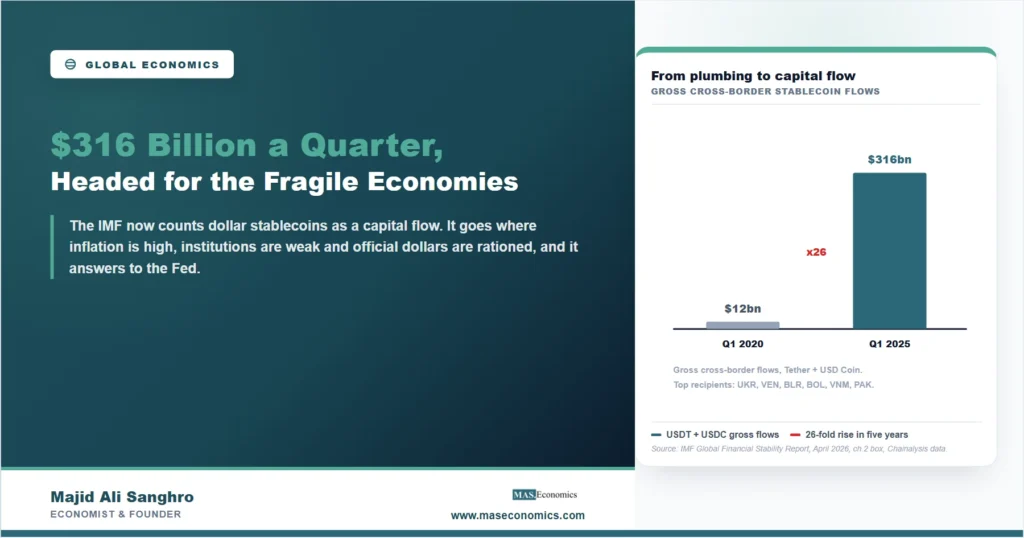
Five years ago, dollar stablecoins were plumbing for crypto traders, tokens pegged to the dollar that made it easier to move between exchanges. The IMF’s April 2026 Global Financial Stability Report treats them as something else entirely: a cross-border capital flow large enough to deserve its own box in the chapter on capital flows to emerging markets. The measured numbers explain the promotion. Gross cross-border stablecoin flows in the two largest dollar tokens rose from an estimated $12 billion in the first quarter of 2020 to $316 billion in the first quarter of 2025, a twenty-six-fold increase in five years, with a large and rising share directed at emerging markets.
The reclassification matters because capital flows are the category through which economists understand contagion, currency pressure and monetary control. Once dollars-on-blockchains are counted as a flow rather than a curiosity, they inherit all the old questions: who sends them, why, what they do to the receiving economy, and what happens when they reverse. The IMF’s box is the first systematic attempt to answer those questions with data, and its findings are more interesting than the usual crypto commentary in either direction.
The Size and the Map
The geography is the finding. The top ten recipients of gross stablecoin inflows relative to GDP in 2024 are not financial centers: Ukraine, Venezuela, Belarus, Bolivia, Vietnam, Pakistan, Georgia, Armenia, Jordan and Mauritius. In Ukraine, Vietnam and Belarus, gross flows reach double-digit shares of annual GDP. Net flows are far smaller, under one percent of GDP even in the largest recipients, and that difference between gross and net is diagnostic: money cycling in and out at high volume is money being used for transactions, remittances and dollar access, not money accumulating as investment. The stablecoin is functioning as infrastructure, a dollar rail rather than a dollar asset.
What Actually Drives the Flows
The box’s regression analysis, run across 18 emerging markets over five years, reads like a diagnosis of financial frustration. Stablecoin inflows are larger in countries with higher inflation and greater exchange rate volatility, the classic conditions for currency substitution. They are larger where institutional and political stability is weaker. They are larger in countries whose residents have no access to short-term dollar assets like US money market funds. And they comove with remittance and trade flows, confirming the payments role. The composite picture is the one our study of crypto-priced devaluations reached from the price side: stablecoins are how households and firms in fragile monetary regimes reach the dollar when official channels ration it.
The global drivers complete the loop, and they are the reason the IMF cares. Inflows fall when the federal funds rate rises, because tighter dollar liquidity raises the opportunity cost, and they rise with global risk aversion, behaving, in the report’s words, with safe-haven dynamics similar to those observed for the dollar itself. Both findings embed the American monetary cycle directly into these markets: a Fed decision now changes the flow of digital dollars into Karachi, Kyiv and Caracas within the month, through a channel no local authority operates. It is the same transmission our piece on exchange rate pass-through describes, running over new rails.
| Driver | Direction | What it indicates |
|---|---|---|
| Domestic inflation and exchange rate volatility | Higher inflows | Currency substitution motive |
| Institutional and political stability | Lower inflows when stronger | Escape from weak institutions |
| Access to US money market funds | Lower inflows when available | Stablecoins substitute for missing dollar assets |
| Remittance and trade flows | Comove | Payments and settlement use |
| Federal funds rate | Lower inflows when higher | US monetary policy transmits directly |
| Global risk aversion and Bitcoin volatility | Higher inflows | Safe-haven behavior, like the dollar |

|
||
Why Central Banks Are Reading This Box
For the receiving economies, the risks the report lists are the old dollarization risks with new speed. Widespread currency substitution weakens monetary policy: a central bank setting rates in a currency its citizens are abandoning controls less with every percentage point of adoption, the erosion our piece on the hollow policy rate measured in the cash economy and stablecoins now extend to the digital one. Pass-through of global financial conditions strengthens, capital flow volatility rises, and capital flow management measures become circumventable at the level of a phone app. Stablecoins also run liquidity transformation, holding reserves against instant redemption promises, which means run risk, and a run on a major stablecoin would now transmit into emerging market payment systems that have quietly built on top of it.
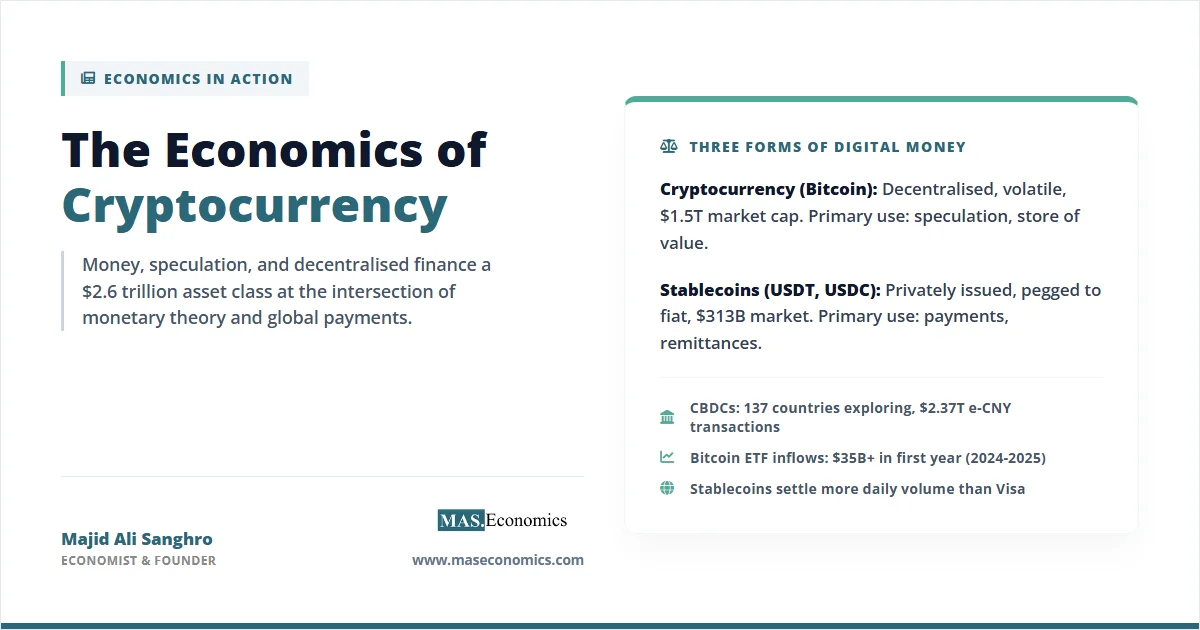
What the report does not do is condemn the technology, and its restraint is itself informative. The same box lists the benefits plainly, faster and cheaper cross-border payments, more competition in payments, wider access to dollar-denominated safety, and its policy prescription is regulation and coordination rather than prohibition: proportionate oversight of intermediaries, anti-money-laundering standards, cross-border data sharing, and, pointedly, the sound macroeconomic policies that remove the reasons people flee their currency in the first place. That last item concedes the deepest point. The flows in Figure 1 are a symptom before they are a threat: measured demand for monetary stability, by households that have stopped waiting for it locally, using an instrument our overview of the economics of cryptocurrency located halfway between money and infrastructure. The dollar’s newest export channel runs through phones, and the exporters of last resort are the countries whose currencies work least well.
MASEconomics Explains
3 economic concepts behind stablecoin flows
These concepts are explored in depth across our educational articles library.
Conclusion
Cross-border stablecoin flows of $316 billion a quarter, up from $12 billion five years earlier, have earned their reclassification: this is a capital flow, concentrated on emerging markets, reaching double-digit shares of GDP in its largest recipients and top-ten scale in economies from Ukraine to Pakistan. The IMF’s driver analysis finds exactly what the geography suggests, currency substitution where inflation and instability are high, dollar access where money market funds are absent, and payments use that tracks remittances and trade, all of it responding to the Fed’s rate and to global risk like the dollar it mimics.
The finding worth carrying away is the direction of causality. The flows go where monetary credibility is scarce, which makes them a measurement of institutional failure before they are a cause of it, and explains why the IMF’s prescription pairs regulation with the sound policies that remove the demand. For the United States the box describes an export channel: the dollar now reaches the world’s fragile economies through phones, at retail, without a correspondent bank. For the countries on the receiving end it describes a clock, because every quarter of double-digit gross flows is another quarter in which the local currency’s remaining functions are quietly being outsourced.
Frequently Asked Questions
How big are cross-border stablecoin flows now?
Gross cross-border flows in the two largest dollar stablecoins, Tether and USD Coin, reached an estimated $316 billion in the first quarter of 2025, against $12 billion in the first quarter of 2020. A large and rising share goes to emerging markets, where gross flows reach double-digit shares of annual GDP in Ukraine, Vietnam and Belarus.
Which countries receive the most relative to their size?
The IMF’s 2024 top ten by gross inflows relative to GDP: Ukraine, Venezuela, Belarus, Bolivia, Vietnam, Pakistan, Georgia, Armenia, Jordan and Mauritius. The list is notable for containing no financial centers, and several members with histories of inflation, currency pressure or restricted dollar access.
Are people investing in stablecoins or using them?
Using them, on the evidence. Net flows stay under one percent of GDP even in the biggest recipients while gross flows run to double digits, a pattern consistent with payments, remittances and dollar access rather than accumulation. Inflows also track remittance and trade flows, confirming the transactional role.
What risks does the IMF identify?
Currency substitution that weakens monetary policy, stronger pass-through of global financial conditions, higher capital flow volatility, circumvention of capital flow management measures, and run risk from stablecoins’ liquidity transformation. The risks grow as stablecoins scale relative to an economy and integrate with its financial system.
Does the report recommend banning them?
No. It recommends proportionate prudential oversight, anti-money-laundering standards, international coordination on regulation and data, and sound macroeconomic policies to address the currency-substitution pressures underneath. The benefits it lists, cheaper payments, competition and broader dollar access, are treated as real and worth preserving.
Thanks for reading! When a currency stops working, its replacement no longer arrives in a suitcase; it arrives in an app store, and the central bank finds out from the data. Happy learning with MASEconomics