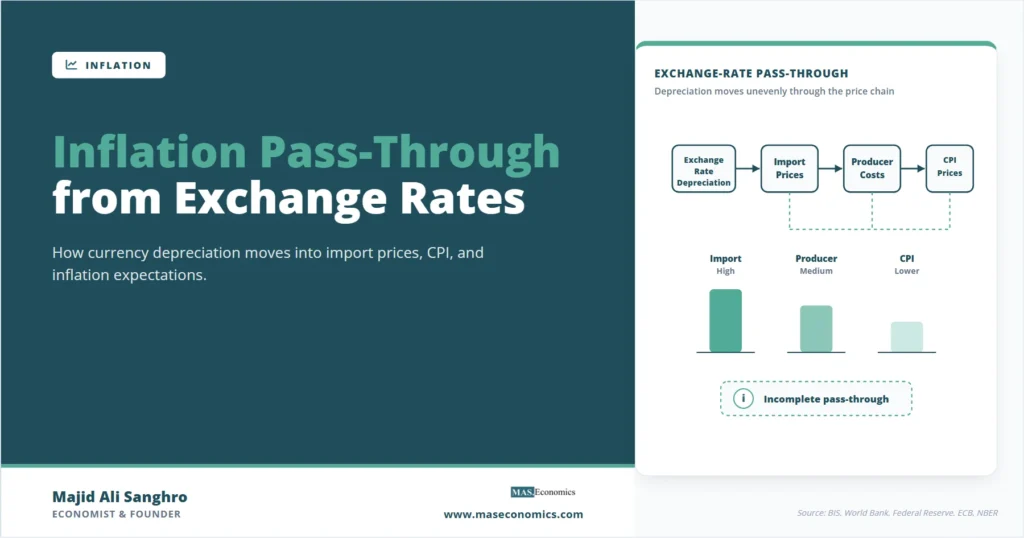
Inflation pass-through exchange rates describe how a change in the exchange rate moves into import prices, producer costs, and eventually consumer prices. A currency depreciation makes foreign goods, imported inputs, and externally priced commodities more expensive in domestic-currency terms. The inflation impact is rarely one-for-one because firms adjust margins, contracts delay price changes, and central bank credibility shapes expectations.
The mechanism matters most when a country imports fuel, food, machinery, medicines, or intermediate inputs. A weaker currency can lift costs before domestic demand changes. The result is a price shock that begins in the foreign-exchange market but appears later in grocery bills, transport costs, business input prices, and headline inflation.
Exchange-rate pass-through is also central to open-economy macroeconomics. It connects purchasing power parity, import pricing, exchange-rate overshooting, inflation expectations, and monetary policy. A depreciation is not automatically an inflation crisis. The final effect depends on the size of the exchange-rate move, the import share of consumption, market structure, inflation history, and whether households believe the central bank will protect price stability.
From Depreciation to the CPI Basket
The first step is mechanical. If the domestic currency falls, the domestic-currency price of imported goods rises unless foreign exporters cut their foreign-currency prices or domestic retailers absorb the shock in margins. A 10 percent depreciation does not mean CPI inflation rises by 10 percent. It means one cost channel has opened.
The pass-through chain usually has three layers:
- Exchange rate to border prices. Importers pay more domestic currency for foreign goods, unless exporters price to market.
- Border prices to producer prices. Firms using imported fuel, equipment, and intermediate goods face higher input costs.
- Producer and import prices to consumer prices. Retail prices rise if firms pass costs to final buyers instead of compressing margins.
This is why exchange-rate pass-through is usually stronger for import prices than for consumer prices. Import prices sit close to the exchange-rate shock. CPI sits further downstream and includes rent, local services, domestic wages, taxes, regulated prices, and distribution margins.
Key idea: exchange-rate pass-through is a transmission ratio, not a law. A depreciation creates upward cost pressure, but the CPI effect depends on pricing power, contracts, demand conditions, expectations, and monetary credibility.
The Pass-Through Coefficient
Economists often summarize the mechanism with a pass-through coefficient. In a simple form:
Here, \(\Delta p_t\) is the change in a price index, \(\Delta e_t\) is the change in the exchange rate, \(X_t\) includes other inflation drivers, and \(\beta\) is the pass-through coefficient. If \(\beta = 0.30\), a 10 percent depreciation is associated with a 3 percent increase in the relevant price index, holding other factors constant.
The coefficient changes depending on the price being measured. Import-price pass-through is usually higher because import prices directly face exchange-rate movements. Producer-price pass-through is often intermediate because firms combine imported and domestic inputs. Consumer-price pass-through is usually lower because CPI includes many non-traded services.
| Stage | Typical Price Measure | Pass-Through Tendency | Reason |
|---|---|---|---|
| First stage | Import prices | Highest | Imported goods are directly priced against foreign-currency costs. |
| Second stage | Producer prices | Medium | Firms combine imported inputs with domestic labor, rent, energy, and margins. |
| Final stage | Consumer prices | Lowest | CPI contains services, distribution margins, taxes, domestic rents, and regulated prices. |
| Expectations stage | Wages and price-setting plans | Variable | Credibility and inflation history decide whether the shock becomes persistent. |
Source: MASEconomics summary based on BIS, World Bank, Federal Reserve, ECB, and NBER exchange-rate pass-through literature.

Sources of Incomplete Pass‑Through
Complete pass-through means a 10 percent depreciation causes imported prices to rise by roughly 10 percent. An incomplete pass-through means the price rise is smaller. In most modern economies, pass-through is incomplete, especially at the consumer-price level.
Several forces explain the gap.
Foreign exporters adjust margins
Exporters may reduce profit margins to protect market share after a partner country’s currency depreciates. This behavior is called pricing to market. It weakens the link between the exchange rate and import prices because the foreign seller absorbs part of the currency shock.
Retailers smooth prices
Retailers do not change sticker prices continuously. Menu costs, customer relationships, contracts, and competitive pressure can delay price changes. This means the exchange-rate effect often appears gradually instead of immediately.
Domestic costs dilute the imported component
A final consumer good includes transport, warehousing, retail wages, rent, advertising, taxes, and local services. Even when the imported component becomes more expensive, the entire retail price does not move one-for-one.
Central bank credibility contains expectations
When households and firms believe inflation will return to target, they are less likely to adjust wages and prices aggressively after a depreciation. This is why inflation targeting and credible monetary policy can reduce pass-through over time. The connection links this topic directly to central banking and monetary policy, monetary policy tools, and the Taylor Rule.
Emerging Markets and Pass‑Through
Exchange-rate pass-through is usually more important in emerging markets than in advanced economies. The reason is not only currency volatility. It is the structure of the economy.
Many emerging markets import a large share of fuel, capital goods, medicines, technology, and industrial inputs. Foreign-currency debt can also raise costs when the domestic currency weakens. If the public has lived through repeated inflation episodes, exchange-rate depreciation can quickly affect inflation expectations.
That said, emerging-market pass-through is not fixed. Countries with stronger monetary frameworks, better inflation credibility, deeper financial markets, and more stable fiscal policy can reduce the pass-through from depreciation to CPI. A depreciation still raises import costs, but it is less likely to become a generalized inflation process.
| Factor | Higher Pass-Through When… | Lower Pass-Through When… |
|---|---|---|
| Import dependence | Fuel, food, and industrial inputs are heavily imported. | Domestic production covers more of the CPI basket. |
| Inflation history | Past inflation makes firms reset prices quickly. | Inflation expectations remain anchored. |
| Market structure | Firms have pricing power and can pass costs on. | Competition forces firms to absorb some costs. |
| Currency invoicing | Imports are priced in dollars or another foreign currency. | More trade is invoiced in domestic currency. |
| Policy credibility | Central bank independence is weak or fiscal dominance is high. | The central bank has a credible inflation target. |
Source: MASEconomics synthesis of exchange-rate pass-through determinants in open-economy macroeconomics.
Currency Shocks vs. Demand Inflation
Exchange-rate pass-through is a cost channel. It can raise prices even when domestic demand is weak. This makes it different from a demand-pull inflation episode, where rising spending pushes firms to raise prices because the economy is overheating.
A depreciation shock often resembles imported cost-push inflation. Imported fuel becomes more expensive. Food imports rise in local-currency terms. Firms using imported machinery, chemicals, packaging, or energy face higher costs. The initial pressure comes from the external price of inputs, not from stronger domestic purchasing power.
This distinction matters for policy. Raising interest rates can support the currency and anchor expectations, but it may not immediately produce more imported fuel, grain, or machinery. If the central bank tightens too little, depreciation may become persistent inflation. If it tightens too much, output and employment can weaken while the imported shock is still passing through.
The trade-off connects exchange-rate pass-through to the Phillips Curve, New Keynesian Phillips Curve, and Friedman-Phelps Natural Rate Hypothesis. A currency shock may start as a relative-price adjustment, but it becomes a macroeconomic inflation problem when expectations, wages, and repeated price-setting decisions adapt to it.
Determinants of Differential Pass‑Through
Two countries can experience the same 10 percent depreciation and face very different inflation outcomes. The difference comes from structure and credibility.
Consider three stylized economies:
- Economy A imports fuel but has anchored expectations and a credible central bank. Import prices rise, transport costs increase, and headline CPI moves up temporarily. Core inflation remains contained.
- Economy B imports fuel and food, has weak competition, and firms have pricing power. Pass-through reaches retail prices more strongly and lasts longer.
- Economy C has a high inflation history, dollarized contracts, weak fiscal credibility, and a depreciating currency. The exchange-rate shock quickly becomes a broader wage-price and expectations problem.
This explains why pass-through estimates vary across countries, sectors, and time periods. The coefficient is not a universal constant. It is a summary of institutions, market behavior, and inflation psychology during a particular period.
Illustrative Pass-Through Path After a 10% Depreciation
Pass‑Through via Imported Inputs
The visible effect of depreciation is that imported consumer goods become more expensive. The larger effect can come through intermediate inputs. Firms import fuel, fertilizer, semiconductors, chemicals, spare parts, machinery, packaging, and logistics services. Even domestically produced goods may contain imported cost components.
This is why exchange-rate pass-through is not limited to imported final goods. A locally produced food item may use imported fertilizer, imported fuel, imported packaging, and imported machinery. A domestic construction project may use imported steel, imported equipment, and foreign-currency financing. A local bus company may buy fuel priced against global oil markets.
Input-output linkages spread the currency shock through production networks. The more imported content sits inside domestic production, the broader the pass-through channel becomes.
Commodity Pricing Can Amplify the Shock
Many commodities are priced internationally in US dollars. For countries that import oil, gas, wheat, edible oils, metals, or fertilizer, a depreciation can raise local-currency costs even if the dollar price of the commodity is unchanged. If global commodity prices rise at the same time as the currency depreciates, the domestic shock becomes much larger.
This double shock appeared in many countries during energy and food price surges. It explains why headline inflation can rise faster than core inflation when exchange-rate depreciation coincides with global commodity pressure. It also explains why energy price shocks and exchange-rate pass-through often reinforce each other.
Pass-Through and Inflation Expectations
The most dangerous form of pass-through is not the initial import-price effect. It is the expectations effect.
If households believe depreciation will continue, they may expect future inflation to rise. Workers may ask for higher wages to protect their real income. Firms may raise prices preemptively to avoid being caught behind rising replacement costs. Retailers may shorten the time between price revisions. Contracts may shift toward foreign-currency indexation. The exchange-rate shock then moves from relative prices into the inflation process itself.
This is why inflation expectations are central to exchange-rate pass-through. A credible central bank can allow a one-time price-level adjustment without letting it become a wage-price spiral. A weak policy framework can turn the same depreciation into persistent inflation.
Econometric Measurement of Pass‑Through
Pass-through is difficult to estimate because exchange rates move for many reasons. A currency may depreciate because of a terms-of-trade shock, domestic policy uncertainty, interest-rate differentials, risk sentiment, capital outflows, or a global dollar cycle. Each cause may have a different inflation effect.
Empirical studies often use distributed lag models, vector autoregressions, local projections, or structural models to trace how prices respond after an exchange-rate movement. These methods connect the topic to distributed lag models, multivariate time series models, and structural breaks in time series analysis.
A careful estimate separates short-run and long-run pass-through. Short-run pass-through captures immediate price adjustment. Long-run pass-through captures the cumulative effect after contracts reset, inventories turn over, and firms adjust pricing strategies.
Policy Responses to Exchange‑Rate Pass‑Through
Central banks cannot ignore exchange-rate pass-through because depreciation can lift inflation and expectations. They also cannot treat every depreciation as a permanent inflation shock. The policy response depends on the source of the depreciation and the credibility of the inflation regime.
If depreciation reflects a temporary global shock and expectations remain anchored, a central bank may avoid excessive tightening. If depreciation reflects domestic policy weakness, fiscal stress, or a loss of confidence, the inflation risk is larger. If depreciation raises fuel and food prices in a country with fragile expectations, monetary policy may need to respond even when output is weak.
The central bank’s communication matters. A clear explanation can separate a one-time relative-price shock from persistent inflation. Credible action can prevent wage and price setters from building depreciation into future contracts. But credibility cannot be created instantly during a crisis. It is accumulated through consistent inflation control, institutional independence, and a clear policy reaction function.
MASEconomics Explains
4 economic concepts behind exchange-rate pass-through
These concepts are explored in depth across our educational articles library.
Explore the MASEconomics BlogConclusion
Inflation pass-through exchange rates are the channel through which currency depreciation affects import prices, producer costs, consumer prices, and inflation expectations. The effect is strongest near the border, weaker at the CPI level, and most dangerous when it changes expectations and wage-price behavior.
Pass-through is not automatic or constant. It depends on import dependence, commodity exposure, market structure, invoicing currency, inflation history, and central bank credibility. This is why the same depreciation can produce a temporary price-level adjustment in one economy and a persistent inflation process in another.
The policy lesson is precise: exchange-rate depreciation should be monitored as a cost and expectations shock, not treated as a mechanical one-for-one inflation rule. Strong monetary credibility, stable expectations, and clear communication reduce the probability that a currency shock becomes an inflation regime.
Frequently Asked Questions
What is exchange-rate pass-through to inflation?
Exchange-rate pass-through to inflation is the share of a currency movement that appears in domestic prices. It usually affects import prices first, then producer prices, and finally consumer prices.
Does currency depreciation always cause inflation?
Currency depreciation usually raises imported cost pressure, but it does not always cause broad inflation. The final effect depends on import dependence, pricing behavior, expectations, and monetary policy credibility.
Why is pass-through higher in emerging markets?
Pass-through is often higher in emerging markets because imported fuel, food, inputs, and foreign-currency contracts play a larger role. Inflation history and weaker credibility can also make firms adjust prices faster after depreciation.
Why is pass-through incomplete?
Pass-through is incomplete because exporters and retailers may absorb part of the exchange-rate shock in margins, contracts delay price changes, and consumer prices include many domestic services and costs.
How do central banks reduce exchange-rate pass-through?
Central banks reduce pass-through by anchoring inflation expectations, maintaining credibility, communicating clearly, and responding when depreciation threatens persistent inflation rather than a one-time relative-price adjustment.
Thanks for reading! If you found this helpful, share it with friends and spread the knowledge. Happy learning with MASEconomics