Almost everything written about artificial intelligence and employment is about the future. Studies estimate what share of tasks could be automated, consultancies project how many roles are at risk by 2030, and the debate proceeds as an argument about a thing that has not happened yet. That framing is now out of date. AI job displacement has been measured, in job listings, in several countries, and the effect is already large in the places where it landed.
Monthly listings in South Asia for the white-collar occupations most exposed to generative AI, in cases where a ready substitute exists, are down by about 20 percent. That is not a projection of what might occur. It is a count of advertisements that were posted in earlier years and are not being posted now.
The number matters less than two things around it. The displacement did not land where most forecasts said it would, and the mechanism that decides how far it goes is one that the standard models leave out entirely.
What the Listings Actually Show
The World Bank’s World Development Report 2026, which takes artificial intelligence and development as its subject, sets out the evidence in a box that runs to two pages. It is worth reading closely because the details do more work than the headline.
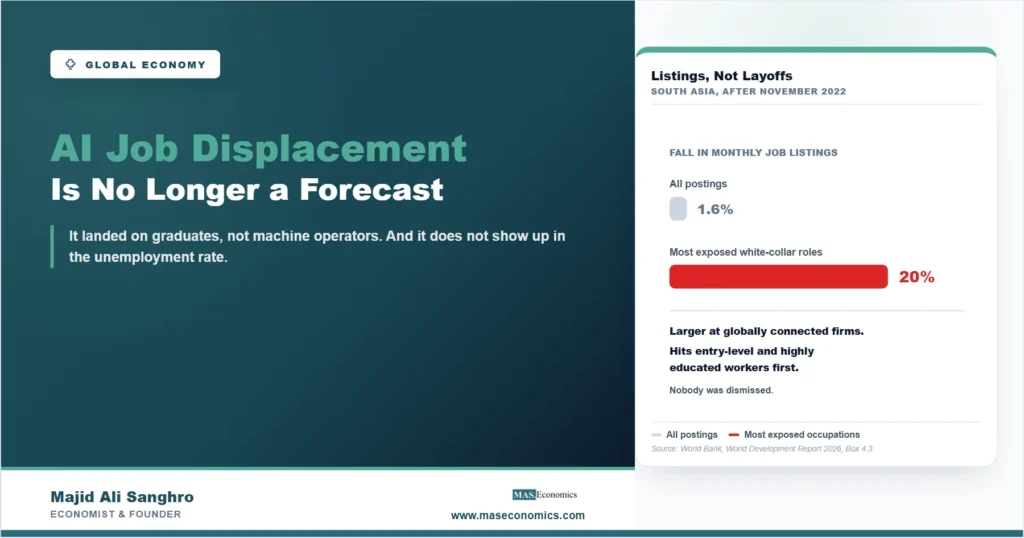
Job postings across South Asia fell 1.6 percent immediately after the release of ChatGPT in November 2022. That figure covers all postings, so it is small by construction. Narrow the lens to the white-collar occupations most exposed to generative AI, where a ready substitute for the task exists, and monthly listings are down about 20 percent.
Two features of that decline are more informative than its size. The effect is larger at globally connected firms, because a multinational faces few frictions when it shifts an automated task across a border. It is smaller at local firms, which the report attributes partly to slower adoption. So the exposure is not evenly spread across an economy. It is concentrated in exactly the segment that had been integrating into world markets.
Evidence from China, drawn from online postings between 2018 and 2024, points the same way and adds a detail that upsets the usual story. Displacement there is concentrated among entry-level, high-wage and highly educated workers in larger cities.
Read that sentence again, because it inverts a generation of commentary. The standard account of automation, developed through decades of experience with machinery, is that it substitutes for routine manual work and complements skilled cognitive work. Generative AI competes directly with human cognitive ability, and the first measurable casualties are graduates in cities, not machine operators. The article on automation and the future of work sets out the older pattern, which makes the departure from it easier to see.
The entry-level detail deserves more weight than it usually gets, because of what a first job does. Early roles are where general education turns into specific competence, where professional judgment is acquired by watching people who already have it, and where the contacts that shape a career get made. Someone who loses a job at forty has lost a job. Someone who never gets the job at twenty-two has lost the mechanism by which they would have become employable at thirty. Those are different injuries, and only one of them shows up promptly in the data.
This also means the damage, if it is real, is slow and compounding rather than sharp. A cohort that enters a narrower market carries lower earnings and thinner experience for years afterward, a pattern well documented for graduates who left university into past recessions. The difference here is that a recession ends on a date and this would not.
| Economy | Finding | Period |
|---|---|---|
| South Asia | All job postings fell 1.6 percent immediately after ChatGPT’s release | From November 2022 |
| South Asia | Monthly listings for the most exposed white-collar occupations with ready substitutes fell about 20 percent | Post-release |
| South Asia | The effect is larger at globally connected firms, smaller at local firms | Post-release |
| China | Displacement concentrated on entry-level, high-wage and highly educated workers in larger cities | 2018 to 2024 |
| Kenya, for scale | Knowledge-intensive services were 2 percent of jobs but 19 percent of job growth | 2006 to 2019 |

|
||
The Kenyan figures are there for proportion, and they are the ones to remember. Knowledge-intensive services were a small share of employment and a large share of its growth. A category that is 2 percent of jobs and 19 percent of job creation is not a niche. It is the escalator.
Why Listings Move Before Employment Does
A reader who checks the unemployment rate after reading the paragraphs above will find nothing dramatic, and that is not a contradiction. It is a measurement problem, and understanding it explains why this shift has been so easy to miss.
A job listing that is never posted does not create an unemployed person. Nobody is dismissed. No claim is filed. The role simply does not come into existence, and the person who would have filled it stays where they are, or does not enter the labor market, or takes something else. Headline unemployment counts people looking for work who cannot find it. It cannot count a job that was never advertised. The guide to how unemployment is defined and measured covers why the headline rate misses several kinds of slack, and this is a clean example.
The United States shows the same signature in a different dataset. In the twelve months to July 2026 the American economy added about 316,000 jobs. A normal expansion adds one and a half to two million. Yet the unemployment rate was 4.1 percent and initial claims were running at 199,000 a week, which is historically low. Firms are not dismissing people, and they are also not hiring them. The reading of the labour market slowdown earlier this year picked up the same pattern, and the piece on the numbers behind employment headlines explains why a low unemployment rate and a frozen hiring market can sit together comfortably.
These are two different economies and two different measurements, and it would be wrong to claim that one caused the other. What can be said is narrower and still useful. The visible symptom in both is the same: hiring that does not happen. In an offshore service economy it shows up as listings that stop appearing. In the United States it shows up as payroll growth an order of magnitude below a normal expansion while nobody is being let go.
The Part Missing From Almost Every Model
Now the mechanism, and this is where the forecasts and the measurements start to talk to each other.
Most economic analysis of artificial intelligence works from the supply side. It asks how much AI can raise the productive capacity of the economy, and it assumes that demand keeps pace with whatever supply becomes possible. Within that frame the arguments are about magnitude and speed. Some models find that if AI capital becomes a close enough substitute for human labor, growth can accelerate beyond its historical exponential path. Others find a counterforce: if tasks are strong complements, total output is held back by whichever task improves slowest, so progress in the automated parts does not translate into faster aggregate growth.
The Bank for International Settlements Annual Economic Report 2026 takes a different route in a box on transformative AI and the natural rate of interest. It keeps the supply-side cases as special cases and then relaxes the assumption that demand follows. What emerges is a fourth possibility, and it has an uncomfortable logic.
Automation moves income away from labor, which is largely spent, and toward capital and further investment, which is largely not. Every displaced worker is also a lost customer. Firms deciding whether to fund the next round of automation look forward at the market for what the automation will produce, find it smaller, and decide the investment is not worth making. Productivity growth stalls, and not because the technology hit a limit. It stalls because the demand that would reward the next advance is missing.
| Scenario | Trend output | Labour share of income | Natural rate of interest |
|---|---|---|---|
| Business as usual | Continues at its historical rate of about 2 percent a year | Broadly unchanged | Stays at its pre-AI level |
| Bounded productivity boost | Permanently higher by a constant margin, which has not happened since the Industrial Revolution | Falls modestly | Rises |
| Transformative AI | Expands faster than exponentially | Falls towards zero | Rises |
| Demand bottleneck | Rises first, then falls below its historical trend as automation stalls | Falls, though less than under transformative AI | Rises first, then falls below its pre-AI baseline |
|
|
|||
The final column is where this stops being an academic exercise. Under the two optimistic scenarios, faster productivity growth raises the return on capital and pushes the natural rate of interest up. Under the demand bottleneck it rises at first, while the supply-side effects dominate, and then falls below where it started. The medium-term pressure on inflation moves the same way, turning disinflationary rather than inflationary.
That prediction is the opposite of the one embedded in most commentary about AI and interest rates, and it is testable. It is also a reminder that the same technology can produce a high-rate world or a low-rate world depending on parameters nobody can currently pin down: how much AI profit depends on consumer demand, how fast competition erodes margins in the AI sector, and how quickly AI products and infrastructure become obsolete.
Set this beside the productivity evidence and the picture becomes coherent rather than contradictory. Task-level studies consistently find efficiency gains of 20 to 50 percent in time saved. Aggregate productivity estimates over a long horizon are below 1 percent. The gap between those two figures is the subject of the article on the AI productivity paradox, and the demand bottleneck offers one candidate explanation for why the gap might persist rather than close.
Why This Reaches Every Economy That Sells Work Over a Wire
The instinct on reading South Asian and Chinese listings data is to file it as a developing-country story. That is the wrong filing, and the reason is in the finding itself.
The displacement is larger at globally connected firms. Those firms are connected to somewhere, and the somewhere is largely the United States, Europe and the other high-income markets that buy remote professional services. The task being automated was being performed at a distance for a client abroad. When the automation happens, the work does not move to another country. It stops being work.
This runs in both directions and both directions matter. For the exporting economy, the escalator described in the Kenyan figures is the one at risk: knowledge-intensive services were 2 percent of jobs and 19 percent of job growth, which is to say they were the route upward. Development through services export has been the most successful path available to countries that missed the manufacturing wave, and it runs through exactly the occupations the report identifies as exposed. The analysis of human capital as an economic asset assumes a market that rewards accumulated skill. That assumption is what is being tested.
For the importing economy, the same connection means the adjustment shows up as costs that fall rather than jobs that disappear domestically, at least at first. A firm in Frankfurt or Chicago that automates a process previously outsourced records lower expenses, and the employment effect lands elsewhere. That is why a European or American reader can find the domestic labor data reassuring and still be looking at a large displacement, because the visible part of it is on somebody else’s statistical office’s books. The piece on how remote work reshaped labour markets covers the infrastructure that made this separation possible, and it is the same infrastructure that now carries the automation.
There is a demographic dimension the report is careful to name. Some economies in the Middle East, North Africa, Afghanistan and Pakistan region carry youth unemployment above 25 to 30 percent, and the report describes them as especially vulnerable. A shock that lands on entry-level professional work arrives differently in a country where a quarter of young people are already out of work.
What This Evidence Does Not Establish
The case above is stronger than the usual forecast because it rests on counts rather than projections. It is still bounded, and the bounds should be stated rather than left for a critic to supply.
Listings are not employment. A fall in advertisements is consistent with a fall in hiring, but it is also consistent with firms changing how they recruit, filling roles internally, or using channels that the data does not capture. It is a leading indicator with known noise, not a headcount.
The 20 percent figure is narrow by construction. It applies to the most exposed white-collar occupations in cases where a ready substitute exists, not to white-collar work generally. Quoting it as a fall in professional hiring at large would misrepresent it, and the smaller all-postings decline of 1.6 percent is the honest number for the aggregate.
Timing is not causation. Listings fell after a product launch, and the correlation is sharp, but other things were happening to global demand in the same period. The China evidence, running from 2018, and the occupational pattern within the South Asian data both make the attribution more credible than timing alone would. Neither makes it certain.
And the demand bottleneck is a modeled possibility, not an observed outcome. It is one of four scenarios from one framework, and the report presents it as a range of possibilities rather than a forecast. Its value is that it identifies a channel the supply-side models cannot represent at all, which means it changes what is worth watching rather than what is known. The discussion of the economics of large language models covers the cost structures that would determine how quickly margins in the sector erode, which is one of the parameters the scenario turns on.
MASEconomics Explains
3 economic concepts behind measured AI displacement
These concepts are explored in depth across our educational articles library.
Conclusion
AI job displacement has moved from the category of things economists argue about to the category of things statistical offices can count. Listings for the most exposed white-collar occupations in South Asia are down about 20 percent, the effect is largest at globally connected firms, and the Chinese evidence puts the burden on entry-level, high-wage and highly educated workers rather than on the routine manual work that earlier waves of automation displaced.
The reason this has been easy to overlook is that it does not register in the headline series. A job that is never advertised produces no unemployment claim and no layoff announcement. It shows up as an absence, which is why the American labor market can post historically low dismissals alongside payroll growth an order of magnitude below a normal expansion, and why both facts are true at once.
The question that decides how far this goes is not a technical one. Automation moves income from wages toward capital, and wages are the larger part of what gets spent. If the market for what the machines produce shrinks as they replace the people who used to buy it, the constraint on further automation becomes commercial rather than technical, and the natural rate of interest falls instead of rising. That scenario is modeled rather than observed. It is the one worth watching, because none of the standard supply-side frameworks can see it coming.
Frequently Asked Questions
Has AI already reduced the number of jobs advertised?
Yes, in measured cases. Job postings across South Asia fell 1.6 percent immediately after ChatGPT’s release in November 2022, and monthly listings for the most exposed white-collar occupations with ready substitutes are down about 20 percent.
Which workers are most affected by AI displacement so far?
Evidence from Chinese online postings between 2018 and 2024 finds displacement concentrated among entry-level, high-wage and highly educated workers in larger cities. This reverses the pattern of earlier automation waves, which substituted for routine manual work.
Why does the unemployment rate not show this?
Because no one is dismissed. A role that is never advertised generates no layoff and no claim. The headline unemployment rate counts people seeking work who cannot find it, so it cannot register a job that was never created.
What is the demand bottleneck in AI economics?
It is the possibility that automation stalls for lack of customers rather than lack of capability. As automation shifts income from labor to capital, spending falls, so firms find further automation unprofitable. In that scenario output eventually falls below trend and the natural rate of interest declines.
Does AI displacement in developing countries matter to advanced economies?
Yes. The measured effect is largest at globally connected firms, which perform outsourced professional work for clients in high-income markets. When that work is automated it does not move to another country, it stops existing, and the cost saving is recorded in the importing economy while the employment effect lands in the exporting one.
Thanks for reading! The most useful habit here is to watch what is not advertised, because the labour market usually announces a change by going quiet before it announces it by going up. Happy learning with MASEconomics