
In a two-person Edgeworth box, many trades are feasible, but only some survive the threat of rejection by individuals or groups. The core of an exchange economy is the set of feasible allocations that no coalition can block using only its own members’ endowments. It is a stability concept, not just an efficiency concept.
The idea extends the logic of the Edgeworth Box. A point can be feasible because total resources are fully allocated. It can be Pareto efficient because no economy-wide reallocation improves one person without hurting another. Yet it may still fail the core test if a subgroup can walk away, pool its own resources, and make all its members better off.
Trade Starts from Ownership
A pure exchange economy begins with endowments. Each agent owns some initial bundle of goods before trade begins. In a two-person, two-good economy, agent A starts with \( \omega_A=(\omega_{xA},\omega_{yA}) \), while agent B starts with \( \omega_B=(\omega_{xB},\omega_{yB}) \). Total resources are fixed:
Any final allocation \(x=(x_A,x_B)\) is feasible if it does not use more than the economy owns:
Feasibility alone is weak. It includes allocations that leave one agent worse off than the starting endowment. Such allocations are unstable because the harmed agent can refuse to trade. This gives the first restriction behind the core: individual rationality.
An allocation is individually rational if every agent weakly prefers the final bundle to the initial endowment. In notation:
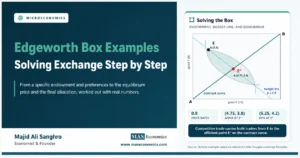
Inside the Edgeworth box, individual rationality creates a lens-shaped region. The two indifference curves through the endowment form the boundary. Points inside the lens make both agents at least as well off as at the endowment, and usually make one or both better off. Points outside it can be blocked by at least one individual refusing the proposed trade.
Hal Varian’s treatment of exchange uses the Edgeworth box to show feasible allocations, voluntary trades, and Pareto-efficient outcomes in a two-person exchange economy Varian, Intermediate Microeconomics. The core adds a sharper bargaining interpretation: an allocation must be acceptable against the threats available to individuals and coalitions.
Blocking Gives the Core Teeth
A coalition is any group of agents. It may contain one person, a pair, a large subgroup, or the entire economy. A coalition blocks an allocation when its members can use their own endowments to choose another feasible allocation for themselves that every member weakly prefers, with at least one member strictly better off.
For a coalition \(S\), blocking means there exists an alternative allocation \(y_S\) such that:
The first line says the coalition can finance the alternative from its own resources. The second and third lines say that the alternative is unanimously acceptable within the coalition and strictly improves at least one member. The core is the set of feasible allocations for which no such blocking coalition exists.
This definition appears in standard general equilibrium notes and textbooks. The University of York lecture notes define the core of an exchange economy as feasible allocations that cannot be improved upon or blocked by any coalition Bucovetsky, Coalitions and Blocking. Cambridge’s general equilibrium chapter gives the same structure: a coalition blocks when it can reassign its own resources so that all members weakly prefer the reassignment and at least one strictly prefers it. Cambridge, The Core of a Market Economy.
The word “coalition” matters. In a two-agent economy, the possible coalitions are simple: A alone, B alone, and the grand coalition \(\{A,B\}\). Singleton coalitions enforce individual rationality. The grand coalition enforces Pareto efficiency. With more agents, many intermediate coalitions appear. Those extra groups can block allocations that are individually rational and Pareto efficient but still unstable against subgroup deviations.
The Two-Person Core Segment
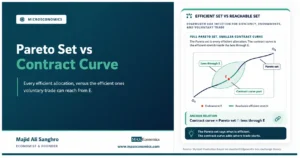
In a two-person Edgeworth box, the core has a clean geometric interpretation. It is the part of the contract curve that lies inside the mutual-gain lens created by the initial endowment. That statement combines two tests.
First, the allocation must be Pareto efficient. If it is not, the grand coalition containing both agents can block it. Both agents can move to another feasible allocation that improves at least one without hurting the other. In the Edgeworth box, this rules out points off the contract curve under standard smooth and convex preferences.
Second, the allocation must be individually rational. If A receives less utility than at the endowment, A alone blocks by keeping the endowment. If B receives less utility than at the endowment, B alone blocks. This cuts the full contract curve down to the segment that both agents weakly prefer to the starting point.
So for a two-person exchange economy with well-behaved preferences:
This is why the core sits naturally between welfare economics and Pareto efficiency, and bargaining theory. Pareto efficiency removes waste. Individual rationality respects initial ownership. The core keeps both conditions and asks whether any group can do better by withdrawing from the proposed allocation.

Coalitions Tighten the Feasible Set
Blocking coalitions restricts the allocation set step by step. Feasibility begins with the whole box. Individual rationality removes points that either agent would reject alone. Pareto efficiency removes points where the grand coalition can find a better feasible allocation. The remaining segment is the two-person core.
This sequence explains the value of the core. It is not a separate welfare criterion competing with Pareto efficiency. It is a stability refinement. It asks whether an allocation can survive all feasible objections by groups that are allowed to use only their own resources.
With two agents, the geometry is compact. With three or more agents, the idea becomes more demanding. Suppose an allocation is Pareto efficient for the whole economy. A subgroup might still be able to pool its own endowments and make each of its members better off, leaving outsiders aside. That subgroup blocks the allocation even though the allocation passes an economy-wide Pareto test.
This is why the core in larger exchange economies can be smaller than the set of individually rational Pareto-efficient allocations. More agents create more possible coalitions. More coalitions create more possible objections. Each objection removes allocations from the stable set.
The idea connects naturally to game theory and strategic behavior. The core is a cooperative game solution concept applied to an exchange economy. Agents do not merely compare individual bundles. They compare what groups can achieve by withdrawing from the proposed allocation and reallocating their own endowments.
Competition Shrinks the Core
Francis Edgeworth’s original insight was that recontracting becomes more restrictive as the number of traders grows. In a small economy, bargaining power can sustain a range of outcomes. In a large economy with many similar traders, the ability of coalitions to form alternative trades narrows the set of stable allocations.
The modern version is the core equivalence idea. As an exchange economy is replicated, meaning that more identical copies of each trader type are added, the core tends to shrink toward the set of competitive equilibrium allocations. Gérard Debreu and Herbert Scarf’s limit theorem formalized this convergence in replicated economies. Debreu and Scarf, A Limit Theorem on the Core of an Economy.
Robert Aumann then proved an exact equivalence in a continuum economy, where individual traders are negligible. In that setting, the core and the set of competitive equilibrium allocations coincide, Aumann, Markets with a Continuum of Traders. The result is one of the cleanest links between cooperative bargaining and price-taking equilibrium.
The economic intuition is straightforward. In a thick market, no small group can demand a special bargain if many alternative partners exist. Coalitions that try to support noncompetitive outcomes are undermined by other coalitions that can offer better trades. As the economy becomes more competitive, stable bargaining outcomes look increasingly like Walrasian equilibrium outcomes.
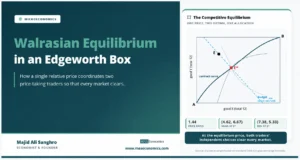
This connects the core to general equilibrium analysis. Competitive equilibrium is usually described through prices, budgets, and market clearing. The core reaches a related conclusion through coalitions and blocking. One route uses price-taking optimization. The other uses the absence of profitable group deviations.
Prices Survive Blocking Tests
Every competitive equilibrium allocation belongs to the core under the usual assumptions. The proof is short and reveals why market prices matter. Suppose \(x\) is a competitive equilibrium allocation supported by prices \(p\). Each agent maximizes utility subject to the budget constraint \(p\cdot x_i \leq p\cdot \omega_i\).
If a coalition \(S\) could block \(x\), then every member could receive a bundle at least as good as the equilibrium bundle, and one member could receive a strictly better bundle. Since each agent was already optimizing at prices \(p\), those weakly preferred bundles must cost at least as much as the equilibrium bundles, and the strictly preferred bundle must cost more. Therefore:
But each equilibrium bundle exhausts or respects the agent’s budget, and the coalition’s alternative must be feasible from the coalition’s own endowments:
Multiplying by prices implies the coalition cannot afford the claimed improvement. The alleged blocking allocation contradicts budget feasibility. Hence, no coalition can block the competitive allocation.
This result is sometimes called the strong core version of the first welfare theorem. Berkeley general equilibrium lecture notes state it directly: in an exchange economy, every Walrasian equilibrium lies in the core, Anderson, General Equilibrium Lecture Notes. The result strengthens the link between market-clearing prices and stable allocation.
Where the Core Can Mislead
The core is powerful, but it is not a complete description of real bargaining. It assumes that coalitions can identify feasible deviations, coordinate among members, and enforce internal redistribution. Real markets have search costs, asymmetric information, legal limits, and contract frictions. These can stop coalitions from forming even when a theoretical blocking allocation exists.
The core also depends on endowments. If the initial distribution of resources is unequal, the individually rational part of the contract curve may also be unequal. The core can remove unstable or wasteful allocations without solving distributive conflict. That limitation is shared with Pareto efficiency. Stability is not the same as fairness.
Nonconvexities create another issue. With increasing returns, indivisible goods, or nonstandard preferences, the core may behave differently from the simple Edgeworth-box picture. Herbert Scarf’s work on the core of an \(n\)-person game became important because it gave general conditions for nonemptiness in balanced games Scarf, The Core of an N Person Game. The existence question is not a minor technicality. If the core is empty, every feasible allocation can be challenged by some coalition.
Even with these limits, the core remains a disciplined way to think about exchange. It forces each proposed allocation to answer a hard question: which group would accept it when that group can use its own resources to do something else?
Bargaining Power Meets Market Thickness
The core gives a bridge between small-number bargaining and competitive markets. In a two-person Edgeworth box, the core can be a long segment. Many efficient trades are stable because neither individual can improve alone, and the pair as a whole has already exhausted Pareto gains.
As more agents enter the economy, the same logic becomes stricter. A person no longer needs to accept an unfavorable bargain with one counterparty if other agents hold similar goods and preferences. Coalitions can form around better terms. Each new coalition adds a blocking test, and the set of unblocked allocations shrinks.
In the limit, the stable bargaining set approaches competitive equilibrium. That is the deep message behind core convergence. Competitive prices are not only imposed by an auctioneer in a textbook model. They can also emerge as the only allocations robust to recontracting when markets are sufficiently thick.
This is why the core belongs in the same conceptual family as Nash equilibrium, public choice theory, and mechanism design. All ask whether a proposed rule or outcome survives incentives. The core asks that question at the group level.
MASEconomics Explains
3 economic concepts behind the core
These concepts are explored in depth across our educational articles library.
Explore the MASEconomics BlogConclusion
The core of an exchange economy analysis shows how feasible allocations are filtered by individual rationality, Pareto efficiency, and coalition blocking. In a two-person Edgeworth box, the core is the individually rational segment of the contract curve. In larger economies, more possible coalitions add more blocking tests, so the core can shrink toward competitive equilibrium. The concept turns exchange theory into a stability test: an allocation survives only when no group can do better with the resources it already owns.
Frequently Asked Questions
What is the core of an exchange economy?
The core of an exchange economy is the set of feasible allocations that no coalition can block. A coalition blocks an allocation when its members can use their own endowments to make all members at least as well off and at least one member strictly better off.
What is a blocking coalition in economics?
A blocking coalition is a group of agents that can reject a proposed allocation and reallocate its own resources in a way that benefits its members. The group does not need resources from outsiders, so its objection is credible within the exchange model.
How is the core shown in an Edgeworth box?
In a two-person Edgeworth box, the core is the segment of the contract curve inside the mutual-gain lens from the initial endowment. That segment is Pareto efficient and individually rational for both agents.
Why does the core shrink in large economies?
The core shrinks because larger economies contain more possible coalitions. More coalitions mean more ways to block allocations, so only allocations close to competitive equilibrium survive all objections.
How is the core related to competitive equilibrium?
Every competitive equilibrium allocation is in the core under standard assumptions. In large replicated or continuum exchange economies, core allocations converge to competitive equilibrium allocations, linking coalition stability to market prices.
Thanks for reading! If you found this helpful, share it with friends and spread the knowledge. Happy learning with MASEconomics