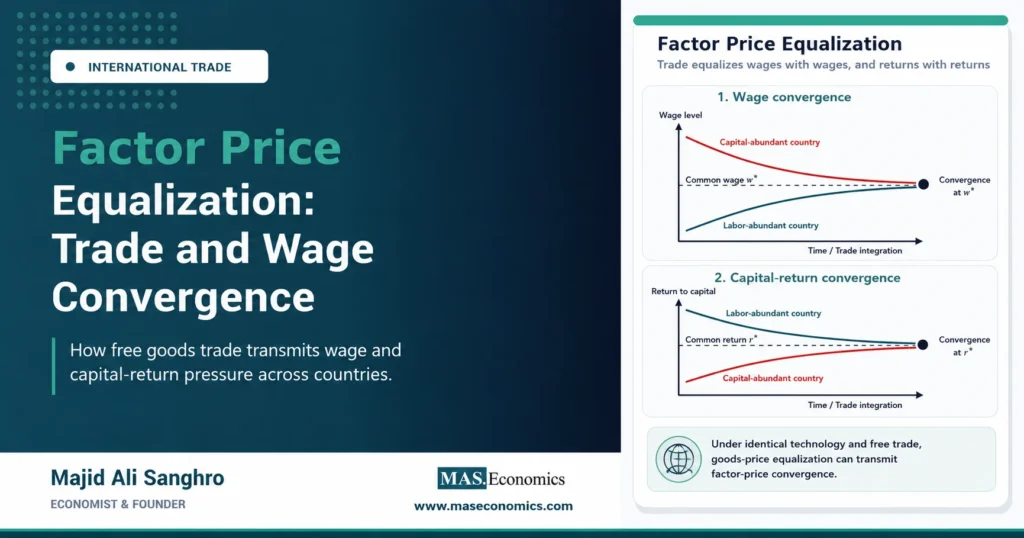
A country can import a labor-intensive shirt without importing the worker who made it, yet the trade still changes the demand for labor at home and abroad. Factor price equalization explains this link: under strict conditions, free trade in goods can make wages and capital returns converge across countries even when labor and capital do not move internationally.
The result is one of the strongest claims in neoclassical trade theory. It says that goods trade can indirectly substitute for factor mobility. When countries trade the goods that use their abundant factors intensively, product prices begin to align, and those product-price changes feed back into factor prices.
The theorem belongs to the Heckscher-Ohlin-Samuelson framework. The Heckscher-Ohlin model explains why countries export goods that use their abundant factors intensively. Factor price equalization explains what that trade can imply for wages and returns to capital.
Goods trade transmits factor pressure
Factor price equalization begins with a simple observation. Goods are produced with factors of production. If a good uses labor intensively, stronger demand for that good raises demand for labor. If a good uses capital intensively, stronger demand for that good raises demand for capital.
International trade changes product prices. A labor-abundant country tends to export the labor-intensive good. A capital-abundant country tends to export the capital-intensive good. As trade opens, the relative price of each country’s export good tends to rise compared with autarky.
Those product-price changes alter factor demand. In the labor-abundant country, the rising price of the labor-intensive export raises the demand for labor and pushes wages upward. In the capital-abundant country, import competition lowers the relative price of the labor-intensive good, reducing the relative demand for labor and putting downward pressure on wages.
The same logic applies to capital. Trade raises the relative reward of the abundant factor and lowers the relative reward of the scarce factor. Under strict assumptions, this process continues until factor prices are equalized across countries.
The theorem needs strict assumptions
The strong form of factor price equalization requires more than ordinary trade. It depends on a tightly structured model. The standard version assumes two countries, two goods, and two factors, usually labor and capital. Both countries share the same technology. Markets are perfectly competitive. Goods move freely. Factors cannot move across borders. Each country produces both goods after trade opens.
These assumptions matter because the theorem is not just saying that wages become more similar. It is saying that identical factors earn the same real return in both countries. That is a much stronger claim.
The basic setting can be summarized as:
| Condition | Role in the theorem | Failure risk |
|---|---|---|
| Same technology | Equal product prices imply the same unit cost equations | Different productivity allows different wages |
| Free goods trade | Product prices converge across countries | Tariffs and transport costs prevent full convergence |
| Perfect competition | Prices equal unit production costs | Market power breaks the price-cost link |
| Both goods produced | Both factor-price equations hold in each country | Specialization can prevent equalization |
| Identical factor quality | Labor and capital are comparable across countries | Skill and capital-quality gaps preserve wage differences |
| Central implication | Goods prices pin down factor prices | The result is conditional, not automatic |
|
Source: MASEconomics editorial synthesis based on the Heckscher-Ohlin-Samuelson trade model.

|
||
The theorem is therefore not a casual prediction that all wages in the world will become equal. It is a benchmark result. It shows how far the logic of goods trade can go when the model removes technology gaps, trade costs, market power, and institutional differences.
Product prices pin down wages
The formal logic comes from unit cost. In a competitive market, the price of a good equals the minimum cost of producing one unit of that good. If there are two goods and two factors, the prices of the two goods can determine the wage rate and the rental rate of capital.
Let \(w\) be the wage and \(r\) be the rental return to capital. If cloth is labor-intensive and machinery is capital-intensive, competitive pricing can be written in simplified form as:
Zero-Profit Conditions
Here, \(P_C\) is the price of cloth, \(P_M\) is the price of machinery, and \(c_C(w,r)\) and \(c_M(w,r)\) are unit cost functions. If both countries use the same technologies and face the same goods prices, they face the same cost equations.
With the same equations and both goods produced, the same wage-rental pair solves the system in both countries. The model’s core implication is therefore:
Equalized Factor Prices
This is why goods trade can act like indirect factor trade. Countries do not need to move workers or machines across borders. By trading goods that embody labor and capital services, they transmit factor-market pressure through product prices.
Abundant factors gain from trade
Factor price equalization is closely related to the Stolper-Samuelson theorem. Stolper-Samuelson says that an increase in the relative price of a good raises the real return to the factor used intensively in producing that good and lowers the real return to the other factor.
In the Heckscher-Ohlin setting, the labor-abundant country exports the labor-intensive good. Trade raises the relative price of that good in the labor-abundant country. The wage rises relative to the return on capital. In the capital-abundant country, trade raises the relative price of the capital-intensive good. The rental return to capital rises relative to wages.
Put differently, each country’s abundant factor gains from trade, while its scarce factor faces pressure. If the labor-abundant country opens to trade, labor becomes more valuable because the country expands production of labor-intensive exports. If the capital-abundant country opens to trade, capital becomes more valuable because capital-intensive export production expands.
Factor price equalization extends the logic. If goods prices fully converge and the model’s assumptions hold, the factor-price changes do not stop at partial adjustment. They continue until the wage and rental rate are the same in both countries.
Wages converge through product markets
The wage effect can be described in two steps. First, trade changes relative goods prices. Second, goods-price changes alter demand for the factors used intensively in those goods
Suppose Home is labor-abundant and Foreign is capital-abundant. Before trade, labor is relatively cheap in Home and relatively expensive in Foreign. Capital is relatively cheap in Foreign and relatively expensive in Home. Trade gives each country an incentive to specialize more toward the good that uses its abundant factor.
As Home expands labor-intensive exports, Home’s demand for labor rises and wages increase. As Foreign imports more labor-intensive goods, demand for labor in Foreign’s import-competing sector falls relative to capital-intensive production. Wages in Foreign face downward pressure relative to capital returns.
The same product-market channel also affects capital returns. In Home, the expansion of labor-intensive exports raises the relative demand for labor and lowers the relative demand for capital. In Foreign, the expansion of capital-intensive exports raises the relative demand for capital and lowers the relative demand for labor.
The adjustment can be shown as a stylized factor-price convergence diagram:
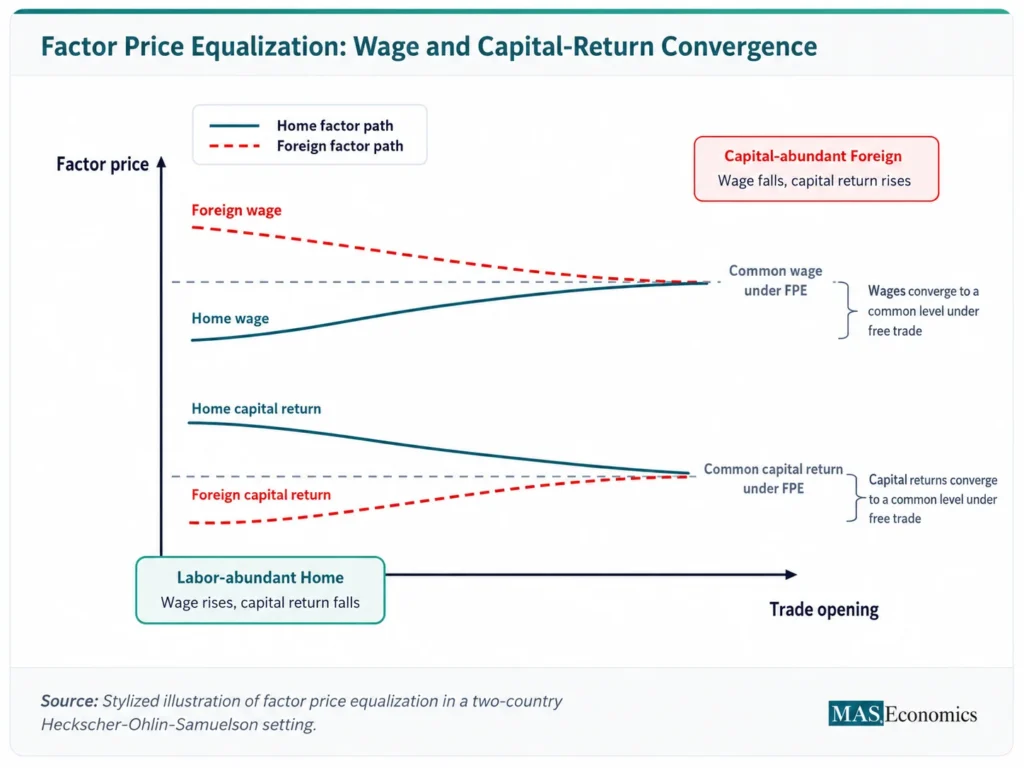
The diagram is stylized, not a real dataset. It shows the theorem’s directional logic in two linked parts. Wages move toward a common level, and capital returns also move toward a common level. In the labor-abundant country, the wage rises while the capital return falls. In the capital-abundant country, the wage falls while the capital return rises. Under the theorem’s strict assumptions, goods trade pushes both factor prices toward equality.
Capital returns complete the adjustment
The capital-return adjustment completes the wage story. Factor price equalization does not only describe wage pressure. It describes the simultaneous adjustment of both factor rewards: wages for labor and rental returns for capital.
If Home is labor-abundant, capital is scarce there before trade. If Foreign is capital-abundant, capital is relatively cheap there before trade. Trade changes the demand for both factors by shifting production toward the goods that use each country’s abundant factor intensively.
When trade opens, Home expands labor-intensive production and contracts capital-intensive import-competing production. This reduces relative demand for capital in Home and lowers the rental rate. Foreign expands capital-intensive exports and contracts labor-intensive production, raising the return to capital there.
The convergence is therefore symmetric. The factor that is initially cheap in a country tends to become more expensive. The factor that is initially expensive tends to become cheaper. In the strict model, the process continues until equal factors earn equal rewards across countries.
This is why the theorem has powerful distributional implications. Trade can raise national income while changing the relative rewards of workers and capital owners. Gains from trade are not automatically shared equally inside each country.
Rybczynski explains production shifts
The Rybczynski theorem helps explain the production side of this logic. In a two-good, two-factor model with fixed goods prices, growth in one factor expands output of the good that uses that factor intensively and contracts output of the other good.
Factor price equalization uses a related production structure. The labor-abundant country has relatively more labor, so it can supply more of the labor-intensive good at world prices. The capital-abundant country has relatively more capital, so it can supply more of the capital-intensive good.
Trade does not simply move goods across borders. It reorganizes production toward each country’s factor abundance. That production shift changes factor demand and therefore factor prices.
This is why Heckscher-Ohlin, Stolper-Samuelson, Rybczynski, and factor price equalization should be kept conceptually distinct. Heckscher-Ohlin explains trade patterns. Stolper-Samuelson explains factor-income effects from goods-price changes. Rybczynski explains output effects from factor-endowment changes. Factor price equalization explains cross-country convergence of factor rewards under strict conditions.
The result is not wage equality
Factor price equalization is often misunderstood as a claim that all observed wages should be equal across countries. That is not what the theorem says. It concerns equalized returns to identical factors under a specific model.
Real-world labor is not identical across countries. Workers differ by skill, education, experience, health, occupation, legal status, bargaining environment, and sector. Capital also differs by quality, technology, infrastructure, financing conditions, and institutional risk. A machine embedded in a reliable logistics network is not economically identical to the same machine in a weak infrastructure setting.
Measured wages also include many non-theorem factors: taxes, social insurance, labor-market regulations, unions, monopsony power, minimum wages, informality, exchange rates, and cost-of-living differences. These factors can keep observed wages apart even when goods trade is intense.
The theorem should therefore be read as a clean benchmark. It identifies a pressure toward convergence, not a guarantee that real wages across countries will become equal in observed data.
Caveat. Factor price equalization applies to identical factors under strict assumptions. Observed wage gaps can persist because workers, technologies, institutions, trade costs, and productivity levels differ across countries.
Complete specialization can break equality
The theorem requires both countries to produce both goods. If one country fully specializes, the system of unit cost equations changes. The goods prices no longer pin down both factor prices in that country in the same way.
For example, if a labor-abundant country produces only the labor-intensive good after trade, the price of that one good gives only one cost equation. With two unknown factor prices, one equation is not enough to determine both the wage and the rental rate. Full specialization weakens the equalization result.
This is more than a technical detail. Countries with very different factor endowments may not share the same diversification cone. One may be so labor-abundant or capital-abundant that it produces a different set of goods. In that case, factor prices can remain different even under free trade.
The diversification condition is therefore central. Factor price equalization is strongest when countries are different enough to trade but similar enough in endowments that both continue producing the same goods.
Trade costs preserve wage gaps
Transport costs, tariffs, border frictions, product standards, and regulatory barriers prevent full goods-price equalization. If goods prices do not fully equalize, factor prices do not need to equalize either.
Even small trade costs can matter. A good that sells for one price in the exporting country may sell for a higher price in the importing country after freight, insurance, tariffs, and distribution costs are included. Producers and workers then face different effective product prices across countries.
Trade costs also vary by sector. Digital services may move across borders cheaply, while perishable foods, heavy goods, and regulated products face higher costs. This unevenness means factor-price pressure is stronger in some sectors than in others.
The theorem’s clean result therefore becomes an empirical tendency only in limited contexts. Trade can narrow some factor-price gaps, especially where goods are highly tradable and technologies are similar, but it rarely eliminates them.
Technology differences matter greatly
Technology is one of the strongest reasons factor prices do not equalize in practice. If one country uses more productive methods, workers and capital can earn more even when goods prices are similar.
In the theorem, the same goods prices and the same technologies imply the same unit cost equations. If technologies differ, the cost equations differ. The same product price can then support different wages and capital returns.
Productivity gaps also affect the meaning of “same labor.” A worker using advanced equipment, reliable electricity, efficient logistics, and strong management systems can produce more per hour than a worker without those complementary inputs. Higher wages may reflect higher productivity rather than a failure of trade theory.
This is why the theorem should not be used as a simple claim that free trade equalizes all living standards. Technology, institutions, and productivity remain central.
Migration and capital flows differ
Factor price equalization is striking because it works without factor mobility. Workers do not migrate, and capital does not cross borders in the strict model. Goods trade alone transmits factor-market pressure.
Direct factor mobility works differently. If workers migrate from a low-wage country to a high-wage country, labor supply changes directly in both places. If capital flows from a low-return country to a high-return country, the capital stock changes directly. These movements can also push factor returns toward convergence.
Goods trade is indirect. A country exports labor-intensive goods instead of exporting labor services through migration. A country exports capital-intensive goods instead of sending capital abroad. The goods embody factor services, so factor-market pressure travels through product markets.
This distinction matters for policy. Restrictions on migration do not necessarily stop all wage convergence pressure, because trade can still change labor demand. Restrictions on goods trade can weaken that channel even if factors remain immobile.
The theorem informs wage debates
Factor price equalization is often invoked in debates about trade and wages. The theorem suggests that opening trade between labor-abundant and capital-abundant countries can put pressure on wages in the capital-abundant country’s labor-intensive sectors while raising wages in the labor-abundant country’s export sectors.
That prediction is directionally important, but it should not be overstated. Real wage outcomes depend on technology, education, institutions, exchange rates, adjustment costs, sectoral mobility, and policy. Trade is one force among several.
The theorem is most useful as a mechanism. It explains why goods trade can affect factor incomes even when workers do not cross borders. Import competition is not just a product-market event. It changes demand for the factors used in competing industries.
This is why trade-and-wage debates often connect product markets with labor markets. The price of imported goods, the competitiveness of domestic sectors, and the intensity with which industries use labor or capital all matter for wage outcomes.
Modern trade weakens exact equalization
Modern trade differs from the simple two-good model. Countries trade intermediate inputs, services, tasks, data, and intellectual property. Firms differ in productivity. Supply chains cross borders multiple times. Technology is not identical across countries. Labor is divided by skill, occupation, and region.
These realities weaken exact factor price equalization. A high-skill engineer, a garment worker, a port operator, and a platform-based service worker are not one homogeneous labor factor. Capital used in advanced semiconductor production is not the same as capital used in basic assembly.
Modern trade can still create convergence pressure in specific tasks and sectors. If a task becomes tradable and can be performed in a lower-wage location with similar productivity, wages for that task may face pressure in higher-wage locations. If global demand expands for a skill-intensive export, wages for that skill can rise.
The theorem remains useful because it gives a clean benchmark. It clarifies why goods and task trade can affect factor returns, while modern models explain why the adjustment is incomplete, uneven, and sector-specific.
Explains
Three concepts behind factor price equalization
Related trade theory concepts are developed across the MASEconomics international trade library.
Explore the MASEconomics BlogConclusion
Factor price equalization shows how free trade in goods can push wages and capital returns toward convergence across countries. The mechanism works through product prices: when goods prices equalize and technologies are the same, the factor prices needed to produce those goods also tend to equalize.
The theorem links several core ideas in trade theory. Heckscher-Ohlin explains why countries export goods that use their abundant factors. Stolper-Samuelson explains how goods-price changes affect factor incomes. Rybczynski explains how factor endowments shape production. Factor price equalization combines these insights into a cross-country convergence result.
The result is powerful but conditional. Real economies have technology gaps, trade costs, institutions, different worker skills, capital-quality differences, and incomplete specialization patterns. Goods trade can transmit wage and capital-return pressure across borders, but exact factor price equalization remains a benchmark rather than a literal prediction.
Frequently Asked Questions
What is factor price equalization?
Factor price equalization is the theorem that free trade in goods can equalize the returns to identical factors, such as labor and capital, across countries under strict Heckscher-Ohlin-Samuelson assumptions.
Why does trade change wages?
Trade changes wages because it changes product prices and production patterns. A higher price for a labor-intensive export raises demand for labor, while import competition can reduce labor demand in competing sectors.
Does factor price equalization mean all wages become equal?
No. The theorem applies to identical labor under strict assumptions. Real wages differ because skills, productivity, institutions, technology, trade costs, and cost of living differ across countries.
How is factor price equalization related to Stolper-Samuelson?
Stolper-Samuelson explains how a change in goods prices changes factor incomes. Factor price equalization applies that logic across countries when goods prices converge through trade.
Which assumptions are needed for factor price equalization?
The main assumptions include identical technology, free trade in goods, perfect competition, identical factor quality, no trade costs, and both countries producing both goods.
Thanks for reading! If you found this helpful, share it with friends and spread the knowledge. Happy learning with MASEconomics