
Game theory mathematics provides the formal language for analysing strategic interactions, situations in which the optimal choice depends on what others choose. From oligopolistic pricing to international trade negotiations, from auction design to central bank signalling, the mathematical structures of game theory underpin some of the most powerful models in modern economics. Six Nobel Prizes in Economics have been awarded for contributions to this field, more than for any other single branch of mathematical economics.
Let’s explore the core mathematical frameworks: normal-form and extensive-form games, the Nash equilibrium and its computation, mixed strategies, repeated games with discounting, and the evolutionary extensions that have reshaped how economists think about stability, learning, and institutional change.
Von Neumann, Morgenstern, and the Birth of a Discipline
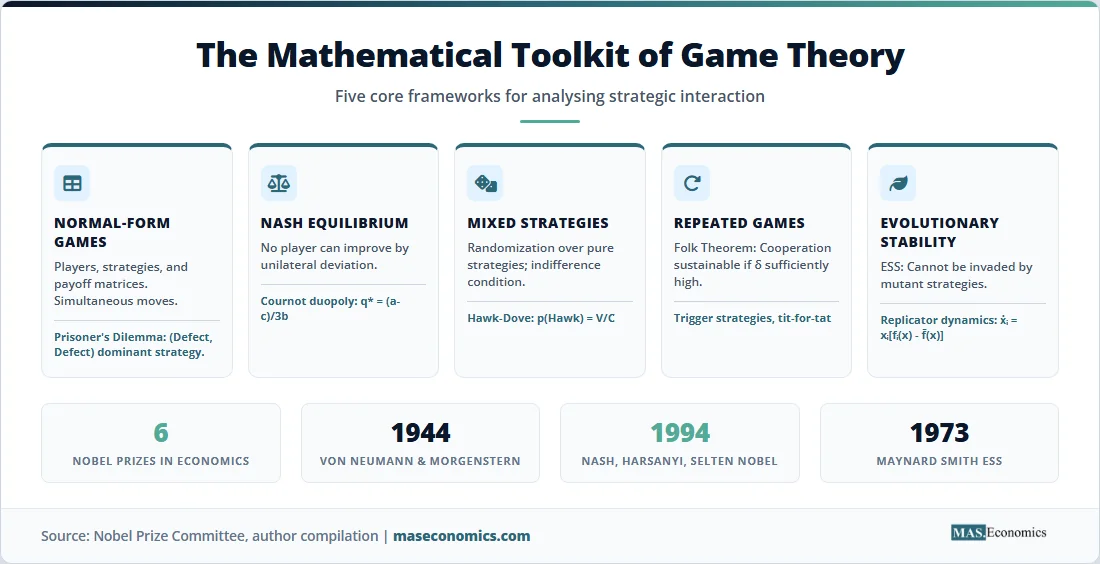
The formal study of strategic behaviour began with John von Neumann and Oskar Morgenstern’s 1944 book, The Theory of Games and Economic Behaviour. Von Neumann and Morgenstern argued that the mathematics developed for the physical sciences was inadequate for economics because economic agents, unlike particles, anticipate and respond to each other’s actions. They proposed a new mathematical framework built around the concept of a “game,” a formal model specifying players, strategies, payoffs, and information.
A game in normal form (also called strategic form) is defined by three elements:
1. A set of players \( N = \{1, 2, \ldots, n\} \)
2. A strategy set \( S_i \) for each player \( i \)
3. A payoff function \( u_i(s_1, s_2, \ldots, s_n) \) that maps each combination of strategies to a real-valued payoff for player \( i \)
The simplest and most famous normal-form game is the Prisoner’s Dilemma. Two suspects are interrogated separately. Each can cooperate (stay silent) or defect (confess). The payoff matrix takes the form:
| Player 2: Cooperate | Player 2: Defect | |
|---|---|---|
| Player 1: Cooperate | (-1, -1) | (-3, 0) |
| Player 1: Defect | (0, -3) | (-2, -2) |

|
||
Each cell contains (Player 1’s payoff, Player 2’s payoff). Defecting is a dominant strategy for both players: regardless of what the other does, defecting yields a higher payoff. The unique equilibrium is mutual defection (-2, -2), even though mutual cooperation (-1, -1) would leave both players better off. This tension between individual rationality and collective welfare is what makes the Prisoner’s Dilemma central to economic analysis of collusion, public goods, and international cooperation.
Nash Equilibrium
John Nash’s contribution, published in 1950 and recognized with the 1994 Nobel Prize, was to generalize the equilibrium concept to any finite game. A Nash equilibrium is a strategy profile \( s^* = (s_1^*, s_2^*, \ldots, s_n^*) \) such that no player can improve their payoff by unilaterally changing their strategy:Computing Nash Equilibria
In a two-player game with two strategies each, Nash equilibria can be found by checking the four possible pure-strategy profiles and identifying those where neither player has an incentive to deviate. Consider a Cournot duopoly where two firms simultaneously choose quantities \( q_1 \) and \( q_2 \). The inverse demand function is \( P = a-b(q_1 + q_2) \) and each firm has constant marginal cost \( c \). Firm \( i \)’s profit is:
Taking the first-order condition and solving the system of two best-response functions yields the Nash equilibrium quantities:
This result, first derived by Antoine Augustin Cournot in 1838 (more than a century before Nash formalized it), demonstrates how the mathematical structure of game theory connects to market structure analysis in industrial organization.
Mixed Strategies
Not every game has a Nash equilibrium in pure strategies. The classic example is the matching pennies game, where one player wins if both coins show the same face and the other wins if they differ. Any deterministic strategy can be exploited, so the only equilibrium involves randomization.
A mixed strategy for player \( i \) is a probability distribution \( \sigma_i \) over the pure strategy set \( S_i \). In a mixed-strategy Nash equilibrium, each player randomizes such that the other player is indifferent among their strategies. Formally, player \( i \)’s expected payoff from any strategy in the support of \( \sigma_i^* \) must be equal:This indifference condition provides the system of equations used to solve for mixed-strategy equilibria. In the Hawk-Dove game, a model of oligopolistic conflict where \( V \) is the value of a contested resource and \( C \) is the cost of fighting, the mixed-strategy equilibrium has each player choosing “Hawk” with probability \( V/C \). When the cost of conflict exceeds the value of the prize (\( C > V \)), both players randomize, and the proportion of aggressive behaviour declines as the cost of conflict rises, a prediction consistent with empirical evidence on tacit collusion in concentrated industries.
Extensive-Form Games and Backward Induction
Many strategic interactions unfold sequentially rather than simultaneously. Extensive-form games represent these situations as game trees, with nodes indicating decision points, branches representing available actions, and terminal nodes specifying payoffs.
The key solution concept for extensive-form games is backward induction: solving the game from the final decision node backward to the initial node. At each stage, the player at that node selects their optimal action, given rational play at all subsequent nodes. The resulting strategy profile is a subgame perfect Nash equilibrium (SPNE), a refinement that eliminates non-credible threats.
Backward induction is critical for analysing Stackelberg competition, where a leader firm commits to a quantity before a follower firm responds. In the Stackelberg model with the same demand function as above, the leader’s optimal quantity is:
which exceeds the Cournot equilibrium quantity. The leader gains a first-mover advantage by committing to a larger output, forcing the follower to produce less. This mathematical result explains why firms in oligopolistic markets invest in capacity, brand recognition, and R&D specifically to establish commitment.
How Cooperation Emerges from Self-Interest
A single round of the Prisoner’s Dilemma leads inexorably to mutual defection. But when the same players interact repeatedly with uncertainty about when the game ends, cooperation becomes sustainable. This is the central insight of repeated game theory, formalized through the Folk Theorem.
In an infinitely repeated game with discount factor \( \delta \) (where \( 0 < \delta < 1 \) reflects the players’ patience), the Folk Theorem states that any individually rational payoff can be sustained as a Nash equilibrium of the repeated game, provided \( \delta \) is sufficiently high. Cooperation in the Prisoner’s Dilemma, sustained by a trigger strategy (cooperate until the other defects, then defect forever), requires:
Using the payoffs from the matrix above (Temptation = 0, Reward = -1, Punishment = -2):
So cooperation is sustainable whenever the discount factor exceeds 0.5, meaning when players care enough about future payoffs. This mathematical framework has been applied to explain cartel stability in OPEC, central bank credibility, trade agreements, and environmental treaties. Robert Axelrod’s 1984 computer tournament, in which the simple “tit-for-tat” strategy outperformed sophisticated alternatives, demonstrated that the mathematical predictions of repeated game theory aligned remarkably well with simulated evolutionary competition.
Evolutionary Game Theory
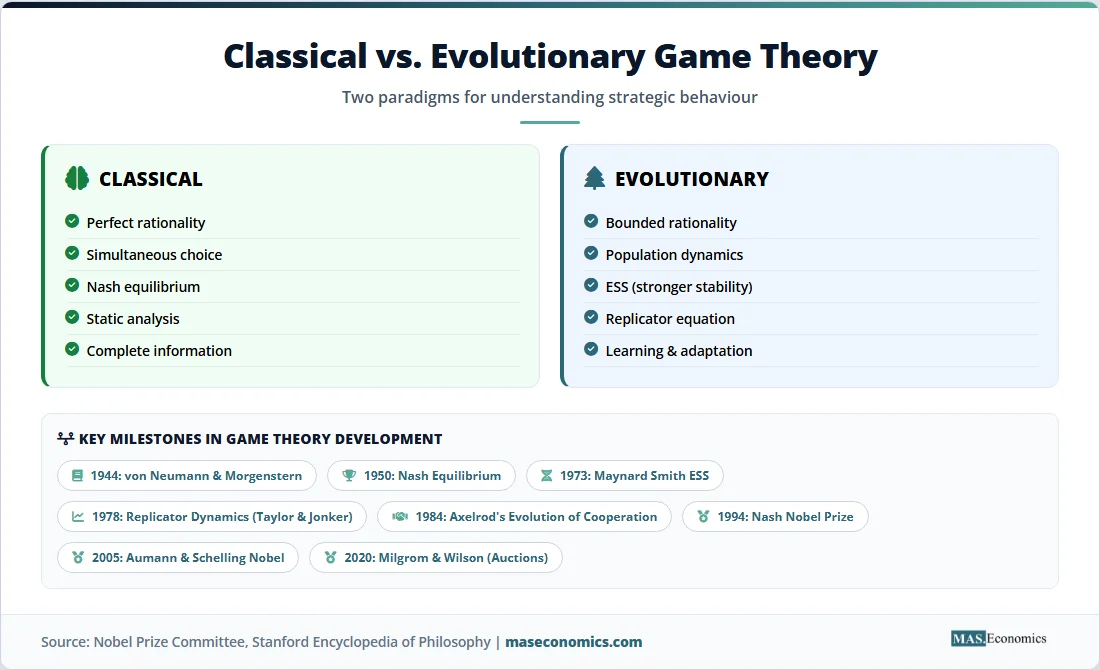
Classical game theory assumes that players are perfectly rational, possess complete information about the game’s structure, and can compute optimal strategies. Evolutionary game theory, pioneered by John Maynard Smith and George Price in 1973, drops all three assumptions. Instead of rational agents choosing strategies, evolutionary game theory models populations of agents who are “programmed” to play particular strategies, with more successful strategies spreading through the population over time.
The central concept is the evolutionarily stable strategy (ESS). A strategy \( s^* \) is an ESS if, once adopted by the entire population, it cannot be invaded by any alternative (“mutant”) strategy \( s’ \). Formally, \( s^* \) is an ESS if for all \( s’ \neq s^* \):Every ESS is a Nash equilibrium, but not every Nash equilibrium is an ESS. The ESS concept is more restrictive: it requires not just that no player has an incentive to deviate, but that any small group of deviators is actively selected against. This makes ESS a stability concept rather than merely an equilibrium concept.
The Replicator Dynamics
The mathematical engine of evolutionary game theory is the replicator equation, which describes how the proportion of each strategy in a population changes over time. If \( x_i \) is the proportion of the population playing strategy \( i \) and \( f_i \) is the fitness (average payoff) of strategy \( i \), the replicator dynamic is:
where \( \bar{f}(x) \) is the average fitness across the entire population. Strategies with above-average fitness grow; those with below-average fitness decline. The rest points of this dynamical system correspond to Nash equilibria of the underlying game, and asymptotically stable rest points correspond to ESSs (with some technical caveats in games with more than two strategies).
This mathematical framework has been applied to the evolution of market structures, the spread of behavioural biases in financial markets, the dynamics of institutional change, and the emergence of social norms. In economics, the replicator dynamic provides a rigorous alternative to the assumption of perfect rationality: instead of asking “what would perfectly rational agents do?”, it asks “what strategies would survive in a population where more successful behaviours are imitated?”
Applications in Modern Economics
Auction Theory and Mechanism Design
Game theory mathematics underpins the design of auctions, from government spectrum sales worth billions to everyday online platforms. William Vickrey’s work on sealed-bid auctions, Roger Myerson’s revelation principle, and the Vickrey-Clarke-Groves mechanism all rely on Nash equilibrium analysis to design rules that incentivize truthful bidding. The 2020 Nobel Prize to Paul Milgrom and Robert Wilson recognized their contributions to auction theory, which governments have used to allocate radio frequencies, fishing quotas, and airport landing slots.
Oligopoly and Industrial Organization
The Bertrand, Cournot, and Stackelberg models form the backbone of oligopoly theory, each based on a different game-theoretic specification of what firms choose (price vs. quantity) and when they choose (simultaneously vs. sequentially). The limit pricing model uses extensive-form games to analyse how incumbent firms deter entry through strategic pricing below the monopoly level.
International Trade and Tariff Wars
Trade negotiations between countries are strategic interactions where each government’s optimal tariff depends on the tariffs set by trading partners. The 2025 to 2026 global tariff escalation can be modelled as a repeated Prisoner’s Dilemma: each country benefits individually from imposing tariffs, but mutual tariff escalation leaves all parties worse off. The WTO’s role, in game-theoretic terms, is to serve as a commitment device that sustains cooperative equilibria in this repeated game.
AI and Algorithmic Game Theory
The intersection of game theory and machine learning has become one of the most active frontiers in mathematical economics. Algorithmic pricing by AI agents raises the possibility of tacit collusion without explicit communication: if competing algorithms converge on supra-competitive prices through reinforcement learning, the result is a Nash equilibrium that harms consumers without any human conspiracy. Multi-agent reinforcement learning, generative adversarial networks (GANs), and mechanism design for AI-driven markets all draw directly on the mathematical foundations covered in this article.
Source: Nobel Prize Committee, Google Scholar citation analysis, author compilation | MASEconomics.com
The chart tracks ten major milestones in game theory mathematics from 1944 to 2020, scored by a composite of citation impact, Nobel Prize recognition, and adoption across academic fields. The teal bars represent foundational contributions (von Neumann, Nash), green bars represent evolutionary game theory developments (Maynard Smith, Axelrod), and the remaining colours denote Nobel-recognized applications. The breadth of colours reflects how game theory has expanded from pure mathematics into economics, biology, computer science, and political science.
MASEconomics Explains
Four mathematical concepts that define modern game theory
Nash Equilibrium
A strategy profile where no player can improve their payoff by unilaterally changing their strategy. Proven by John Nash (1950) to exist in every finite game. The foundational solution concept of non-cooperative game theory, recognised with the 1994 Nobel Prize.
Evolutionarily Stable Strategy
A strategy that, once adopted by a population, cannot be invaded by any mutant strategy. Introduced by Maynard Smith and Price (1973). Every ESS is a Nash equilibrium, but not every Nash equilibrium is an ESS, making it a stronger stability concept suited to dynamic, evolutionary analysis.
Replicator Dynamics
A system of differential equations describing how strategy frequencies change in a population over time. Strategies with above-average fitness grow; those with below-average fitness decline. Rest points correspond to Nash equilibria, and asymptotically stable rest points correspond to ESSs.
Subgame Perfect Equilibrium
A refinement of Nash equilibrium for extensive-form (sequential) games, found by backward induction. It eliminates non-credible threats by requiring that strategies constitute a Nash equilibrium in every subgame, not just the game as a whole. Essential for analysing entry deterrence, bargaining, and commitment.
Conclusion
Game theory mathematics has evolved from a niche branch of applied mathematics into the analytical backbone of modern economics. The Nash equilibrium provides the static solution concept for strategic interactions. Mixed strategies extend the framework to situations where deterministic play is exploitable. Repeated games explain how cooperation emerges from self-interest through the mathematics of discounting. And evolutionary game theory replaces the assumption of perfect rationality with population dynamics, showing that strategies surviving competitive pressure converge to Nash equilibria without any player consciously computing them.
The mathematical progression from von Neumann’s minimax theorem (1928) to Nash’s existence proof (1950) to Maynard Smith’s ESS (1973) to the replicator dynamics (1978) represents one of the most productive intellectual arcs in twentieth-century science. Each step broadened the domain of application: from two-person zero-sum games to n-player non-cooperative games, from static equilibria to dynamic evolutionary processes, from chess to oligopoly, from biology to algorithmic pricing. The six Nobel Prizes awarded for game-theoretic contributions confirm that this mathematical framework has become indispensable for understanding strategic behaviour across every domain of economic life.
Did you find this article helpful? Share it with someone who loves economics. And remember, at MASEconomics, we make complex ideas simple.