When the United States and the European Union dispute beef, the fight is rarely about a tariff. It is about whether hormone-treated cattle can cross the border at all, a restriction the EU defends on safety grounds, and US exporters call disguised protection. When Japanese ports inspect every imported apple for pests while waving through domestic fruit, no duty is charged, yet the effect on trade is real. These are non-tariff barriers, the policy measures other than tariffs that restrict, complicate, or raise the cost of importing goods. As average tariffs have fallen worldwide over decades of trade agreements, these measures have become the main battleground of trade policy, and they are far harder to see, measure, and challenge than a number in a tariff schedule.
The shift matters because the visible part of protection has shrunk while the hidden part has grown. A tariff is transparent: a stated percentage, collected at the border, easy to compare across countries. A non-tariff barrier can be a quota, a licensing requirement, a product standard, a customs procedure, or a government procurement rule, and its trade-restricting effect is often buried inside a measure that has a legitimate non-trade purpose. Separating genuine regulation from protection dressed as regulation is the central difficulty in this area, and it is why these barriers generate more trade disputes than tariffs do.
Defining Non-Tariff Barriers
The term covers any government measure other than an ordinary customs duty that affects the quantity, price, or ease of imported goods. The World Trade Organization and UNCTAD distinguish a broad category of non-tariff measures, which includes all such regulations whether or not they are protectionist, from the narrower idea of a non-tariff barrier, where the measure actually restricts trade beyond a legitimate policy aim. The distinction matters because most non-tariff measures are not barriers at all. A food-safety rule that applies equally to domestic and imported tomatoes serves consumers; the same rule applied only to imports, or set at a level that domestic producers happen to meet and foreign ones cannot, becomes a barrier.
This is what separates non-tariff barriers from the instruments covered in a general survey of tariffs, quotas, and other trade barriers. A tariff announces itself. A non-tariff barrier frequently hides inside a measure whose stated purpose is health, safety, the environment, or national security, which makes its protective effect contestable rather than obvious. The same logic that hides true protection behind headline tariff numbers in the effective rate of protection operates here in a different form: what a measure is called rarely settles what it does to trade.
Categories of Non-Tariff Barriers
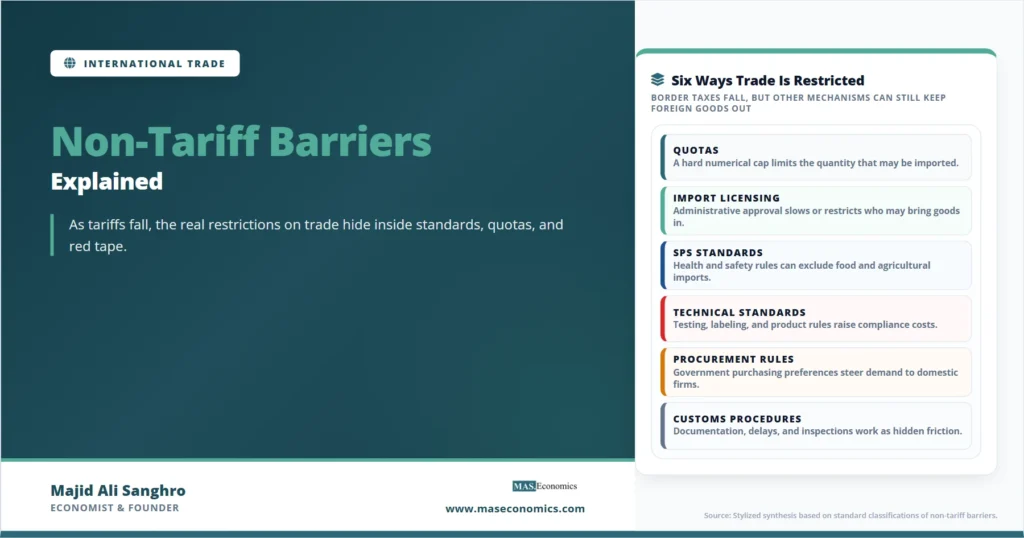
Non-tariff barriers are not a single tool but a family of distinct instruments, each with its own mechanism and its own economic effect. Treating them as interchangeable obscures how differently they work.
| Type | Mechanism | Primary effect |
|---|---|---|
| Quotas and quantitative limits | Cap the physical volume of a good that may be imported | Restricts quantity directly; raises domestic price |
| Import licensing | Requires permission or paperwork before importing | Adds cost and delay; can ration access |
| Sanitary and phytosanitary (SPS) measures | Food-safety, animal, and plant-health rules | Can block products on safety grounds, justified or not |
| Technical barriers to trade (TBT) | Product standards, labeling, testing, certification | Raises compliance cost; can exclude non-conforming goods |
| Government procurement rules | Preferences for domestic suppliers in public contracts | Closes a slice of demand to foreign firms |
| Customs and administrative procedures | Inspection, valuation, and documentation requirements | Adds friction and delay at the border |
|
Categories based on WTO and UNCTAD classifications of non-tariff measures.

|
||
Quotas are the most direct. By capping the volume that may enter, a quota fixes the quantity and lets the domestic price rise to whatever clears the restricted market. Unlike a tariff, a quota generates no government revenue unless import licenses are auctioned; the gap between the world price and the higher domestic price, the quota rent, typically goes to whoever holds the right to import. This is the sharpest difference between a quota and a tariff: a tariff lets price stay fixed and quantity adjust, while a quota fixes quantity and lets price adjust, and the two distribute the gains very differently even when they cut imports by the same amount.
Standards are the most contested. Sanitary and phytosanitary measures govern food safety and animal and plant health, while technical barriers to trade cover product specifications, labeling, and testing. Both can be entirely legitimate, and both can be weaponized. The World Trade Organization’s work on international standards exists precisely because harmonized rules reduce the chance that a standard becomes a hidden barrier. When two countries accept each other’s testing, a product certified once can sell in both; when they do not, a firm must run duplicate certifications, and the cost can exceed any tariff it would have paid.
Why standards dominate modern disputes. The WTO’s SPS and TBT agreements require that measures be based on scientific evidence and be no more trade-restrictive than necessary. The contested cases are rarely about whether safety matters; they are about whether a specific rule is calibrated to genuine risk or to keeping competitors out.
Legal Mechanism vs Economic Effect
A non-tariff barrier has to be read on two levels that are easy to conflate. The legal mechanism is what the measure formally does: it caps a quantity, requires a license, sets a standard, or specifies a procurement preference. The economic effect is what it does to trade and welfare: it raises the domestic price, rations supply, transfers rents, or imposes compliance costs. The two do not map neatly onto each other, which is what makes these barriers slippery.
Consider a labeling requirement. The legal mechanism is trivial, a rule about what text must appear on a package. The economic effect can be large if the labeling standard is unique to one market and forces exporters to run separate production lines. Conversely, a measure with an aggressive-sounding legal form, such as an outright import ban, may have a small economic effect if the product was barely traded anyway. Judging a non-tariff barrier requires asking not what it is called or how it is structured, but how much trade it actually deters and who bears the cost.
The political context adds a third layer. Because most non-tariff barriers ride on a legitimate-sounding purpose, they are politically easier to impose than a tariff. A government that would face challenge for raising a tariff can quietly tighten an inspection regime or adjust a standard, achieving similar protection while claiming to protect consumers. This deniability is exactly why these measures have multiplied as tariffs have fallen, and why distinguishing the stated purpose from the trade effect is the analytical core of the subject.
Caveat. Calling a measure a non-tariff barrier is a claim, not a neutral description. Many measures that one country labels protectionist, the other defends as legitimate regulation. The WTO dispute system exists because there is often no objective line, only a contested judgment about whether a rule is necessary and evidence-based.
Measuring Non-Tariff Barriers
A tariff has a number. A non-tariff barrier usually does not, and this makes the whole category resistant to the clean comparison that tariffs allow. Economists deal with this by estimating an ad valorem equivalent, the tariff rate that would have the same trade-reducing effect as a given non-tariff measure. The estimates are imprecise because the same standard can be a trivial formality for one exporter and a binding wall for another, and because the trade-restricting effect depends on how the measure is administered, not just how it is written.
The data problem compounds the measurement problem. Tariffs are published in schedules; non-tariff measures are scattered across regulations, customs practices, and administrative decisions that may not be centrally recorded. International bodies such as UNCTAD maintain databases that count notified measures, but counting measures is not the same as measuring their restrictiveness. A country with many notified standards may be more open than one with few but harshly applied ones. The gap between what can be counted and what actually matters is wider for non-tariff barriers than for any other instrument of trade policy.
Measuring Non-Tariff Barriers
The multilateral trading system does not ban non-tariff measures, since most serve legitimate ends, but it disciplines them. The General Agreement on Tariffs and Trade contains a general prohibition on quantitative restrictions such as quotas, with exceptions. The SPS Agreement requires that health measures rest on scientific principles and not discriminate arbitrarily between countries where the same conditions prevail. The TBT Agreement requires that technical regulations not create unnecessary obstacles to trade and encourages the use of international standards. The Agreement on Import Licensing Procedures aims to keep licensing simple and predictable rather than a tool of rationing.
These rules turn the question of whether a measure is a legitimate regulation or a disguised barrier into a justiciable one. A country that believes another’s standard is protectionist can bring the case to the WTO, where panels weigh the scientific basis and the necessity of the measure. The hormone-beef dispute between the EU and the US ran for years through exactly this process. The system does not eliminate non-tariff barriers; it forces governments to defend their measures as necessary and evidence-based, which raises the cost of using regulation as covert protection.
Non-Tariff Barriers and Modern Trade
As tariffs have receded, non-tariff barriers have become the dominant friction in global commerce, and their character has shifted with the structure of trade itself. Global supply chains mean a single good crosses borders many times as components, so a standard or customs delay that adds cost at each crossing compounds in a way a one-time tariff would not. The same fragmentation of production that makes modern globalization efficient also makes it acutely sensitive to regulatory friction, because frictions stack at every stage of the chain.
The barriers also blur into investment policy. Measures that look like product regulation can function as barriers to foreign direct investment when meeting a local standard effectively requires producing locally. A rule that a product be tested in-country, or that a service provider hold a domestic license, pushes foreign firms from exporting toward establishing a local presence, converting a trade barrier into an investment requirement. This convergence is why modern trade negotiations increasingly cover regulatory cooperation, mutual recognition, and standards alignment rather than just tariff schedules. The frontier of trade policy is no longer the customs duty; it is the regulation behind the border.
Explains
Three distinctions that make sense of non-tariff barriers
Explore more on trade policy and the rules that govern it.
Explore the MASEconomics BlogConclusion
Non-tariff barriers are measures other than tariffs, quotas, licensing, standards, procurement rules, and customs procedures that restrict trade, and they have become the principal instrument of protection as tariffs have fallen. Their defining feature is that the trade-restricting effect is usually embedded in a measure with a legitimate non-trade purpose, which makes them harder to see, harder to measure, and far harder to challenge than a tariff. The analytical task is always to separate the legal mechanism from the economic effect, and the stated purpose from the actual restriction.
The multilateral system responds not by banning these measures but by disciplining them, requiring that health and technical rules be necessary and evidence-based and that quantitative restrictions be the exception rather than the rule. That framework cannot draw a clean line between genuine regulation and disguised protection, because no such line exists in the abstract; it can only force governments to justify their measures and give trading partners a venue to contest them. As production fragments across borders and regulation moves behind the border, non-tariff barriers will remain the contested core of trade policy, less visible than the tariff but more consequential for how openly the world actually trades.
Frequently Asked Questions
What are non-tariff barriers?
Non-tariff barriers are government measures other than tariffs that restrict or raise the cost of importing goods. They include quotas, import licensing, food-safety and product standards, government procurement preferences, and customs procedures. Their defining feature is that the trade-restricting effect is often embedded in a measure with a legitimate non-trade purpose, which makes them harder to identify than a straightforward tariff.
How are non-tariff barriers different from tariffs?
A tariff is a transparent tax collected at the border that raises the price while letting quantity adjust, and it generates government revenue. A non-tariff barrier typically works by capping quantity or raising compliance costs, often generates no government revenue, and is usually hidden inside a regulation. Tariffs are easy to compare across countries; non-tariff barriers are difficult to measure because their effect depends on how a rule is administered, not just how it is written.
Are non-tariff barriers allowed under WTO rules?
Most non-tariff measures are allowed because they serve legitimate purposes such as health and safety. The WTO disciplines them rather than banning them. Quantitative restrictions like quotas are generally prohibited with exceptions, while sanitary and technical measures must be based on scientific evidence and be no more trade-restrictive than necessary. A country that believes a measure is disguised protection can challenge it through the WTO dispute system.
Why have non-tariff barriers become more important?
Decades of trade agreements have driven average tariffs down, so the visible part of protection has shrunk. At the same time, non-tariff measures have grown, partly because they are politically easier to impose under a legitimate-sounding purpose, and partly because global supply chains make trade more sensitive to regulatory friction that compounds at each border crossing. As a result, standards and behind-the-border regulation now generate more trade disputes than tariffs.
Thanks for reading! If you found this helpful, share it with friends and spread the knowledge. Happy learning with MASEconomics