Comparative advantage can show that two countries have a reason to trade, but it does not by itself determine the exact international price at which trade occurs. Reciprocal demand is John Stuart Mill’s answer to that missing step: trade prices are set by how strongly each country wants the other country’s export.
Mill’s theory explains why the terms of trade settle somewhere between the two countries’ domestic opportunity-cost ratios. One country’s willingness to supply exports is inseparable from its demand for imports. International value is therefore determined by demand on both sides of the exchange.
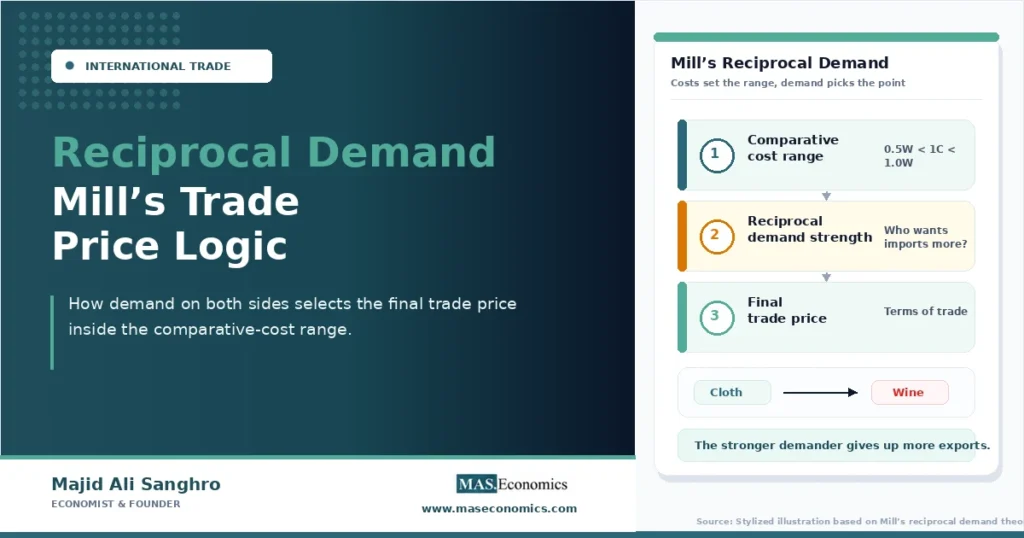
This makes reciprocal demand a bridge between comparative advantage and terms-of-trade analysis. Comparative advantage sets the range of mutually beneficial trade; reciprocal demand helps determine the exact trade price inside that range.
Comparative costs leave price open
Ricardo’s comparative advantage shows that trade can benefit countries when relative production costs differ. A country exports the good it produces at lower opportunity cost and imports the good that is relatively more costly at home. This logic explains the direction of trade.
But the Ricardian cost comparison alone does not determine the exact international exchange ratio. If England is relatively efficient in cloth and Portugal is relatively efficient in wine, cloth will tend to move from England to Portugal and wine from Portugal to England. The unresolved question is how much wine exchanges for a unit of cloth.
Trade is mutually beneficial only if the international terms of trade lie between the two domestic cost ratios:
Trade Price Range
The inequality identifies a feasible range, not a single price. The international price could settle near England’s domestic ratio, near Portugal’s domestic ratio, or somewhere in the middle. Mill’s contribution was to explain that the final point depends on reciprocal demand.
Mill shifts attention to demand
John Stuart Mill developed reciprocal demand in Principles of Political Economy. His key move was to treat international value as a two-sided demand problem. Each country demands the other country’s good, but that demand is expressed through the quantity of its own good it is willing to offer in exchange.
In domestic markets, demand and supply can often be separated conceptually. In international barter-style trade, the separation is less clean. The supply of exports by one country is also its demand for imports. To offer cloth is to demand wine. To offer wine is to demand cloth.
Mill’s insight can be stated simply: the terms of trade adjust until each country’s demand for the other country’s goods is matched by the other country’s willingness to take its goods in exchange.
Core idea. Reciprocal demand says that the international trade price is determined by the relative strength of each country’s demand for the other country’s export.
This explains why costs alone are not enough. Costs define the range within which trade can happen. Demand determines where the final exchange ratio falls within that range.
Reciprocal demand sets terms of trade
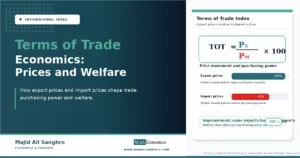
The terms of trade measure the rate at which exports exchange for imports. In index form, they are often written as:
Terms of Trade
In Mill’s setting, the same logic appears as an international exchange ratio. If cloth exchanges for wine, the terms of trade tell how much wine a cloth-exporting country receives for each unit of cloth. A higher exchange value for cloth improves the cloth exporter’s terms of trade and worsens the wine exporter’s terms, holding the goods fixed.
Reciprocal demand explains which side receives more favorable terms. If Portugal strongly wants English cloth while England’s demand for Portuguese wine is weaker, Portugal may offer more wine per unit of cloth. England’s terms of trade improve. If England strongly wants wine and Portugal’s demand for cloth is weaker, the terms move in Portugal’s favor.
The mechanism does not require negotiation in the narrow sense. It is a market-clearing logic. International prices move until the quantities each country wants to import and export are mutually consistent.
A simple two-good example clarifies
Consider two countries, England and Portugal, and two goods, cloth and wine. England has comparative advantage in cloth. Portugal has comparative advantage in wine. Before trade, suppose one unit of cloth costs 0.5 units of wine in England and 1.0 unit of wine in Portugal.
For trade to benefit both countries, the world price of cloth in terms of wine must be between 0.5 and 1.0. If one cloth exchanges for less than 0.5 wine, England does better by staying with domestic production. If one cloth exchanges for more than 1.0 wine, Portugal does better by producing cloth at home instead of importing it.
The feasible range is therefore:
The exact trade price depends on reciprocal demand. If Portugal’s demand for cloth is strong, Portugal may be willing to give up 0.9 units of wine for one unit of cloth. If Portugal’s demand is weak, the price may settle closer to 0.6 units of wine. Both prices can be inside the mutually beneficial range, but they distribute the gains from trade differently.
This example shows why the final trade price is not mechanically pinned down by production costs. Costs create the boundaries. Reciprocal demand selects the position inside those boundaries.
| Demand condition | Likely trade-price pressure | Terms-of-trade effect |
|---|---|---|
| Portugal strongly demands English cloth | Portugal offers more wine for cloth | England’s terms of trade improve |
| England strongly demands Portuguese wine | England offers more cloth for wine | Portugal’s terms of trade improve |
| Both countries have similar demand strength | Trade price settles nearer the middle of the range | Gains are shared more evenly |
| One country has weak import demand | It is less willing to offer exports | Terms tend to move in its favor |
| Central rule | Relative demand strength selects the price | The stronger demander gives up more |
|
Source: Stylized example based on Mill’s reciprocal demand theory.

|
||
The stronger demander pays more
The phrase “stronger demander pays more” captures the intuition, but it needs careful interpretation. A country does not pay with money in the simplest classical trade model. It pays by giving up more of its export good for a given amount of imports.
If a country has very strong demand for imports, it is willing to supply more exports to obtain them. That willingness tends to move the terms of trade against it. The country still gains from trade as long as the exchange ratio remains inside the mutually beneficial range, but it captures a smaller share of the total gains.
If a country has weaker demand for imports, it is less eager to trade on unfavorable terms. Its trading partner must offer better terms to induce trade. This can shift the distribution of gains toward the country with weaker reciprocal demand.
This is not a moral claim about bargaining power. It is a demand-side price mechanism. The relative intensity and elasticity of each country’s demand helps determine how the gains from trade are divided.
Elasticity affects the final price
Elasticity matters because demand strength is not only about wanting imports. It is also about how quickly import demand changes when the terms of trade move. A country with inelastic demand for imports keeps demanding foreign goods even when they become more expensive in terms of exports. A country with elastic demand reduces imports more sharply when the terms become unfavorable.
In reciprocal demand theory, the country with more inelastic import demand is more likely to accept worse terms of trade. It must give up more exports to obtain the imports it wants. The country with more elastic import demand can step back more easily, which improves its relative position in the exchange.
This gives Mill’s theory a distributional edge. Trade can expand total welfare, but the division of gains depends on demand elasticities. The country that needs the partner’s product more urgently often captures less of the surplus created by trade.
Elasticity also explains why the same comparative-cost structure can produce different trade prices across cases. If preferences or income levels change, reciprocal demand changes, and the international exchange ratio can move even when production costs are unchanged.
Demand and supply are linked
Mill’s theory is easy to misunderstand if import demand and export supply are treated as separate forces. In international exchange, a country’s demand for imports is expressed through its supply of exports. The two sides are joined by the terms of trade.
For a cloth-exporting country, the value of desired imports must be paid for by exports:
Trade-Balance Condition
Here, \(X\) is export quantity, \(M\) is import quantity, \(P_X\) is the export price, and \(P_M\) is the import price. The equation shows why a country’s import demand has an export-side counterpart. More imports require either more exports or better terms of trade.
This balanced-trade condition is a simplified theoretical benchmark, not a full description of modern trade accounts. Real countries can run trade deficits or surpluses financed through asset flows. The basic logic remains useful because it shows why international demand is reciprocal rather than one-sided.
The connection with the balance of payments is direct. Goods trade is only one part of external accounts, but the same accounting discipline applies: external purchases must be financed by exports, income receipts, transfers, borrowing, or asset sales.
Offer curves formalize the logic
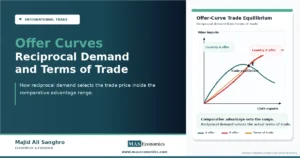
Offer curves later gave Mill’s reciprocal demand theory a geometric form. An offer curve shows how much of its export good a country is willing to offer for different quantities of the import good at alternative terms of trade.
This article avoids duplicating the offer-curve diagram because the central purpose here is narrower. The point is to understand Mill’s price-setting logic before moving to the full curve geometry. In words, the offer-curve intersection is the place where each country’s willingness to export and demand for imports are mutually consistent.
That formalization matters because reciprocal demand is not just a verbal theory of strong and weak wants. It can be represented as a market-equilibrium condition. The international price adjusts until the desired export supply of one country equals the desired import demand of the other, and vice versa.
The key lesson remains Mill’s: international values are determined by demand on both sides. Costs define what trade can make possible; reciprocal demand determines the exact exchange ratio.
Large countries face stronger effects
Reciprocal demand matters most when countries are large enough to influence world prices. A small country usually takes the world terms of trade as given. Its demand for imports and supply of exports are too small to shift the international exchange ratio.
A large country can affect the terms of trade. If its demand for a foreign good rises sharply, the world price of that import may rise relative to its exports. Its terms of trade deteriorate. If foreign demand for its exports strengthens, its terms of trade may improve.
This large-country logic helps explain why terms-of-trade effects remain important in trade policy. A large country may be able to improve its terms of trade by reducing import demand through a tariff, though such a policy creates domestic distortions and can reduce global welfare. It can also invite retaliation.
Small countries face a different calculation. Since they cannot usually move world prices, their welfare effects come mainly from the efficiency gains and losses created by trade policy, not from improving the international exchange ratio.
Income changes alter reciprocal demand
Reciprocal demand can shift when national income changes. As income rises, demand for imported goods may grow, especially if the imported good has a high income elasticity. A country may then be willing to offer more exports to obtain more imports.
Growth can also change the supply side. If factor accumulation expands the production of the export good, the country can offer more exports at given terms of trade. The Rybczynski theorem explains how factor growth can change the output mix in a two-good, two-factor trade model.
When a large country’s export supply expands faster than world demand, the export price may fall relative to import prices. The country exports more volume but receives less purchasing power per unit exported. This is the terms-of-trade channel behind some concerns about export-biased growth.
Mill’s framework therefore remains relevant beyond the original classical examples. Any change that alters import demand, export supply, or demand elasticity can change the trade price.
Factor trade theories add causes
Mill’s theory explains how trade prices are selected within a feasible range, but it does not by itself explain all sources of comparative advantage. Later theories add production structure.
The Heckscher-Ohlin model links trade patterns to factor abundance. A labor-abundant country tends to export labor-intensive goods, while a capital-abundant country tends to export capital-intensive goods under the model’s assumptions. Reciprocal demand then affects the terms at which those goods exchange internationally.
Modern trade analysis adds further mechanisms, including economies of scale, product differentiation, firm heterogeneity, and global value chains. These themes are developed in modern trade theory, where trade is not limited to the classical exchange of two final goods.
The relation among these theories is complementary. Comparative advantage explains why trade is possible. Factor-endowment and modern models explain why countries specialize in particular goods. Reciprocal demand explains how the international price is determined once trade takes place.
Modern trade uses money prices
Classical reciprocal demand is often presented as if goods exchange directly for goods. Modern trade usually uses money prices, currencies, invoices, credit, and contracts. That institutional difference changes the surface form of the model, but not its underlying logic.
When a country demands more imports, it must still finance them through exports, services income, transfers, borrowing, or asset sales. When foreign demand for its exports rises, its export prices, production incentives, and external balance can change. These are modern versions of reciprocal demand.
Exchange rates complicate the picture because they affect the domestic-currency prices of exports and imports. A depreciation may make exports cheaper to foreign buyers and imports more expensive to domestic buyers. The real terms of trade depend on how export and import prices respond, not only on the nominal exchange rate.
This is why the reciprocal-demand idea remains useful even when the simple barter framework is no longer literal. International trade still depends on the demand each side has for what the other side supplies.
Mill’s theory has limits
Reciprocal demand is a powerful idea, but it is not a complete theory of modern trade. The simplest version assumes two countries, two goods, balanced trade, and clear commodity exchange. Real trade includes many countries, many goods, intermediate inputs, services, capital flows, exchange-rate regimes, and policy barriers.
The theory also abstracts from distribution within countries. A country may gain from better terms of trade while some workers, firms, or regions lose. The Stolper-Samuelson theorem shows how trade can affect factor incomes differently, even when national gains are positive.
Transport costs, tariffs, standards, and contracts also affect trade prices. These frictions can create gaps between the pure terms-of-trade ratio in theory and the prices firms actually face in trade.
These limits do not remove the value of Mill’s theory. They identify its proper role. Reciprocal demand explains the basic price-setting mechanism in international trade; fuller models add production, distribution, finance, and institutions.
Caveat. Reciprocal demand explains trade-price determination inside the mutually beneficial range. It does not by itself explain every modern influence on trade prices, including exchange rates, tariffs, freight costs, credit conditions, or global value chains.
Explains
Three concepts behind reciprocal demand
Related trade theory concepts are developed across the MASEconomics international trade library.
Explore the MASEconomics BlogConclusion
Reciprocal demand explains how the exact international trade price is determined after comparative advantage has created the possibility of mutually beneficial exchange. Domestic opportunity costs set the boundaries; each country’s demand for the other country’s export determines where the terms of trade settle inside those boundaries.
Mill’s contribution was to show that international value is not governed by cost alone. The country with stronger demand for imports tends to give up more exports, while the country with weaker or more elastic demand tends to receive more favorable terms.
The theory remains useful because it connects trade prices to the demand conditions on both sides of the market. Modern trade models add money prices, factor endowments, firms, policy barriers, and external accounts, but the central insight remains: trade prices reflect reciprocal willingness to exchange.
Frequently Asked Questions
What is reciprocal demand in international trade?
Reciprocal demand is each country’s demand for the other country’s export good, expressed through the amount of its own export good it is willing to offer in exchange.
How did Mill explain trade prices?
Mill argued that trade prices are determined by the relative strength of demand on both sides of international exchange. The terms of trade settle where each country’s desired imports and exports are mutually consistent.
How is reciprocal demand related to comparative advantage?
Comparative advantage sets the range within which trade can benefit both countries. Reciprocal demand determines the exact international exchange ratio within that range.
What happens when a country has stronger import demand?
A country with stronger import demand is usually willing to offer more exports to obtain imports. This tends to move the terms of trade against that country, although it can still gain from trade.
Are reciprocal demand and offer curves the same?
No. Reciprocal demand is the underlying theory of two-sided demand in trade. Offer curves are a geometric way to represent that theory by showing each country’s willingness to exchange exports for imports at different terms of trade.
What is Mill’s theory of reciprocal demand?
John Stuart Mill’s answer, in 1848, to a gap Ricardo left open: comparative advantage shows that two countries gain from trading, but not at what price. Mill argued that the terms of trade settle where each country’s demand for the other’s exports is just matched by the other’s demand for its own, so that the value of exports equals the value of imports. The country that wants the other’s goods more urgently, relative to its size, ends up paying more of its own.
Thanks for reading! If you found this helpful, share it with friends and spread the knowledge. Happy learning with MASEconomics