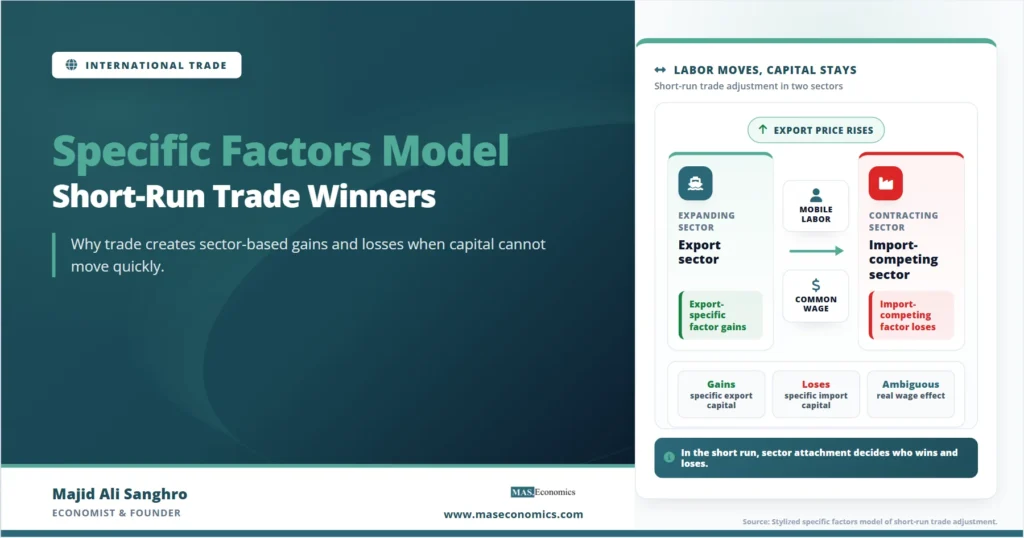
A tariff cut can raise national income while still reducing the earnings of workers and capital owners tied to import-competing industries. The specific factors model explains this short-run trade conflict by separating factors that can move across sectors from factors that are stuck in particular industries.
The model is useful because trade adjustment is not instant. Labor may move between industries over time, but land, machines, buildings, sector-specific skills, supplier networks, and local capital often cannot shift quickly. That short-run immobility shapes who gains and who loses when trade changes product prices.
In international trade theory, the model sits between simple comparative advantage and the long-run Heckscher-Ohlin model. It explains why the politics of trade often depends on sectors first and factors later.
Short-run trade has immobile capital
The specific factors model begins with a simple distinction. Some inputs can move between sectors in the short run, while others are tied to one sector. The mobile factor is usually labor. The specific factors are usually capital, land, or equipment that cannot be moved quickly from one industry to another.
Consider a two-sector economy. One sector produces an export good, such as aircraft, software, or agricultural commodities. The other sector produces an import-competing good, such as textiles, steel, or basic manufactured goods. Labor can move between the two sectors. Sector-specific capital cannot.
The production side can be written as:
Two-Sector Production
Here, \(Q_X\) is output in the export sector and \(Q_M\) is output in the import-competing sector. Labor can be reallocated, so total labor satisfies:
The key assumption is that \(K_X\) cannot immediately become \(K_M\). A machine designed for aircraft production cannot instantly become textile equipment. Farmland cannot instantly become a chip factory. This is why the model is built for short-run distributional analysis.
Labor moves across sectors
Because labor is mobile, workers move toward the sector that pays the higher wage. In equilibrium, the wage is the same across sectors, although the real purchasing power of that wage depends on goods prices.
Firms hire labor until the value of the marginal product of labor equals the wage. For the export sector:
Export-Sector Labor Demand
For the import-competing sector:
Import-Competing Labor Demand
The wage \(w\) is common because labor can move. But each sector’s labor demand depends on its product price and its marginal product of labor. If the price of the export good rises, the value of labor in the export sector rises. Firms in that sector demand more workers, and the economy’s labor allocation shifts.
The specific factor in the expanding sector gains because more labor works with it. The specific factor in the contracting sector loses because labor leaves. Workers face a more ambiguous result because the nominal wage may rise, but goods prices also change.
Product prices drive factor incomes
The model’s distributional logic begins with a change in product prices. Suppose a country opens to trade and the relative price of its export good rises. Export producers become more profitable at the old wage. They hire more labor. The wage rises as workers move toward the export sector.
The short-run labor-market adjustment can be shown with a two-sector factor-market diagram. Labor used in the export sector is measured from the left, while labor used in the import-competing sector is measured from the right. The two value-of-marginal-product curves determine the common wage and the allocation of labor between sectors.
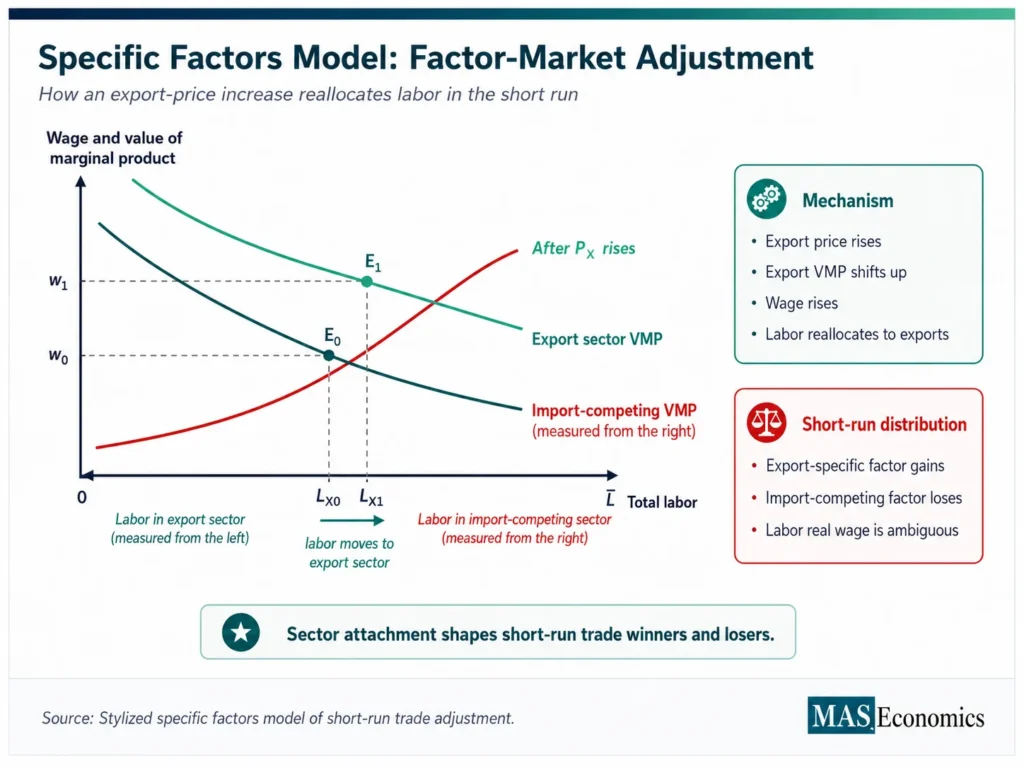
In the diagram, the export-sector value-of-marginal-product curve shifts upward when the export price rises. The equilibrium moves from \(E_0\) to \(E_1\), the common wage rises from \(w_0\) to \(w_1\), and labor moves from \(L_{X0}\) to \(L_{X1}\) in the export sector. Since total labor is fixed, the import-competing sector loses labor.
But the wage does not rise as much as the export price. The reason is diminishing marginal product. As more labor enters the export sector, each additional worker has less specific capital to work with, so the marginal product of labor falls. The higher product price raises the value of labor, but the expanding labor force pushes marginal product down.
This creates a clear income ranking:
Short-Run Distributional Ranking
The factor specific to the export sector gains because its product price rises more than the wage. The factor specific to the import-competing sector loses because wages rise while its product price does not. Labor’s real income depends on consumption. Workers gain in terms of the unchanged import good but lose in terms of the export good if that good becomes more expensive.
The export sector gains clearly
When the export good’s price rises, the return to the factor specific to the export sector rises. This is the strongest result in the model. The export-specific factor benefits because it is tied to the sector whose output price has increased.
For example, if a country exports agricultural products and world food prices rise, owners of land used in that export sector tend to gain. Labor moves toward agriculture, output expands, and the value of land rises. The land cannot move to another sector, so its return is directly tied to the fortunes of that export industry.
The same logic applies to sector-specific capital. If aircraft exports become more valuable, specialized factories, engineering capacity, and firm-specific capital in that sector become more profitable. The sector’s specific factor captures part of the trade gain.
This result explains why export-oriented industries often support trade liberalization. The model does not require every person in the export sector to gain equally, but it predicts that the factor tied to the expanding sector has a clear interest in the price change.
Import-competing capital loses clearly
The factor specific to the import-competing sector loses when trade lowers the relative price of that sector’s output or raises the relative return available elsewhere. Even if the import-competing product price stays unchanged while the export price rises, the import-competing specific factor can lose because wages rise economy-wide.
As labor leaves the import-competing sector, output contracts. The fixed factor in that sector is combined with fewer workers. Its marginal contribution falls, and its return declines. The sector may still operate, but the owners of its specific capital receive lower income.
This is why trade adjustment often produces concentrated losses. A textile machine, a steel mill, a local supplier network, or a port facility designed around one commodity cannot instantly shift into the expanding export sector. The capital remains specific, so the owners bear sector-specific losses.
The result also explains why trade opposition can be politically strong even when aggregate welfare rises. Losses are often concentrated among industries, regions, and owners of sector-specific assets, while gains are spread more broadly across consumers, workers, and export-sector owners.
Workers face ambiguous real income
Labor is mobile in the specific factors model, so workers receive the same nominal wage across sectors after adjustment. But the real wage is not automatically higher or lower. It depends on the goods workers buy.
When the export good’s price rises, the nominal wage rises by less than the export price. Workers are worse off in terms of the export good because their wage buys less of it. If the import-competing good’s price is unchanged, workers are better off in terms of that good because their nominal wage has risen.
The real wage is therefore ambiguous:
Real Wage Ambiguity
The welfare effect for workers depends on consumption shares. If workers spend heavily on the good whose price rose, their real income may fall. If they mostly consume the good whose price did not rise, their real income may improve.
This is one reason the specific factors model gives a more cautious short-run prediction than the long-run factor-endowment model. It does not say workers as a group must gain or lose from trade. It says their real outcome depends on how wages and consumer prices move together.
Distribution follows sector attachment
The specific factors model predicts gains and losses according to sector attachment rather than broad factor class. This is the key difference from the long-run Stolper-Samuelson theorem.
In Stolper-Samuelson, the central question is which factor is used intensively in the good whose price rises. If the labor-intensive good’s price rises, labor gains in real terms and capital loses. That is a long-run result in a model where factors can move and the economy can fully adjust.
In the specific factors model, the central question is which sector a factor is tied to. Capital in the export sector gains, while capital in the import-competing sector loses. Labor is mobile and has an ambiguous real-income effect.
This sector-based logic better matches many short-run trade conflicts. Owners, workers with sector-specific skills, local suppliers, and communities tied to one industry may resist trade even when the economy’s aggregate gains are positive.
| Group | Short-run position | Effect after export-price rise |
|---|---|---|
| Export-specific factor | Tied to the expanding sector | Gains clearly |
| Import-competing specific factor | Tied to the contracting sector | Loses clearly |
| Mobile labor | Moves between sectors | Ambiguous real-income effect |
| Consumers | Buy both goods | Effect depends on consumption basket |
| Central rule | Sector attachment dominates in the short run | Export-sector factors gain, import-competing factors lose |
|
Source: MASEconomics editorial synthesis based on the specific factors model of short-run trade adjustment.

|
||
The model explains trade politics
The specific factors model explains why trade politics often forms around industries. Long-run theories may predict gains for abundant factors or losses for scarce factors, but short-run conflicts are frequently sectoral. Export industries support openness. Import-competing industries seek protection. Workers and communities tied to contracting sectors face adjustment costs.
The model also explains why opposition to trade can be intense even when the average gain is positive. Specific factors cannot exit easily. Owners of sector-specific assets may face capital losses. Workers may need retraining, relocation, or time to find jobs in expanding sectors. Local governments may lose tax bases tied to declining industries.
This does not make protection automatically efficient. A tariff can protect a specific factor in the import-competing sector, but it also raises consumer prices and creates welfare losses. The model clarifies the distributional reason for protectionist pressure without treating protection as costless.
Trade politics is therefore not only about national gains from trade. It is also about who bears transition costs, how quickly labor can move, and whether policy cushions losses without blocking productive reallocation.
Adjustment costs shape the short run
The phrase “short run” in the specific factors model does not mean a fixed number of months or years. It means a period in which at least one important factor cannot move across sectors. The length of that period depends on the economy.
In some industries, capital can be repurposed quickly. In others, machinery, skills, land, infrastructure, and supplier networks remain tied to one use for a long time. A steel mill, fishing fleet, oil field, garment cluster, or specialized software team may have assets that cannot easily shift into the expanding export sector.
Labor mobility also varies. The model assumes labor can move, but real workers face housing constraints, family ties, licensing rules, skill gaps, search costs, and uncertainty. When labor is less mobile than the model assumes, short-run losses can be more severe and more persistent.
This is why the model is useful even when its assumptions are simplified. It focuses attention on the transition period, where trade’s distributional effects are often most visible.
National gains can coexist with losses
The specific factors model is compatible with national gains from trade. When trade raises the price of the export good relative to the import-competing good, the economy can reallocate labor toward the sector where it has stronger international opportunities. Aggregate income can rise.
But aggregate gains do not mean every group gains. The export-specific factor can gain by more than enough to compensate the import-competing specific factor, at least in principle. Whether compensation occurs is a political and institutional question, not a result guaranteed by the market.
This distinction matters for welfare analysis. A policy can raise national income while leaving some groups worse off. The model therefore separates efficiency from distribution. It explains how trade can expand the total surplus while creating identifiable losers.
The same logic appears in many trade debates. The economic case for trade openness often rests on aggregate gains, while the political conflict often comes from concentrated losses. The specific factors model shows why both claims can be true at the same time.
Specific factors differ from Heckscher-Ohlin
The specific factors model and the Heckscher-Ohlin model share a concern with factors of production, but they answer different questions. Heckscher-Ohlin is mainly a long-run model of trade patterns based on factor abundance. It asks why labor-abundant countries export labor-intensive goods and capital-abundant countries export capital-intensive goods.
The specific factors model is mainly a short-run model of income distribution. It asks who gains and loses when product prices change while some factors are tied to sectors. The answer is not simply “labor” or “capital.” The answer depends on sector attachment.
In Heckscher-Ohlin and Stolper-Samuelson, factors are classified by type and intensity. In the specific factors model, factors are classified by mobility. Mobile labor moves between sectors. Specific capital or land remains in place.
This makes the model especially useful for explaining transitional conflict after trade liberalization, commodity price shocks, tariff reductions, or export booms. It captures the period before the economy reaches a long-run allocation.
Policy choices affect adjustment
The model has direct policy implications. Since trade creates both aggregate gains and concentrated losses, the policy question is not only whether trade raises national income. It is also how adjustment costs are handled.
Adjustment policies can include retraining, wage insurance, relocation support, unemployment protection, infrastructure investment, and regional development. These policies do not remove the distributional conflict, but they can reduce the cost of moving resources toward expanding sectors.
Protectionist policies take a different route. Tariffs, quotas, and subsidies can slow the contraction of import-competing sectors, but they usually impose costs on consumers and other producers. They may also delay adjustment by keeping labor and capital tied to declining uses.
The specific factors model does not choose a policy by itself. It clarifies the trade-off. A government can protect specific factors, support adjustment, or allow market reallocation with limited compensation. Each choice distributes costs differently.
The model has clear limits
The specific factors model is stylized. It usually has two goods, one mobile factor, and two sector-specific factors. Real economies have many sectors, many forms of capital, many worker skills, financial frictions, firm heterogeneity, and global value chains.
The model also assumes competitive markets and clear product-price changes. Real trade shocks may arrive through exchange rates, tariffs, technology, demand shifts, transport costs, or multinational production. These channels can blur the clean price shock in the textbook model.
Another limitation is the treatment of labor as mobile. Many workers are partly specific in practice because skills, networks, licenses, and location tie them to sectors. When labor is also specific, the distributional effects become sharper and more local.
Caveat. The specific factors model is a short-run benchmark. It explains sector-based trade losses clearly, but real adjustment also depends on worker mobility, credit conditions, regional labor markets, firm behavior, and policy design.
Explains
Three concepts behind the specific factors model
Related trade theory concepts are developed across the MASEconomics international trade library.
Explore the MASEconomics BlogConclusion
Specific factors model analysis explains why trade creates clear short-run winners and losers even when the economy can gain overall. The factor tied to the expanding export sector gains, the factor tied to the contracting import-competing sector loses, and mobile labor faces an ambiguous real-income effect.
The model’s strength is its attention to time. In the short run, capital, land, skills, and local networks often remain sector-specific. Product-price changes therefore affect income through sector attachment before long-run factor mobility can reshape the economy.
This makes the model an essential bridge between trade theory and trade politics. It shows why distributional conflict can be intense, why adjustment policy matters, and why national gains from trade do not eliminate the need to study who gains, who loses, and how quickly resources can move.
Frequently Asked Questions
What is the specific factors model?
The specific factors model is a short-run trade model where one factor, usually labor, can move between sectors, while other factors, such as capital or land, are tied to particular industries.
Who gains from trade in the specific factors model?
The factor specific to the expanding export sector gains clearly because the price of that sector’s output rises and more mobile labor moves into the sector.
Who loses from trade in the specific factors model?
The factor specific to the import-competing sector loses clearly because labor leaves that sector and its relative product-market position weakens after trade opens.
What happens to workers in the model?
Workers receive a common wage because labor is mobile, but their real income effect is ambiguous. The wage may rise in terms of one good and fall in terms of another.
How does the model differ from Stolper-Samuelson?
Stolper-Samuelson is a long-run factor-income result based on factor intensity. The specific factors model is a short-run result based on sector attachment and limited factor mobility.
Thanks for reading! If you found this helpful, share it with friends and spread the knowledge. Happy learning with MASEconomics