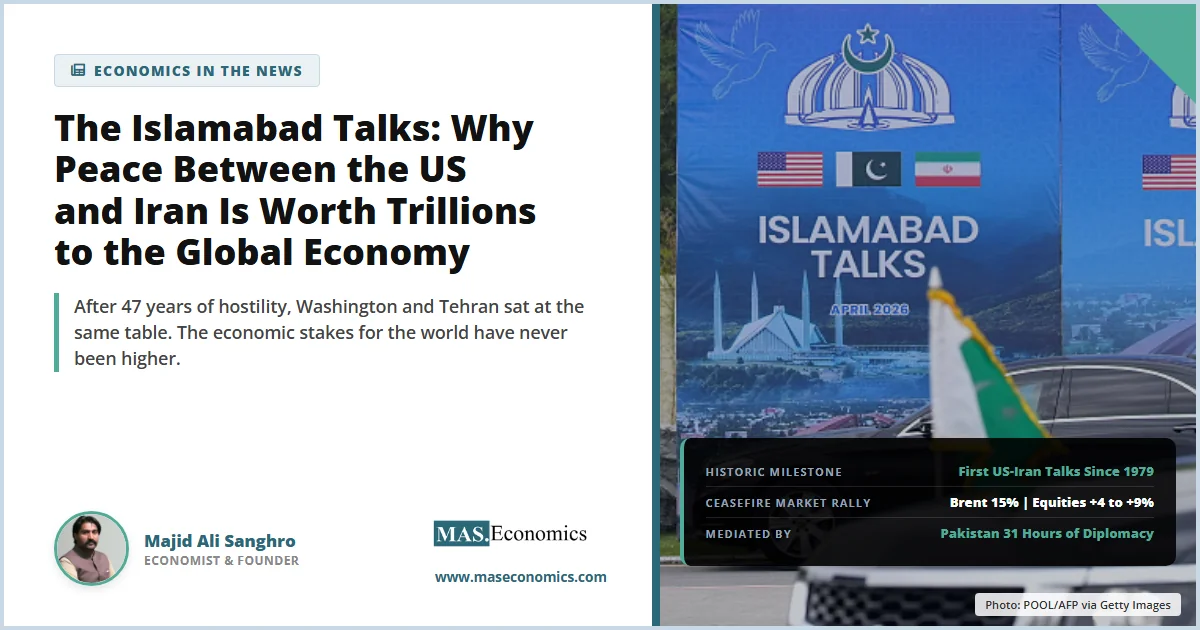
For 21 consecutive hours on April 11–12, 2026, senior officials from the United States and Iran negotiated face-to-face in Islamabad’s Serena Hotel. US Vice President JD Vance led the American delegation. Iranian Parliament Speaker Mohammad Bagher Ghalibaf led Tehran’s. Pakistan’s Prime Minister Shehbaz Sharif and Chief of Defence Forces Asim Munir mediated.
No formal agreement was reached. But something far more important happened: two nations that had not spoken directly since the 1979 Islamic Revolution sat at the same table, exchanged written proposals, and negotiated for nearly a full day. As Pakistan’s Foreign Minister Ishaq Dar said after the talks concluded: “Pakistan has been and will continue to play its role to facilitate engagement and dialogue between the Islamic Republic of Iran and the United States of America in the days to come.” Iran’s foreign ministry spokesperson echoed the sentiment: “Diplomacy never comes to an end.”
The Islamabad Talks may not have ended the war. But they opened a door that had been sealed for 47 years. And the economic stakes of what happens next, for Iran, for the United States, for the global economy, and for the billions of people affected by the Strait of Hormuz closure, are staggering.
What the Islamabad Talks Achieved
It is easy to view the Islamabad Talks as a failure because no deal was signed. That framing misses the point entirely. Consider what did happen.
The ceasefire brokered by Pakistan on April 8, the first pause in six weeks of fighting, held throughout the talks. The two-week truce prevented what could have been a catastrophic escalation. According to multiple reports, both delegations covered the full range of issues: the Strait of Hormuz, Iran’s nuclear programme, sanctions relief, war reparations, the release of frozen Iranian assets, and the cessation of hostilities on all fronts, including Lebanon.
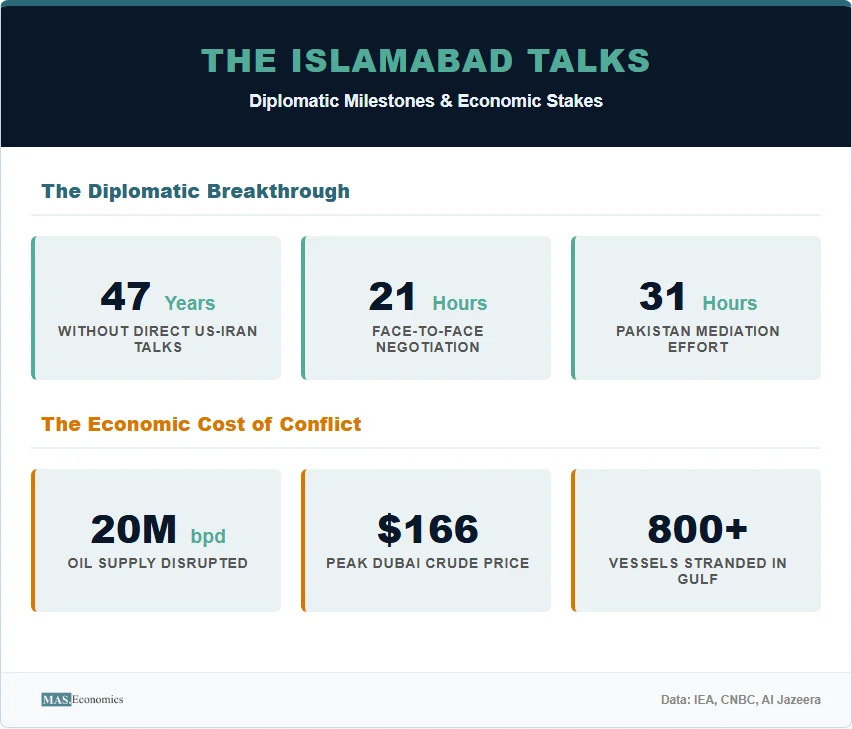
Pakistan conducted 31 hours of continuous diplomacy across multiple sessions. The talks produced what officials described as a “clearer understanding of each other’s positions,” and both sides exchanged written texts, a concrete foundation for further negotiations.
Former Pakistani Ambassador to the UN Zamir Akram put it in perspective: “The metric of success should be an agreement to continue this process in search of a solution. It will not happen in a couple of days.” By that measure, the Islamabad Talks succeeded. The channel is open. The process continues.
Table 1: The Islamabad Talks: Key Facts
| Detail | Description |
|---|---|
| Dates | April 11–12, 2026 (21 hours of negotiations) |
| Venue | Serena Hotel, Islamabad, Pakistan (Red Zone, high-security) |
| US delegation | Vice President JD Vance, Special Envoy Steve Witkoff, Jared Kushner (~300 members) |
| Iran delegation | Parliament Speaker Ghalibaf, FM Abbas Araghchi (~70 members) |
| Mediator | Pakistan (PM Sharif, FM Dar, CDF Asim Munir – 31 hours of mediation) |
| Topics discussed | Strait of Hormuz, nuclear programme, sanctions, war reparations, frozen assets, Lebanon |
| Outcome | No formal deal; written texts exchanged; ceasefire intact; further talks expected |
| Historic significance | First direct US-Iran negotiations since the 1979 Islamic Revolution |

|
|
Sources: Al Jazeera, NPR, CNN, CNBC.
The Economic Cost of This War
The economic damage inflicted by six weeks of conflict has been staggering. Understanding its scale is essential to appreciating why the Islamabad Talks matter so much to the global economy.
The International Energy Agency has characterised the Strait of Hormuz closure as “the largest supply disruption in the history of the global oil market.” Approximately 20 million barrels of oil per day, one-fifth of global petroleum consumption, were cut off. Brent crude surged from $70 before the war to above $113 at its peak, a rise of over 60%. Dubai crude, which tracks physical delivery in the Middle East, exceeded $166 per barrel, a record, according to CNBC.
The damage extends far beyond oil. The attacks on Qatar’s Ras Laffan complex disrupted approximately one-third of global helium supply and 20% of global LNG exports. Fertiliser prices surged as the Gulf states, which account for 36% of global urea exports, lost their shipping routes. The Coface commodity analysis showed naphtha prices in Singapore rising 60%, with cascading effects across plastics, packaging, and manufacturing.
An estimated 130 million barrels of crude oil and 46 million barrels of refined fuel were stranded on nearly 200 tankers. More than 800 vessels remained trapped inside the Persian Gulf. US gasoline prices hit an all-time record of $3.96 per gallon. European gas futures surged 85% in a single month.
The human cost has been even greater. Thousands of lives have been lost. Millions have been displaced. Entire communities in Iran and Lebanon have been devastated. The economic suffering is not abstract; it is measured in development budgets cut, fuel subsidies strained, and families unable to afford basic commodities.
This is the context that makes the Islamabad Talks not just a diplomatic exercise, but an economic imperative.
How Markets Responded to Pakistan’s Ceasefire
The Pakistan-brokered ceasefire on April 8 triggered one of the most dramatic single-day market recoveries in recent memory. The response demonstrates, in trillions of dollars of market value, what peace is worth to the global economy.
Source: Market data via CNBC, Express Tribune. Single-day percentage moves on April 8, 2026, following the Pakistan-mediated ceasefire announcement.
Stock markets surged across every region. South Korea’s Kospi rose 6.8%. Japan’s Nikkei gained 5.3%. Germany’s DAX jumped 4.8%. Pakistan’s bourse soared more than 9%. Simultaneously, energy prices fell sharply: Brent crude dropped 13.6%, WTI fell 15%, and European gas futures declined nearly 17%. These are not routine market movements; they represent trillions of dollars in restored global market value in a single trading session.
The message from financial markets is unambiguous: peace is the most valuable commodity in the world. Every day the ceasefire holds, every step toward a permanent agreement translates directly into lower energy costs, higher equity values, stronger currencies in import-dependent nations, and relief for households struggling with the erosion of purchasing power.
Why Pakistan Succeeded Where Others Could Not
The United Nations Security Council failed to pass a resolution on the Strait of Hormuz. European capitals offered statements but no mediation. Traditional Gulf mediators like Oman and Qatar were themselves affected by the conflict. It was Pakistan, a country more often in the headlines for security challenges than diplomatic breakthroughs, that delivered the ceasefire and hosted the most consequential peace talks of 2026.
As CNN documented, Pakistan’s success rested on a unique set of relationships:
Trust from both sides. Pakistan shares a 900-kilometre border with Iran, hosts the world’s second-largest Shia population, and has deep cultural ties with Tehran. Simultaneously, Pakistan’s military-to-military relationship with the US is strong; President Trump publicly praised Pakistan’s army chief as his “favourite field marshal.” Crucially, Pakistan does not host US military bases, which overcame Iranian sovereignty concerns. As Al Jazeera reported, “a messenger transmits, but Pakistan shaped the sequencing, timing, and framing of proposals. It had leverage with all sides.”
Its own economic stakes. Pakistan imports much of its oil from the Middle East and was directly harmed by the Hormuz closure. Remittances from millions of Pakistani workers in Gulf states were at risk. Pakistan signed a mutual defence agreement with Saudi Arabia in 2025, meaning escalation could have drawn it into the conflict. As Tufts University professor Fahd Humayun told CNN: “Pakistan had enormous stakes, probably more stakes than any other country east of Iran in this particular conflict.”
Principled neutrality. Pakistan condemned attacks by all sides. It maintained its channel to Iran while expressing solidarity with Saudi Arabia. It did not join the anti-Iranian coalition. This balanced approach earned it the credibility that no other potential mediator possessed.
The international response validated Pakistan’s role. UN Secretary-General Guterres welcomed the ceasefire. French President Macron called PM Sharif to congratulate him. Turkiye’s Erdogan, Qatar’s emir, the King of Bahrain, and the chancellors of Germany and Austria all expressed support. The world recognised what Islamabad had achieved.
The Economic Case for Peace
The Islamabad Talks are not just about geopolitics. They are about economics, and the economic argument for a permanent peace agreement between the US and Iran is overwhelming.
Table 2: The Economic Benefits of Peace: What a Permanent Agreement Would Deliver
| Beneficiary | Impact of Continued Conflict | Impact of Permanent Peace |
|---|---|---|
| Global oil markets | Brent above $100; 20% of supply disrupted; record gasoline prices | Brent returns toward $70; Hormuz fully reopens; 800+ stranded vessels released |
| Iran | Devastating infrastructure damage; civilian suffering; international isolation deepens | Sanctions relief; frozen assets released; reconstruction investment; reintegration into global trade |
| United States | Rising domestic fuel prices; war costs mounting; consumer confidence falling | Lower energy costs for households; reduced military expenditure; diplomatic credibility restored |
| Asia-Pacific | 80% of Hormuz oil flows to Asia; inflation rising; central banks unable to cut rates | Interest rate cuts resume; manufacturing costs normalise; trade flows restored |
| Gulf states | Infrastructure damaged; tourism collapsed; aviation disrupted; investment frozen | Reconstruction begins; investor confidence returns; regional stability attracts capital |
| Developing nations | Fertiliser shortages; food price inflation; debt stress from energy import bills | Fertiliser supply restored; food security stabilises; fiscal pressure eases |
|
|
||
For Iran, the economic case for peace is existential. The war has devastated infrastructure, disrupted daily life, and compounded decades of sanctions-driven economic hardship. Iranian citizens have endured extraordinary suffering. A permanent agreement that includes sanctions relief and the release of frozen assets would unlock the potential of an economy with the world’s fourth-largest proven oil reserves and a young, educated population of 88 million. Iran’s people deserve the chance to rebuild, and a peace agreement is the only path to that future.
For the United States, the economic cost of the war is being felt at the kitchen table. Gasoline prices are at record highs. Inflation is running above the Federal Reserve’s target. Consumer confidence, as measured by the University of Michigan survey, has fallen to 47.6, the lowest on record. American farmers in Iowa are reporting soaring fertiliser and diesel costs that threaten the planting season. A permanent peace would directly lower energy costs for every American household and business.
For the global economy, the stakes are measured in trillions. The Strait of Hormuz carries one-fifth of the world’s oil and a third of its seaborne urea fertiliser. Every week the Strait remains under restrictions adds billions of dollars to the global energy and food bill. The oil shock has complicated central bank decision-making worldwide, delaying the rate cuts that economies need to sustain growth.
The Road Ahead
The Islamabad Talks concluded without a formal deal, but they did not end in failure. They ended with a foundation for further negotiations. The key unresolved issues, Iran’s nuclear programme, the Strait of Hormuz security framework, sanctions relief, and the Lebanon question, are complex and will require multiple rounds of diplomacy to resolve.
Table 3: Scenarios for What Comes Next
| Scenario | What Happens | Economic Impact |
|---|---|---|
| Talks continue (most likely) | Further rounds in Islamabad or another venue; ceasefire extended; Hormuz gradually reopens | Oil falls below $90; markets rally; central banks resume rate cuts; reconstruction begins |
| Comprehensive deal reached | Nuclear framework agreed; sanctions lifted; Hormuz fully open; Lebanon ceasefire included | Oil returns toward $70; trillions in global value restored; Iran reintegrates into world trade |
| Stalemate persists | Ceasefire holds but no progress; Hormuz partially restricted; diplomatic channel preserved | Oil stabilises near $95–$100; uncertainty continues; markets price in “security premium” |
| Ceasefire collapses | Hostilities resume; Hormuz fully closed again; further escalation | Oil spikes above $130; global recession risk rises sharply; humanitarian crisis deepens |
|
|
||
History offers some reason for cautious optimism. Pakistan’s experience in mediation is not new. In 1988, Islamabad itself participated in the Geneva Accords on the Soviet withdrawal from Afghanistan, where UN-mediated indirect talks between Pakistan and Afghanistan produced a landmark agreement. As Ambassador Akram noted, “Proximity talks have been used before. Pakistan itself participated in one in Geneva in 1988 on the Afghan issue.”
The key lesson from that experience, and from every major peace negotiation in history, is that breakthroughs rarely come in the first round. The Obama administration’s nuclear deal with Iran took 18 months. The Camp David Accords between Egypt and Israel required 13 days of intensive negotiation after years of preparation. What matters is that the process continues.
A New Chapter After 47 Years
Perhaps the most significant outcome of the Islamabad Talks is the simple fact that they happened at all. The United States and Iran have not had direct diplomatic engagement since the 1979 Islamic Revolution severed relations between the two countries. The hostage crisis, the Iran-Iraq War, decades of sanctions, the nuclear standoff, and now a shooting war; the relationship has been defined entirely by hostility.
The Islamabad Talks represent a crack in that wall. Both governments demonstrated a willingness to sit in the same room, exchange proposals in writing, and negotiate for 21 hours straight. That is nothing. That is the precondition for everything that comes next.
The economic potential of a normalised US-Iran relationship is enormous. Iran possesses the world’s fourth-largest proven oil reserves and the second-largest natural gas reserves. Its population of 88 million is young and educated. Under sanctions, Iran’s economy has been locked out of global trade, finance, and technology. A comprehensive peace agreement that includes sanctions relief would not only help Iran rebuild but would also add significant supply to global energy markets, putting downward pressure on the oil prices that are currently squeezing households worldwide.
For the United States, normalised relations would remove a major source of geopolitical risk, reduce the “war premium” embedded in energy prices, and open commercial opportunities in one of the Middle East’s largest consumer markets. The economic logic of engagement over confrontation is not a new argument; it is the same logic that drove the original Bretton Woods agreements, the formation of the WTO, and every major trade agreement of the past 80 years. Trade creates mutual dependency. Mutual dependency reduces the risk of war. This is the foundational insight of liberal economic theory, and it is precisely what the Islamabad Talks have the potential to set in motion.
MASEconomics Explains
Four economic concepts that explain why peace is worth trillions
Supply Shock
A supply shock is a sudden disruption to the availability of a critical commodity. The Hormuz closure created the largest oil supply shock in history, removing 20% of global petroleum supply. Supply shocks raise prices, fuel inflation, and can trigger recessions. Peace and the reopening of the strait would reverse this shock, allowing prices to normalise and economies to stabilise.
Sanctions and Their Economic Effects
Economic sanctions restrict a country’s ability to trade, access financial markets, and use the global banking system. Iran has been under varying degrees of sanctions since 1979. While designed to change state behaviour, sanctions also impose severe costs on civilian populations, restricting access to medicine, technology, and economic opportunity. Sanctions relief, as part of a peace agreement, would allow Iran’s economy to reconnect with the world.
Gains from Trade
One of the most fundamental principles in economics is that voluntary trade makes both parties better off. When nations trade freely, they specialise in what they produce most efficiently, raising output and living standards for all. The 47-year rupture in US-Iran relations has denied both economies the gains that would flow from normal commercial engagement. Restoring trade would create economic value for both sides, a point that makes peace not just morally right but economically rational.
Geopolitical Risk Premium
Financial markets price in the risk of conflict through a “geopolitical risk premium”, an additional cost embedded in oil prices, insurance rates, and shipping costs. The Iran war has added an estimated $25–30 per barrel to global oil prices. A permanent peace agreement would remove this premium, delivering immediate savings to consumers and businesses worldwide and allowing central banks to resume the interest rate cuts that economies need.
Want to understand these concepts in more depth? Explore our full library of economic explainers, from measuring the gains from trade to why oil shocks keep coming back.
Explore the MASEconomics Blog →Let Peace Prevail
The Islamabad Talks did not produce a deal. But they produced something that may prove more durable: a channel of communication between two nations that had refused to speak for nearly half a century. In economics, we understand that the cost of conflict is always higher than the cost of compromise. The data is unambiguous: the war has cost the global economy billions of dollars per day in lost output, stranded cargo, and inflated energy prices. A permanent peace would return trillions in value to markets, households, and economies worldwide.
Pakistan deserves immense credit for making the Islamabad Talks possible. In a world where traditional multilateral institutions struggled to act, Islamabad stepped forward with the credibility, relationships, and strategic vision to bring two adversaries to the table. The task ahead is formidable; the gaps between the US and Iranian positions remain wide, and external spoilers threaten the ceasefire daily. But the channel is open, the parties have engaged, and the path to further negotiations exists.
We believe that economics is, at its core, a discipline about human welfare, about how societies organise themselves to produce prosperity, reduce suffering, and build a better future. The Islamabad Talks are a test of whether diplomacy can achieve what military force could not: a sustainable peace that allows the people of Iran, the citizens of the United States, and the billions of people dependent on the Strait of Hormuz to live in security and dignity.
We hope these talks continue. We hope peace prevails. And we hope that the next time the world gathers in Islamabad, it is to celebrate an agreement, not to negotiate under the shadow of war.
Did you find this article helpful? Share it with someone who cares about peace and the global economy. And remember, at MASEconomics, we make complex ideas simple.