
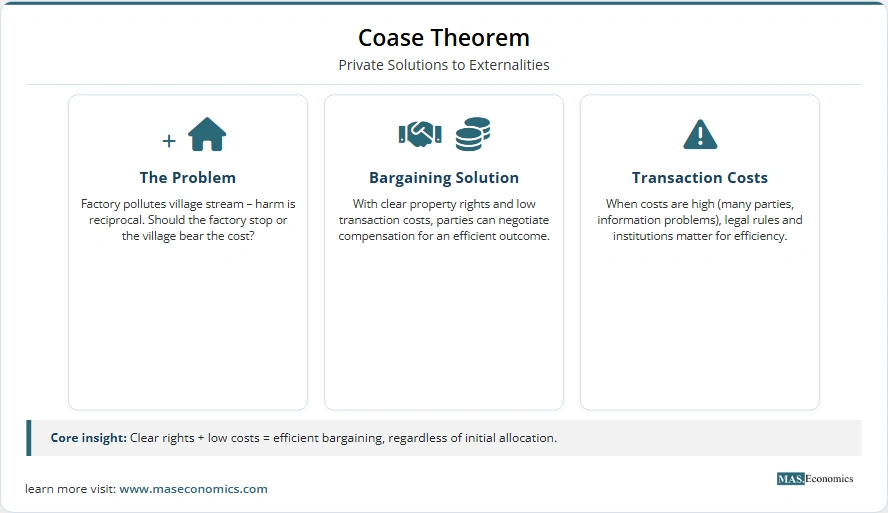
Consider this scenario: A textile factory opens next to your village. Its wastewater flows into the stream where your community fishes and where farmers irrigate their crops. Who should pay to fix this? The factory owner? The farmers? The government?
For most of the 20th century, economists had a simple answer: tax the factory. Make the polluter pay. This was common sense, backed by one of the most respected economists of the era, Arthur Pigou.
Then along came Ronald Coase, a soft-spoken British economist with a radical idea that turned everything upside down. What if, Coase asked, the problem is not one-sided? What if the harm is reciprocal? And what if, under the right conditions, the affected parties could work things out themselves, without any government intervention at all?
Pigou’s Simple Solution
To understand why Coase was so radical, we need to understand the conventional wisdom he challenged.
In 1920, the Cambridge economist Arthur Pigou published The Economics of Welfare. He introduced the concept of externalities, costs imposed on third parties that are not reflected in market prices. When a factory emits smoke that damages neighboring laundries, that is an externality. The factory’s private costs (fuel, labor, materials) are less than its social costs (fuel, labor, materials plus the laundry damage).
Pigou’s solution was elegantly simple: tax the factory an amount equal to the damage it causes. This “Pigouvian tax” would force the factory to internalize the externality. The factory would then have an incentive to reduce pollution, install filters, or even shut down if the damage exceeded its profits. The tax revenue could compensate the victims.
This approach became textbook economics. It seemed obvious: if someone harms others, make them pay. Governments around the world adopted Pigouvian taxes and regulations to address pollution, noise, and countless other problems.
But Pigou’s solution had a hidden assumption: that government intervention is necessary because private parties cannot or will not solve the problem themselves. Coase would challenge this assumption at its core.
The Man Behind the Theorem
Ronald Coase was not a typical economist. Born in 1910 in London, he studied at the London School of Economics (LSE) from 1929 to 1932, earning a Bachelor of Commerce degree. A traveling scholarship took him to the University of Chicago, but his early career was spent at the Dundee School of Economics and the University of Liverpool.
In 1935, Coase returned to LSE as a faculty member, where he remained until 1951. During these years, he wrote what would become two of the most cited articles in economics: “The Nature of the Firm” (1937) and, later, “The Problem of Social Cost” (1960). His work was sparse but profound; each paper opened entirely new fields of inquiry.
In 1951, Coase moved to the United States, eventually landing at the University of Chicago in 1964. It was at Chicago that his most famous paper would face its ultimate test.
The 1960 Seminar: When Coase Won Over Chicago
When Coase submitted “The Problem of Social Cost” for publication, it challenged the Pigouvian orthodoxy that Chicago economists held dear. The faculty invited him to present his ideas at a seminar in 1960. In the room were twenty of the profession’s giants, including George Stigler and Milton Friedman, both future Nobel laureates.
The story goes that the audience began unanimously opposed to Coase’s argument. But as the discussion progressed, Coase’s logic slowly won them over. By the end, even his fiercest critics had shifted their positions. George Stigler later described it as a “paradigm-shifting moment” in the genesis of Chicago law and economics.
Coase would receive the Nobel Prize in 1991 for his “discovery and clarification of the significance of transaction costs and property rights for the institutional structure and functioning of the economy.”
The Core Idea: Harm Is Reciprocal
Coase’s fundamental insight was stunning in its simplicity: harm is reciprocal. When a factory pollutes a stream, it harms the downstream users. But preventing the factory from polluting also harms the factory owner and its customers. The real question is not “who caused the harm?” but “which harm is greater?”
As Coase wrote in his 1960 paper:
“The traditional approach has tended to obscure the nature of the choice that has to be made. The question is commonly thought of as one in which A inflicts harm on B, and what has to be decided is: how should we restrain A? But this is wrong. We are dealing with a problem of a reciprocal nature. To avoid the harm that B would inflict on A. The real question that has to be decided is: should A be allowed to harm B, or should B be allowed to harm A? The problem is to avoid the more serious harm.”
This reciprocal view changes everything. It is not about punishing the “bad guy.” It is about comparing the value of two activities, factory production versus clean water, and choosing the outcome that maximizes total value.
The Classic Examples
Coase illustrated his argument with several legal cases.
The Confectioner and the Doctor
In Sturges v. Bridgman, a confectioner had operated machinery in his shop for decades. A doctor then built a consulting room next door and found that the noise and vibration made it impossible to examine patients. The doctor sued to stop the confectioner’s machinery.
The court granted the injunction, forcing the confectioner to stop. But Coase asked: what if the confectioner’s business was more valuable than the doctor’s? Under the court’s ruling, the confectioner would have to shut down or move, even if his product was worth more than the doctor’s services. But with bargaining, the confectioner could pay the doctor to allow the machinery to continue. If the confectioner’s profit exceeded the doctor’s loss, a mutually beneficial deal was possible.
The Cattle and the Crops
Coase’s most famous example involves a cattle rancher and a farmer on neighboring land. The rancher’s cattle occasionally stray onto the farmer’s land, destroying crops. The question: Should the rancher be liable for the damage?
Coase showed that the answer does not affect the efficient outcome if bargaining is costless.
Suppose the rancher is liable. He will factor crop damage into his costs and reduce his herd size until the marginal benefit of another steer equals the marginal damage. If the rancher is not liable, the farmer will pay the rancher to reduce the herd, up to the value of the crops saved. Either way, the final herd size is the same, the one that maximizes total value.
This is the heart of what became known as the Coase Theorem.
The Coase Theorem
The Coase Theorem is actually two related propositions:
Proposition 1 (Efficiency): When property rights are clearly defined and transaction costs are zero, private bargaining will lead to an efficient outcome regardless of who initially holds the rights.
Proposition 2 (Invariance): When property rights are clearly defined and transaction costs are zero, the final allocation of resources will be the same, regardless of who initially holds the rights. (The only difference is who pays whom.)
These propositions were revolutionary. They suggested that government intervention, taxes, subsidies, and regulations might be unnecessary under ideal conditions. Private parties could solve externality problems themselves through bargaining.
A MASEconomics Example: The Factory and the Village
Let us make this concrete with a Pakistani example.
Consider a textile factory upstream from a village. The factory employs 200 workers and produces fabric worth Rs 10 million annually. The village downstream uses the river for fishing and irrigation, generating Rs 6 million annually in fish and crops. The factory’s pollution reduces the village’s output by Rs 2 million per year (from Rs 6 million to Rs 4 million).
The total value of both activities combined is Rs 14 million (Rs 10 million + Rs 4 million). But if the factory closed, the village would produce Rs 6 million, a total of just Rs 6 million. Clearly, keeping the factory open with compensation is better: Rs 14 million versus Rs 6 million.
Now consider two legal rules:
Rule 1: The factory is liable. The factory must pay for the Rs 2 million damage. Its net profit becomes Rs 8 million (Rs 10 million – Rs 2 million). The village gets Rs 6 million (Rs 4 million from production + Rs 2 million compensation). Total: Rs 14 million. The factory stays open.
Rule 2: The factory is not liable. The village suffers Rs 2 million in damage. The village can pay the factory up to Rs 2 million to reduce pollution. Suppose the factory can install filters costing Rs 1.5 million that eliminate all damage. The village pays Rs 1.5 million to the factory. The factory’s net: Rs 10 million – Rs 1.5 million (filters) + Rs 1.5 million (payment) = Rs 10 million. The village’s net: Rs 6 million – Rs 1.5 million = Rs 4.5 million. Total: Rs 14.5 million.
The correct calculation: Without filters, the village gets Rs 4 million and the factory Rs 10 million, totaling Rs 14 million. With filters costing Rs 1.5 million, the village gets Rs 6 million and the factory Rs 8.5 million, totaling Rs 14.5 million. So installing filters increases total value by Rs 0.5 million. The village can pay up to Rs 2 million (its damage) to get filters installed. The factory will accept any payment above Rs 1.5 million (its cost). They split the Rs 0.5 million gain. The factory ends up with between Rs 8.5 and Rs 10 million; the village with between Rs 4 and Rs 6 million. The exact split depends on bargaining power. But the key point: the filters get installed regardless of who had the initial right. The only difference is who pays whom.
This is Coase’s invariance result in action.
The Crucial Caveat
Coase’s theorem is often misunderstood. Critics point out that zero transaction costs do not exist in the real world. Coase knew this perfectly well. In fact, his point was exactly the opposite: because transaction costs are positive, legal rules and property rights matter enormously.
What are transaction costs? They include:
- Search costs: Finding who is affected and how to contact them.
- Bargaining costs: Negotiating an agreement can be time-consuming and contentious.
- Enforcement costs: Ensuring the agreement is followed.
- Strategic behavior: Parties may hold out for a better deal, delaying agreement.
- Free riding: When many parties are affected, each may hope others will pay.
As Coase wrote in Section 6 of his paper:
“In order to carry out a market transaction it is necessary to discover who it is that one wishes to deal with, to inform people that one wishes to deal and on what terms, to conduct negotiations leading up to a bargain, to draw up the contract, to undertake the inspection needed to make sure that the terms of the contract are being observed, and so on. These operations are often extremely costly, sufficiently costly at any rate to prevent many transactions that would be carried out in a world in which the pricing system worked without cost.”
When transaction costs are high, the initial allocation of rights matters. If the factory is not liable and bargaining with 1,000 villagers is prohibitively costly, the pollution continues, even if the village’s total loss exceeds the factory’s gain. The efficient outcome may not be reached.
This is where government intervention, Pigouvian taxes, regulations, or court rulings, can potentially improve outcomes. The challenge is that government intervention also has costs and may be poorly designed.
Applications
Despite the caveats, Coase’s insights have shaped policy in countless areas.
Emissions Trading
The most direct application is emissions trading systems. The U.S. Acid Rain Program, the European Union Emissions Trading System (EU ETS), and China’s national carbon market all create tradable permits for pollution. By clearly defining property rights (permits to emit) and allowing trading, these systems harness Coasean bargaining to reduce pollution at the lowest cost. Polluters who can reduce emissions cheaply do so and sell their permits; those facing high costs buy permits. The total pollution cap is fixed, but who reduces what is determined by the market.
Spectrum Auctions
When governments auction radio spectrum to telecom companies, they are creating property rights and letting the market allocate them. Companies that value spectrum most (because they can serve more customers) will bid the highest. This is Coasean efficiency in action.
Fisheries Quotas
Many countries now use individual transferable quotas (ITQs) for fishing. Each fisher gets a share of the total allowable catch, and quotas can be bought and sold. Fishers who can fish efficiently buy quotas from less efficient fishers. The total catch is sustainable, and it is caught at the lowest cost.
Tradable Water Rights
In water-scarce regions like Australia’s Murray-Darling Basin and parts of the western United States, tradable water rights allow farmers to buy and sell water. A farmer growing high-value crops can buy water from a farmer growing lower-value crops. Both benefit, and water goes to its highest-value use.
Each of these applications required the government to create a property rights system. But once created, private bargaining does the rest.
Blockchain and the Coasean Dream
The rise of blockchain technology has sparked new interest in Coase. Proponents argue that smart contracts and decentralized platforms can reduce transaction costs to near zero, creating a Coasean paradise where private ordering replaces legal systems.
But is this true? A 2025 paper by Martino and Ringe examines “The Social Cost of Blockchain” and finds a more complex picture.
The Promise
Blockchain offers several features that should reduce transaction costs:
- Decentralization: No need for trusted intermediaries.
- Immutability: Transactions cannot be altered once recorded.
- Self-enforcement: Smart contracts execute automatically.
- Minimal trust: Parties need not know or trust each other.
These features seem to align perfectly with Coase’s assumptions. In theory, blockchain could enable billions of strangers to bargain and transact at negligible cost.
The Reality
Martino and Ringe identify several ways blockchain creates new transaction costs:
- Environmental externalities: Proof-of-work mining consumes enormous energy, imposing costs on everyone. Bitcoin’s energy use rivals that of medium-sized countries. These costs are not reflected in transactions.
- Concentrated power: Despite claims of decentralization, mining power concentrates in a few large pools. A handful of miners effectively become new intermediaries.
- Governance risks: Who decides when a blockchain protocol changes? Core developers and major miners can impose changes that affect all users. Hard forks create two incompatible ledgers, confusing property rights.
- Smart contract bugs: Code is not law, it is just code. Bugs can destroy billions in value, as with the 2016 DAO hack. When things go wrong, there is no court to appeal to.
- Custodial risks: Most users do not hold crypto directly; they use exchanges and wallets. These intermediaries are vulnerable to hacks, fraud, and bankruptcy, as FTX spectacularly demonstrated.
As Lorne and Aldad argue in their 2023 paper on Coase and DeFi, the crypto world must ultimately answer how it reduces transaction costs in trading across time. The 2020 pandemic fueled crypto activity, but the fundamental questions remain: Can decentralized finance truly lower transaction costs, or does it simply shift them to new forms?
Martino and Ringe conclude that blockchain does not eliminate transaction costs or intermediaries. It reshuffles them, often in less transparent ways. Code is not law, and the law retains an essential role in providing legal finality and resolving disputes.
The Empty Core Problem
A 2026 paper by Aivazian and Callen raises a more fundamental challenge to Coase. Using cooperative game theory, they show that the Coase theorem may break down when more than two parties are involved, even with zero transaction costs.
The problem is the core of the bargaining game. The core is the set of outcomes that no coalition can improve upon. When the core is empty, there is no stable outcome that all parties can agree on. Any proposed deal can be blocked by a coalition that can do better on its own.
Aivazian and Callen show that with three or more parties, the core may be empty under one property rights regime but non-empty under another. This means the initial allocation of rights does affect whether an efficient outcome is even possible. The invariance proposition fails.
Transaction costs make the empty core problem worse. When bargaining is costly, parties may never find a stable agreement.
This is a significant theoretical challenge. It suggests that Coase’s results are less robust than commonly thought, and that institutional design, including legal rules, matters even in ideal conditions.
Other-Regarding Preferences
A 2021 paper by Hervés-Beloso and Moreno-García offers a more optimistic extension. They incorporate “other-regarding preferences,” meaning people care about fairness, not just their own payoffs, into a general equilibrium model with tradable rights.
Their result: under certain conditions, Coasean efficiency still holds. Even when people care about fairness, as long as rights can be traded costlessly and preferences satisfy certain properties, equilibrium allocations are efficient and belong to the core.
This is important because real people do care about fairness. Experiments show that bargainers often reject offers they consider unfair, even when it costs them money. The fact that Coasean logic can accommodate such preferences strengthens its relevance.
Critiques and Limitations
Coase’s theorem has faced decades of scrutiny. The main critiques include:
Wealth Effects
When rights are assigned differently, the distribution of wealth changes. The party that receives the right becomes wealthier; the other becomes poorer. This can affect their willingness to pay or accept compensation. If the factory owner is richer under one rule, he may value pollution differently. The invariance result requires that income effects be negligible, which may not hold.
Strategic Behavior
Parties may not bargain in good faith. They may hold out for a better deal, delaying agreement. They may misrepresent their valuations. They may engage in brinkmanship. These behaviors can prevent efficient outcomes even when transaction costs are low.
Information Asymmetries
If one party does not know how much the other values the right, bargaining may fail. The polluter may demand too much; the victim may offer too little. Efficient trades may not occur.
Large Numbers
When many parties are affected, bargaining becomes exponentially harder. Coordinating thousands of villagers to negotiate with a factory is practically impossible. Free riding becomes irresistible; each villager hopes others will pay.
The Hold-Up Problem
If one party invests in reliance on a future agreement, the other party can “hold up” the first by demanding a larger share of the surplus. Anticipating this, the first party may underinvest. This problem, identified by Grossman and Hart (1986) and others, can prevent efficient outcomes even with zero transaction costs.
Does Coase Still Matter?
After all these critiques and extensions, you might wonder: should we still care about the Coase theorem? Absolutely. Here is why.
As a Diagnostic Framework
Coase teaches us to look for transaction costs. When we see an externality not being internalized, the question is: what barriers prevent private bargaining? Is it unclear property rights? High negotiation costs? Strategic behavior? This diagnostic approach is invaluable.
As a Justification for Property Rights
Coase shows why clear, well-defined property rights are essential. When rights are fuzzy, bargaining cannot happen. When they are clear, private solutions become possible.
As a Caution Against Government Failure
Coase reminds us that government intervention also has costs. Regulations may be poorly designed, captured by special interests, or impose unintended consequences. The choice between market and government is always a choice between imperfect alternatives.
As a Foundation for Institutional Analysis
Coase’s work spawned entire fields, law and economics, new institutional economics, and transaction cost economics. These fields study how legal rules, organizational forms, and social norms affect economic performance.
As a Reminder of Reciprocity
Most importantly, Coase taught us to see externalities as reciprocal. The problem is not one of assigning blame, but of comparing values. This perspective is more subtle and more useful than the simple “polluter pays” intuition.
The Bottom Line
The Coase theorem is not a literal description of how the world works. It is a thought experiment, a benchmark against which we can measure reality. By showing what would happen in a world of zero transaction costs, Coase revealed why transaction costs matter so much in our world.
When transaction costs are low, private bargaining can work. When they are high, law and institutions matter. The art of economic policy is to design institutions that minimize transaction costs, define rights clearly, and enable private solutions wherever possible.
As Coase himself said in his Nobel lecture: “The world of zero transaction costs has often been described as a Coasean world. Nothing could be further from the truth. It is the world of modern economic theory, one which I was hoping to persuade economists to leave.”
We should leave that world, too, but carry its lessons with us.
Did you find this article helpful? Share it with someone who loves economics. And remember, at MASEconomics, we make complex ideas simple.