Does it matter whether a company finances itself with debt or equity? Ask most business owners, and they will tell you it matters enormously. Debt is cheaper, they say, but too much debt invites bankruptcy. Equity is safer, but it dilutes ownership. There must be a perfect balance, a sweet spot where the cost of capital is minimized, and firm value is maximized.
In 1958, two economists published a paper that turned this conventional wisdom on its head. Franco Modigliani and Merton Miller argued that, under a set of carefully specified conditions, the value of a firm is completely unaffected by its capital structure. The mix of debt and equity, they claimed, is irrelevant.
The idea was so radical that it took years for the profession to accept it. Today, the Modigliani-Miller theorem is the bedrock upon which modern corporate finance is built, not because it describes reality perfectly, but because it forces us to ask exactly why capital structure does matter.
The Traditional View
Before 1958, finance textbooks taught that a firm’s cost of capital followed a U-shaped curve. As the company added debt, the cost of capital initially fell. Debt was cheaper than equity, and the tax deductibility of interest (though not yet fully appreciated) made it even cheaper. But beyond some point, the cost of equity and debt would rise sharply as investors demanded higher returns to compensate for the increased risk of bankruptcy. Somewhere in the middle lay an optimal capital structure that minimized the cost of capital and maximized firm value.
This view was intuitive, but it lacked a rigorous theoretical foundation. It was also difficult to test empirically. How could one separate the effect of leverage on value from the myriad other factors that affect stock prices? Modigliani and Miller, both trained in the neo-classical tradition, saw an opportunity to apply the logic of arbitrage to the capital market.
The Two Minds Behind the Theorem
Franco Modigliani (1918–2003) was an Italian economist who fled fascism in 1939. After earning a law degree from the University of Rome, he arrived in the United States and eventually earned a PhD from the New School for Social Research. He taught at the University of Illinois, Carnegie Mellon, and later MIT, where he would win the Nobel Prize in 1985 (shared with Miller) for his work on consumption and corporate finance.
Merton H. Miller (1923–2000) was an American economist who studied at Harvard and Johns Hopkins, and taught at the London School of Economics and Carnegie Mellon before moving to the University of Chicago. He was known for his sharp wit and his insistence on the power of market equilibrium reasoning.
Their collaboration began at Carnegie Mellon in the 1950s. In a 1958 paper published in the American Economic Review, they laid out what would become known as Proposition I and Proposition II.
Proposition I: The Irrelevance Result
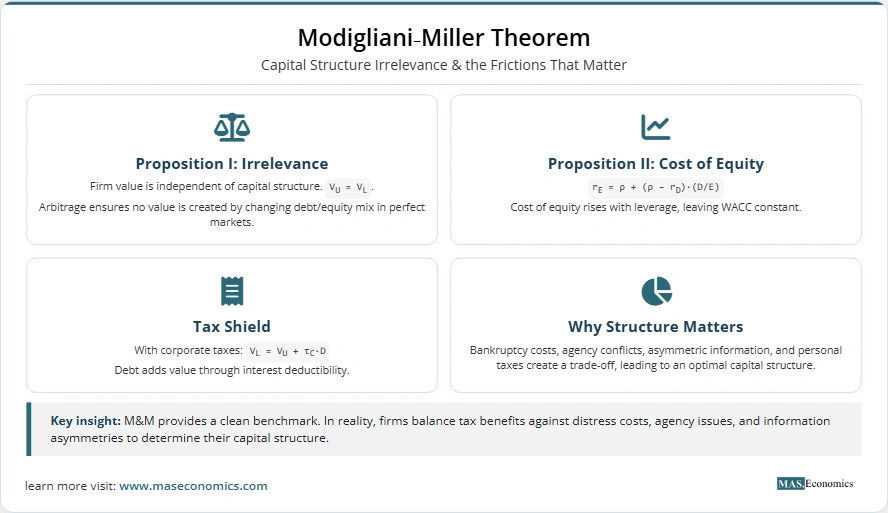
The first proposition is the most famous: the market value of any firm is independent of its capital structure and is given by capitalizing its expected return at a rate appropriate for its risk class.
In symbols:
V_j = \frac{\bar{X}_j}{\rho_k}
$$
where \(V_j\) is the total market value of the firm (debt plus equity), \(\bar{X}_j\) is the expected return on the firm’s assets (earnings before interest), and \(\rho_k\) is the capitalization rate for an unlevered firm in the same risk class.
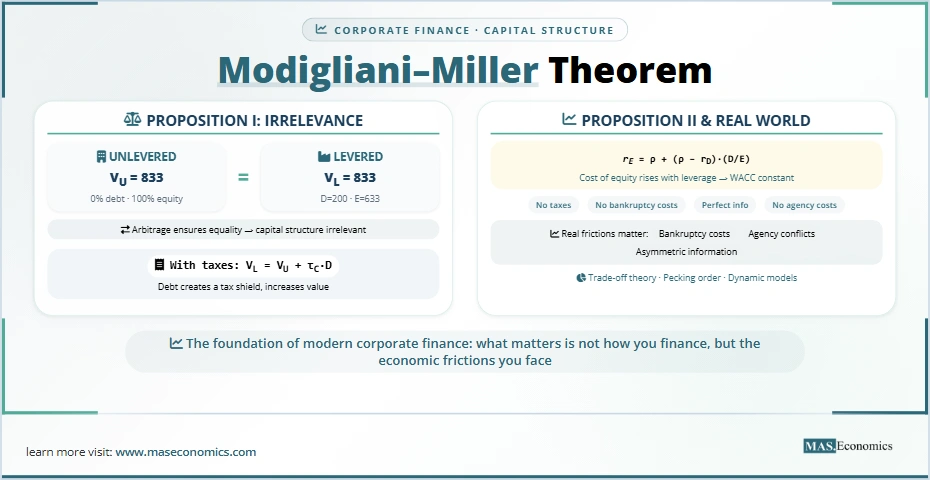
What does this mean in practice? Take two firms that are identical in every way except that one uses debt and the other does not. According to Proposition I, the total market value of the two firms should be equal. Why? Because investors can replicate the effect of leverage on their own, at the same cost, by borrowing on personal account. If the levered firm were worth more, investors would sell the levered firm’s shares, buy the unlevered firm’s shares, and borrow personally to replicate the leverage. This arbitrage would drive prices back into line.
A MASEconomics Example
Consider two Pakistani textile firms, Textilia and Levertex. Both have the same expected earnings before interest of Rs 100 million. Textilia is all-equity financed. Levertex has Rs 200 million in debt at an interest rate of 10% (so interest payments are Rs 20 million) and the rest in equity. Suppose the required return for unlevered textile firms in Pakistan is 12%.
According to Proposition I, the market value of Textilia should be:
V_U = \frac{100}{0.12} = 833.33 \text{ million rupees}
$$
Now, what about Levertex? Its equity holders are entitled to earnings after interest: \(100-20 = 80\) million. If the market valued Levertex’s equity using the same 12% rate, its equity would be \(80 / 0.12 = 666.67\) million. Adding debt of 200 million gives a total firm value of 866.67 million, higher than Textilia. But M&M argued this could not persist. An investor holding 1% of Levertex’s shares (worth 6.6667 million) would receive 1% of 80 million = 0.8 million. That investor could instead sell those shares, borrow 2 million (1% of Levertex’s debt) on a personal account, and buy 1% of Textilia’s shares (worth 8.3333 million). The investor’s total investment would be \(8.3333-2 = 6.3333\) million. The investor’s return would be 1% of Textilia’s earnings (1 million) minus interest on the personal loan (\(2 \times 0.10 = 0.2\) million) = 0.8 million, the same as before. But the investor has freed up 0.3334 million in capital. To earn the same return, the investor could invest the freed capital at the risk-free rate, earning extra. This would drive demand for Textilia’s shares, raising its price, and sell Levertex’s shares, lowering its price, until the values equalize.
Thus, in a world without taxes or bankruptcy costs, capital structure does not matter.
Proposition II: The Cost of Equity
Proposition II describes how the cost of equity changes with leverage. It states that the expected return on equity is a linear function of the debt-equity ratio:
i = \rho_k + (\rho_k-r) \frac{D}{S}
$$
where \(i\) is the cost of equity, \(\rho_k\) is the cost of capital for an unlevered firm, \(r\) is the interest rate on debt, and \(D/S\) is the debt-to-equity ratio.
In words: as a firm takes on more debt, the cost of equity rises exactly enough to keep the overall cost of capital constant. The increase reflects the additional financial risk borne by shareholders. So the cheaper debt is offset by more expensive equity.
The Crucial Assumptions
The irrelevance result rests on a set of assumptions that are clearly unrealistic:
- No taxes – interest is not tax-deductible; personal taxes are ignored.
- No transaction costs – investors can borrow and lend at the same rate as corporations.
- No bankruptcy costs – default is costless.
- Perfect information – all investors have the same expectations about future earnings.
- No agency problems – managers always act in the interest of shareholders.
These assumptions are strong, but they serve a purpose: they isolate the pure logic of capital structure. Any real-world deviation from the theorem must be explained by relaxing one or more of these assumptions.
The Tax Correction (1963)
In a 1963 follow-up paper, Modigliani and Miller acknowledged the most obvious missing element: corporate taxes. Interest payments are deductible from taxable income, while dividends are not. This creates a tax advantage for debt. In the presence of corporate taxes, the value of a levered firm becomes:
V_L = V_U + \tau_C D
$$
where \(\tau_C\) is the corporate tax rate. The extra term \(\tau_C D\) is the present value of the interest tax shield. Under this corrected theory, a firm could increase its value simply by substituting debt for equity. The optimal capital structure would be 100% debt.
But of course, we do not observe firms with all-debt capital structures. Something else must be limiting the use of debt.
The Miller Equilibrium (1977)
Merton Miller revisited the tax issue in a 1977 presidential address to the American Finance Association. He showed that when personal taxes are introduced, the corporate tax advantage of debt can be offset by higher personal taxes on interest income. In equilibrium, the tax advantage of debt to the firm is exactly balanced by the tax disadvantage to the marginal bondholder. The result: capital structure becomes irrelevant again, even with corporate taxes.
Miller’s insight was that the aggregate supply of corporate debt adjusts until the marginal investor’s personal tax rate on interest equals the corporate tax rate. In this equilibrium, the value of the firm is independent of its leverage, but now the equilibrium is determined by market forces rather than by any individual firm’s decision.
Why Capital Structure Does Matter
While the Modigliani-Miller theorem provides a powerful benchmark, real-world capital structures are clearly not arbitrary. Three broad classes of frictions break the irrelevance result.
1. Bankruptcy and Financial Distress Costs
When a firm uses debt, it risks default. Default itself may impose direct costs (legal fees, administrative expenses) and indirect costs (loss of customers, suppliers, and employees; fire-sale of assets). The expected costs of financial distress rise with leverage. Firms balance these costs against the tax benefits of debt, a trade-off that leads to an interior optimum.
The static trade-off theory, popularized by Myers (1984) and others, suggests that each firm has a target debt ratio where the marginal tax benefit equals the marginal expected distress cost.
2. Agency Costs
Conflicts of interest between shareholders and bondholders can lead to under-investment (the “debt overhang” problem) or asset substitution (taking excessive risk). These agency costs tend to rise with leverage, and they can be mitigated by debt covenants or by using equity.
3. Asymmetric Information
Myers and Majluf (1984) introduced the pecking order theory: because managers know more about the firm’s prospects than outside investors, they prefer internal financing (retained earnings) to external financing. If external financing is needed, they prefer debt to equity, because issuing equity can signal that the firm is overvalued. Thus, observed debt ratios reflect the cumulative need for external financing rather than a target ratio.
The pecking order theory has received strong empirical support, especially for small and medium-sized enterprises (e.g., the Ghanaian study by Agyei et al., 2020).
Modern Views: Dynamic Capital Structure
Fischer, Heinkel, and Zechner (1989) extended the trade-off theory to a dynamic setting where firms face recapitalization costs. They showed that even small transaction costs can lead to wide swings in a firm’s debt ratio over time. Firms do not continuously adjust to a target; instead, they wait until leverage reaches an upper or lower boundary before refinancing. This dynamic view reconciles the observed variation in debt ratios with the idea that firms care about capital structure.
Does M&M Still Matter?
After all these extensions and critiques, one might ask: Should we still teach the Modigliani-Miller theorem? Absolutely. Here is why.
As a Benchmark
The theorem gives us a clean baseline. Whenever we see a firm’s financing decisions affecting its value, we know to look for the specific market imperfections that cause that effect. Without M&M, our thinking about capital structure would be muddled.
As a Pedagogical Tool
The theorem is one of the best examples of the power of arbitrage reasoning. It teaches students to think like an economist: to see through financial packaging and focus on the underlying economic fundamentals.
As a Foundation
The subsequent literature, tax, bankruptcy costs, agency, and asymmetric information all build directly on the M&M framework. The trade-off theory, the pecking order theory, and modern dynamic models all trace their lineage to the 1958 paper.
As a Reminder
The theorem reminds us that finance is not about clever packaging; it is about real assets and cash flows. A firm cannot create value simply by issuing more debt unless it also changes something else, such as taxes, risk, or information.
The Bottom Line
The Modigliani-Miller theorem is one of those rare ideas that seem absurd at first and obvious later. It says that in a perfect market, the way you finance a firm is irrelevant. Of course, markets are not perfect. But by showing us what a perfect market would look like, the theorem forces us to confront the imperfections that really matter. It has inspired generations of research into bankruptcy costs, taxes, agency problems, and asymmetric information, and it remains the starting point for any serious discussion of capital structure.
Frequently Asked Questions
What is the Modigliani-Miller theorem?
The 1958 result that in a world with no taxes, no bankruptcy costs and no information asymmetry, a firm’s total value depends only on the earning power of its assets, not on whether it is financed with debt or equity. Rearranging the balance sheet does not create value, it only redistributes claims on the same cash flows.
What are Modigliani-Miller propositions I and II?
Proposition I says firm value is independent of capital structure. Proposition II says the cost of equity rises linearly with leverage, exactly enough to offset the cheaper debt, so the weighted average cost of capital stays flat. The second proposition is what makes the first one work.
Why does capital structure matter in the real world?
Because the assumptions fail. Interest is tax deductible, which makes debt cheaper and pushes firms toward borrowing. Bankruptcy has real costs, which pushes back. Managers know more than investors, so the choice of financing signals something. The theorem’s value is that it tells you exactly which imperfection you are relying on.
Did you find this article helpful? Share it with someone who loves economics. And remember, at MASEconomics, we make complex ideas simple.