Why do two competing firms sometimes settle on prices that neither would change even if they could? Why do countries often end up in trade wars that leave everyone worse off? Why does a crowded market sometimes collapse into a monopoly? And how do we make sense of situations where what is best for you depends entirely on what others do?
These questions lie at the heart of strategic interaction, the realm where economics meets game theory. For most of history, economists had no systematic way to answer them. Then, in 1950, a 22‑year‑old mathematics graduate student at Princeton published a one‑page paper that would transform how we understand strategic decision‑making. That paper introduced the concept we now call the Nash equilibrium.
What Did Economists Believe?
Before John Nash, economists had a rich tradition of analyzing strategic situations, but no unified theory. Augustin Cournot, in 1838, had shown how two duopolists might settle on a quantity that is a best response to each other’s output. Francis Edgeworth had explored price competition. But these were isolated models, not a general framework.
The first major breakthrough came in 1944 with the publication of John von Neumann and Oskar Morgenstern’s Theory of Games and Economic Behavior. They introduced the idea of game theory as a mathematical discipline. However, their focus was largely on two‑person zero‑sum games, where one player’s gain is exactly the other’s loss. For such games, they proved the minimax theorem, showing that there is a value of the game and that players can guarantee at least that value by choosing mixed strategies.
But what about games where interests are not diametrically opposed? What about three or more players? What about situations where cooperation or conflict are mixed? The theory was silent. Economists knew that many real‑world interactions, from bargaining to oligopoly to voting, did not fit the zero‑sum mould. There was a gaping hole in the theory of strategic behaviour.
It was into this gap that Nash stepped.
John Forbes Nash Jr.
John Forbes Nash Jr. was born in 1928 in West Virginia. A brilliant but unconventional student, he entered Princeton in 1948 to study mathematics. There, he was immersed in the intellectual ferment surrounding game theory. Von Neumann and Morgenstern were at Princeton; the Theory of Games was a major talking point.
Nash’s doctoral supervisor, Albert Tucker, later recalled that Nash came to him with an idea for a new kind of equilibrium, one that would apply to all games, not just zero‑sum. The idea was deceptively simple: a set of strategies is in equilibrium if each player’s strategy is a best response to the others. No player can gain by changing alone.
In 1950, Nash published his result in a one‑page note in the Proceedings of the National Academy of Sciences. The paper, titled “Equilibrium Points in n‑Person Games,” was a masterpiece of concision. It defined the equilibrium, proved its existence using Kakutani’s fixed‑point theorem, and noted its implications.
But the reception was not immediately enthusiastic. Von Neumann, upon hearing Nash’s idea, reportedly dismissed it as “trivial”, perhaps because he saw it as a generalisation of the minimax theorem. It took years for the importance of Nash’s contribution to be fully appreciated. Nash went on to make groundbreaking contributions to pure mathematics (including the Nash embedding theorem) and to economics (including his work on bargaining). He struggled with mental illness for decades, but eventually, in 1994, he shared the Nobel Prize in Economic Sciences with John Harsanyi and Reinhard Selten for his work on game theory.
The Core Idea Explained
To understand Nash equilibrium, consider a game with any number of players. Each player chooses a strategy, a plan of action, from their available options. The payoff each player receives depends on the combination of strategies chosen by everyone.
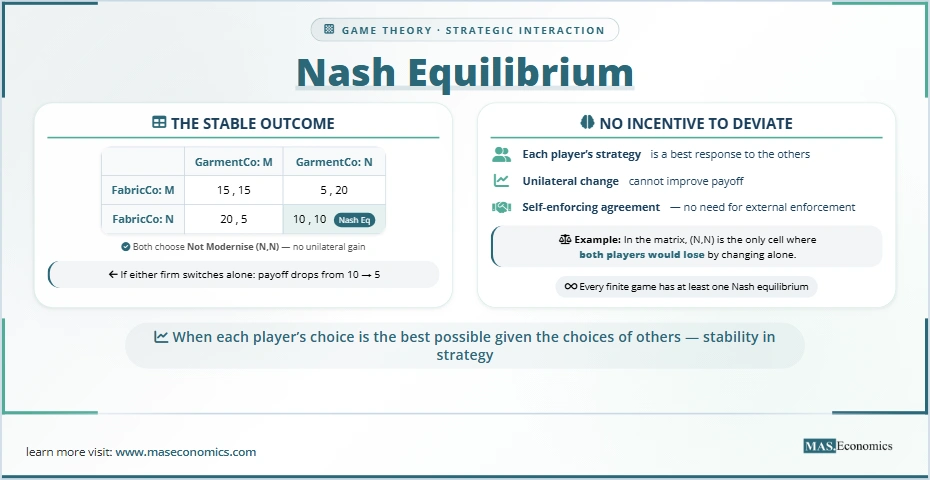
A Nash equilibrium is a set of strategies, one for each player, with the property that no player can gain by unilaterally changing their own strategy. In other words, each player’s strategy is a best response to the strategies of the others.
Consider a simple two‑player game. Suppose two Pakistani textile firms, FabricCo and GarmentCo, are deciding whether to modernise their factories. Each can choose either Modernise (M) or Not Modernise (N). The payoffs (in millions of rupees) are as follows:
| GarmentCo: M | GarmentCo: N | |
|---|---|---|
| FabricCo: M | (15, 15) | (5, 20) |
| FabricCo: N | (20, 5) | (10, 10) |
Let us examine whether any combination is a Nash equilibrium.
- Suppose both modernise: (M, M). If FabricCo switches to N while GarmentCo stays at M, FabricCo’s payoff rises from 15 to 20. So FabricCo can gain by deviating. Therefore, (M, M) is not an equilibrium.
- Suppose FabricCo modernises and GarmentCo does not: (M, N). FabricCo gets 5; if it switches to N, its payoff becomes 10, a gain. So not an equilibrium.
- Suppose FabricCo does not modernise and GarmentCo does: (N, M). Symmetrically, GarmentCo would want to switch. Not an equilibrium.
- Finally, (N, N): each gets 10. If FabricCo switches to M, its payoff falls to 5; if GarmentCo switches, its payoff also falls to 5. Neither can gain by changing alone. So (N, N) is a Nash equilibrium.
This simple example illustrates the core logic. A Nash equilibrium is a mutual best response: each player is doing the best they can, given what the others are doing. It is a self‑enforcing outcome: if players are at such an equilibrium, no one has an incentive to move away.
Nash proved that every finite game (with any number of players) has at least one Nash equilibrium, possibly in mixed strategies (where players randomise over pure strategies). His proof used a fixed‑point theorem, a mathematical technique that shows the existence of a solution to certain kinds of equations. This existence result is fundamental: it assures us that the concept is not empty.
A MASEconomics Example
Consider two Pakistani exporters, ExpoCorp and TradeLink. They are considering whether to target the European market (E) or the Southeast Asian market (A). The payoffs depend on how many enter each market. Suppose the payoff matrix (in millions of rupees) is:
| TradeLink: E | TradeLink: A | |
|---|---|---|
| ExpoCorp: E | (12, 12) | (18, 6) |
| ExpoCorp: A | (6, 18) | (8, 8) |
Which outcomes are Nash equilibria?
- (E, E): each gets 12. If ExpoCorp switches to A, it gets 6, worse. If TradeLink switches, it also gets 6, worse. So (E, E) is an equilibrium.
- (A, A): each gets 8. If ExpoCorp switches to E, it gets 18, better. So (A, A) is not an equilibrium.
- (E, A): ExpoCorp gets 18, TradeLink gets 6. If ExpoCorp switches to A, it gets 8, worse; if TradeLink switches to E, it gets 12, better. So (E, A) is not an equilibrium.
- (A, E): similarly not an equilibrium.
Thus (E, E) is the only Nash equilibrium. Both firms end up targeting Europe, even though they would collectively be better off if one went to Asia, but that would require coordination and trust, which are not part of the non‑cooperative game.

Building on Nash’s Foundation
Nash’s equilibrium was a beginning, not an end. Over the following decades, economists and game theorists extended the concept to handle richer situations.
Incomplete Information
In many real‑world games, players do not know each other’s payoffs or private information. John Harsanyi (1967–68) showed that such games can be transformed into games of incomplete information by introducing “types” drawn from a known distribution. A Bayesian Nash equilibrium is then a set of strategies, one for each type of each player, that maximise expected payoffs given beliefs about others’ types. This framework underpins modern auction theory, contract theory, and many other areas.
Subgame Perfection
Reinhard Selten (1965, 1975) pointed out that Nash equilibrium sometimes predicts implausible outcomes in games with sequential moves. For example, in the entry‑deterrence game, a threat to retaliate might not be credible. Selten introduced subgame perfect equilibrium, requiring that strategies be optimal at every decision point, not just overall. This refinement eliminated many “empty threats” and became the standard for dynamic games.
Correlated Equilibrium
Robert Aumann (1974) introduced the concept of correlated equilibrium, where players can coordinate their strategies using a common random signal. Correlated equilibria can achieve outcomes that are not possible as Nash equilibria, and they are often more plausible in situations where players can observe a shared event. Aumann’s work highlighted the role of correlation in strategic thinking and has influenced mechanism design and economics.
Evolutionary Game Theory
Nash equilibrium also found a home in biology. John Maynard Smith and George Price (1973) introduced the evolutionarily stable strategy (ESS), a refinement of the Nash equilibrium for populations of individuals playing symmetric games. ESS became the foundation for evolutionary game theory, used to explain animal behaviour, cultural evolution, and even language.
The Challenge
Despite its elegance, the Nash equilibrium is not without its critics and limitations.
Multiple Equilibria and Coordination
Many games have more than one Nash equilibrium. Which one will players choose? For instance, in the “Battle of the Sexes”, there are two pure‑strategy equilibria. Without additional assumptions (like focal points or communication), the theory does not predict which one will occur. This problem of equilibrium selection remains an active area of research.
Experimental Deviations
Behavioural economists have run countless experiments testing the Nash equilibrium. In some games, such as the Prisoner’s Dilemma, players often cooperate despite the Nash equilibrium being defection. In others, like the Ultimatum Game, players reject low offers even when the Nash equilibrium predicts acceptance. These deviations suggest that people are influenced by fairness, reciprocity, and bounded rationality, factors not captured by the standard model.
The Limits of Rationality
Nash equilibrium assumes that players are perfectly rational, can compute best responses, and have common knowledge of rationality. In complex games, real players may use heuristics, learn over time, or simply make mistakes. Herbert Simon’s concept of bounded rationality and the subsequent literature on learning in games show that equilibrium may emerge as a long‑run outcome of learning processes rather than as an instantaneous result of perfect foresight.
Dynamic and Stochastic Considerations
The static nature of the Nash equilibrium does not directly explain how players reach it. Modern research on learning in games and distributed Nash equilibrium seeking (as surveyed in a recent Proceedings of the IEEE article) examines how players can iteratively adjust their strategies using only local information to converge to an equilibrium. These methods are crucial for applications in multi‑agent systems, power grids, and network control.
Where Is Nash Equilibrium Used Today?
Today, the Nash equilibrium is ubiquitous. It appears in virtually every field of economics and far beyond.
Industrial Organization
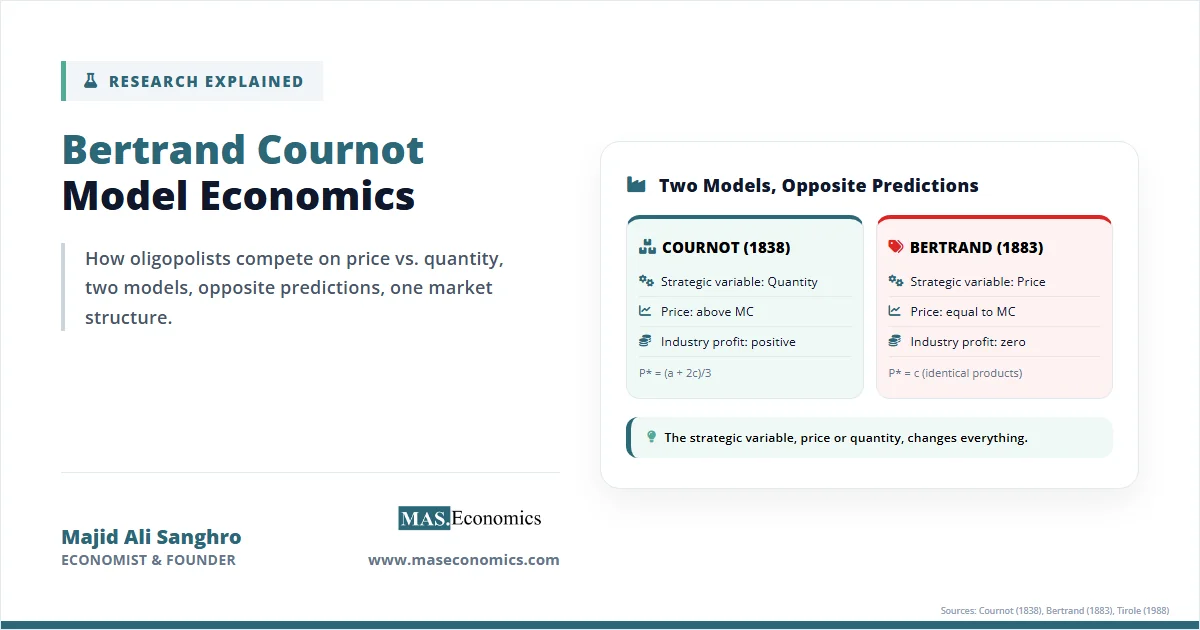
In oligopoly theory, the Nash equilibrium is the workhorse. The Cournot model of quantity competition and the Bertrand model of price competition are both analysed through the Nash equilibrium. Merger policy, entry deterrence, and R&D races are all understood through game‑theoretic lenses.
Auction Design
Auctions are a classic application. The Bayesian Nash equilibrium (incomplete information) predicts bidding behaviour in first‑price, second‑price, and many other auction formats. This theory guides the design of spectrum auctions, electricity markets, and advertising auctions.
Political Economy
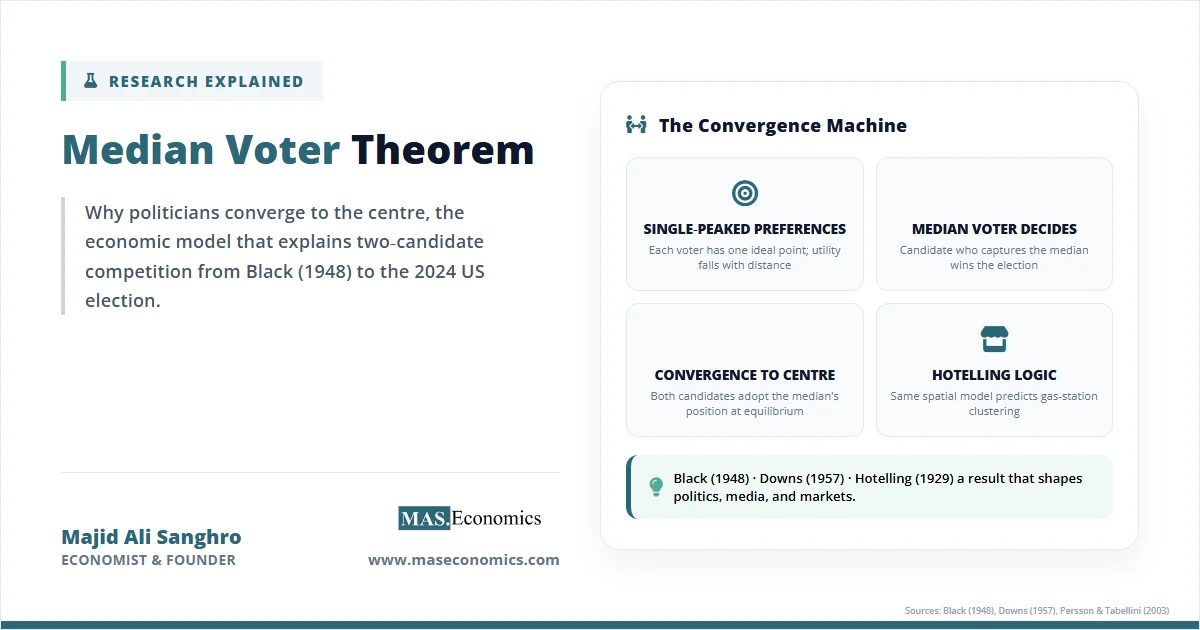
Voting behaviour, legislative bargaining, and international conflict are often modelled as games. The Nash equilibrium provides a way to analyse strategic behaviour in these contexts. For example, the median voter theorem can be seen as a Nash equilibrium of a spatial voting game.
Computer Science and AI
Nash equilibrium is central to multi‑agent systems, algorithmic game theory, and artificial intelligence. In machine learning, generative adversarial networks (GANs) can be interpreted as a two‑player zero‑sum game, with the equilibrium corresponding to the generator producing realistic data. Distributed optimisation and multi‑robot coordination often rely on Nash equilibrium concepts.
Biology and Evolutionary Theory
Evolutionary game theory uses Nash equilibrium (and its refinements) to model natural selection, animal conflict, and the emergence of cooperative behaviour. The concept helps explain why certain strategies persist in populations.
Control Theory and Engineering
Engineers now apply Nash equilibrium to problems like wind farm control, smart grid management, and traffic routing. In these settings, autonomous agents (wind turbines, electric vehicles, etc.) must coordinate their actions without centralised control. Distributed algorithms that converge to the Nash equilibrium provide a solution.
Why Does Nash Equilibrium Still Matter?
More than seventy years after its introduction, the Nash equilibrium remains the most influential concept in strategic analysis. It provides a unified language for thinking about interdependence, a benchmark against which to compare actual behaviour, and a design tool for creating institutions that align individual incentives with social goals.
Yes, the theory has been extended, refined, and sometimes questioned. Behavioural economics reminds us that real people are not perfectly rational. Learning theory shows how equilibrium might be approached over time. And multiple equilibria remind us that the environment matters. But none of this diminishes the fundamental insight: when each person’s best choice depends on what others do, the only stable outcomes are those where no one wants to change unilaterally.
The Nash equilibrium offers a way to cut through the complexity of strategic situations. It tells us to look for outcomes where everyone is doing their best, given what others are doing, and to think carefully about what would happen if someone changed their mind.
So the next time you see two firms competing, two countries negotiating, or two people bargaining, ask yourself: what is the Nash equilibrium? The answer might just explain why things are the way they are.
Did you find this article helpful? Share it with someone who loves economics. And remember, at MASEconomics, we make complex ideas simple.