Can a policy that harms some people still be called “efficient”? If winners could compensate losers, does that make the policy good, even if compensation is never paid? And what does this have to do with the billion‑dollar cost‑benefit analyses that shape our world?
Consider two hypothetical countries: Textilia and Machinia. Textilia is weighing a high‑speed rail line that will slash commute times for millions but will displace a few hundred homeowners along the route. Machinia is debating a carbon tax that will clean the air for everyone but will force a handful of coal plants to close, costing local jobs.
In both cases, the policies create clear winners and losers. If we insisted that no one should be worse off, the strict Pareto standard, neither policy could ever be approved. Yet in the real world, governments approve such policies all the time. How do economists justify this?
The answer lies in a concept that has quietly become the workhorse of modern policy analysis: the Kaldor‑Hicks criterion. It is the theoretical foundation behind cost‑benefit analysis, the justification for most government regulation, and the standard by which efficiency is measured in law and economics. And it rests on a simple but radical idea: a policy is efficient if the winners could compensate the losers, regardless of whether they actually do.
The Tyranny of Unanimity
Before Kaldor and Hicks, welfare economics was trapped. The dominant framework for evaluating social outcomes was Pareto efficiency, named after the Italian engineer‑turned‑economist Vilfredo Pareto (1848–1923). A change is a Pareto improvement if it makes at least one person better off and no one worse off. A state of affairs is Pareto efficient if no further Pareto improvements are possible.
The appeal of Pareto efficiency was undeniable: it required no interpersonal comparisons of utility and no value judgments about who “deserved” what. If everyone agreed, the change was unambiguously good. For economists who wanted to be “scientific” and “value‑free,” Pareto was a safe harbour.
But there was a fatal problem: Pareto improvements are vanishingly rare. Almost every policy, from building a bridge to raising taxes to regulating pollution, creates winners and losers. If economists could only endorse policies that made everyone better off, they would have nothing to say about most of the important decisions governments face.
This created what the economist Nicholas Kaldor would later call a “stultifying” situation. The economist as an adviser, he argued, was “completely stultified” if he could not compare the gains of some with the losses of others. If the incomparability of utility between different individuals was strictly pressed, “not only are the prescriptions of the welfare school ruled out, but all prescriptions whatever.”
Lionel Robbins, a leading figure at the London School of Economics, had forcefully argued in the 1930s that interpersonal comparisons of utility were impossible and therefore welfare economics was impossible. He had a point: how can you compare the pain of a factory worker losing his job with the pleasure of a commuter gaining time? There is no common scale.
But the policy world does not stand still. Governments needed guidance. And in 1939, two British economists independently offered a way out.
Kaldor and Hicks
Nicholas Kaldor (1908–1986) was a Hungarian‑born economist who spent most of his career at Cambridge University. A brilliant and combative thinker, he was deeply involved in economic policy, serving as an adviser to several governments and playing a key role in the development of the value‑added tax. His 1939 paper, “Welfare Propositions of Economics and Interpersonal Comparisons of Utility,” was a direct response to Robbins’s skepticism. Kaldor argued that the economist did not need to compare utilities directly; he only needed to show that the winners could compensate the losers.
John Hicks (1904–1989) was one of the most influential British economists of the twentieth century. His 1939 paper, “The Foundations of Welfare Economics,” arrived at almost exactly the same conclusion from a slightly different angle. Hicks would later win the Nobel Prize in 1972 for his work on general equilibrium theory. In his welfare paper, he proposed that a policy could be considered beneficial if it allowed for a “compensation test,” that is, if the gainers could compensate the losers and still be better off.
The two papers appeared in the same year, in the same journal (The Economic Journal), and they essentially invented what we now call the Kaldor‑Hicks criterion. Both men agreed that the compensation did not have to be actually paid; the possibility was enough to establish that the policy increased “economic efficiency” in some objective sense.
The Core Idea Explained
The Kaldor‑Hicks criterion can be stated with deceptive simplicity: a policy or change is efficient if those who gain from it could hypothetically compensate those who lose, and still be better off themselves.
This is often called a potential Pareto improvement. The keyword is “potential.” Unlike a true Pareto improvement, a Kaldor‑Hicks improvement does not require that compensation actually be paid. It only requires that the gains are large enough that compensation is possible.
Let us see how this works with a concrete MASEconomics example.
Example: The Textilia Pollution Tax
Consider that Textilia is considering a tax on industrial pollution. The tax will cost the city’s three factories $1 million each in compliance costs, a total loss of $3 million. But the tax will reduce pollution so dramatically that the city’s 100,000 residents will each gain $100 in better health and quality of life, a total gain of $10 million.
In strict Pareto terms, this policy is not an improvement. The factory owners are worse off. But under the Kaldor‑Hicks criterion, the policy is efficient. Why? Because the winners gain $10 million, the losers lose $3 million. The winners could, in principle, take $3 million of their gains, compensate the factory owners, and still have $7 million left over. Whether they actually do so is irrelevant to the efficiency judgment.
This is why cost‑benefit analysis, which you have encountered in articles like [[Fiscal Policy: Key Objectives, Strategies, and Challenges Explained]], works the way it does. When policymakers ask whether a project’s benefits exceed its costs, they are implicitly asking the Kaldor‑Hicks question.
A Deeper Look at the Logic
The logic behind Kaldor‑Hicks rests on a separation of efficiency from distribution. Kaldor and Hicks argued that economists should focus on efficiency, making the economic pie as large as possible, and leave questions of how to slice the pie to politicians and moral philosophers. As Kaldor wrote, “Whether the landlords, in the free‑trade case, should in fact be given compensation or not, is a political question on which the economist, qua economist, could hardly pronounce an opinion.”
This division of labour is appealing. It allows economists to offer clear, technical advice without wading into contentious value disputes. And it gives policymakers a straightforward metric: if benefits exceed costs, the policy is efficient; if costs exceed benefits, it is not.
But as we shall see, this neat separation is more fragile than it first appears.
A Formal Demonstration: The Compensating Test in Numbers
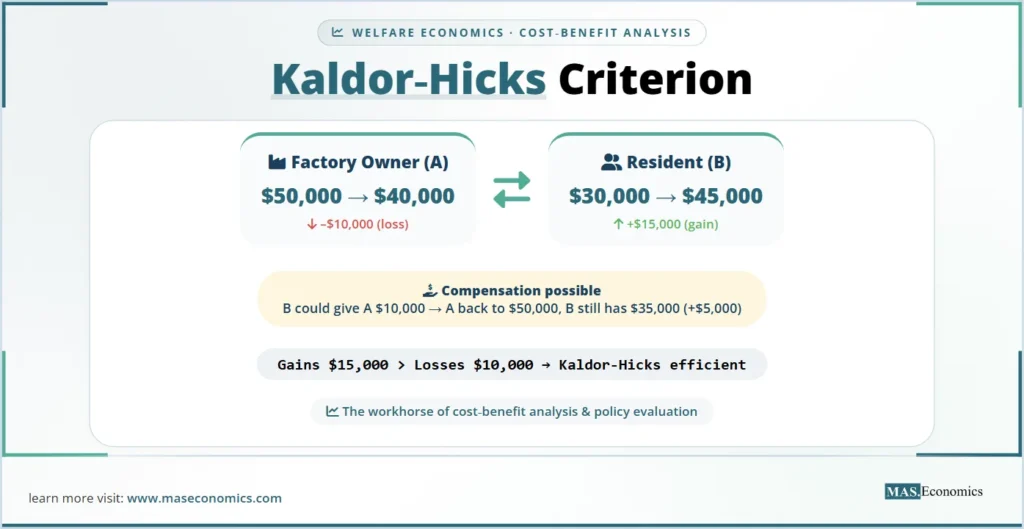
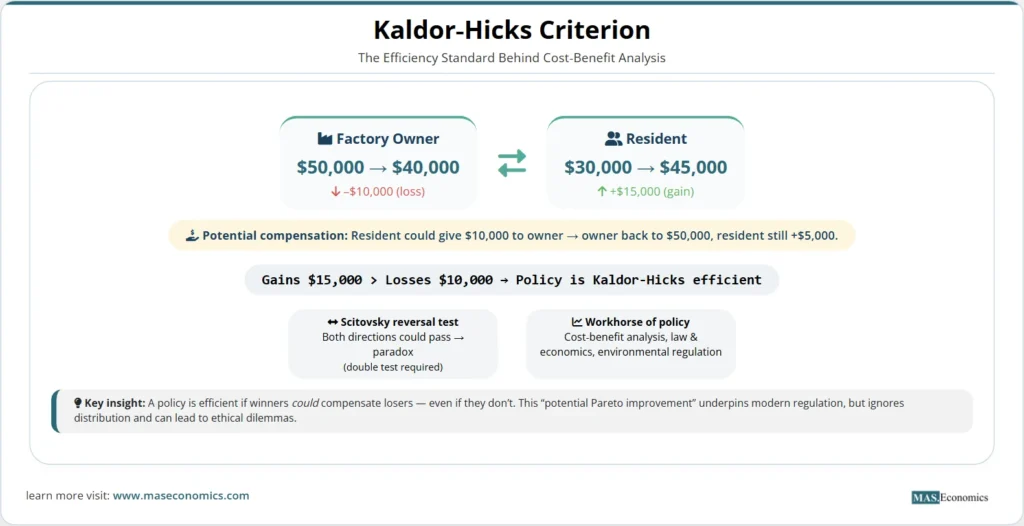
To make the Kaldor‑Hicks criterion precise, economists use the concept of compensating variation. Consider a simple society with just two people: A (a factory owner) and B (a resident). The current situation (status quo) gives A an income of $50,000 and B an income of $30,000. A proposed policy, a pollution tax, will change their incomes as follows:
| Individual | Income Before Policy | Income After Policy | Change |
|---|---|---|---|
| A (factory owner) | $50,000 | $40,000 | –$10,000 |
| B (resident) | $30,000 | $45,000 | +$15,000 |
| Total | $80,000 | $85,000 | +$5,000 |
The total income of society increases by $5,000. A loses $10,000, B gains $15,000. According to the Kaldor‑Hicks criterion, this policy is efficient because the gainer (B) could compensate the loser (A). How much compensation would be needed? B would need to give A $10,000 to make A whole again. After that transfer, A would have $50,000 (the same as before), and B would have $45,000 – $10,000 = $35,000, which is $5,000 more than his original $30,000. So both end up at least as well off, and one is strictly better off.
Now, let us formalise this in terms of compensating variation. For a loser, the compensating variation is the amount of money that, if received, would restore them to their original utility level. For a gainer, the compensating variation is the amount they would be willing to pay to secure the change. The Kaldor‑Hicks criterion is satisfied if the sum of the gainers’ willingness to pay exceeds the sum of the losers’ willingness to accept compensation.
In our example:
- Loser A’s willingness to accept (WTA) = $10,000 (the amount needed to make him indifferent).
- Gainer B’s willingness to pay (WTP) = up to $15,000 (the amount he gains; he would be willing to pay any amount less than $15,000 to secure the policy).
Since WTP ($15,000) > WTA ($10,000), the policy passes the Kaldor‑Hicks test.
A Numerical Representation with a Simple Table
We can represent the compensation test algebraically. Let:
- \(L\) = set of losers, each with loss \(l_i\)
- \(G\) = set of gainers, each with gain \(g_j\)
The policy is a Kaldor‑Hicks improvement if:
\sum_{j \in G} g_j > \sum_{i \in L} l_i
$$
In our numbers: \(15,000 > 10,000\) → efficient.
Now suppose the numbers were reversed: A loses $15,000, B gains $10,000. Then \(10,000 < 15,000\), and the policy would fail the test. The losers could not be compensated by the gainers.
This simple arithmetic illustrates the essence of Kaldor‑Hicks: net benefits matter, not just who wins and who loses.
But there is a subtlety. What if the policy changes relative prices, so that the amounts people are willing to pay or accept are not simply the dollar changes in income? This is where the Scitovsky paradox emerges, which we will explore next.
The Scitovsky Paradox
No sooner had Kaldor and Hicks proposed their criterion than it came under fire. In 1941, the economist Tibor Scitovsky pointed out a fundamental flaw: the criterion could be paradoxical. A change from state A to state B might pass the Kaldor‑Hicks test, but a change from B back to A might also pass.
How is this possible? Scitovsky constructed a simple numerical example to illustrate the problem.
Scitovsky’s Example
Consider an economy with two people, A and B, and two goods, X and Y. Their preferences are such that:
- Person A ranks a bundle of one unit of X and one unit of Y higher than two units of X alone.
- Person B ranks a bundle of one unit of Y and one unit of X higher than two units of Y alone.
Now, consider two social states:
- State I: A has 1X and 1Y; B has 1Y.
- State II: A has 2X; B has 2Y.
Scitovsky showed that moving from State I to State II could pass the Kaldor‑Hicks test: A could give B some of his extra X and still be better off. But moving back from State II to State I could also pass: B could give A some of his extra Y and still be better off. The criterion, therefore, gave no guidance about which state was “better.”
This is the Scitovsky paradox. It reveals that the Kaldor‑Hicks criterion is not “distribution‑neutral.” Whether a policy passes depends not only on the size of the gains but on who is gaining and losing, and on the relative prices of the goods involved.
The Double Test
Scitovsky proposed a solution: apply a double test. A change should only be considered a Kaldor‑Hicks improvement if both the move forward passes the test and the move backward fails. This became known as the Scitovsky reversal test or the double Kaldor‑Hicks test.
In practice, the Scitovsky paradox is most relevant for large‑scale policy changes that dramatically alter relative prices. For small projects with negligible price effects, the risk of paradox is minimal. But the paradox served as an important warning: the Kaldor‑Hicks criterion is not as simple or as innocent as it seems.
Why Kaldor‑Hicks Isn’t Enough
Despite its widespread use, the Kaldor‑Hicks criterion has attracted fierce criticism from economists, legal scholars, and philosophers. The critiques fall into several overlapping categories.
1. The Compensation Problem
The most obvious criticism is that compensation is rarely paid. In the real world, when a policy passes the Kaldor‑Hicks test, the losers often bear their losses without any compensation. The factory owners in our Textilia example lose $3 million, and no one pays them back.
Kaldor and Hicks were aware of this. They argued that compensation was a political issue, not an economic one. But critics respond that if compensation never occurs, the policy has not actually made anyone better off; it has simply redistributed resources. The “potential” in “potential Pareto improvement” becomes an empty promise.
As the legal scholar Jules Coleman put it, the Kaldor‑Hicks criterion treats the distribution of income as irrelevant to efficiency. But if the existing distribution is unjust, then the willingness to pay that underlies the test may itself be unjust. In a deeply unequal society, a policy that passes Kaldor‑Hicks may simply entrench that inequality further.
2. The Measurement Problem
The Kaldor‑Hicks criterion measures gains and losses in terms of willingness to pay. But willingness to pay depends on the ability to pay. A wealthy person’s willingness to pay to avoid pollution is far higher than a poor person’s, even if they suffer the same health effects. This means the Kaldor‑Hicks criterion systematically favours the preferences of the rich.
Consider two people: a billionaire and a minimum‑wage worker. The billionaire might be willing to pay $1,000 to reduce his risk of cancer by a tiny fraction; the worker might be willing to pay only $50. Under Kaldor‑Hicks, the billionaire’s preferences count twenty times as much. This is not a neutral measure of welfare; it is a measure of purchasing power.
As one critic noted, “If the present pattern of income distribution is more unjust, the ability of the Kaldor‑Hicks efficiency criterion in wealth distribution is lower.” In a society with massive inequality, policies that pass the Kaldor‑Hicks test may simply entrench that inequality further.
3. The Scitovsky Paradox (Revisited)
Even with the Scitovsky reversal test, the Kaldor‑Hicks criterion can produce contradictory results. The paradox reveals that the criterion is not a straightforward measure of “efficiency” independent of distribution. As we saw in Scitovsky’s example, whether a policy passes depends on relative prices, which themselves depend on the distribution of income.
4. The Moral Critique
Perhaps the deepest critique comes from those who argue that the Kaldor‑Hicks criterion ignores moral values entirely. As one philosopher put it, the criterion “neglects ethical values, including personal integrity, fulfilling promises, commitment to moral principles.”
Consider an extreme example: if a sadist gains $10 of pleasure from torturing someone who loses $5 of welfare, the Kaldor‑Hicks criterion would call the torture efficient. The winners could compensate the losers and still be better off. Yet almost no one would call torture efficient in any morally meaningful sense.
This is not just a hypothetical. Cost‑benefit analysis has been used to justify policies that critics say violate basic human rights. For instance, valuing a statistical life at different rates in rich and poor countries (as in the famous Larry Summers memorandum) can lead to conclusions that many find morally repugnant. If we accept that some goods, like clean air, bodily integrity, or political freedom, are not commodities that can be traded off against money, then the Kaldor‑Hicks criterion is fundamentally incomplete.
5. The Unanimity Problem
Finally, the Kaldor‑Hicks criterion abandons the one attractive feature of Pareto efficiency: unanimity. Under Pareto, a change could be said to be unambiguously good because everyone agreed. Under Kaldor‑Hicks, people who are made worse off are told that their losses do not matter as long as someone else gains enough.
Defenders of the criterion sometimes argue that, over time, everyone gets a turn being a winner. “General compensation,” they say, will even things out. But as one critic noted, John Maynard Keynes had a response to this: “In the long run, we are all dead.” The promise of future compensation is cold comfort to those who lose their homes, their jobs, or their health today.
Moreover, as the German legal scholar Horst Eidennüller argued, it is “not reasonable to expect people to wait for benefitting from long‑term effects of general compensation.” People experience losses now; they may never see the promised future gains.
The Workhorse of Cost‑Benefit Analysis
Despite these critiques, the Kaldor‑Hicks criterion remains the dominant framework for policy evaluation in economics. Every major government, from the United States to the European Union, uses cost‑benefit analysis to evaluate regulations, infrastructure projects, and environmental policies. And cost‑benefit analysis is simply the Kaldor‑Hicks criterion applied to the real world.
In Regulatory Impact Analysis
In the United States, Executive Order 12866 (signed by President Clinton in 1993) requires that all major regulations undergo a cost‑benefit analysis. The Office of Management and Budget (OMB) reviews these analyses, and a regulation is considered acceptable if its benefits exceed its costs. This is Kaldor‑Hicks in practice: if the winners could compensate the losers, the regulation is deemed efficient.
In Environmental Economics
Environmental economists use Kaldor‑Hicks to value ecosystem services, to set pollution standards, and to evaluate climate policy. The controversy over the “social cost of carbon,” the dollar value of the damage caused by each ton of carbon dioxide, is a controversy over whether Kaldor‑Hicks can capture the full moral weight of climate change. Critics argue that no dollar figure can capture the suffering of future generations; defenders argue that we need some metric to guide policy.
In Law and Economics
Richard Posner, the founder of the law and economics movement, explicitly equated his wealth maximization principle with the Kaldor‑Hicks criterion. In Posner’s view, the law should be interpreted to maximize social wealth, even if that means some parties lose. This has been enormously influential in tort law (where efficient levels of deterrence are calculated), contract law (where efficient breach is allowed), and antitrust (where mergers are evaluated by their net benefits).
In Development Economics
The Kaldor‑Hicks criterion underpins many cost‑benefit analyses of development projects. When the World Bank evaluates a dam, a road, or a power plant, it uses Kaldor‑Hicks to determine whether the project’s benefits outweigh its costs. This has led to fierce debates: Does a project that destroys a community’s way of life count as “efficient” if it produces more electricity? The answer depends on whether you accept the Kaldor‑Hicks framework.
Does Kaldor‑Hicks Still Matter?
The Kaldor‑Hicks criterion is not a perfect tool. It ignores distribution, relies on questionable measurements, can lead to morally repugnant conclusions, and abandons the attractive principle of unanimity. Yet it remains the most practical tool we have for evaluating policies in a world where unanimity is impossible. Its defenders argue that it should not be used alone; it tells us about efficiency, not about justice, fairness, or rights. A complete policy evaluation requires both, and economists should not pretend otherwise.
But for what it does, Kaldor‑Hicks is indispensable. Every time a government builds a road, approves a drug, or sets a pollution standard, it is implicitly using the criterion. The question is not whether we should use it, but whether we use it wisely, with full awareness of its limitations and with a commitment to supplement it with other moral considerations. As Nicholas Kaldor put it, the economist’s job is to show that even if those who suffer are fully compensated, the rest of the community will still be better off. Whether compensation should actually be paid is a political question, but knowing the answer to the efficiency question is the first step toward better policy.
And in a world of scarce resources, that is no small thing.
Did you find this article helpful? Share it with someone who loves economics. And remember, at MASEconomics, we make complex ideas simple.