You have almost certainly used a platform today. Perhaps you ordered a ride through Uber, bought something on Amazon, or scrolled through Instagram. You might have booked a stay on Airbnb, watched a video on YouTube, or paid for a coffee using an app store payment system. None of these transactions would have been possible without the invisible infrastructure of a digital platform connecting you, the consumer, with a provider, seller, or content creator.
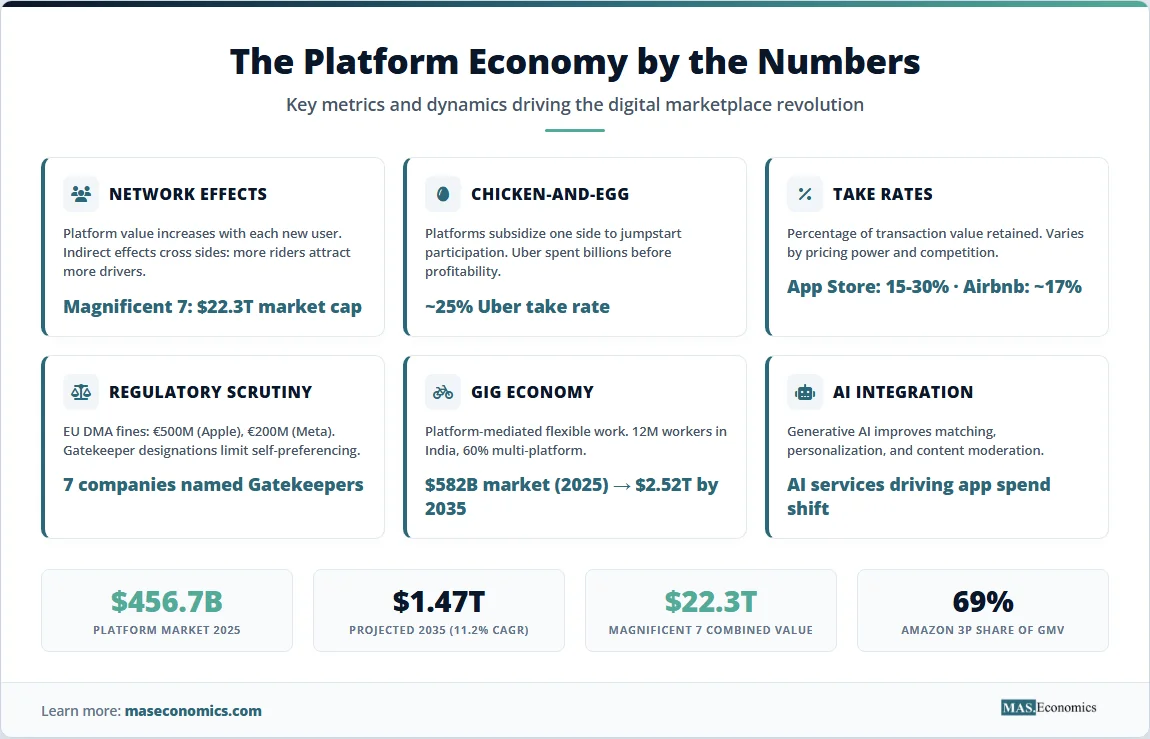
Platforms are not a new invention. Marketplaces have existed for millennia. Farmers have gathered in town squares to sell produce, and stock exchanges have matched buyers and sellers of securities for centuries. What is new is the scale. Digital platforms have become the dominant organizational form of the modern economy, reshaping industries from retail and transportation to media and finance. The global digital platform market was valued at $456.7 billion in 2025 and is projected to reach $1.47 trillion by 2035, growing at a compound annual rate of 11.2%.
Let’s explore how platform economics works, why dominant platforms are so difficult to dislodge once they reach critical mass, how they generate enormous revenues with relatively few physical assets, and what governments around the world are doing to address their growing power.
What Makes a Platform Different from a Traditional Business?
Traditional businesses create value through a linear value chain. A manufacturer buys raw materials, transforms them into products, and sells those products to customers. The firm owns its inventory, employs its workers, and captures value through the margin between production cost and selling price. This is the world of pipes: value flows in one direction, from producer to consumer.
Platforms operate differently. They do not primarily create value by producing goods or services themselves. They create value by facilitating interactions between two or more distinct groups of users. Uber does not own cars or employ drivers. Airbnb does not own hotel rooms. Amazon Marketplace does not manufacture most of the products sold on its site. These companies are not traditional producers. They are matchmakers.
The defining feature of a platform is that it sits between different user groups and reduces the transaction costs that would otherwise prevent them from interacting. Before Uber, finding a taxi in an unfamiliar city meant standing on a street corner, hoping a vacant cab would pass, and negotiating payment in cash. Uber eliminated the search costs, reduced uncertainty about pricing, and made the transaction seamless. That is the core function of every successful platform: making it easier, cheaper, or faster for different groups to connect.
Platforms also differ from traditional businesses in their cost structure. Once a platform is built, adding an additional user costs almost nothing. Google can serve one more search result, Facebook can accommodate one more user profile, and Airbnb can list one more apartment with near-zero marginal cost. This creates enormous economies of scale that traditional asset-heavy businesses cannot match. A hotel chain must build or lease new properties to expand. Airbnb can double its listings with negligible additional capital expenditure.
This asset-light model is reflected in the financial performance of leading platforms. Uber generated $14.4 billion in revenue in the fourth quarter of 2025 alone, up 20% year-over-year, with monthly active platform consumers reaching 202 million. Airbnb’s global revenue exceeded $12 billion in 2025, an all-time high for the company. Amazon’s third-party marketplace, which accounted for 69% of the company’s global gross merchandise value, reached an estimated $575 billion in sales in 2025. These companies do not own the cars, homes, or inventory that generate their revenue. They own the platform that connects supply and demand.
| Platform | Type | Core Network Effect | 2025 Revenue/GMV | Commission/Fee Model |
|---|---|---|---|---|
| Amazon Marketplace | E-commerce | More sellers → more selection → more buyers | $575B GMV (third-party) | 8-15% referral fee + FBA + advertising |
| Uber | Ride-hailing | More riders → more drivers → lower wait times | $54.1B gross bookings (Q4 2025) | ~25% take rate |
| Airbnb | Accommodation | More guests → more hosts → more listings | $12.2B revenue (2025) | ~3% host fee + ~14% guest fee |
| App Store (Apple) | Digital distribution | More developers → more apps → more users | $550B cumulative developer payouts | 30% standard (15% for small developers) |
| Meta Platforms | Social media | More users → more content → more users | $1.45T market cap | Advertising (indirect monetization) |

|
||||
Each of these platforms has achieved its dominant position by solving the chicken-and-egg problem and harnessing network effects. The table also reveals another important pattern: platforms employ different monetization strategies depending on the nature of the transactions they facilitate. Understanding these strategies is essential to understanding how platforms capture value.
Network Effects
The most important concept in platform economics is network effects. A product or service exhibits network effects when its value to each user increases as the total number of users grows. A telephone is useless if only one person owns one. It becomes valuable when two people can connect, and its value grows exponentially as the network expands. The same principle applies to platforms, but with a critical twist.
Economists distinguish between two types of network effects. Direct network effects occur when a platform becomes more valuable to users on the same side of the market. WhatsApp and Facebook benefit from direct network effects. The more of your friends who use the app, the more valuable it becomes to you.
Indirect network effects, also known as cross-side network effects, occur when the value to users on one side of the platform increases with the number of users on the other side. This is the defining dynamic of multi-sided platforms. More Uber riders attract more Uber drivers, which reduces wait times for riders, which attracts more riders, which attracts more drivers. The virtuous cycle feeds on itself. More Airbnb guests attract more hosts, which increases the variety and availability of listings, which attracts more guests. More Amazon third-party sellers increase product selection, which attracts more shoppers, which attracts more sellers.
Network effects create a powerful competitive moat. Once a platform achieves critical mass, it becomes very difficult for a competitor to dislodge it. A new social network might offer better features, but if all your friends are on the incumbent platform, switching is costly. A new ride-hailing app might charge lower commissions, but if there are no drivers on the platform, riders will not wait. This is why platform markets tend toward winner-take-all or winner-take-most outcomes.
Research on platform competition confirms that network effects create barriers to entry that give established platforms a significant competitive edge. New entrants face a classic chicken-and-egg problem: they cannot attract one side of the market without the other, but they cannot attract either side without both already present. The most common solution is aggressive subsidization. Uber famously subsidized both riders and drivers with billions of dollars in venture capital to build its network before attempting to turn a profit. This “get big fast” strategy is a hallmark of platform competition.
The concentration of value among platform companies is striking. The “Magnificent Seven” technology companies, nearly all of which are platform businesses, reached a record $22.3 trillion in combined market value in late 2025. As of early 2026, Nvidia was valued at approximately $4.3 trillion, Apple at $3.8 trillion, Alphabet at $3.6 trillion, Microsoft at $2.8 trillion, Amazon at $2.3 trillion, and Meta Platforms at $1.5 trillion. These are not just the most valuable technology companies. They are the most valuable companies in the world, and every single one of them is built on a platform business model.
Source: Business Research Insights (2026), capital.com, company earnings reports | MASEconomics.com
The chart tells a compelling story. The solid teal line shows the digital platform market expanding from $190 billion in 2020 to an estimated $508 billion in 2026. The dashed red line tracks the combined market capitalization of the five largest platform companies, which surged to approximately $15.2 trillion by 2025. Platform valuations have grown far faster than the underlying market, reflecting investor expectations that network effects will continue to concentrate value among a small number of dominant players.
How Platforms Make Money
If platforms create value by facilitating interactions, how do they capture a share of that value for themselves? The answer is more complex than simply charging a fee. Because platforms serve multiple interdependent user groups, pricing decisions are strategically delicate. Charging too much to one side can drive users away, which reduces the value of the platform for the other side, which can trigger a downward spiral.
In many platforms, one side of the market is subsidized while the other side pays. Google provides free search to billions of users while charging advertisers to reach them. Uber often subsidizes riders in new markets to build demand while charging drivers a commission on each trip. Credit card companies charge merchants fees while offering consumers rewards and cash back. Dating apps let users join for free but charge for premium features.
Which side gets subsidized depends on several factors. The side that is more price-sensitive is typically subsidized to encourage participation. The side that values the platform more highly, or that has fewer alternatives, is charged. The side that is harder to attract, or that generates stronger positive spillovers for the other side, is also more likely to receive favorable pricing.
Recent research on multi-sided platform pricing confirms that sequential pricing, where platforms set prices for different sides in a particular order rather than simultaneously, can produce higher industry profits than simultaneous pricing, and that prices tend to be more balanced across the platform under sequential approaches. This suggests that platform pricing strategies are not static. They evolve as the platform matures and as competitive conditions change.
Platforms also increasingly rely on advertising as a revenue stream. Global digital platform advertising reached $413 billion in 2025 and is projected to advance to $445.4 billion in 2026. In India alone, e-commerce and food delivery platforms are projected to generate more than Rs 28,000 crore from advertising in 2026, up 30% from the previous year. Advertising has become a critical margin lever for platforms operating on narrow transaction economics.
Subscription models are another growing revenue stream. Global streaming subscription revenue exceeded $150 billion for the first time in 2025, reaching $157.1 billion, as platforms pivot from rapid subscriber acquisition toward monetization strategies centered on pricing and advertising. The shift from pure transaction fees to recurring subscription revenue reflects the maturing of platform business models.
Why Governments Are Targeting Platforms
The same network effects that make platforms so valuable also make them a source of concern for regulators and policymakers. When a platform achieves dominance in its market, that dominance can become self-reinforcing in ways that make competition nearly impossible. The result is a growing global movement to regulate platform power.
The most significant regulatory development is the European Union’s Digital Markets Act (DMA), which came into force in November 2022 and moved into full enforcement mode in 2025. The DMA designates large digital platforms as “Gatekeepers” and imposes specific obligations designed to limit their market power and foster fair competition. Alphabet, Amazon, Apple, Booking, ByteDance, Meta, and Microsoft have all been named as Gatekeepers.
In April 2025, the European Commission imposed its first fines under the DMA: €500 million on Apple and €200 million on Meta. The Apple case concerned violations of the anti-steering obligation with respect to app developers, while Meta was accused of employing a “consent or pay” model that required users to either consent to data processing or switch to a fee-based, ad-free version.
The DMA review process is ongoing. In January 2026, the European Commission released its summary of industry responses to consultations that ran from July to September 2025. The review is examining whether the DMA is achieving its goals of contestability and fairness, its impact on business users and consumers, and whether the rules should be extended to cover artificial intelligence services. A formal report is due by May 2026.
Regulatory scrutiny is not limited to Europe. China issued new rules in December 2025 to regulate pricing practices of internet platforms, effective April 2026. The United States continues to pursue antitrust cases against major platforms, though enforcement has been complicated by political considerations. Regulators now treat platform practices, including self-preferencing, data access restrictions, and exclusionary conduct, as core antitrust issues rather than ancillary concerns.
The economic rationale for this regulatory attention is straightforward. When network effects are strong and when users find it costly to switch between platforms, market power becomes entrenched. A platform that controls access to customers can extract higher fees from businesses that depend on that access. A platform that controls user data can use that data to identify and neutralize competitive threats. And a platform that benefits from strong network effects can deter entry even if its service quality deteriorates.
Understanding these dynamics requires a solid foundation in market structures. Platforms often exhibit characteristics of natural monopolies, but they operate in fast-moving digital markets where technological change can, in principle, disrupt incumbents. The policy challenge is to preserve competition without stifling innovation or depriving consumers of the genuine benefits that platforms provide.
The Gig Economy and Platform Labor
One of the most consequential and controversial dimensions of platform economics is its impact on labor markets. The rise of platform-mediated gig work has created new forms of flexible employment while simultaneously raising fundamental questions about worker classification, income security, and the distribution of platform-generated value.
The global gig economy market was valued at $582.2 billion in 2025 and is projected to reach $2.52 trillion by 2035, growing at a compound annual rate of 15.8%. This expansion is driven by digital platform adoption, with nearly 60% of gig workers participating across multiple platforms and approximately 52% of consumers regularly using on-demand services.
The picture on the ground is more complex than the aggregate growth figures suggest. In India, for example, the gig workforce reached an estimated 12 million workers in 2025, contributing approximately ₹2.35 lakh crore to GDP. Yet nearly 40% of gig workers report earnings below ₹15,000 per month, and many have limited access to credit and financial services. This duality, rapid growth in aggregate activity alongside persistent economic insecurity for individual workers, characterizes the platform labor economy globally.
The regulatory response to platform labor is evolving. In the European Union, the Platform Work Directive, adopted in 2024, establishes a presumption of employment for platform workers in certain circumstances, shifting the burden of proof to platforms to demonstrate that workers are genuinely self-employed. India’s Economic Survey for 2025-2026 called for policies that “reshape the terms” of gig work so that people take up these jobs because they want to, not because they have no alternative.
For a deeper analysis of the economic forces shaping gig work, see our article on the gig economy and the digital divide. The platform labor debate encapsulates the central tension of platform economics. Platforms create enormous value by matching supply and demand more efficiently than traditional intermediaries, but the distribution of that value between platform owners, consumers, and workers is neither automatic nor obviously fair.
The Future of Platform Economics
The platform economy is entering a new phase. The era of explosive, venture-capital-fueled growth is giving way to an era of consolidation, regulatory oversight, and the integration of artificial intelligence into platform operations.
One clear trend is the increasing dominance of marketplaces in e-commerce. By 2026, nearly 9 out of 10 e-commerce dollars will flow through marketplace ecosystems, with stores accounting for just 13% of online retail revenue. The marketplace model has become the default architecture for online commerce.
Artificial intelligence is accelerating this consolidation. Generative AI services are reshaping platform economics in multiple ways. Consumer spending on non-gaming apps surpassed gaming for the first time in 2025, driven by AI-powered services. Platforms are deploying AI to improve matching algorithms, personalize recommendations, automate content moderation, and optimize pricing in real time. The companies that can deploy AI most effectively will likely strengthen their competitive positions further.
At the same time, the regulatory perimeter is expanding. The EU is developing a Digital Fairness Act, with a legislative proposal expected in late 2026. China’s new platform pricing rules will take effect in 2026. The global trend is toward greater platform accountability, particularly regarding data practices, algorithmic transparency, and fair treatment of business users.
For businesses, the implications are clear. Success in the platform economy increasingly requires navigating complex platform dependencies. Sellers on Amazon must manage fees, advertising costs, and algorithm changes. Restaurants on delivery platforms must balance the incremental revenue from platform orders against the commissions and the loss of direct customer relationships. App developers must comply with app store policies while competing with the platform owner’s own apps. Understanding platform economics is not just an academic exercise. It is a practical necessity for anyone operating in digital markets.
The integration of AI as a factor of production will only deepen platform advantages. Platforms that control large datasets can train better AI models, which improves user experience, attracts more users, and generates more data. This feedback loop could make platform dominance even more entrenched than it already is.
The Economics Behind the Headlines
Key Takeaway and Conclusion
Platform economics has fundamentally altered how value is created and captured in the digital age. The largest platforms have grown from startups to multi-trillion-dollar enterprises in less than two decades by solving coordination problems and harnessing network effects. The digital platform market, valued at $456.7 billion in 2025, is projected to more than triple by 2035. Platform companies dominate the list of the world’s most valuable corporations. The marketplace model now accounts for nearly 90% of e-commerce revenue. These developments represent a structural shift in how economic activity is organized, not a temporary trend.
At the same time, the forces that make platforms efficient also raise legitimate concerns about market concentration and competition. Network effects create powerful barriers to entry. Pricing strategies that solve the chicken-and-egg problem can become exploitative when alternatives disappear. Regulators in Europe, China, and the United States are actively developing frameworks to preserve the benefits of platforms while curbing their excesses. The outcome of these efforts will shape the evolution of digital markets for the next decade.
The platform economy is still evolving. Artificial intelligence is being integrated into every major platform, promising better matching, more personalization, and new services. The regulatory framework is being constructed in real time. The next decade will determine whether platform dominance intensifies or whether competition and regulation succeed in creating a more contestable digital marketplace.
Did you find this article helpful? Share it with someone who cares about peace and the global economy. And remember, at MASEconomics, we make complex ideas simple.