On August 5, 2024, a federal judge in Washington ruled that Google, a company whose main product costs its users nothing, is a monopolist. The finding in United States v. Google put the company’s share of general internet search at about ninety percent, and it turned a word from the first chapter of every economics textbook into front-page news. A what is a monopoly question sounds simple, and the everyday answer usually is: one big company. The economic answer is more precise and more useful. A monopoly is a market with a single seller of a product that has no close substitute, protected by something that keeps rivals out.
Each part of that definition does real work. One seller. No close substitute. A barrier that keeps the situation from fixing itself. Size alone is not on the list, and that omission is the first thing worth understanding, because it separates companies that are merely large from companies that hold power over a price.
One Seller, No Close Substitute
A monopolist faces no direct competitor, but the sharper test is what happens when it raises its price. In a competitive market, a seller who raises the price loses customers to rivals selling nearly the same thing. The monopolist’s customers have nowhere comparable to go. Economists measure this with cross-price elasticity: when the price of one good rises, does demand for another good rise with it? If yes, the two goods are substitutes and each one disciplines the other’s price. A monopoly exists where that discipline is missing.
This is why the definition does not say “big company.” A village with one well has a water monopoly, however small the operation. A large firm in a crowded industry, an airline among several on the same route, or one supermarket chain among four, holds far less pricing power than its size suggests. What matters is the customer’s next best option, not the seller’s revenue.
Pure monopoly, one seller and literally no alternative, is rare. Real markets sit on a spectrum that runs from perfect competition, through monopolistic competition and oligopoly, to monopoly at the far end. The useful concept across that whole range is market power: the degree to which a firm can hold its price above its costs without losing its buyers. Monopoly is the extreme case, and the mechanics of that extreme case explain the milder ones.
How a Monopolist Picks Its Price
A firm in a competitive market is a price taker. The market price is set by supply and demand across many sellers, and any firm that asks for more sells nothing. A monopolist is a price maker. It chooses the price, and the whole market demand curve becomes its menu of options: a high price and few sales, or a lower price and more sales.
The choice is less free than it looks. To sell one more unit, the monopolist must cut the price, and in most markets it must cut the price on every unit, not just the extra one. So the revenue gained from one more sale, which economists call marginal revenue, is always less than the price on the tag. The monopolist expands output as long as marginal revenue covers marginal cost, the cost of producing one more unit, and stops where the two meet. That stopping point comes earlier, at a smaller quantity and a higher price, than it would in a competitive market, where price itself is driven toward marginal cost.
How much higher the price can go depends on the price elasticity of demand. If buyers can cut back easily, delay a purchase, or make do with a loose substitute, the markup stays modest. If they cannot, as with a life-sustaining medicine or the only bridge into town, the markup can be very large. This also answers a common misunderstanding: a monopolist cannot charge “anything it wants.” It is constrained by its own demand curve. Raise the price far enough and even captive customers buy less, switch to poor substitutes, or go without. The monopolist searches for the price that extracts the most, which is a real constraint, just a much weaker one than competition.
One more ingredient is needed to make the position durable: a barrier to entry. High monopoly profit is an invitation, and without a barrier, entrants accept it. Barriers come in several forms. Control of an essential input, a legal grant such as a patent or an exclusive license, network effects that make a product more valuable the more people already use it, or the sheer scale of upfront investment a challenger would need. Much of that upfront investment is unrecoverable if entry fails, and those sunk costs make challenging an incumbent a gamble that many potential rivals decline.
The Triangle of Trades That Never Happen
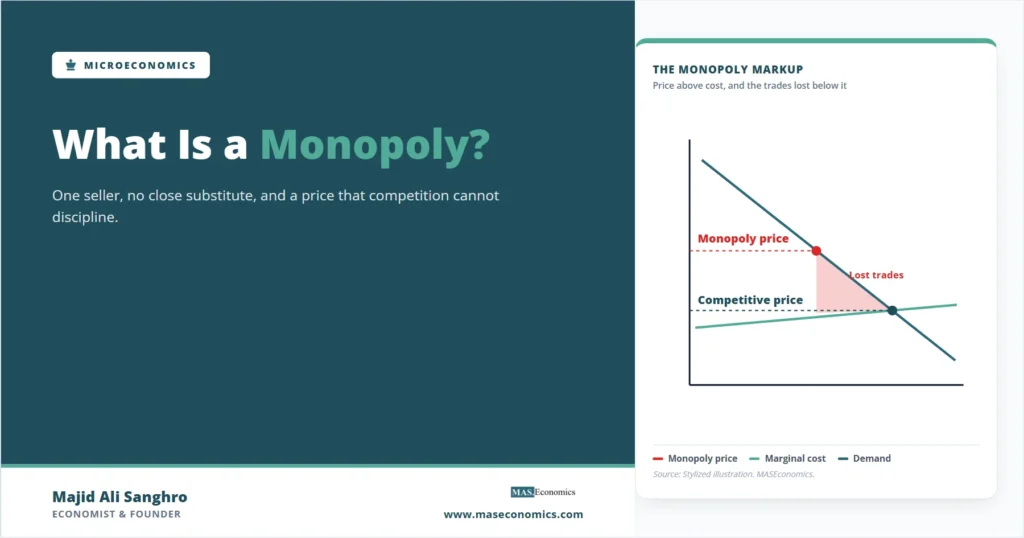
The obvious complaint about monopoly is the high price. The economist’s complaint is subtler, and it is worth separating the two. The extra money a monopolist collects from customers who keep buying is a transfer: the buyer loses, the seller gains, and the two cancel out in the total. The deeper cost is the buyers who drop out entirely. At the competitive price they would have bought, the good was worth more to them than it cost to produce, and both sides would have gained from the trade. At the monopoly price those trades never happen. The value they would have created simply does not exist.
Economists call that missing value deadweight loss, and in a price and quantity diagram it appears as a triangle sitting between the demand curve and the marginal cost line, over the units that go unproduced. It is the part of monopoly harm that no one receives.
The diagram compresses the whole argument into one picture. The monopolist stops where marginal revenue meets marginal cost, sells the smaller quantity, and charges the price the demand curve allows at that quantity. A competitive industry would keep producing until price fell to marginal cost. The shaded triangle between those two outcomes is the set of mutually beneficial trades that the market never makes. Its size grows with the gap between the two prices, which is why economists worry more about some monopolies than others.
From Standard Oil to the Google Ruling
The United States wrote the rulebook for dealing with private monopoly, and its history runs through a handful of famous cases. The Sherman Antitrust Act of 1890 made it illegal to monopolize trade, and in 1911 the Supreme Court used it to break Standard Oil, which had controlled roughly ninety percent of American oil refining, into thirty-four separate companies. In 1984, AT&T, the regulated telephone monopoly, was split from its regional operating companies under a consent decree with the Department of Justice. In 2001, an appeals court upheld the finding that Microsoft had illegally maintained its operating-system monopoly, though the company was not broken up.
An important legal detail sits underneath all of these cases. Being a monopoly is not illegal in the United States. The Federal Trade Commission’s guidance is explicit that the law punishes monopolization, meaning the acquisition or defense of monopoly power through exclusionary conduct, not the possession of a dominant position won by building a better product. A firm that dominates because customers freely prefer it has broken no law. A firm that dominates because it locked the doors has.
The Google case shows how the modern version of the question works. The court did not find that Google’s search engine was worse than its rivals, and the product’s price to users is zero. The finding turned on the roughly $26 billion Google paid in 2021, according to evidence presented at trial, to be the default search engine on phones and browsers, payments the court judged to have locked rivals out of the scale they needed to compete. A zero-price product can still carry monopoly power, because users pay in attention and data rather than money, and advertisers pay in cash on the other side of the platform. The price the monopolist protects is not always the one on the shelf.
| Structure | Sellers | Entry | Power over price | Everyday example |
|---|---|---|---|---|
| Perfect competition | Very many | Free | None: price takers | Wheat farming, currency exchange |
| Monopolistic competition | Many, differentiated | Easy | Modest, via branding | Restaurants, clothing brands |
| Oligopoly | A few | Hard | Considerable, interdependent | Aircraft makers, mobile networks |
| Monopoly | One | Blocked | Constrained only by demand | Patented drugs, local utilities |

|
||||
Monopolies Governments Create on Purpose
Not every monopoly is an accident or a crime. Some are deliberate policy. A patent is a temporary legal monopoly, granted for a term that runs twenty years from the filing date in the United States, and the logic is a straight trade. Inventions are expensive to create and cheap to copy, so without protection, copiers would undercut inventors the day after launch and much less would be invented. Society accepts years of monopoly pricing as the fee for getting the invention at all. The same bargain, with different terms, sits behind copyright and pharmaceutical regulatory exclusivity.
The bargain’s sharp edge shows in medicine prices. The discoverers of insulin sold their patent to the University of Toronto in 1923 for one dollar each, precisely because they did not want a monopoly price standing between patients and the drug. Modern insulin products, protected by successive patents on improved versions and delivery devices, spent years among the clearest examples of what monopoly pricing does when demand cannot walk away.
A second deliberate monopoly is the natural monopoly, where one producer genuinely is the cheapest arrangement. Electricity distribution is the standard case. The wires reaching a house are enormously expensive to build and almost costless to use once built, so two competing grids would mean paying for the same infrastructure twice. Most countries respond by allowing one network and regulating its price, converting the monopoly problem from too little competition into a supervision problem: a regulator setting the price a competitive market cannot set. That supervision is imperfect, and the debate over how well regulators resist the influence of the firms they oversee is as old as regulation itself.
Where the Textbook Case Gets Complicated
The clean diagram comes with real-world qualifications. The first is the threat of entry. A market with one seller today can still behave almost competitively if a rival could enter quickly the moment prices rose too far. What disciplines the incumbent is not actual competition but the ease of potential competition, which is why economists pay as much attention to barriers as to market shares.
The second qualification is time. Joseph Schumpeter argued that the interesting competition in a modern economy is not many firms selling the same thing at cost, but a sequence of temporary monopolies, each overthrown by the next innovation. On this view, the prospect of monopoly profit is the prize that funds invention, and today’s dominant firm is tomorrow’s cautionary tale. The history of mainframes, film cameras, and video-rental chains gives the argument some force. Its limit is that not every monopoly is waiting to be overthrown; some entrench themselves precisely to stop the next wave from arriving, which is what antitrust cases are usually about.
The third qualification is that harm has more dimensions than price. A monopolist can let quality slide, slow its pace of improvement, or degrade the terms of use, because dissatisfied customers have nowhere to go. In zero-price digital markets this is the main worry: the product stays free while its quality, privacy terms, or usefulness quietly deteriorate. The monopoly diagram drawn in prices still applies, but the price axis has to be read broadly, as everything a customer gives up to use the product.
MASEconomics Explains
3 economic concepts behind monopoly
These concepts are explored in depth across our educational articles library.
Conclusion
What is a monopoly has a precise answer that the everyday usage blurs: a single seller of a product with no close substitute, protected by barriers that keep rivals out. The definition turns on substitutes and entry, not on size, which is why a small-town utility can be a truer monopoly than a giant firm in a crowded industry.
The economics follows from one fact: a monopolist chooses its price, and it chooses the price that maximizes its own profit rather than the number of beneficial trades. The result is a higher price, a smaller quantity, and a triangle of value that simply goes missing. Yet the same logic explains why societies create monopolies on purpose, granting patents to reward invention and franchising utilities where one network is genuinely cheapest. The judgment antitrust law has settled on reflects that balance. Dominance won by being better is legal, and dominance defended by locking the doors is not, which is the line the Standard Oil, AT&T, Microsoft, and Google cases have each drawn in their own era.
Frequently Asked Questions
Is having a monopoly illegal in the United States?
No. Holding monopoly power is legal if it was won by offering a better product or service. What the Sherman Act punishes is monopolization: acquiring or protecting that power through exclusionary conduct such as locking rivals out of distribution. The recent Google ruling turned on conduct, not on market share alone.
What is the difference between a monopoly and an oligopoly?
A monopoly has one seller; an oligopoly has a few large sellers who watch each other closely. Oligopolists hold real pricing power, but each firm’s best move depends on what its rivals do, which makes strategic interaction the defining feature. A monopolist answers only to its customers’ demand curve.
What is a natural monopoly?
A natural monopoly exists where one producer can serve the whole market more cheaply than two or more could, usually because of very high infrastructure costs. Electricity grids, water networks, and railway tracks are common examples. Governments typically allow a single provider and regulate its prices instead of forcing competition.
Can a monopoly charge any price it wants?
No. A monopolist is constrained by its own demand curve: raise the price and customers buy less, delay purchases, or turn to imperfect substitutes. It searches for the single price that maximizes profit, which sits above the competitive price but well below the highest price any customer would pay.
Thanks for reading! Once you see that a monopolist’s power comes from missing substitutes rather than sheer size, most antitrust headlines become much easier to judge. Happy learning with MASEconomics