
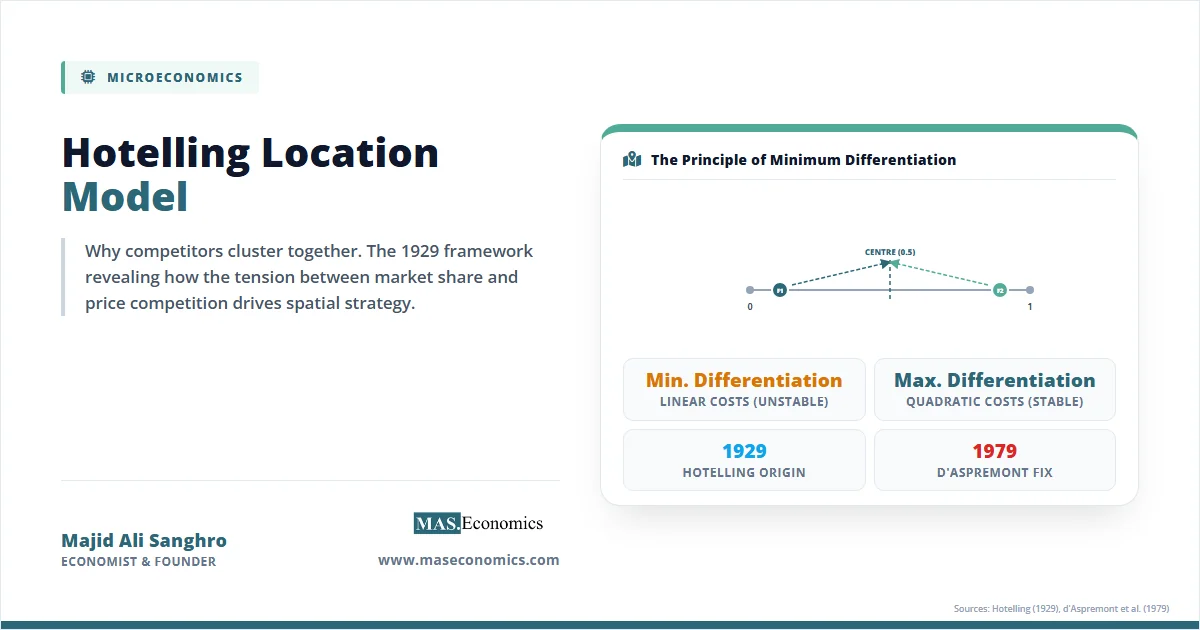
Competitors often open their stores side by side. Fast food restaurants cluster on the same intersection, pharmacies are located across the street from one another, and political parties converge on the ideological centre. This spatial clustering defies the naive expectation that firms should spread out to capture distinct local monopolies. The Hotelling Location Model, introduced by Harold Hotelling in 1929, provides the canonical economic explanation for this phenomenon. The model shows that when firms compete on location and price, the profit-maximising strategy drives them toward the centre of the market. This result, known as the principle of minimum differentiation, has become a foundational concept in industrial organisation, spatial economics, political science, and platform design, explaining why differentiation is often minimal despite the apparent gains from variety.
Before Hotelling, models of market structures largely ignored space. The standard Bertrand and Cournot frameworks assumed that firms and consumers occupied a single point, making distance irrelevant. Hotelling introduced a linear market where consumers were distributed continuously, and firms chose both a location and a price. This simple addition of space generated important insights. Firms face a core tension: moving toward the centre captures more customers from the rival, but it also intensifies price competition. Resolving this tension depends on the nature of transportation costs, the distribution of consumers, and the number of competitors. The game theory underlying these decisions continues to shape how economists understand product differentiation and spatial strategy.
What the Hotelling Model Shows
The basic version of the Hotelling Location Model considers a linear market, often described as a street or a beach of length 1. Consumers are distributed uniformly along this line. Two firms sell a homogeneous physical product but can choose where to position themselves. Consumers incur a transportation cost for travelling to the firm, which is proportional to the distance. Each consumer buys exactly one unit of the good from the firm offering the lowest total price, defined as the firm’s mill price plus the transportation cost.
If the two firms locate at the extreme ends of the market, at positions 0 and 1, they each serve half the market. Consumers located to the left of the midpoint buy from the left firm, and those to the right buy from the right firm. However, neither firm has an incentive to remain at the endpoint. If the firm at position 0 moves slightly to the right, say to position 0.1, it still retains all the consumers to its left and captures some consumers who were previously closer to the rival. By moving toward the centre, a firm steals market share without losing its entire hinterland, provided prices remain fixed.
This incentive drives both firms toward the midpoint, location 0.5. At the centre, the market is split evenly. Any deviation away from the centre causes a firm to lose more customers on the side it abandons than it can gain on the side it approaches. The centre is the only Nash equilibrium in locations when prices are fixed or when the locational choice dominates the pricing decision. Hotelling concluded that this tendency toward the centre explains the excessive similarity of brands, the clustering of retail establishments, the convergence of political platforms, and the homogenisation of media offerings.
The model’s logic extends seamlessly to product characteristics that are not strictly geographical. A soft drink’s sweetness, a car’s fuel efficiency, a news network’s ideological slant, or a streaming service’s content tilt can all be mapped onto a linear spectrum. Consumers have preferences over these characteristics and incur a utility loss, analogous to a transportation cost, when the product does not match their ideal point. The foundations of consumer preferences dictate this disutility from a mismatch. Firms choosing product characteristics face the same incentive to cluster near the median consumer preference as ice cream carts on a beach.
Hotelling Model in Equations
The formalisation of the Hotelling Location Model requires specifying the consumer distribution, the transportation cost function, and the strategic interaction between firms. Consider a linear market normalised to the interval \([0, 1]\). Consumers are uniformly distributed along this interval with density 1. Each consumer demands one unit of the good, and their reservation price is sufficiently high that the entire market is covered. A consumer located at point \(x\) buying from firm \(i\) at location \(a_i\) and price \(p_i\) incurs a total cost of:
where \(t\) is the transportation cost per unit of distance and \(|x – a_i|\) is the distance between the consumer and the firm. For simplicity, assume Firm 1 is located at \(a\) and Firm 2 is located at \(1-b\), where \(a \geq 0\) and \(b \geq 0\) and \(a+b \leq 1\). This parameterisation allows both firms to be anywhere on the line, with \(a\) measuring Firm 1’s distance from the left end and \(b\) measuring Firm 2’s distance from the right end.
The indifferent consumer, denoted \(\hat{x}\), is the consumer for whom the total cost of buying from either firm is identical:
Solving for \(\hat{x}\) yields the marginal consumer’s location:
Firm 1’s demand, \(D_1\), is equal to \(\hat{x}\), representing all consumers to the left of the indifferent consumer. Firm 2’s demand, \(D_2\), is \(1 – \hat{x}\). The profit functions for the two firms are:
To find the Nash equilibrium in prices, we take the first-order condition for each firm with respect to its own price and solve the system of reaction functions. For Firm 1, the first-order condition is:
Rearranging gives Firm 1’s reaction function:
By symmetry, Firm 2’s reaction function is:
Substituting Firm 2’s reaction function into Firm 1’s yields the equilibrium prices. Assuming a marginal cost of zero for simplicity, the equilibrium prices are:
These equilibrium prices reveal a key insight. When the firms are located further apart, indicated by a smaller sum \(a+b\), prices are higher. Distance provides local monopoly power, softening price competition. When the firms are close together, competition intensifies, and prices fall. In the limiting case where both firms occupy the same location, \(a + b = 1\), prices drop to marginal cost, replicating the standard Bertrand competition result.
Substituting the equilibrium prices back into the demand functions yields the equilibrium market shares. If prices are endogenous, the incentive to move toward the centre is tempered by the price effect. However, under the original Hotelling formulation with linear transportation costs, the price effect can lead to the non-existence of a pure strategy equilibrium in locations, a problem resolved by subsequent literature. The key variables and their roles are summarised below.
- \( [0, 1] \): The linear market space. It represents the geographic or characteristic space where consumers are distributed.
- \( a, b \): Firm locations from the ends. These are the strategic variables that determine the degree of product differentiation.
- \( t \): Transportation cost rate. It measures the disutility per unit of distance and determines the intensity of local monopoly power.
- \( \hat{x} \): Indifferent consumer location. It determines the market boundary between the two firms.
- \( p_1^*, p_2^* \): Equilibrium prices. These are the prices that maximise profit given the rival’s price and firm locations.
- \( D_1, D_2 \): Demand functions. These are the market shares determined by the indifferent consumer’s position.
Key Assumptions and Limitations
The Hotelling Location Model’s elegant results depend on several restrictive assumptions. When these assumptions are relaxed, the predictions change considerably, and the principle of minimum differentiation no longer holds universally. Understanding these boundaries is necessary for applying the model to real markets.
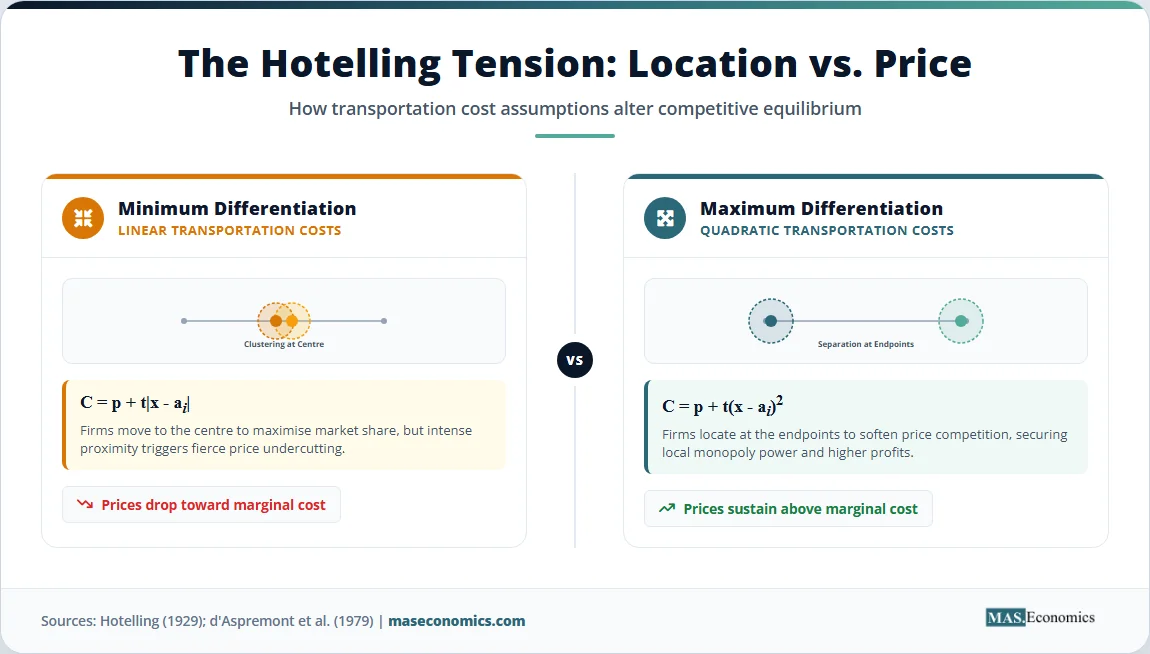
The most famous limitation is the non-existence of equilibrium under linear transportation costs. Hotelling’s original analysis assumed that transportation costs were linear in distance, \(t|x – a_i|\). d’Aspremont, Gabszewicz, and Thisse (1979) proved that with linear costs, no pure strategy Nash equilibrium in prices exists when firms are located too close together. If the firms are near the centre, each has an incentive to undercut the other’s price slightly to capture the entire market, while the other firm then has an incentive to leapfrog to the other side. This price competition is so intense that it destroys the equilibrium (d’Aspremont, Gabszewicz, and Thisse, 1979).
To restore equilibrium, d’Aspremont and colleagues proposed using quadratic transportation costs, where the cost is proportional to the square of the distance, \(t(x – a_i)^2\). With quadratic costs, consumers far from the firm face rapidly escalating disutility, making them less likely to switch firms for a small price cut. This softens price competition and guarantees the existence of an equilibrium. However, the equilibrium prediction reverses: instead of minimum differentiation, firms maximally differentiate by locating at the endpoints, \(a = 0\) and \(b = 0\). Maximum differentiation softens price competition and maximises profits, showing that the original clustering result was an artefact of the linear cost assumption.
The model also assumes a uniform distribution of consumers. In reality, consumer preferences are often clustered or bimodal. If consumer density is higher at the extremes of the characteristic space, firms may find it profitable to locate away from the centre to cater to these niche segments. The tactical interactions between firms also change if the market has more than two competitors. With three firms on a linear market, no pure strategy equilibrium in locations exists, because the firm in the centre is always incentivised to jump over one of its rivals to gain a flank.
The model also assumes that firms choose both location and price simultaneously, or in a specific sequence. In most markets, locations are fixed in the long run, while prices adjust in the short run. A two-stage game, where firms first commit to locations and then compete on prices, better reflects this reality. In this two-stage game, firms anticipate the intense price competition that results from proximity and may choose to differentiate to sustain higher prices.
Finally, the assumption of a one-dimensional characteristic space is limiting. Most products compete on multiple attributes simultaneously, such as price, quality, brand reputation, and specific features. Multi-dimensional spatial models exist, but they are considerably more complex and often lack closed-form solutions, making them less tractable than the simple linear model.
Empirical Evidence on Spatial Competition
Testing the Hotelling Location Model requires data on firm locations, product characteristics, and consumer preferences. The broad empirical pattern supports the intuition that firms cluster, but the pure minimum differentiation result is rarely observed in its strictest form. Firms balance the market share benefit of moving toward the centre against the price competition effect, leading to partial differentiation in most markets.
In retail markets, the clustering of similar establishments is well documented. A classic study by Economides (1993) examined the spatial distribution of markets and quality variations, finding that firms often cluster near the centre of product spaces to capture broader demand, though this is tempered by the need to soften price competition (Economides, 1993). More recent work using high-frequency geolocation data has confirmed that fast food restaurants, banks, pharmacies, and coffee chains tend to co-locate, driven by the desire to capture spillover traffic from the rival’s customers (NBER Working Paper).
The chart below illustrates a stylised representation of how Firm 1’s market share changes as it moves from the left end of the market toward the centre, assuming Firm 2 is fixed at the centre and prices are held constant. As Firm 1 approaches the midpoint, its market share approaches 50%, showing the strong incentive for spatial convergence under fixed prices.
Stylised market share for Firm 1 as it moves from position 0 toward the centre (position 0.5), while Firm 2 remains fixed at 0.5. With fixed prices and linear transportation costs, moving toward the centre always increases market share, validating the minimum differentiation incentive.
In political science, the median voter theorem is a direct application of the Hotelling Location Model. Anthony Downs (1957) argued that in a two-party system, both parties converge to the policy preferences of the median voter to maximise their vote share, mirroring the convergence of firms to the spatial centre. Empirical tests of this proposition yield mixed results. While parties do broadly target the centre in general elections, they also maintain distinct ideological profiles to mobilise their base and avoid alienating core supporters. This deviation from pure convergence is consistent with the quadratic cost version of the model, where differentiation serves to reduce the intensity of competition (Downs, 1957).
In product differentiation, the model predicts that firms will offer products that are more similar than consumers would prefer. This prediction holds in markets like commercial air travel, where airlines often cluster their offerings around standardised economy and business classes, and in the media industry, where news outlets often converge on a centrist or mainstream perspective to maximise audience share. However, niche markets frequently exhibit maximum differentiation, as firms cater to extreme preferences with specialised products, a pattern consistent with the multi-dimensional extensions of the model.
The table below contrasts the original Hotelling Model with the quadratic cost extension, showing how the transportation cost assumption fundamentally alters the equilibrium prediction.
| Feature | Original Model (Linear Costs) | Quadratic Cost Extension |
|---|---|---|
| Transportation cost function | \( t|x – a_i| \) | \( t(x – a_i)^2 \) |
| Price competition near the centre | Fierce; leads to undercutting | Moderated; guaranteed price equilibrium |
| Equilibrium location strategy | Minimum differentiation (move to centre) | Maximum differentiation (move to endpoints) |
| Reason for location choice | Maximise market share | Soften price competition to maximise profits |
| Existence of pure strategy equilibrium | Non-existent if firms are too close | Always exists |
 | ||
Comparison of Hotelling’s original linear cost model and the quadratic cost extension. The choice of the transportation cost function reverses the equilibrium from minimum to maximum differentiation.
How the Hotelling Model Still Matters
The Hotelling Location Model remains a key framework for understanding competitive strategy, urban economics, and digital market design. Its core insight, that the desire to capture market share drives competitors toward similarity, explains phenomena ranging from the layout of shopping districts to the algorithms governing search engine results.
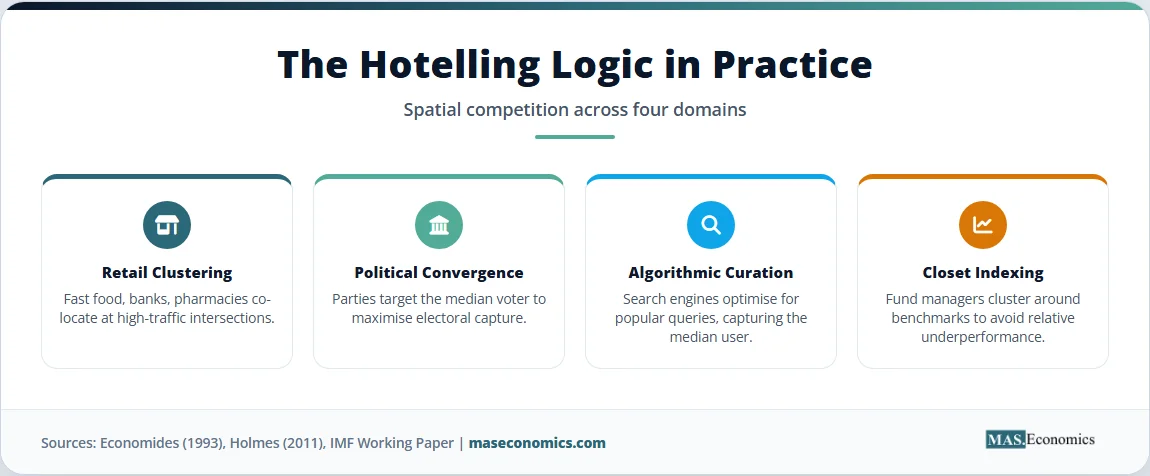
In urban economics, the model explains the formation of commercial districts. Zoning laws and land use regulations often mandate the separation of residential and commercial areas, but within commercial zones, retailers cluster voluntarily. This clustering is not merely a coincidence; it is the equilibrium outcome of a spatial game. A lone electronics store may attract some destination traffic, but a cluster of electronics stores creates a shopping destination that benefits all participants by drawing consumers who want to compare products. This agglomeration effect, an extension of the basic model, shows that clustering can be welfare-enhancing for consumers when comparison shopping is valued, even if it reduces product variety. The spatial dynamics observed in physical retail mirror the clustering behaviour predicted by the formal model, a topic explored in broader analyses of market structure dynamics.
In product strategy, the model provides a formal justification for the pervasive phenomenon of product imitation. When a firm introduces a successful innovation, competitors often release similar products rather than fundamentally different ones. The incentive to locate near the centre of consumer preference in product characteristic space drives this me-too behaviour. The Nash equilibrium of the spatial game predicts that if one firm occupies the centre, the rival’s best response is to locate as close to it as possible without triggering a destructive price war. This explains the striking similarity among smartphones, automobile designs, software interfaces, and consumer electronics, where functional requirements and consumer preferences create a well-defined centre of the market.
The model also illuminates the dynamics of digital platforms. Search engines, social media feeds, and e-commerce recommendation systems can be modelled as two-sided markets where the platform’s algorithm acts as the location choice. When a search engine optimises for the most popular queries, it effectively positions itself at the centre of the information market, providing results that appeal to the median user. This strategy captures the largest audience but often leaves users with niche interests underserved, a digital manifestation of the minimum differentiation principle. Platform designers must actively counteract this tendency by diversifying results, acting as a social planner who forces firms to spread out to increase aggregate welfare. The homogenisation of digital content, where news feeds across different platforms converge on similar trending topics, is a direct consequence of the Hotelling logic applied to attention economies. The economics of social media and attention markets reflect this convergence, as platforms continuously adjust their algorithms toward the median user preference to maximise engagement.
The Hotelling Location Model also matters in political economy. The convergence of political parties to the centre, predicted by the median voter theorem, has important implications for democratic representation. If both parties offer identical centrist platforms, voters at the ideological extremes are systematically disenfranchised. This creates an opening for populist or radical parties that sit at the extremes, breaking the two-party duopoly. The model predicts that the stability of the political centre depends on the distribution of voters and the intensity of ideological competition, factors that mirror the transportation cost and consumer distribution in the commercial version of the model. The public choice dynamics of party competition are thus deeply intertwined with spatial economics.
Financial markets show the same dynamic. In the asset management industry, fund managers often cluster their portfolios around benchmark indices, a practice known as closet indexing. Just as firms in the Hotelling Model move toward the centre to avoid losing market share, fund managers mimic the index to avoid underperforming their peers. This clustering reduces the variety of investment strategies available and can increase systemic risk, as a shock to the benchmark affects all managers simultaneously. Regulatory authorities use spatial competition models to assess the diversity of the financial ecosystem and design rules that encourage genuine differentiation (IMF Working Paper on Banking Competition). The lack of differentiation in financial markets is particularly dangerous because it converts idiosyncratic risks into systemic ones, a dynamic also observed in the 2008 financial crisis, where correlated mortgage-backed securities led to widespread collapse.
MASEconomics Explains
Four economic concepts behind the Hotelling Model
Conclusion
The Hotelling Location Model provides the foundational framework for understanding why competitors cluster together, whether on a physical street, in a product characteristic space, or along an ideological spectrum. By formalising the tension between the market share incentive to move toward the centre and the price competition incentive to differentiate, Hotelling captured a dynamic that recurs across economics, marketing, and political science. The original linear model predicted minimum differentiation, while d’Aspremont’s quadratic cost extension reversed the result to maximum differentiation. Empirical evidence confirms that firms balance these forces, resulting in partial differentiation in most real markets. The model has been applied to retail clustering, political party convergence, search engine algorithms, and asset management strategies, each demonstrating the same underlying spatial logic.
Did you find this article helpful? Share it with someone who loves economics. And remember, at MASEconomics, we make complex ideas simple.