
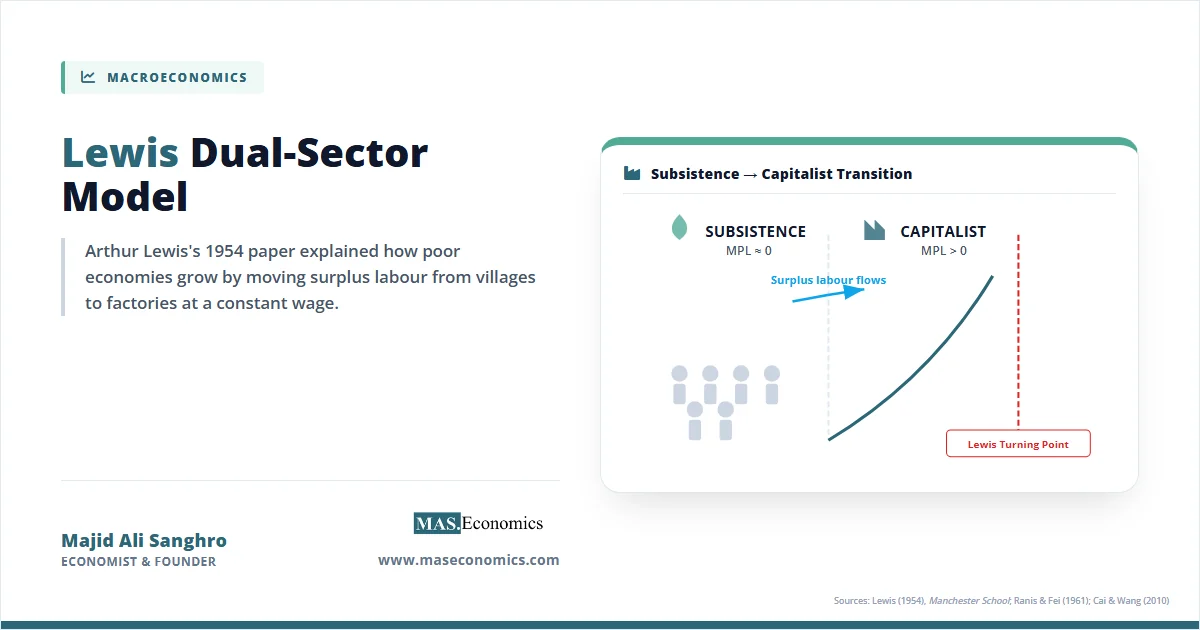
In 1954, the Manchester School published a 53-page paper by Arthur Lewis titled “Economic Development with Unlimited Supplies of Labour“. It became the most-cited article in the history of development economics. Lewis won the Nobel Prize in 1979, jointly with Theodore Shultz, for the framework it set out. The Lewis Dual-Sector Model divides a developing economy into a low-productivity subsistence sector with surplus labour and a capitalist sector that grows by hiring this surplus at a small wage premium. Capitalist profits are reinvested, expanding the capitalist sector until the subsistence reservoir runs dry, the Lewis turning point, after which growth must shift to a new regime. What follows derives the two-sector framework, presents the wage and accumulation rules, surveys the empirical record from China and the agricultural-productivity-gap literature, and shows how the framework still anchors discussion of South Asian and African industrialisation today.
What the Lewis Dual‑Sector Model Shows
Before 1954, neoclassical economics assumed that labour markets were clear. Wages adjust until the supply of labour equals the demand. If a worker loses a job, they accept a lower wage, and a new employer hires them. Unemployment is frictional or voluntary. This assumption works well for industrialised economies where labour is scarce and capital is abundant. It fails completely for the vast majority of the human population living in mid-twentieth-century Asia, Africa, and Latin America. In these regions, rural populations were huge, and industrial employment was minimal. Wages did not clear the market. Millions of people worked on family farms, producing barely enough to eat, and they would gladly have taken a factory job at almost any wage.
Lewis observed that in poor countries, family farms employ far more workers than strict productivity warrants. Social norms dictate that output is shared among family members regardless of individual contribution. A family farm with ten workers might produce the same output as a farm with seven workers. The extra three workers contribute nothing to total output. Their marginal product is zero. Yet they receive a share of the harvest, so their consumption equals the average product of labour on the farm, not their marginal product. This institutional arrangement creates a massive pool of disguised unemployment. These workers appear employed, but they add no economic value.
The Lewis Dual-Sector Model exploits this fact. The capitalist sector can hire these surplus workers without offering a wage high enough to bid them away from agriculture. It only needs to pay a small premium above the subsistence income to attract them. Because the wage is constant and low, the capitalist sector generates large profits. Capitalists reinvest these profits in new factories and machinery, which requires even more labour. The cycle continues. Profits drive investment, investment drives employment, and employment drains the rural reservoir. Growth is self-sustaining as long as surplus labour exists. The process stops when the rural sector runs out of redundant workers. At that point, the capitalist sector must compete for labour, wages rise, profits fall, and the easy phase of industrialisation ends.
Lewis Dual‑Sector Model in Equations
The Lewis Dual-Sector Model formalises this intuition with a two-sector structure. The economy is divided into a subsistence sector and a capitalist sector. Each sector operates under different rules for production, wage determination, and saving behaviour.
The subsistence sector (S) has a production function exhibiting zero or negligible marginal product of labour beyond a threshold:
Here, \( Y_S \) is output in the subsistence sector, \( L_S \) is labour employed in the subsistence sector, and \( L_S^* \) is the threshold beyond which extra workers add no output. Wages in the subsistence sector are determined by the average product, reflecting a family-sharing or institutional rule, rather than the marginal product:
Because \( Y_S \) is spread across a large number of workers, \( w_S \) is very low, often just above biological subsistence.
The capitalist sector (M) has a standard concave production function with capital \( K_M \) fixed in the short run:
The capitalist wage is set at a small premium \( \alpha \) above the subsistence wage to attract migrants from the rural area:
Profit-maximising employment in the capitalist sector solves the standard condition where the marginal product of labour equals the wage:
Capitalist profits are the surplus of output over the wage bill:
The central Lewis assumption is that capitalists save and reinvest a high fraction of profits, while subsistence-sector earners do not save. This difference in saving and investment behaviour is the engine of structural change:
Each new unit of capital raises the marginal product schedule in the capitalist sector, so employment expands at the constant wage \( w_M \). Surplus labour flows from S to M without raising the wage, until the subsistence sector runs out of redundant workers. Beyond this Lewis turning point, the marginal product of labour in the subsistence sector rises above \( w_S \), forcing the capitalist wage to rise too. Growth slows or shifts to a new regime.
Consider a worked example. Suppose the subsistence sector has 100 workers producing 100 units of output, so \( w_S = 1 \). With \( \alpha = 0.30 \), the capitalist wage is \( w_M = 1.30 \). If the capitalist marginal-product schedule is \( MPL = 5 – 0.04 L_M \), then setting \( MPL = 1.30 \) gives \( 5 – 1.30 = 0.04 L_M \), which solves to \( L_M = 92.5 \). Profits at this employment level are the area between the MPL curve and the wage line, equal to \( 0.5 \times 92.5 \times (5 – 1.30) = 171.1 \) units. If \( s_\pi = 0.7 \), reinvested capital is 119.8 units. This new capital shifts the MPL schedule upward, allowing the capitalist sector to absorb more labour at the same wage in the next period. The cycle repeats until the 100 rural workers are drained, and the wage must rise.
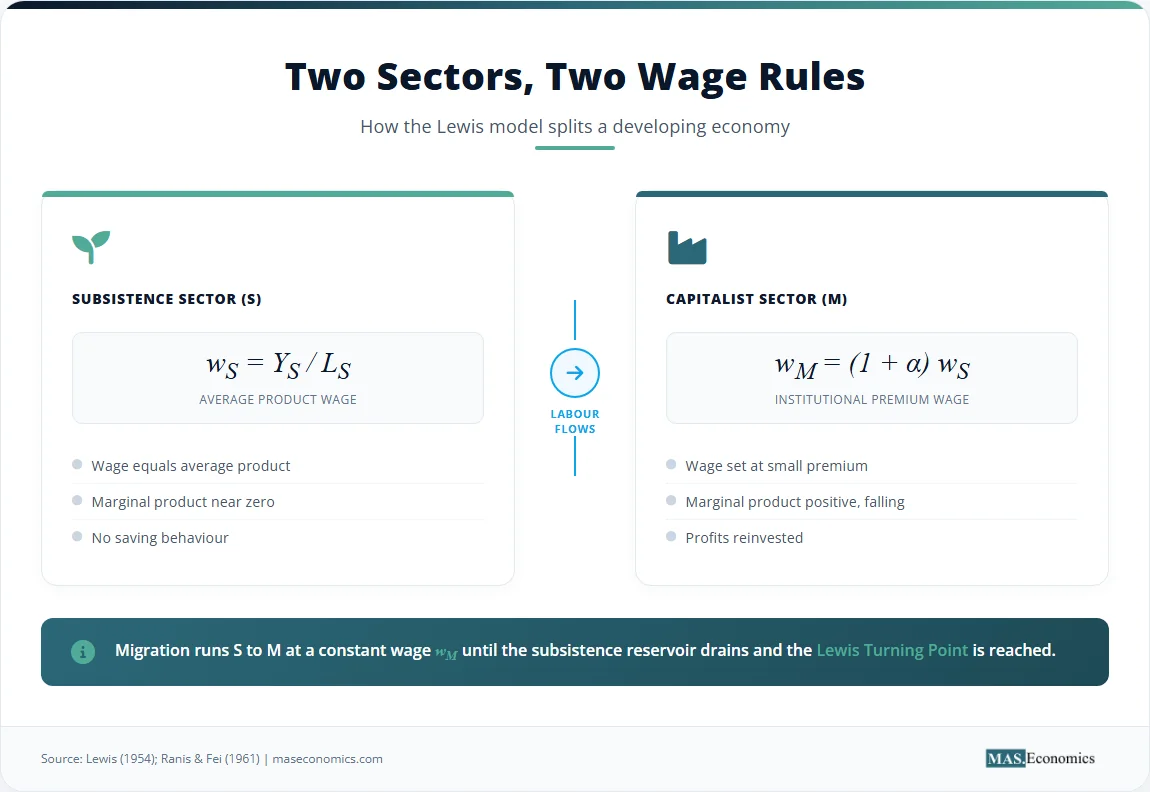
| Feature | Subsistence Sector (S) | Capitalist Sector (M) |
|---|---|---|
| Production function | \( F_S(L_S) \), MPL ≈ 0 | \( F_M(K_M, L_M) \), MPL > 0, concave |
| Wage rule | \( w_S = Y_S / L_S \) (average product) | \( w_M = (1 + \alpha) w_S \), \( \alpha \approx 0.30 \) |
| Saving behaviour | Negligible | \( s_\pi \approx 0.6 \text{–} 0.8 \) of profits |
| Source of growth | None endogenously | Profit reinvestment |
| Capital intensity | Low / static | Rising |
| Output share over time | Falling | Rising |
 |
||
Key Assumptions and Limitations
The Lewis Dual-Sector Model rests on five central assumptions. First, it assumes the marginal product of labour in the subsistence sector is zero or negligible. This is the foundational premise that allows labour to be withdrawn without reducing total agricultural output. Empirical evidence challenges this. Even in very poor rural economies, withdrawing labour during peak seasons reduces harvests. The zero-marginal-product assumption is a long-run average that obscures seasonal bottlenecks.
Second, the model assumes the capitalist wage remains constant during the surplus-labour phase. The capitalist sector sets the wage at a fixed premium above the subsistence income, and this wage does not rise as employment expands. This assumption ignores the possibility of urban labour-market pressures. The Harris-Todaro migration model, developed later, showed that urban unemployment can persist alongside rural-urban migration, because migrants are drawn by expected urban wages rather than guaranteed employment. Urban living costs and informal-sector dynamics can push the effective capitalist wage above the simple rural premium.
Third, the model assumes capitalists reinvest a high fraction of their profits. This drives the expansion of the capitalist sector. If capitalists consume their profits or remit them abroad, the mechanism stalls. In many developing economies, foreign-owned firms repatriate profits, and local elites invest in real estate or foreign assets rather than productive manufacturing capacity. The reinvestment assumption is a behavioural regularity specific to certain historical periods, not a universal law.
Fourth, the model assumes sectoral closed labour markets except for the one-way migration from subsistence to capitalist sectors. It ignores the informal urban sector. Most migrants from rural areas do not immediately enter formal factory employment. They work as street vendors, day labourers, or domestic workers. This informal sector acts as a buffer, absorbing migration flows without immediately feeding the capitalist accumulation process.
Fifth, the model assumes a single, sharp Lewis turning point. Once surplus labour is exhausted, wages begin to rise. In reality, the transition is gradual and uneven. Some regions exhaust their surplus labour earlier than others. Different industries face turning points at different times, depending on their geographic location and skill requirements. The turning point is better understood as a prolonged phase than a specific year.
T.W. Schultz presented the most famous theoretical challenge to the Lewis framework in his 1964 book Transforming Traditional Agriculture. Schultz argued that traditional farmers are efficient at the margin. They allocate their resources optimally given their constraints. If this is true, the marginal product of labour in subsistence agriculture cannot be zero. Withdrawing a worker must reduce output. Schultz won the 1979 Nobel Prize jointly with Lewis, specifically for this counterargument. The Schultz critique implies that moving labour out of agriculture imposes a real cost in lost farm output, which the Lewis model ignores.
Evidence for the Lewis Dual‑Sector Model
Empirical testing of the Lewis Dual-Sector Model has focused on three questions: whether surplus labour actually exists, whether the turning point can be observed, and whether the agricultural-productivity gap matches the model’s predictions.
Gustav Ranis and John Fei provided the canonical formalisation of the Lewis framework in their 1961 American Economic Review paper, “A Theory of Economic Development“. They extended the Lewis model by rigorously defining the phases of development. In Phase 1, the marginal product of labour in agriculture is zero, and labour can be withdrawn without cost. In Phase 2, the marginal product is positive but below the institutional wage, so withdrawing labour reduces the agricultural surplus available to feed industrial workers. In Phase 3, the marginal product exceeds the institutional wage, and the commercialisation of agriculture is complete. The Ranis-Fei framework showed that the turning point occurs at the transition from Phase 2 to Phase 3, when agricultural wages begin to reflect true scarcity. Their mathematical rigour made the Lewis model testable.
The most dramatic empirical confirmation of the Lewis mechanism comes from China. Fang Cai argued in his 2010 China Economic Journal paper, “Demographic Transition, Demographic Dividend, and Lewis Turning Point in China“, that China crossed the Lewis turning point around 2003 to 2008. During the 1990s, massive internal migration supplied cheap labour to coastal factories. Real wages for migrant workers in the Pearl River Delta stagnated despite rapid industrial expansion. After 2008, migrant wages began rising by more than ten percent per year. The rural reservoir of redundant workers was thinning. Factories reported labour shortages. The wage acceleration was the signature of the Lewis turning point. Cai documented that the rural surplus labour force had declined sharply through the 2000s, forcing employers to raise wages to attract workers.
Douglas Gollin, David Lagakos, and Michael Waugh examined the broader cross-country evidence in their 2014 Quarterly Journal of Economics paper, “The Agricultural Productivity Gap”. They found that the value added per worker in agriculture in poor countries is, on average, four times lower than in non-agricultural areas. This gap is far larger than the gap in rich countries, consistent with substantial misallocation and surplus labour. However, they argued that the gap reflects selection effects more than zero marginal product. Less-skilled workers remain in agriculture, while more-skilled workers migrate to cities. This selection bias means the observed productivity gap overstates the true surplus-labour effect. Moving a random rural worker to the city would not raise their productivity by the full gap, because the migrant lacks the skills of the average urban worker. The Gollin et al. finding supports the Lewis intuition that poor countries have massive sectoral imbalances, but it qualifies the policy implication that labour transfer alone will close the gap.
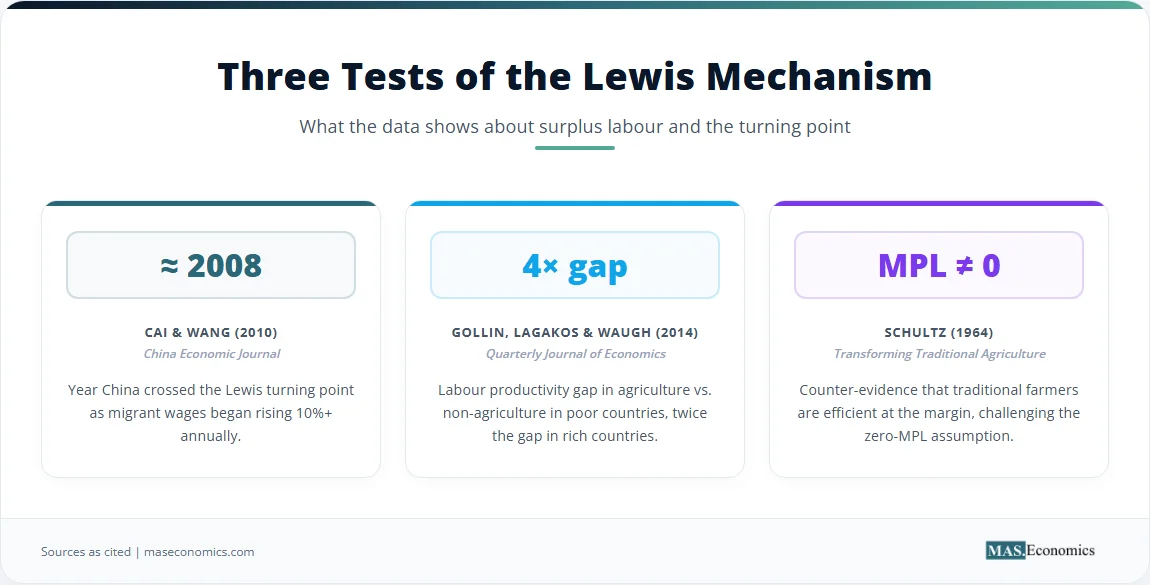
Migrant wages stagnated through the 1990s while a labour surplus persisted. Wages accelerated after 2008 as the rural reservoir thinned. Source: Cai (2010), China Economic Journal; National Bureau of Statistics of China; MASEconomics calculation.
How the Lewis Dual‑Sector Model Matters
The Lewis Dual-Sector Model remains the foundational framework for understanding structural change. Its influence persists because it isolates the key mechanism of early industrialisation: the transfer of underemployed labour from low-productivity agriculture to high-productivity manufacturing at a constant wage. Three applications show their enduring relevance.
China’s industrialisation from 1978 to the 2010s is the most successful Lewisian transformation in history. When Deng Xiaoping launched economic reforms, roughly seventy percent of the Chinese labour force worked in agriculture. Most lived at subsistence levels. The household responsibility system raised farm incomes slightly, but the rural surplus remained enormous. As special economic zones opened along the coast, factories absorbed millions of migrant workers. The hukou system of residential permits kept migrant workers tethered to their rural origins, preventing them from settling permanently in cities and demanding urban wages. This institutional arrangement reinforced the Lewis constant-wage assumption. Wage data from migrant workers in Guangdong and Zhejiang show real wage stagnation through the 1990s, even as manufacturing output exploded. The Lewis model explains why early reform delivered rapid industrialisation without wage pressure. After the turning point around 2008, Chinese manufacturing wages rose sharply. The country had to shift from labour-transfer growth to productivity-driven growth, a much harder transition.
The middle-income trap debate is fundamentally a debate about the post-turning-point regime. The Lewis model predicts that growth based on labour transfer is inherently temporary. Once the surplus is absorbed, the capitalist sector must pay higher wages, profits are squeezed, and the accumulation engine slows. Countries must find a new engine. The Solow-Swan growth model provides the post-turning-point framework: growth must come from capital deepening and total factor productivity. Endogenous growth theory adds that investments in innovation and human capital are the only way to sustain growth once the demographic dividend is spent. Countries that fail to make this shift, where wages rise, but productivity does not keep pace, lose their competitive advantage in labour-intensive manufacturing. They get stuck between low-wage competitors and high-innovation economies. Singapore’s industrialisation is a rare example of a successful shift from labour-intensive manufacturing to high-value production, driven by deliberate state investment in education and technology.
South Asia and Africa today are still navigating the Lewisian transition. India’s agricultural workforce remains around forty-three percent of total employment as of 2023, according to World Bank ILO-modelled data. The country is mid-transition. It has a vast pool of rural labour, but manufacturing absorption has been historically slow. India’s service sector grew faster than its manufacturing sector during the 2000s, creating a unique pattern of structural change that bypassed traditional factory employment. Sub-Saharan Africa presents an even greater puzzle. The region has the largest remaining labour reservoir in the world, but it has experienced what Dani Rodrik termed “premature deindustrialisation” in his 2016 *Journal of Economic Growth* paper. Manufacturing employment is shrinking as a share of total employment, before the region ever developed a substantial industrial base. Urbanisation is occurring, but workers are moving into informal services rather than formal manufacturing. The Lewis mechanism is failing to operate as predicted because the global manufacturing environment has changed. Automation and global supply-chain competition make it harder for latecomers to follow the labour-intensive industrialisation path that East Asia took. The Lewis framework still shapes the World Bank’s Country Partnership Frameworks and IMF Article IV staff reports for low-income countries, which consistently emphasise the need to move labour from agriculture to higher-productivity sectors, even though the practical path for doing so is narrower than it was fifty years ago.
The model also informs modern industrial policy. Governments in developing countries design special economic zones, export subsidies, and skills-training programmes to accelerate the Lewis transfer. The goal is to replicate the East Asian model of drawing surplus labour into export-oriented manufacturing. The theoretical justification for these policies traces directly back to the 1954 Lewis paper. The model is simple, but it captures the central dynamic of early development: the shift from farms to factories.
MASEconomics Explains
4 economic concepts behind the Lewis Dual-Sector Model
Conclusion
The Lewis Dual-Sector Model is the foundational framework for understanding why poor economies industrialise and why their growth rates change once the surplus labour reservoir runs out. It divides the economy into a subsistence sector with surplus labour and a capitalist sector that accumulates profits. The turning point marks the end of easy, labour-transfer growth and the beginning of productivity-driven growth. Evidence from China confirms the model’s basic prediction of wage stagnation followed by acceleration, while cross-country studies show agricultural productivity gaps are large but influenced by selection effects.
Did you find this article helpful? Share it with someone who loves economics. And remember, at MASEconomics, we make complex ideas simple.