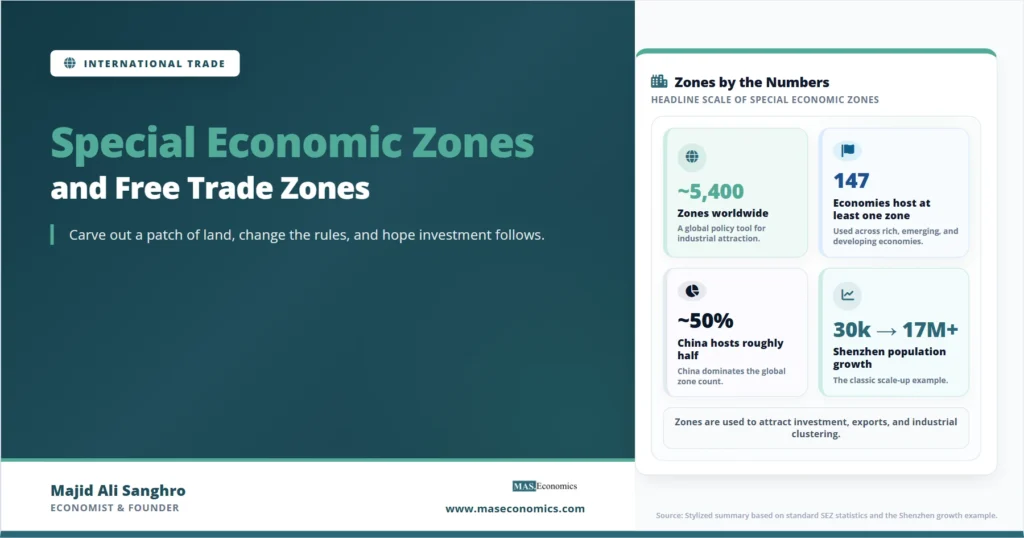
In 1980, Shenzhen was a fishing town of around 30,000 people across the border from Hong Kong. China designated it one of its first four special economic zones, fenced off a patch of coast, and offered foreign firms tax breaks, relaxed rules, and the freedom to operate outside the planned economy that governed the rest of the country. Four decades later, Shenzhen is a city of more than 17 million people, home to Huawei and Tencent, with an economy larger than that of many nations. No single policy experiment has been credited with more of one country’s growth, and none has been copied more widely. The number of such zones worldwide rose from around 845 in 1997 to roughly 5,400 across 147 economies by 2019, according to UNCTAD’s World Investment Report 2019.
The basic idea is simple and old. A government carves out a defined geographic area and applies a different set of economic rules inside it than outside, usually some mix of tax incentives, duty-free treatment of imported inputs, lighter regulation, and better infrastructure. The aim is to attract investment, boost exports, and create jobs in a controlled space without overhauling the entire national economy at once. What varies enormously is how well the idea works in practice, and that variation is where the economics gets interesting.
Zone Categories and Functions
The term special economic zone is an umbrella, and the names underneath it describe different ambitions. A free trade zone, in the narrowest sense, is a duty-free area, often near a port or airport, where goods can be imported, stored, handled, and re-exported without paying the tariffs they would face if they entered the domestic market. The classic version is a customs enclave: goods are treated as if they have not yet legally arrived in the country, which suits warehousing, transshipment, and light processing.
An export processing zone goes a step further by adding manufacturing. Firms import components duty-free, assemble or process them inside the zone, and export the finished goods, paying tariffs only if the product is sold domestically. A full special economic zone is broader still, often a large area with its own administration, infrastructure, and a wide menu of incentives covering taxes, land, labor rules, and customs, intended to host a diverse range of industries rather than a single export activity. The boundaries between these categories blur in practice, but the progression from a simple duty-free warehouse to a self-governing industrial city captures the range.
| Zone type | Core feature | Main activity | Typical incentive |
|---|---|---|---|
| Free trade zone | Duty-free customs enclave | Storage, handling, re-export | No tariffs on goods in transit |
| Export processing zone | Duty-free inputs for export goods | Assembly and manufacturing for export | Tariff and tax relief tied to exporting |
| Special economic zone | Broad regulatory and fiscal carve-out | Diverse industry and services | Tax holidays, land, lighter regulation |
| Specialized or innovation zone | Sector focus, often high-tech | Research, services, advanced manufacturing | Talent, infrastructure, sector support |
|
Source: MASEconomics synthesis based on UNCTAD World Investment Report 2019 zone typology.

|
|||
The duty-free treatment of imported inputs is what links zones directly to trade policy. A zone effectively suspends the tariffs analyzed in the overview of trade policy instruments for firms that operate inside it and export their output. In doing so, it removes the cost penalty that a tariff on inputs would otherwise impose on an exporter, a penalty closely related to the logic of the effective rate of protection, where tariffs on inputs can quietly tax a producer even when the headline rate looks low.
Government Motivations for Zones
The economic case for a zone rests on the idea that a country may be unable to reform its whole economy quickly but can change the rules in one place. For a developing economy with high tariffs, heavy regulation, weak infrastructure, and an uncertain investment climate, a zone offers foreign firms a sealed environment where those obstacles are removed. The government bets that the resulting investment, jobs, exports, and knowledge transfer will justify the revenue it forgoes through tax breaks.
Three mechanisms are supposed to deliver the payoff. The first is foreign direct investment: zones lower the entry cost for multinational firms, a cost otherwise raised by the barriers examined in the discussion of how countries restrict market access. The second is agglomeration, the productivity gain that comes when firms, workers, and suppliers cluster together, sharing infrastructure and a labor pool. The third is the demonstration effect: a zone can serve as a controlled testbed for reforms a government is not yet willing to apply nationwide, which is precisely how China used its early zones before extending liberalization to the wider economy.
That testbed logic explains why zones appeal even to governments skeptical of broad liberalization. A zone contains the experiment. If it succeeds, it can be scaled and replicated; if it fails, the damage is bounded. This connects zones to the wider return of state-directed development described in the article on the revival of industrial policy, because a zone is, in effect, place-based industrial policy: the government picks a location rather than a single firm, and shapes the conditions there to grow the activity it wants.
Note. A special economic zone is industrial policy applied to a place rather than a product. The government does not subsidize a chosen good directly; it changes the rules in a chosen location and lets firms decide what to make there.
Global Distribution of Zones
The global distribution of zones is strikingly uneven, and it is dominated by one country. China alone accounts for roughly half of all special economic zones in the world, a concentration that reflects both the scale of its economy and the central role zones played in its development strategy. After China, the largest numbers are found across a mix of developing and middle-income economies, with the Philippines, India, the United States, Russia, and Turkey among the leaders. Developed economies host only a small share of the global total, though some, such as the United States with its foreign-trade zones, use them extensively for customs purposes rather than for development.
The pattern matters because it shows how thoroughly the Chinese model was exported as an idea. About three-quarters of developing economies and almost all transition economies use zones in their early stages of industrialization. The instrument spread because the Shenzhen story was so visible, but visibility is not the same as transferability, and the record outside China is far more mixed.
Successes and Failures of Zones
The history of zones is a history of a few spectacular successes and many disappointments. Lining up the notable episodes shows that the same policy produces very different outcomes depending on what surrounds the fence.
| Zone | Launched | Approach | Outcome |
|---|---|---|---|
| Shannon, Ireland | 1959 | First modern free zone, airport-based | Pioneered the model; durable but modest |
| Shenzhen, China | 1980 | Testbed for market reform near Hong Kong | From fishing town to global tech hub |
| Dominican Republic free zones | 1970s | Export apparel and assembly | Large employment gains over decades |
| Many African and Latin American zones | 1990s onward | Replicated incentives without supporting conditions | Weak links to the local economy, limited spillovers |
|
Source: UNCTAD World Investment Report 2019 and World Bank zone studies.
|
|||
Shenzhen succeeded for reasons that travel poorly. It sat next to Hong Kong, a deep source of capital, management, and access to world markets. It coincided with a vast, low-cost labor force and a national government committed to making the experiment work. The zone was not a substitute for those conditions; it was a switch that turned them on. Where the surrounding conditions are absent, the same incentives often produce an enclave that imports components, assembles them with cheap labor, exports the result, and connects to almost nothing in the host economy. Jobs appear, but the knowledge transfer and supplier linkages that justify the tax breaks do not.
Caveat. A zone is an amplifier, not an engine. It can magnify the advantages a location already has, but it cannot manufacture a skilled workforce, reliable infrastructure, or political stability that do not exist outside the fence. Copying Shenzhen’s incentives without its surroundings rarely copies its results.
Costs and Risks of Zones
Zones are not free, even when they attract investment. The most direct cost is forgone revenue: tax holidays and duty exemptions are money the government does not collect, and if the investment would have arrived anyway, that revenue is simply lost. There is also the risk of displacement rather than creation, where firms relocate from elsewhere in the country into the zone to capture the incentives, shifting activity around the map without adding much to the national total.
A subtler concern is the race to the bottom. When many countries offer zones with ever-larger incentives to attract the same mobile investment, the main effect can be to transfer value from host governments to firms, with each country bidding away its tax base to avoid losing the project to a neighbor. The competition resembles the strategic dynamics that appear elsewhere in trade policy, and it raises the same question posed by optimal tariff theory: a policy that looks rational for one country in isolation can leave everyone worse off once all of them play it at once.
There are also labor and regulatory concerns. Lighter rules inside the fence can mean weaker protections, and the export-enclave model can leave workers exposed to the volatility of a single global market. None of this means zones fail by default. It means the accounting has to include what the government gives up and what the zone might merely relocate, not only the headline figures for investment and jobs that zone authorities prefer to report.
Zones in Trade and Development
Special economic zones occupy a specific place in the toolkit of a country trying to grow through trade. They are not a trade theory and not a tariff; they are an institutional device for changing the conditions of production in a chosen location, sitting alongside the foreign direct investment they aim to attract and the broader process of globalization that makes mobile, footloose production possible in the first place. They matter because they are where abstract questions about comparative advantage, factor costs, and investment climate become concrete decisions about a fenced patch of land.
The honest assessment is that zones can work and often do not, and the difference lies less in the design of the incentives than in everything around them. A zone that connects to local suppliers, builds skills that spread beyond the fence, and operates in a country with the basic conditions for growth can accelerate development meaningfully. A zone that exists only to harvest tax breaks for footloose assembly tends to produce an isolated enclave and a hole in the budget. The instrument is genuinely useful, but it is not the shortcut its most famous success story is sometimes taken to promise.
Explains
Three ideas behind economic zones
See how zones connect to trade, investment, and growth.
Explore the MASEconomics BlogConclusion
Special economic zones and free trade zones are geographic carve-outs where a government applies different economic rules than in the rest of the country, usually combining tax incentives, duty-free treatment of inputs, lighter regulation, and improved infrastructure. They range from simple duty-free customs enclaves to full industrial cities with their own administration, and they exist because a government may be unable to reform an entire economy quickly but can change the rules in one place. The aim is to attract investment, expand exports, create jobs, and in some cases test reforms before applying them nationwide.
The instrument spread worldwide on the strength of China’s experience, where Shenzhen grew from a fishing town into a global technology hub. By 2019 there were roughly 5,400 zones across 147 economies, with China hosting about half. Yet the success that inspired the global wave depended on conditions, proximity to Hong Kong, a national commitment to reform, and an abundant workforce, that do not travel with the policy. Outside such settings, zones often become isolated export enclaves with weak links to the local economy, and their tax breaks can cost more revenue than the investment they attract is worth.
The realistic verdict is that a zone amplifies the advantages a place already holds rather than creating them from nothing. Where the surrounding conditions support growth, a well-designed zone can accelerate it; where they do not, generous incentives rarely substitute for them. Understanding that distinction is what separates a zone that drives development from one that simply relocates activity and forgoes revenue.
Frequently Asked Questions
What is a special economic zone?
A special economic zone is a geographically defined area within a country where the government applies more favorable economic rules than elsewhere, typically tax incentives, duty-free treatment of imported inputs, lighter regulation, and better infrastructure. The goal is to attract investment, boost exports, and create jobs without reforming the entire national economy at once.
What is the difference between a special economic zone and a free trade zone?
A free trade zone is the narrower term, usually a duty-free customs enclave near a port or airport for storing, handling, and re-exporting goods without paying tariffs. A special economic zone is broader, often a large area with its own administration and a wide range of incentives covering taxes, land, labor, and customs, hosting diverse industries rather than a single activity.
Why was Shenzhen’s special economic zone so successful?
Shenzhen sat next to Hong Kong, which supplied capital, management, and access to world markets, and it opened during a period of abundant low-cost labor and strong national commitment to reform. The zone amplified advantages that were already present. Those surrounding conditions, rather than the incentives alone, explain why the result has been so hard to replicate elsewhere.
How many special economic zones are there in the world?
According to UNCTAD’s World Investment Report 2019, there were roughly 5,400 zones across 147 economies, up from around 845 in 1997. China hosts about half of the global total. About three-quarters of developing economies and almost all transition economies use zones during their early industrialization.
What are the main drawbacks of special economic zones?
The main drawbacks are forgone tax revenue, the risk that firms merely relocate from elsewhere in the country rather than adding new activity, and a race to the bottom in which competing governments bid away their tax base to attract the same mobile investment. Zones can also create isolated enclaves with weak links to the local economy and weaker labor protections.
Thanks for reading! If you found this helpful, share it with friends and spread the knowledge. Happy learning with MASEconomics