When a government posts a 10 percent tariff on imported cars and a 5 percent tariff on imported steel, the headline number on the car looks modest. Yet the carmaker may be enjoying protection well above 10 percent, while a finished-goods producer that buys heavily taxed inputs may be protected far less than its own tariff suggests, or even penalized. The effective rate of protection measures the protection that a tariff structure grants to the value a domestic industry actually adds, rather than the protection implied by the tariff on the finished product alone. It is one of the most useful and most misunderstood ideas in trade policy, because it explains why two industries facing the same nominal tariff can be sheltered to completely different degrees.
The gap between the posted tariff and the protection an industry truly receives is not a rounding error. In tariff schedules that rise as goods move from raw material to finished product, a pattern known as tariff escalation, the effective rate can run several times the nominal rate. Understanding why requires separating the price of a finished good from the value a domestic producer adds to it after paying for imported inputs.
Nominal Protection and Value Added
A nominal tariff is the tax stated in the tariff schedule on a given product. If a country levies a 10 percent duty on imported bicycles, the nominal rate of protection on bicycles is 10 percent. That figure tells consumers how much more they pay and tells the importer how much duty is owed at the border. What it does not tell anyone is how much the domestic bicycle assembler benefits, because the assembler does not produce a bicycle from nothing. The assembler buys frames, tires, gears, and other components, some of them imported, and adds labor, capital, and know-how to turn those parts into a finished machine.
The portion the producer contributes, the difference between the selling price of the finished good and the cost of the traded inputs that went into it, is value added. Protection that matters to a producer is protection of that value added, not protection of the gross price of the final product. A tariff on the finished good raises the price the producer can charge. A tariff on imported inputs raises the producer’s costs. The net effect on the margin available to domestic factors, the wages, returns, and profits earned inside the country, is what the effective rate of protection captures.
This is why a single nominal number is misleading. Two industries can both face a 10 percent tariff on their output, but if one relies heavily on imported inputs that are themselves taxed and the other uses mostly domestic inputs, the protection delivered to their value added will differ sharply. The same logic that underlies the gains from specialization in the theory of comparative advantage and specialization also shapes how a tariff on a finished good interacts with the tariffs on its inputs.
Effective Rate of Protection Formula
The intuition becomes precise once it is written down. Consider a single domestic activity that produces one unit of a final good. Under free trade, the world price of that final good is fixed, and a portion of it is spent on traded inputs. The value added per unit under free trade is the final price minus the cost of those inputs.
Let \(V\) be value added per unit of output at free-trade prices and \(V’\) be value added per unit once tariffs are applied to both the output and the inputs. The effective rate of protection, \(g\), is the proportional change in value added that the tariff structure produces:
EFFECTIVE RATE OF PROTECTION
For the common case of a single imported input, the relationship can be written directly in terms of tariff rates. Let \(t\) be the nominal tariff on the final good, \(t_i\) the nominal tariff on the imported input, and \(a_i\) the share of the input in the free-trade price of the final good, that is, the cost of the input divided by the price of the output before any tariffs. Then:
Three features of this expression do most of the explanatory work. First, the output tariff \(t\) raises effective protection, because it lifts the price the producer receives. Second, the input tariff \(t_i\) lowers effective protection, because it raises the producer’s costs and squeezes the margin. Third, the denominator \(1-a_i\) is the value-added share, and dividing by a number smaller than one magnifies the result. When traded inputs make up a large fraction of the output price, the value-added share is small, and any wedge between the output tariff and the input tariff is amplified into a large effective rate.
Note. When the output and input tariffs are equal, so that \(t = t_i\), the formula collapses to \(g = t\). Uniform tariffs across the production chain make the effective rate equal the nominal rate, which is one reason economists who favor neutrality often prefer flat tariff schedules.
Worked Example: Bicycle Assembler
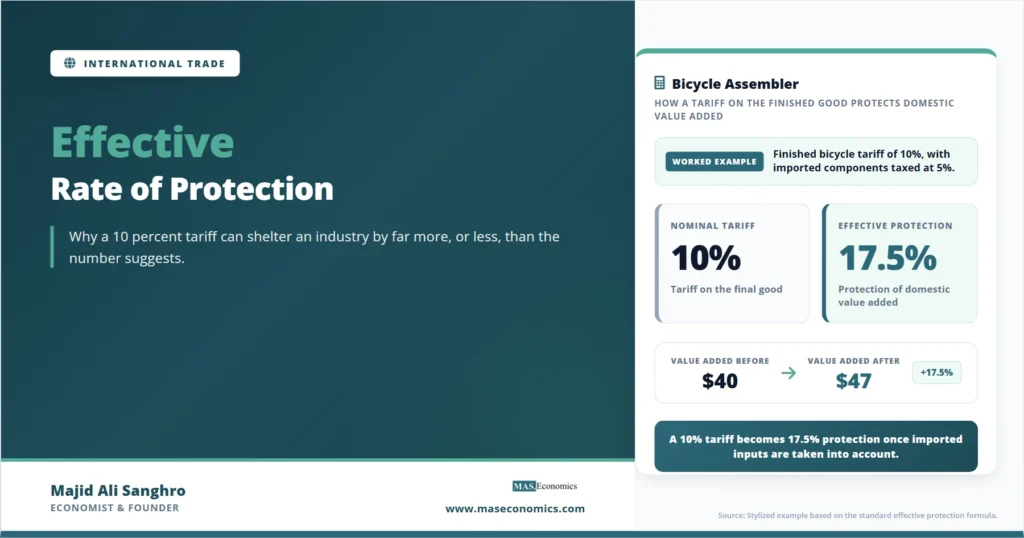
Numbers make the mechanism concrete. Suppose a bicycle sells for 100 at world prices, and the domestic assembler buys 60 worth of imported components to make it. Value added under free trade is 40, the 100 selling price minus the 60 input cost. The input share \(a_i\) is therefore 0.6.
Now apply a 10 percent tariff on finished bicycles and a 5 percent tariff on imported components. The domestic price of a bicycle rises to 110. The cost of the imported components rises to 63. Value added at the new prices is 110 minus 63, which equals 47. The effective rate of protection is the proportional change in value added: \((47-40)/40 = 0.175\), or 17.5 percent.
The nominal tariff on the bicycle was 10 percent. The effective rate is 17.5 percent. The assembler’s protected margin grew far faster than the headline tariff because the output tariff lifted the full selling price while the input tariff applied only to the 60 of components, and because the protected margin started from a value-added base of just 40. The same arithmetic runs through the formula directly: \((0.10-0.6 \times 0.05)/(1-0.6) = (0.10-0.03)/0.40 = 0.175\).
| Item | Free trade | With tariffs (t = 10%, tₕ = 5%) |
|---|---|---|
| Price of finished bicycle | 100 | 110 |
| Cost of imported components | 60 | 63 |
| Domestic value added | 40 | 47 |
| Nominal protection on output | — | 10.0% |
| Effective rate of protection | — | 17.5% |
|
Stylized example based on standard effective-protection formulas. Values are illustrative.

|
||
The gap widens further when inputs make up a larger share of the product or when the input tariff is zero. If the assembler imported components duty-free while the finished bicycle still carried a 10 percent tariff, value added would rise from 40 to 50, an effective rate of 25 percent on a nominal tariff of just 10 percent. The more an industry is “finishing” rather than “making,” the more a finished-goods tariff concentrates its protective force on a thin slice of value added.
Tariff Escalation and Protection
The bicycle case is not a quirk. It reflects a deliberate pattern in many national tariff schedules called tariff escalation, in which duties rise as a product moves along the chain from raw material to semi-finished input to finished good. Raw cocoa may enter at a low or zero tariff, processed cocoa paste at a higher rate, and finished chocolate at a higher rate still. Each step up the chain raises the output tariff facing the next producer while keeping that producer’s input tariff comparatively low.
Escalation is exactly the configuration that drives effective rates above nominal rates for finishing industries. A government that wants to encourage domestic processing rather than raw-material export tends to build escalation into its schedule, whether by design or through the accumulated lobbying of finished-goods producers. The result is that the industries closest to the consumer, the assemblers and processors, often receive the highest effective protection, while upstream input suppliers receive less.
This pattern has a sharp consequence for developing economies that export raw materials. When wealthy markets escalate their tariffs, a cocoa-growing country faces low duties on raw beans but steep effective protection shielding chocolate makers in the importing country. The tariff structure quietly discourages the exporting country from moving up the value chain into processing, locking in a pattern of trade in unprocessed commodities. This is one reason the politics of tariff schedules cannot be read from headline rates alone, a theme that runs through any careful treatment of tariffs, quotas, and other trade barriers.
Negative Effective Rates
The formula also produces a result that surprises people who think of tariffs only as shelter. If the input tariff is high enough relative to the output tariff, the effective rate of protection can be negative. A negative effective rate means the tariff structure leaves a domestic producer worse off than free trade would, taxing its value added rather than protecting it.
Return to the formula \(g = (t-a_i t_i)/(1-a_i)\). The numerator turns negative when \(a_i t_i\) exceeds \(t\), that is, when the cost increase from taxed inputs outweighs the price increase from the output tariff. Suppose a furniture maker faces a 5 percent tariff on finished furniture but a 20 percent tariff on the imported wood and hardware that make up 70 percent of the product’s value. The numerator is \(0.05-0.70 \times 0.20 = 0.05-0.14 = -0.09\), and the effective rate is \(-0.09 / 0.30 = -0.30\), or negative 30 percent. The furniture maker is squeezed: the modest protection on its output is overwhelmed by the heavy tax on its inputs.
Caveat. Negative effective protection is common for industries that depend on inputs which are themselves protected for the benefit of an upstream lobby. A nominal tariff that looks like support for a downstream industry can, in combination with input tariffs, function as a hidden tax on it.
This explains a recurring frustration in trade politics. A government grants a tariff to “help” a domestic manufacturer, the manufacturer’s headline protection looks generous, and yet the firm complains that policy is hurting it. Often the complaint is correct. The protection on its finished product is real but small, while the protection extended to its suppliers raises its costs by more. The effective rate, not the nominal rate, captures who is actually being helped and who is being squeezed.
Limitations of Effective Protection
The effective rate of protection is a measure of the incentive a tariff structure gives to resources flowing into an activity. It is not a welfare measure and was never meant to be. A high effective rate tells you that a tariff schedule is pulling labor and capital toward an industry, but it says nothing about whether that reallocation is efficient or whether consumers are better off. Protection that draws resources into a heavily sheltered finishing industry can still impose high costs on the wider economy, costs that show up as higher consumer prices and as resources diverted from activities where the country has a genuine comparative advantage.
The measure also rests on simplifying assumptions. The basic formula treats input coefficients as fixed, meaning it assumes the proportion of inputs to output does not change when prices change. In reality, producers substitute toward cheaper inputs when tariffs alter relative prices, which softens the effect the simple formula predicts. The standard version also assumes traded inputs, ignoring non-traded inputs such as domestic services and overheads, which complicate the calculation of value added. And it assumes world prices are fixed, which holds for a small country but not for a large one whose import volumes can move global prices, the case examined in the theory of the optimal tariff for a large country.
Despite these limits, the effective rate remains the right tool for one specific question: given a full schedule of tariffs on outputs and inputs, which activities does the structure encourage, and by how much? That question cannot be answered by reading nominal tariffs alone, and any analysis that distinguishes legal mechanism from economic effect, as serious trade-policy analysis must, has to work with effective rather than nominal protection.
Explains
Three concepts that sit behind effective protection
Explore more on trade theory and policy mechanisms.
Explore the MASEconomics BlogConclusion
The effective rate of protection reframes a tariff from a tax on a finished product into a policy that reshapes the margin available to domestic value added. Because a tariff on output raises the price a producer receives while a tariff on inputs raises the producer’s costs, the protection that actually reaches domestic factors depends on the entire tariff schedule and on how thin or thick the value-added slice is. When inputs make up a large share of the product, and the output tariff exceeds the input tariff, effective rates climb well above nominal rates. When input tariffs dominate, effective protection can turn negative, taxing the very industry a headline tariff appears to support.
This is why tariff escalation matters, why finishing industries often capture the most protection, and why developing economies that export raw materials face structural barriers to moving into processing. The measure does not judge whether protection is wise; it diagnoses where a tariff schedule channels resources. Read alongside the nominal schedule, the effective rate exposes the difference between the protection a government announces and the protection it actually delivers.
Frequently Asked Questions
What is the difference between the nominal and effective rate of protection?
The nominal rate is the tariff stated on a finished product. The effective rate measures protection of domestic value added, the margin a producer earns after paying for traded inputs. Because output tariffs raise the producer’s price while input tariffs raise its costs, the two rates can differ substantially, and the effective rate is the one that reflects the true incentive facing domestic factors.
How do you calculate the effective rate of protection?
For a single imported input, the effective rate is \(g = (t-a_i t_i)/(1-a_i)\), where \(t\) is the tariff on output, \(t_i\) is the tariff on the imported input, and \(a_i\) is the input’s cost share in the free-trade output price. Equivalently, it is the proportional change in value added per unit of output once tariffs are applied to both the product and its inputs.
Can the effective rate of protection be negative?
Yes. When the tariff on imported inputs is high enough relative to the tariff on the finished product, the cost increase from taxed inputs outweighs the price gain from the output tariff. The effective rate then turns negative, meaning the tariff structure taxes the industry’s value added rather than protecting it, even though the headline tariff on its output is positive.
Why does tariff escalation raise effective protection?
Tariff escalation means duties rise from raw materials to finished goods. A finishing industry then faces a high tariff on its output and a low tariff on its inputs, the exact configuration that pushes the effective rate above the nominal rate. Escalation concentrates protective force on the value added by finishing industries and discourages raw-material exporters from moving into processing.
What is a protective tariff?
A protective tariff is a duty imposed mainly to shield domestic producers from foreign competition rather than to raise revenue. It works by raising the landed price of the import so that the domestic product becomes competitive at a higher price than it could otherwise command. The effective rate of protection matters here because the shelter a protective tariff actually provides depends on the duties charged on the inputs the domestic producer buys, not only on the tariff on the finished good.
Thanks for reading! If you found this helpful, share it with friends and spread the knowledge. Happy learning with MASEconomics