Reach into your pocket for a phone, and you are holding the output of three economic systems at once. The chip was fabricated in a state-directed industrial economy, the software was written by private firms competing for profit, and the spectrum your signal travels on was auctioned by a government that owns the airwaves. The old classroom contrast of capitalism vs socialism vs mixed economy suggests a world neatly sorted into three camps. The real world looks nothing like that. Almost every functioning economy on the planet today is a blend, and the interesting question is not which pure system a country has chosen but where it has drawn the lines between markets and the state.
An economic system is, at bottom, a set of answers to three questions every society has to settle: who owns productive resources, how decisions about producing and distributing goods get coordinated, and how large a role the state plays in directing the result. Capitalism, socialism, and the mixed economy are best understood not as rival ideologies to cheer for but as different default answers to those questions. This article works through each system in turn, with the real countries that illustrate it, then sets the three side by side so the comparison is clear. Once the questions are separated out, the labels become far less mysterious, and the reason real economies cluster in the middle becomes obvious.
Three Questions Every Economy Faces
Economists since Paul Samuelson have framed the core problem of any economy as three deceptively simple questions: what to produce, how to produce it, and for whom. Behind those lie three institutional choices that distinguish one system from another. The first is ownership. Are factories, land, banks, and intellectual property held by private individuals and firms, or by the state and the wider community? The second is allocation. Are prices set by the interaction of supply and demand in markets, or by central planners working from quantitative targets? The third is the role of the state. Is the government a referee that sets rules and steps back, or an active director that owns key industries and steers investment?
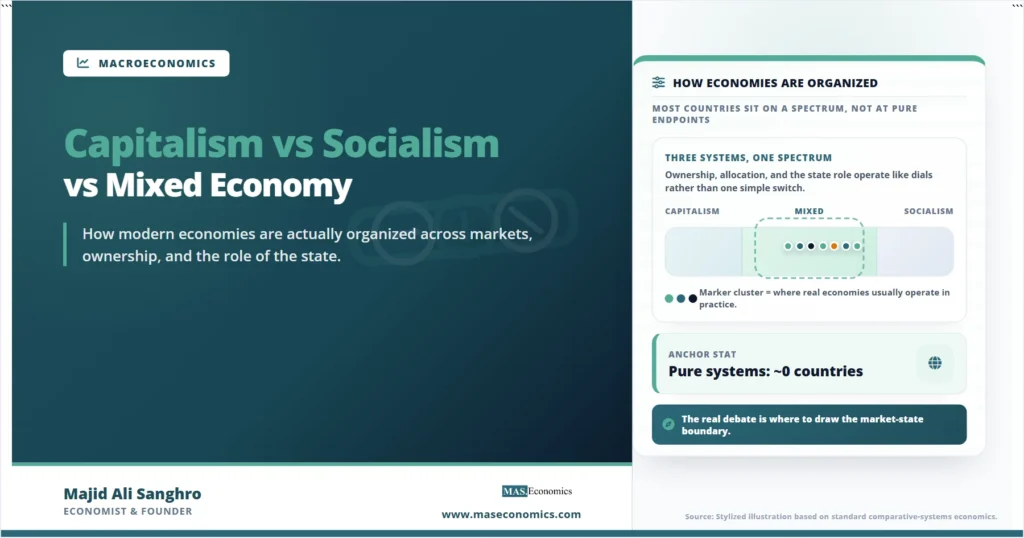
These three axes are related but not identical, and that distinction is the key to the whole subject. A country can have mostly private ownership yet heavy state direction, as wartime economies often do. It can have extensive public ownership yet still rely on market prices, as some reformed socialist economies attempt. Treating ownership, allocation, and state role as separate dials, rather than a single switch flipped between capitalism and socialism, is what lets you see why a three-way comparison is really a position along a spectrum. With the questions in hand, each system becomes a recognizable pattern of answers rather than a slogan.
Capitalism: Ownership and Prices
Capitalism rests on private ownership of the means of production and on markets as the primary mechanism for allocating resources. Individuals and firms own capital, decide what to make, and compete for customers. No central authority tells a bakery how many loaves to bake; the baker responds to prices, which rise when bread is scarce and fall when it is plentiful. Adam Smith’s enduring insight, set out in 1776, was that this decentralized scramble, with each participant pursuing private gain, can produce a coherent social order without anyone intending it. Prices act as signals and incentives at the same time, telling producers what is valued and rewarding those who supply it. Profit is the reward for getting it right, and loss is the penalty for getting it wrong, which is why capitalist economies reallocate resources quickly when conditions change.
The theoretical case for this arrangement is strong. Under a demanding set of assumptions, a competitive market equilibrium is efficient in the sense that no one can be made better off without making someone else worse off, a property economists call Pareto efficiency. Decentralized prices also solve an information problem that defeats any planner: the knowledge of local conditions, tastes, and opportunities is scattered across millions of people and is communicated through the price system rather than collected in one office. This was the heart of Friedrich Hayek’s argument that markets coordinate dispersed knowledge in a way no central authority can replicate. Add the incentive to innovate, since a better product or cheaper process is rewarded with profit, and the system tends to be dynamic, raising productivity and living standards over time.
Capitalism in Practice: The United States and Hong Kong
The United States is the economy most people picture when they think of capitalism, and for good reason. Production is overwhelmingly private, capital markets are deep, and the culture rewards entrepreneurship. Yet even the US is not pure capitalism. The federal government regulates industries, enforces antitrust law, supplies public goods such as defense and the interstate highway system, and runs large social programs. The American case shows that the capitalist label describes the dominant tendency, not a complete absence of the state. Hong Kong, for decades, sat closer to the laissez-faire end, with low taxes, light regulation, and free trade, which is why it regularly topped indices of economic freedom. Even there, the government owned all the land and provided substantial public housing, a reminder that the purest real-world cases still carry a public component.
Where Pure Capitalism Breaks Down
Pure capitalism is a textbook construct rather than a place, because real markets routinely fail to deliver the efficient outcome the theory promises. When production imposes costs on bystanders, as pollution does, private decisions ignore the social damage, a problem economists study under market failure and externalities. Some goods, such as national defense or clean air, are non-excludable and non-rival, so private firms underprovide them; these are the classic public goods that markets struggle to supply. Information gaps let sellers exploit buyers, monopolies restrict output to raise prices, and shared resources get depleted in the familiar pattern of the tragedy of the commons. Capitalism also tends to produce inequality, since returns flow to those who already own capital, and it is prone to booms and busts that no individual firm can prevent. Each of these is a reason a purely private economy invites correction, and every capitalist country has accepted some.
Socialism: Ownership and Allocation
Socialism inverts the first answer. Productive resources are owned collectively, whether through the state, cooperatives, or public bodies, on the argument that those who generate value should share in it and that essential goods should not be rationed purely by ability to pay. The motivation is partly about distribution. Markets reward those who already hold capital and skills, and they can produce inequality that a society judges unacceptable even when the outcome is technically efficient. Socialism promises that productive wealth serves the community rather than private owners, and that basic needs such as healthcare, housing, and education are guaranteed rather than left to the market.
Where socialism becomes most distinctive is in allocation. In the centrally planned version associated with the twentieth-century Soviet economy, a planning authority set output targets, fixed prices, and directed inputs to enterprises according to a national plan rather than to market demand. The appeal was coordination without the waste of competition and the ability to mobilize resources toward national goals, which is how the Soviet Union industrialized rapidly and built a heavy-industry base in a few decades. The difficulty, as the historical record showed, was informational and motivational. Planners could not gather and process the dispersed knowledge that prices summarize automatically, so plans produced gluts of unwanted goods and chronic shortages of wanted ones. Without profit and loss, enterprises lacked sharp incentives to economize or innovate, and quality lagged. The result was an economy that could mobilize for a few priorities but struggled to satisfy ordinary consumers.
Socialism in Practice: The Soviet Union, Cuba, and the Spectrum Today
The Soviet Union and Maoist China are the textbook cases of comprehensive central planning, and both eventually moved away from it. Cuba retains extensive state ownership and central direction, with most enterprises in public hands and a large guaranteed social sector, though it has introduced limited private activity. These command-style cases are now rare. Much of what is called socialism today is not central planning at all. Market socialism keeps social ownership of major assets but lets prices and competition do the allocating, while the social-democratic economies of Western Europe combine overwhelmingly private ownership with large redistributive states. The word covers a wide range, and conflating Scandinavian welfare states with command economies obscures more than it reveals. The Nordic model is the clearest example: high taxes and generous public services sit on top of thoroughly capitalist, market-driven production, which is social democracy rather than socialism in the ownership-and-planning sense.
The label attached to an economy often tracks its distributional ambitions more than its allocation method. A country can run markets for nearly everything while taxing and spending heavily to reshape who ends up with what. That combination is common, and it is not the same as replacing markets with planning.
Mixed Economy: The Dominant Form
A mixed economy combines private ownership and market allocation with public provision, regulation, and redistribution. It is not a compromise reached by splitting the difference between two ideologies; it is the practical result of letting markets do what they do well while using the state to address what they do badly. Private firms produce most goods and respond to prices, but governments supply public goods, regulate monopolies and pollution, insure citizens against unemployment and old age, and redistribute income through taxes and transfers. The mix is built up failure by failure and need by need, which is why no two mixed economies look exactly alike.
The reason this arrangement dominates is structural. The efficiency case for markets holds only under conditions that real economies violate constantly, and the failures are not exotic edge cases but pervasive features of modern life: environmental damage, healthcare, education, infrastructure, financial stability. At the same time, the informational case against comprehensive planning is decisive enough that no large economy attempts to set most prices centrally. Each system is strong precisely where the other is weak, so economies converge on blends that lean on markets for allocation and on the state for correction and insurance. The twentieth century ran the experiment at both extremes, and the survivors were the mixtures.
Varieties of the Mix: China, Singapore, and the Nordics
What varies across mixed economies is the mix itself, and the variation is large. The United States leans further toward private provision and lighter regulation. The Nordic countries combine market production with very large welfare states, taxing heavily to fund universal services while leaving firms to compete. China runs extensive markets under a state that retains ownership of strategic sectors and directs investment heavily, a model often called state capitalism. Singapore pairs free trade and business-friendly policy with state ownership of land, extensive public housing, and large sovereign investment funds. These are all mixed economies, differing in where they set the dials rather than in kind. The lesson of the comparison is that “mixed” is not a single midpoint but a wide band, and the meaningful disagreements happen inside it.

Comparing Ownership, Allocation, and State Role
Laying the systems side by side on the three institutional dimensions clarifies what actually separates them and how the mixed economy borrows from both poles. The contrast is sharpest in the idealized versions; in practice, every column below has been softened by the realities of the others.
| Dimension | Capitalism (ideal) | Socialism (ideal) | Mixed economy |
|---|---|---|---|
| Ownership of resources | Private individuals and firms | State, community, or cooperatives | Mostly private, with public ownership of selected sectors |
| Allocation mechanism | Market prices and competition | Central plan or social direction | Markets for most goods, public provision for the rest |
| Role of the state | Rule-setter and enforcer of contracts | Owner, planner, and director of output | Regulator, insurer, redistributor, and limited owner |
| Main strength | Efficiency and innovation through incentives | Coordination toward collective goals and equality of provision | Captures market efficiency while correcting market failure |
| Main weakness | Market failures, inequality, instability | Information and incentive problems under planning | Boundary disputes over where the line should fall |
| Real examples | United States, Hong Kong | Former Soviet Union, Cuba | Nordic states, China, Singapore |
|
Source: MASEconomics editorial synthesis.
|
|||
The bottom rows point to where the real debate lives. Because virtually every country is mixed, political argument is rarely about whether to have markets or the state at all. It is about the boundary: how much to tax, what to leave to private firms, which industries warrant public ownership or heavy regulation, how generous social insurance should be. Those choices are contested partly on efficiency grounds and partly on values, since the line between markets and the state is also a line between competing ideas of fairness.
Boundary as the Central Debate
Drawing the boundary well is harder than picking a side, because market failures and government failures are both real. The economic case for state intervention rests on identifiable failures: externalities, public goods, monopoly, information asymmetry, and macroeconomic instability. Yet intervention has its own pathologies. Regulators can be captured by the industries they oversee, public spending can be diverted by interest-group pressure, and political incentives can pull policy away from the public interest, the central theme of public choice theory. A serious comparison of systems weighs the cost of leaving a failure uncorrected against the cost of a correction that misfires.
Sometimes the private solution turns out to be better than either pole suggests. The Coase theorem shows that when property rights are clear and bargaining is cheap, parties can resolve externalities themselves without the state setting the outcome, which cautions against assuming every market failure needs a public fix. The broader lesson is that the choice is not capitalism or socialism in the abstract but a series of concrete, case-by-case decisions about where each tool works. The analytical traditions that inform those decisions, from classical liberalism to Keynesian and institutional economics, are surveyed in our overview of the schools of thought in economics.
Explains
Three ideas that shape how systems get classified
Explore related explainers on systems, markets, and the state.
Explore the MASEconomics BlogConclusion
The framing of capitalism vs socialism vs mixed economy is most useful once it stops being a contest between three teams and becomes a way of reading three institutional dials: who owns productive resources, how allocation is coordinated, and how active the state is. Pure capitalism and pure socialism are theoretical endpoints that clarify the trade-offs but describe almost no actual country. Capitalism delivers efficiency and innovation through prices and incentives but leaves real failures uncorrected. Socialism aims at coordination and equality of provision but runs into the information and incentive problems that defeated comprehensive planning.
What survives the contact between theory and practice is the mixed economy, in wide varieties. The United States, the Nordic states, China, and Singapore are all mixtures of private markets and public direction that differ in where they set the dials rather than in which system they have adopted. That is why the productive question is never which pure system to install. It is where, sector by sector, to draw the boundary between what markets handle and what the state handles, knowing that both markets and governments can fail and that the right line depends on the specific failure in view.
Frequently Asked Questions
What is the main difference between capitalism and socialism?
The core difference is ownership and how resources are allocated. Under capitalism, productive resources are privately owned and prices set by markets coordinate what gets produced. Under socialism, those resources are owned collectively or by the state, and allocation is steered by social direction or a central plan rather than by private profit and market prices.
What is a mixed economy in simple terms?
A mixed economy combines private markets with an active state. Private firms own most resources and respond to prices, while the government regulates industries, supplies public goods such as roads and defense, insures people against unemployment and old age, and redistributes income through taxes. It uses markets for efficiency and the state to fix what markets get wrong.
Is the United States a capitalist or a mixed economy?
The United States is a mixed economy that leans toward the capitalist end. Most production is private and market-driven, but the government regulates industries, supplies public goods, runs large social insurance programs such as Social Security and Medicare, and redistributes income through taxes. No large modern economy, including the US, operates as pure laissez-faire capitalism.
Why do most countries have mixed economies?
Because each pure system is strong where the other is weak. Markets allocate efficiently and reward innovation but fail to handle externalities, public goods, monopoly, and instability. Central planning can coordinate toward collective goals but cannot process the dispersed information that prices summarize. Blending the two lets a country use markets for allocation while using the state to correct failures and provide insurance.
Are Nordic countries socialist?
No. The Nordic countries are market economies with private ownership and competitive firms, combined with high taxes and generous public services. They are best described as social democracies, which are large redistributive states sitting on top of capitalist production. That differs from socialism in the ownership-and-planning sense, where the state owns the means of production and directs output.
Can an economy be purely capitalist or purely socialist?
In theory, yes; in practice, no large economy is. Pure capitalism would mean no public goods, regulation, or redistribution, which no functioning state maintains. Pure socialism would mean comprehensive central planning of most prices and output, which historical command economies attempted and largely abandoned because of information and incentive problems. Real economies settle somewhere along the spectrum between the two.
Thanks for reading! If you found this helpful, share it with friends and spread the knowledge. Happy learning with MASEconomics