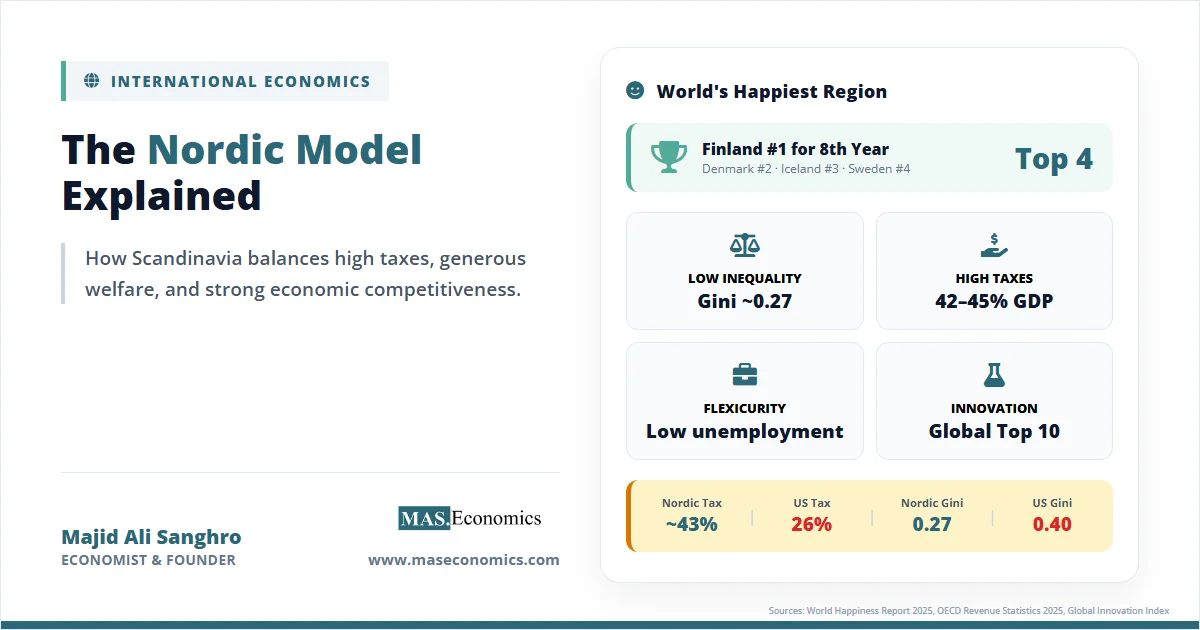
In March 2025, the World Happiness Report named Finland the world’s happiest country for the eighth consecutive year, with Denmark, Iceland, and Sweden occupying the second, third, and fourth spots, respectively according to Politico’s coverage of the report. Meanwhile, the OECD’s 2025 Economic Survey of Sweden noted that the country combines high living standards and strong labour force participation with low public debt and low income inequality. Nordic model economics explains how a group of small, open economies in Northern Europe consistently achieve outcomes that elsewhere appear contradictory: high taxes alongside competitive economies, generous welfare states alongside strong work incentives, and low inequality alongside strong growth.
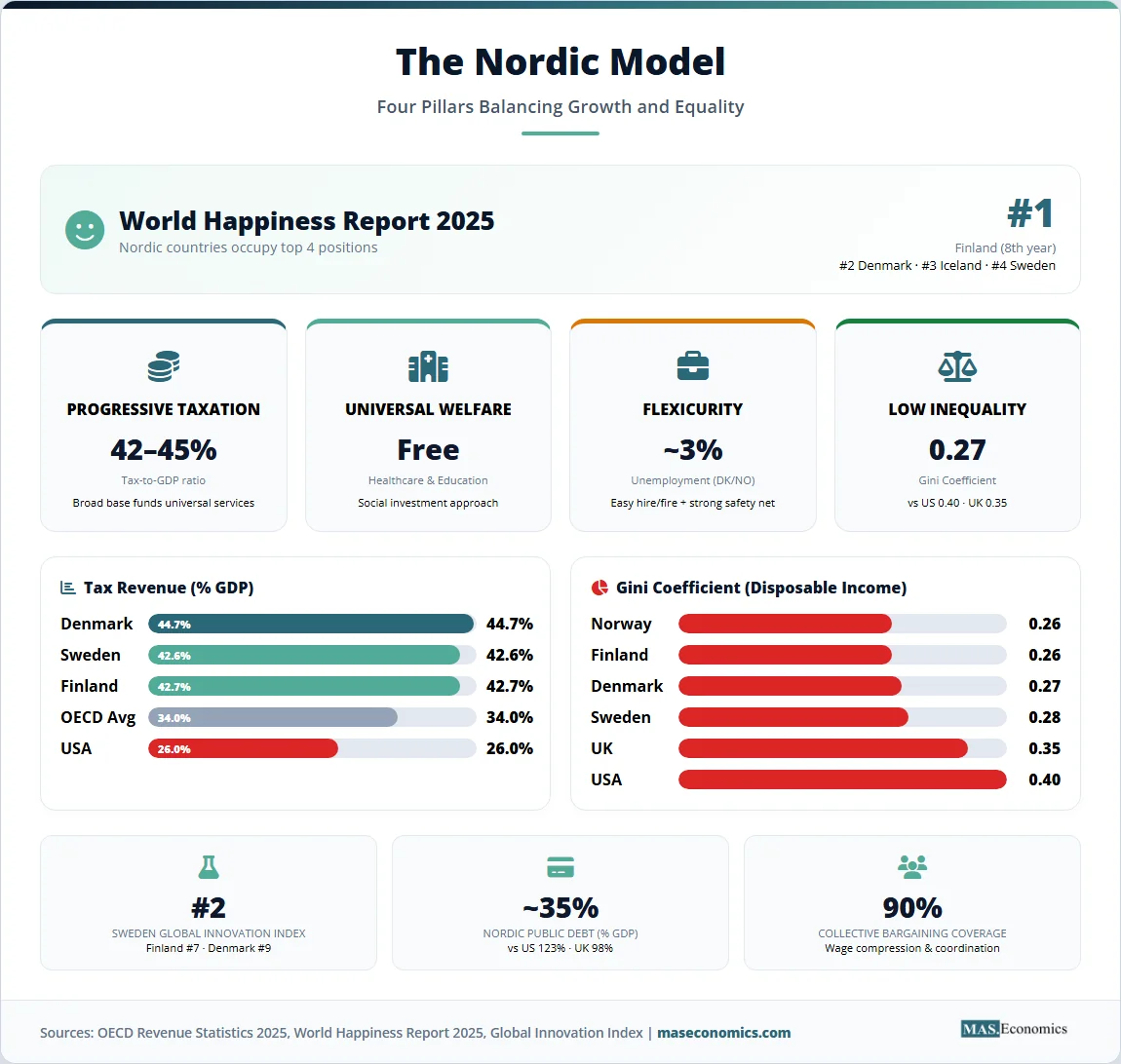
Denmark, Sweden, Norway, and Finland consistently rank among the wealthiest and most equal countries on Earth. According to OECD Revenue Statistics 2025, Denmark’s tax-to-GDP ratio hovers around 45%, with Sweden, Norway, and Finland clustering between 42% and 43%; well above the OECD average of 34%. Yet these economies remain highly competitive. The 2025 Global Innovation Index ranked Sweden second in the world, Finland seventh, and Denmark ninth.
The Origins and Evolution of the Nordic Model
The Nordic model did not emerge from a single blueprint or ideological vision. It evolved through decades of political compromise, pragmatic policymaking, and adaptation to external shocks. Its roots lie in the social democratic movements of the early twentieth century, which established universal social insurance programs and strong labor unions. By the 1930s, agreements between employer federations and trade unions had institutionalized collective bargaining, laying the foundation for coordinated wage-setting and labor market stability.
The post-war period saw the expansion of the welfare state, with universal healthcare, free education, and comprehensive social security becoming pillars of Nordic societies. The oil crises of the 1970s and the banking crises of the 1990s forced reforms. Sweden, for instance, overhauled its pension system in the 1990s, moving from a defined-benefit to a notional defined-contribution model, which improved fiscal sustainability while preserving the universal character of the welfare state. Denmark introduced its celebrated “flexicurity” model in the 1990s, combining easy hiring and firing with generous unemployment benefits and active labor market policies.
Despite occasional challenges, the model has proven resilient. Nordea’s 2025 Economic Outlook notes that “the Nordic economies remain resilient amid global headwinds, supported by solid foundations” and that Denmark, Sweden, and Norway belong to the exclusive group of AAA-rated nations, characterised by strong public finances and solid external balance sheet surpluses.” The region’s ability to combine fiscal policy prudence with generous social provision is a defining feature of the model.
Timeline: Key Milestones in the Development of the Nordic Model
| Period | Event | Economic Significance |
|---|---|---|
| 1890s–1930s | Formation of strong labor unions and employer federations | Established tradition of centralized collective bargaining. |
| 1930s–1950s | Expansion of universal social insurance programs | Laid foundation for comprehensive welfare state. |
| 1960s–1970s | Rapid growth of public sector employment | High taxes became necessary to fund expanding public services. |
| 1990s | Banking crises and economic reforms; Denmark’s flexicurity model | Introduced flexibility and fiscal discipline while preserving social safety nets. |
| 2000s–2010s | Tax reforms and pension system overhauls | Improved work incentives and long-term fiscal sustainability. |
| 2020–2025 | Resilience through pandemic and global uncertainty | Nordic economies maintain AAA ratings and low unemployment despite global headwinds. |

|
||
The Nordic model is not static. It continues to evolve in response to demographic pressures, technological change, and global competition. The key to its longevity lies in its ability to adapt while preserving the core principles of universalism, high labor force participation, and coordinated market economies.
Four Pillars of the Nordic Model
The Nordic model can be understood through four interconnected economic mechanisms: income redistribution through the tax-and-transfer system, progressive taxation, the comprehensive welfare state, and labor market flexibility.
Income Redistribution and Low Inequality
The Nordic countries have among the lowest levels of income inequality in the developed world. Statistics Norway data for 2025 shows a Gini coefficient for earnings of just 0.211 across all industries, indicating extremely low wage dispersion. This low inequality is not accidental. It results from two forces: wage compression through coordinated collective bargaining, which reduces the gap between high and low earners, and a highly redistributive tax-and-transfer system that further narrows disparities.
OECD data show that government redistribution reduces inequality in every OECD country, with Finland achieving the largest reduction (0.24 Gini points). A 2025 analysis in Jacobin found that the gap between the average Nordic Gini for disposable income and the American Gini is 12.5 points, of which roughly 7.3 points are attributable to tax and transfer programs. The remaining difference comes from “predistribution”, a more equal distribution of market incomes before taxes and transfers. This combination of predistribution and redistribution is central to understanding welfare economics in the Nordic context.
Progressive Taxation: High Taxes, Broad Bases
The Nordic model is financed by some of the highest tax-to-GDP ratios in the world. According to OECD Revenue Statistics 2025, Denmark’s tax-to-GDP ratio is around 45%, while Sweden, Norway, and Finland cluster between 42% and 43%. The OECD average is 34%, and the United States stands at approximately 26%. The Nordic tax system relies on several pillars: progressive personal income taxes, broad-based value-added taxes (typically 24–25%), and relatively high taxes on consumption.
Unlike some countries that rely heavily on corporate income taxes or social security contributions, the Nordic model emphasizes broad tax bases with relatively few exemptions. This broad base allows rates to be high without being confiscatory. A 2024 Nordic Economic Policy Review paper on Sweden found that, despite significant reductions in labor taxes, direct taxes on labor fell from 17% of GDP in 1998 to 10% in 2022, and the size of automatic stabilizers remained stable. The study concluded that “it is possible to increase the incentives to work without substantial impairment of the automatic stabilisers.” This finding challenges the notion that high taxes necessarily undermine work incentives.
The tax system also serves as a powerful automatic stabilizer. When the economy slows, and unemployment rises, tax revenues fall and social transfers increase automatically, cushioning the downturn without requiring legislative action. This fiscal architecture is a key reason why the Nordic economies weathered the 2008 financial crisis and the COVID-19 pandemic better than many of their European peers.
The Welfare State: Universalism and Social Investment
The Nordic welfare state is universal, meaning that benefits and services are available to all citizens regardless of income or employment status. Healthcare is publicly funded and largely free at the point of use. Education is free from primary school through university. Childcare is heavily subsidized, enabling high female labor force participation. Elder care is publicly provided. Unemployment benefits replace a substantial portion of lost income, typically 60–70% of previous earnings.
This universalism distinguishes the Nordic model from means-tested welfare systems that target only the poor. By providing benefits to everyone, the system generates broad political support and avoids the stigma associated with “welfare.” Universalism also promotes social cohesion and trust, which in turn facilitates the high tax compliance needed to fund the system.
The welfare state is not merely a safety net. It functions as a social investment. Free education and active labor market policies improve human capital and labor productivity. Subsidized childcare enables both parents to work, raising household incomes and expanding the tax base. Universal healthcare reduces financial stress and improves population health, contributing to higher labor force participation among older workers. Nordregio’s analysis notes that “the Nordic Region has had one of the highest employment rates in Europe for a long time, especially for women and older adults.”
This social investment perspective reframes welfare spending as productive expenditure rather than consumption. By investing in human capital and labor force participation, the welfare state contributes to economic growth and fiscal sustainability.
Labor Market Flexibility: The Flexicurity Model
The fourth pillar of the Nordic model is labor market flexibility, exemplified by Denmark’s celebrated “flexicurity” system. According to Nordregio, “Denmark, in particular, is known for its flexicurity system, which makes it easy for companies to lay off staff, but at the same time, the state provides good benefits and reskilling opportunities for workers.” The model rests on three legs: flexible hiring and firing rules for employers, generous unemployment benefits for workers, and active labor market policies that help the unemployed find new jobs.
This combination of flexibility and security creates a dynamic labor market. Danish workers change jobs more frequently than workers in most other European countries, and the unemployment rate remains among the lowest in the EU. Employers can adjust their workforce quickly in response to changing market conditions, while workers have confidence to change jobs because they are protected by a strong safety net and have access to retraining programs.
Sweden and Finland have similar, though less celebrated, models. Sweden’s collective bargaining system, which covers approximately 90% of workers, sets wages and working conditions without direct government intervention. This coordinated wage-setting helps prevent wage-push inflation and maintains competitiveness in export-oriented industries. Understanding unemployment in the Nordic context requires recognizing that frictional and structural unemployment are mitigated by active labor market policies, while cyclical unemployment is cushioned by automatic stabilizers.
Comparing the Nordic Model to the US and UK
The radar chart below compares the Nordic countries (averaged) against the United States and the United Kingdom on six key economic and social indicators: GDP per capita, tax-to-GDP ratio, income inequality (inverted so higher values mean more equality), labor force participation, life satisfaction, and public debt. The Nordic profile shows high performance across all dimensions except public debt, where the US is an outlier.
Nordic Model vs. US and UK: A Comparative Radar (Indexed to 100)
Sources: OECD Revenue Statistics 2025 (tax-to-GDP); World Bank GDP per capita (PPP); World Bank labor force participation; IMF public debt data. All values indexed to 100 for comparability.
The second chart shows tax revenue as a percentage of GDP for selected countries, illustrating the fiscal foundation of the Nordic model. The Nordic countries collect between 42% and 45% of GDP in taxes, roughly 15–20 percentage points higher than the United States and 8–10 points higher than the United Kingdom. This revenue funds the universal welfare state and public services that underpin the model.
Tax Revenue as a Percentage of GDP (2024 Estimates)
Sources: OECD Revenue Statistics 2025; OECD Revenue Statistics database. Values for 2024 are preliminary estimates.
The following table summarizes key economic and social indicators for the Nordic countries, the United States, and the United Kingdom, providing a snapshot of the trade-offs and outcomes associated with the Nordic model.
Key Indicators: Nordic Countries vs. US and UK (2025 Estimates)
| Indicator | Denmark | Sweden | Norway | Finland | US | UK |
|---|---|---|---|---|---|---|
| Tax-to-GDP Ratio (%) | 44.7 | 42.6 | 41.8 | 42.7 | 26.0 | 35.3 |
| Gini Coefficient (Disposable Income) | 0.27 | 0.28 | 0.26 | 0.26 | 0.40 | 0.35 |
| World Happiness Score (2025) | 7.52 (#2) | 7.35 (#4) | 7.26 (#7) | 7.74 (#1) | 6.72 (#24) | 6.78 (#21) |
| Unemployment Rate (%) | 2.9 | 7.5 | 2.1 | 7.2 | 4.1 | 4.3 |
| GDP Growth (2025 est.) | 2.6 | 2.5 | 2.0 | 0.5 | 2.1 | 1.1 |
| Public Debt (% GDP) | 32 | 33 | 42 | 75 | 123 | 98 |
|
|
||||||
Sources: OECD Revenue Statistics 2025 (tax-to-GDP); OECD Government at a Glance 2025 (Gini); World Happiness Report 2025; Eurostat and national statistics offices (unemployment, GDP, public debt).
Lessons and Takeaways
The Nordic model offers four enduring lessons for economic policy and institutional design.
First, high taxes and a large welfare state are compatible with strong economic performance. The Nordic countries consistently rank among the most competitive and innovative economies in the world, despite tax burdens that are 15–20 percentage points of GDP higher than the United States. The key is that taxes fund productive social investments: education, healthcare, childcare, and active labor market policies that boost labor force participation and human capital.
Second, universalism generates political sustainability. By providing benefits to all citizens rather than targeting only the poor, the Nordic welfare state avoids the stigma and political vulnerability of means-tested programs. Universal programs command broad political support and are more resistant to retrenchment. The high levels of social trust in Nordic societies, reflected in the World Happiness Report’s finding that Nordic countries “rank among the top places for expected and actual return of lost wallets”, facilitate high tax compliance and effective governance.
Third, labor market flexibility and strong worker protections can coexist. Denmark’s flexicurity model demonstrates that it is possible to combine easy hiring and firing with generous unemployment benefits and active labor market policies. This combination creates a dynamic labor market that adjusts quickly to economic shocks while protecting workers from the worst consequences of job loss. The model’s success depends on high levels of trust between employers, unions, and the state, and on substantial public investment in retraining and job placement services.
Fourth, the Nordic model is not static. It has evolved in response to crises and continues to adapt. The pension reforms of the 1990s, the tax reforms of the 2000s, and ongoing adjustments to labor market policies demonstrate that the model is not a rigid ideological construct but a pragmatic framework that can be recalibrated as circumstances change. Welfare economics provides the analytical tools to evaluate these trade-offs, and the Nordic experience shows that it is possible to achieve both efficiency and equity.
The Nordic model also faces challenges. The Nordic Sustainable Development Report 2025 highlights “the Nordic paradox: strong social and economic outcomes but persistent environmental and spillover challenges.” The report notes that the Nordic countries have challenges with regard to responsible consumption, climate action, and international spillovers that negatively affect other countries’ capacities to implement sustainable development goals. Population aging, immigration, and the green transition present further tests. The model’s ability to meet these challenges will determine whether the Nordic success story continues.
MASEconomics Explains
Four economic concepts behind the Nordic model
Conclusion
Nordic model economics explains how a group of small, open economies in Northern Europe consistently achieve outcomes that elsewhere appear contradictory: high taxes alongside competitive economies, generous welfare states alongside strong work incentives, and low inequality alongside strong growth. Finland’s eighth consecutive year as the world’s happiest country, Sweden’s second-place ranking in the Global Innovation Index, and the region’s AAA credit ratings amid global uncertainty are not accidents. They are the product of a century of institutional evolution, pragmatic policymaking, and a commitment to combining economic efficiency with social equity.
The model is not a simple template that can be exported wholesale to other countries with different histories, institutions, and social norms. Its core principles, universalism, social investment, labor market flexibility, and fiscal prudence offer valuable lessons. As demographic pressures, climate change, and technological disruption reshape the global economy, the Nordic experience demonstrates that it is possible to maintain a generous welfare state and a competitive economy, provided that institutions are well-designed and policies are continuously adapted to changing circumstances.
Frequently Asked Questions
What is the Nordic model?
The economic arrangement shared by Denmark, Sweden, Norway, Finland and Iceland: high taxes funding universal public services, a large welfare state, strong unions bargaining across whole sectors, and markets that are otherwise open and lightly regulated. The bargain is security for workers rather than protection for jobs.
How do Nordic countries afford high taxes without hurting growth?
Because the taxes fund things that raise how many people work: childcare, education, healthcare and retraining. High employment widens the tax base, which pays for the services, which keeps employment high. Firms stay competitive because it is easy to hire and dismiss, with the state, not the employer, carrying the cost of unemployment.
What is flexicurity?
The Danish combination of flexible hiring and firing rules with generous unemployment benefits and active retraining. Employers can restructure quickly, and workers accept it because losing a job does not mean losing income or health cover. It is the mechanism that lets an open economy carry a large welfare state.
Did you find this article helpful? Share it with someone who loves economics. And remember, at MASEconomics, we make complex ideas simple.