On 27 July 2026 the State Bank of Pakistan held its policy rate at 11.5 percent. Analysts read the statement, the government bond market repriced, and the financial press moved on to the next meeting. Outside that circle the decision landed on almost nobody, because most of the money in the country never passes through a bank. This is the central problem of monetary policy in a cash economy, and it is not a Pakistani curiosity. It is the ordinary working condition of central banks across much of the world.
An interest rate is a price on borrowed money that has been through an intermediary. It reaches a household through a mortgage, a car loan or a deposit rate. It reaches a firm through a credit line that reprices. Where those connections exist, a rate change travels. Where they do not, the announcement is still made, the markets still move, and the economy mostly carries on as before.
The Banks Used to Be the Bigger Half
Pakistan lets you measure the problem rather than assert it, because the State Bank publishes both quantities every week. One is currency in circulation, the physical cash in tills and pockets and under mattresses. The other is credit to the private sector, everything the entire banking system has lent to private business.
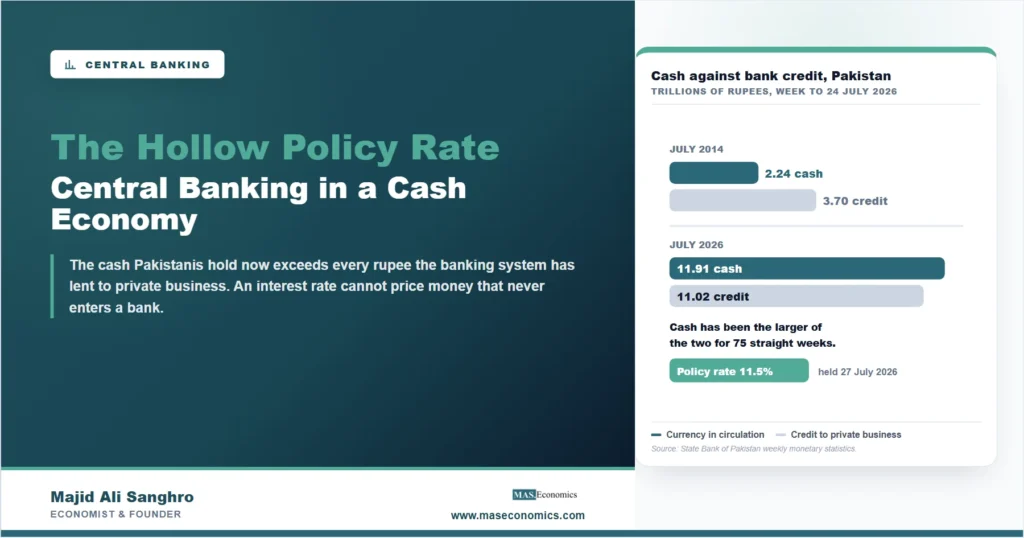
In July 2014 the banks were comfortably the bigger half. Private credit stood at 3.70 trillion rupees against 2.24 trillion rupees of cash, so lending was about 1.65 times the currency outside the banks. In the week to 24 July 2026, cash was 11.91 trillion rupees and private credit was 11.02 trillion. The money people are holding in their hands is now larger than everything the banking system has lent to every private business in the country.
The two lines first crossed in June 2020. They swapped places repeatedly for the next four years, and then the crossing became permanent: cash has been above private credit in every single week since 28 February 2025, seventy five weeks in a row at the latest reading. Over the whole period since June 2020, cash has been the larger of the two in about two thirds of all weeks.
That is what a hollow policy rate looks like in one picture. The State Bank prices the smaller half of that comparison. The larger half answers to food prices, the harvest, the open-market exchange rate and money sent home from abroad.
What the Rate Still Reaches, and What It Never Touches
The rate is not powerless. It is narrow, and the distinction matters because the parts it reaches are real. It sets the government’s cost of borrowing directly, because banks hold sovereign debt and reprice it the same day. It sets deposit and lending rates for the formal sector, which is a genuine slice of economic activity even if it is a minority of transactions. It supports the currency, and since the exchange rate prices every imported good in every bazaar, banked or not, that channel does reach people who have never seen a bank statement. This is the standard monetary transmission mechanism working through the connections that exist.
What it does not touch is the wage paid in banknotes, the shopkeeper who buys stock from cash takings, the household that saves in gold or livestock rather than in a deposit account, and the informal lender whose rate has never been within sight of the policy corridor. According to the World Bank’s Global Findex, more than half of Pakistani adults still have no account at a financial institution, and Pakistan is one of eight countries that together hold half of the world’s 1.3 billion unbanked adults.
The Central Bank Says the Same Thing, in Its Own Words
None of this is a criticism the State Bank would reject. Its own explanation of monetary policy states that the full effects of a rate change on inflation often take six to eight quarters to materialize, and it aims at a medium-term inflation target of 5 to 7 percent. Read that carefully. One to two years is the lag in the part of the economy the rate can actually reach. In the cash half, the lag is not long. There is no channel for it to be long through.
A central bank in this position is being asked to hit a target with an instrument that is connected to a minority of the economy, and then judged by the standards of institutions whose instruments are connected to almost all of theirs. The State Bank’s own institutional history shows how much of its effort has gone into building that connection rather than adjusting the price along it.
The Firms That Joined the System Pay for the Ones That Did Not
Narrow transmission has a distribution, and this is the part that usually goes unsaid. When policy has to work through a small formal sector, that sector carries the entire adjustment. A registered manufacturer with a repricing credit line feels the full weight of a tightening cycle. The unregistered competitor down the road holds no bank loan to reprice and feels none of it.
So disinflation costs more output per point than it would in a banked economy, and the cost lands on exactly the firms that pay tax, keep records and hire formally. It also creates a quiet incentive to stay outside, which narrows the channel a little further with each cycle. A policy instrument that only touches the formal economy is, over time, a tax on being formal.
The Most Effective Monetary Action of the Year Was Not a Rate Decision
The past year in Pakistan produced an unusually clean demonstration of what does move money in an economy like this. Workers’ remittances reached a record 41.6 billion dollars in the fiscal year to June 2026, up 8.6 percent from 38.3 billion. The State Bank and the government attribute the increase less to the level of interest rates than to plumbing: enforcement against the informal hawala and hundi networks, reform of the exchange companies, and better digital channels for sending money home.
Money that used to arrive outside the measured economy now arrives inside it, where policy can see it, price it and reach it. That is a permanent widening of the channel rather than a temporary change in its price. Every account opened and every transfer formalised makes the next rate decision reach a little further. In economies at this stage, transmission is not the assumption behind monetary policy. It is the objective, and financial development belongs in the monetary department rather than in a separate one. The link between financial inclusion and inflation control is usually framed as a trade-off, and this is the case for reading it as a complement.
Why This Matters Where the Plumbing Already Works
A reader in Chicago or Frankfurt might file this under other people’s problems. Two things make it theirs.
The first is that the strength of monetary policy is a property of the financial system, not of the central bank’s resolve. American rate changes hit hard because American households carry mortgages, credit card balances and car loans that reprice or are refinanced. When that connection weakens, so does the policy, in rich countries too. The clearest recent example is the American mortgage market, where cuts in the policy rate have not reached borrowers as expected, because most households are locked into loans fixed years ago. That is the same phenomenon as Pakistan’s, in a much milder form: a channel that is narrower than the textbook assumes.
The second is that a great deal of the world runs on the cash-heavy version. Egypt, Nigeria, Bangladesh and dozens of other economies operate orthodox inflation-targeting frameworks designed for financial systems they do not yet have. Anyone reading an emerging-market rate decision, holding emerging-market debt, or judging an IMF program by whether the central bank raised rates enough is implicitly assuming a transmission mechanism that may not be there. The right question is not whether the rate went up. It is how much of the economy the rate can find.
MASEconomics Explains
3 economic concepts behind the hollow policy rate
These concepts are explored in depth across our educational articles library.
Conclusion
Monetary policy in a cash economy is not a weaker version of the standard model. It is the standard model applied to a minority of the economy, with the rest left to prices and shocks the central bank does not set. Pakistan makes the point measurable rather than theoretical: the cash people hold has exceeded everything the banking system lends to private business for seventy five consecutive weeks, and the country’s own central bank concedes that the effects it can produce take six to eight quarters to arrive.
The useful conclusion is not that these central banks should stop setting rates. The rate does real work in the sovereign debt market, in the formal credit market and through the exchange rate, and Pakistan’s disinflation is genuine. It is that the work of widening the channel, opening accounts, formalising remittances and pulling transactions into the measured economy, is monetary policy rather than a preliminary to it. The best evidence for that came from the past year, when the largest change in how money moved through Pakistan was not a decision about the price of money at all.
Frequently Asked Questions
What is a cash economy in monetary terms?
One where a large share of transactions and savings sit outside the banking system, so most money is never intermediated. The practical marker is a high ratio of currency in circulation to bank credit or to deposits. In Pakistan that ratio has passed one, meaning cash held by the public now exceeds all bank lending to private business.
Does the policy rate do anything in a cash economy?
Yes, through three channels that still function. It sets the government’s borrowing cost, since banks hold sovereign debt and reprice it immediately. It sets deposit and lending rates in the formal sector. And it supports the currency, which prices imported goods for everyone, banked or not. What it does not reach is cash wages, informal credit and savings held outside the financial system.
Why did cash overtake bank credit in Pakistan?
Both grew, but cash grew faster. In July 2014 private credit was 3.70 trillion rupees against 2.24 trillion of currency. By July 2026 currency was 11.91 trillion against 11.02 trillion of credit. The two first crossed in June 2020 and cash has been above credit every week since 28 February 2025.
Who bears the cost of tight policy when transmission is narrow?
The formal sector. Registered firms with bank credit absorb the whole adjustment, while unregistered competitors hold no loans to reprice and feel very little. That makes each point of disinflation more expensive in lost output than it would be in a banked economy, and it quietly rewards staying informal.
How can a central bank widen its transmission channel?
By bringing transactions into the measured economy. Pakistan’s record 41.6 billion dollars of remittances in the fiscal year to June 2026 followed enforcement against informal transfer networks, exchange-company reform and better digital channels, not a change in interest rates. Account opening, payment digitisation and remittance formalisation all widen the channel permanently rather than adjusting the price along it.
Is this only a developing-economy problem?
No, though it is far more severe there. Transmission strength depends on financial connections everywhere. American rate cuts have reached mortgage borrowers only partially because most households hold fixed loans taken out years earlier. That is the same principle in a mild form: policy reaches as far as the plumbing carries it.
Thanks for reading! Once you start asking how much of an economy an interest rate can actually find, a lot of central banking arguments look different. Happy learning with MASEconomics