No economic statistic gets blamed for more, with less examination, than the trade gap. What is a trade deficit? It is the amount by which a country’s imports of goods and services exceed its exports over a period: buy more from the world than the world buys from you, and the difference is the deficit. The United States has run one every year since 1976, which fifty years of political speeches have described as losing. The economics is less obliging. A trade deficit is not a score, and reading it as one has launched trade wars against a number that does not mean what the combatants think it means.
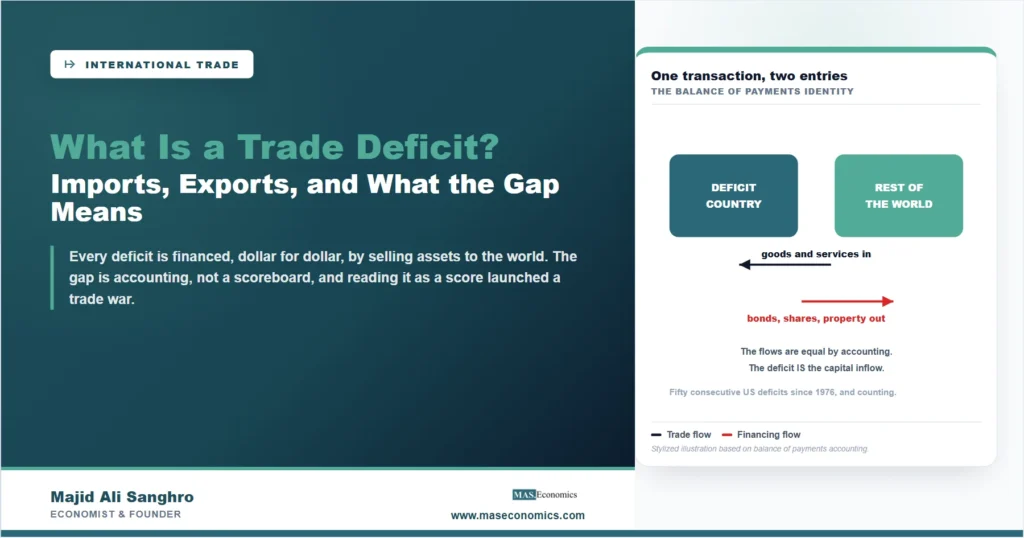
The reason lies in a piece of accounting that almost never survives translation into headlines: every dollar of trade deficit is, by construction, matched by a dollar of foreign investment flowing the other way. The two are not cause and effect debated by economists; they are two entries describing the same transactions. Understanding that identity is most of what separates careful readings of the gap from campaign rhetoric, and it fits in one section.
Every Deficit Is Financed, Instantly and Exactly
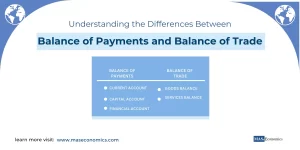
Consider what actually happens when a country imports more than it exports. The extra imports must be paid for, and the payment leaves foreigners holding domestic money or claims on it. They do not burn it. They use it to buy the deficit country’s assets: government bonds, shares, factories, property, bank deposits. So a country running a trade deficit is necessarily selling assets or IOUs to the rest of the world in the same amount, and a country running a surplus is necessarily accumulating claims on its customers. The ledger that records both sides, and the strict bookkeeping that makes them equal, is the subject of our guide to the balance of payments and the balance of trade.
This identity rewrites the moral of the story. A trade deficit means a country is absorbing more goods and services than it produces, financed by selling claims on its future; a surplus means a country is producing more than it consumes and lending the difference abroad. Which position is enviable depends entirely on why it exists and what the financing buys. A deficit that funds productive investment can be a sign of strength, an economy the world is eager to invest in; a deficit that funds consumption on borrowed money can be the opposite. The number alone cannot tell you which story you are in, and the full set of flows behind it is mapped in our piece on external accounts.
Why the American Deficit Is a Special Case
The world’s largest trade deficit belongs to the United States, and it is no accident of bad negotiating. The dollar is the world’s reserve currency, which means foreign central banks, firms, and savers structurally want to hold dollar assets, especially Treasuries. That standing global demand for American IOUs is, through the identity above, a standing force for American trade deficits: the world cannot accumulate dollar claims unless America runs the deficits that supply them. The arrangement gives the United States an extraordinary privilege, financing its deficits cheaply in its own currency, and a permanent gap that no tariff schedule has managed to close, because tariffs do not touch the saving and investment behavior the deficit actually reflects.
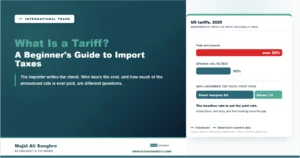
That last point is the one the tariff war of 2025 and 2026 is testing at scale. A tariff can shrink imports from one country, but if national saving and investment are unchanged, the overall deficit tends to reappear, rerouted through other partners or offset by exchange rate moves. Bilateral deficits, the country-by-country gaps that dominate political argument, are especially poor guides: a country naturally runs deficits with its suppliers and surpluses with its customers, just as a household runs a large bilateral deficit with its supermarket and an enormous surplus with its employer. Meanwhile the cost of the tariffs lands largely at home, in the pattern our analysis of who pays the tariff documents.
None of this makes deficits harmless. The financing side is real: decades of deficits mean foreigners hold trillions in claims on American assets, and the income on those claims flows abroad. A deficit driven by an overvalued currency can hollow out tradable industries, with regional damage that outlasts the macroeconomics. And for countries without the reserve-currency privilege, deficits financed by short-term borrowing in foreign currency have ended in crisis many times, which is why the same statistic warrants calm in Washington and vigilance in an emerging market. The gap’s meaning depends on who runs it, in what currency it is financed, and for how long, three questions the headline number never answers. Within the spending accounts, the deficit simply appears as negative net exports, the fourth component in our explainer on aggregate demand, dragging on measured demand while the matching capital inflow quietly supports investment on the other side of the ledger.
Reading the Gap Like an Economist
Three habits turn the trade deficit from a slogan back into information. First, ask about saving and investment, not trade policy: a country’s overall balance equals its national saving minus its domestic investment, so a persistent deficit is telling you the country invests more than it saves, and any durable change must move one of those. Second, ignore bilateral gaps except as curiosities; the overall balance is the economic quantity, and even it needs the goods-versus-services detail checked, since the United States runs a meaningful surplus in services that the goods-only headline hides. Third, look at the financing. Deficits funded by long-term equity investment in productive capacity age well; deficits funded by short-term debt in someone else’s currency age badly, a lesson written across every emerging-market crisis of the past half century. The exchange rate sits behind all three habits as the price that ties the flows together, a role our piece on exchange rates in global trade explains.
MASEconomics Explains
3 economic concepts behind trade deficits
These concepts are explored in depth across our educational articles library.
Explore the MASEconomics BlogConclusion
What is a trade deficit has a one-line answer, imports exceeding exports, and a meaning that only emerges from the accounting around it. Every deficit is financed by an equal sale of assets to the rest of the world, so the gap is really a statement about saving, investment, and the world’s appetite for a country’s IOUs, not a scoreboard of trading skill. That is why bilateral gaps mislead, why tariffs reroute deficits rather than close them, and why the same statistic can signal strength in a reserve-currency economy and danger in one financed by short-term foreign borrowing.
Read with those distinctions, the number still earns attention. The financing accumulates into foreign claims whose income flows abroad; the industrial composition of the gap has real regional consequences; and the durability of the arrangement rests on the world’s continued willingness to hold the deficit country’s assets. What the gap does not support is the reading it most often receives, and fifty consecutive American deficits alongside five decades of American prosperity are the standing exhibit for why.
Frequently Asked Questions
What is a trade deficit in simple terms?
A trade deficit is the amount by which a country’s imports of goods and services exceed its exports over a period. The gap is paid for by selling assets, bonds, shares, property, or bank claims, to the rest of the world, so a trade deficit always comes paired with an equal inflow of foreign investment.
Is a trade deficit bad for a country?
Not by itself. A deficit means absorbing more than the country produces, financed by selling claims on the future. If the financing funds productive investment and comes on stable terms, deficits can accompany strength; if it funds consumption through short-term foreign-currency debt, it can end in crisis. The level, financing, and purpose matter more than the sign.
Why does the United States always run a trade deficit?
Because it invests more than it saves, and because the world structurally wants to hold dollar assets. Foreign demand for Treasuries and other dollar claims finances the gap cheaply, and the world can only accumulate those claims if America supplies them by running deficits. The United States has run one every year since 1976.
Can tariffs fix a trade deficit?
Tariffs can shrink imports from targeted countries, but the overall deficit reflects national saving and investment, which tariffs barely touch. In practice deficits reroute through other partners or adjust through exchange rates, while much of the tariff cost falls on domestic consumers and firms. Bilateral gaps can move; the total tends to persist.
What is the difference between the trade deficit and the current account?
The trade balance covers goods and services. The current account adds cross-border income flows, interest, dividends, workers’ remittances, and transfers. A country can run a trade deficit and a smaller current account deficit, or the reverse, depending on those income flows, so economists usually treat the current account as the fuller measure.
Thanks for reading! Fifty years of American deficits and fifty years of arguments about them, and the whole debate turns on one line of accounting most speeches skip. Happy learning with MASEconomics