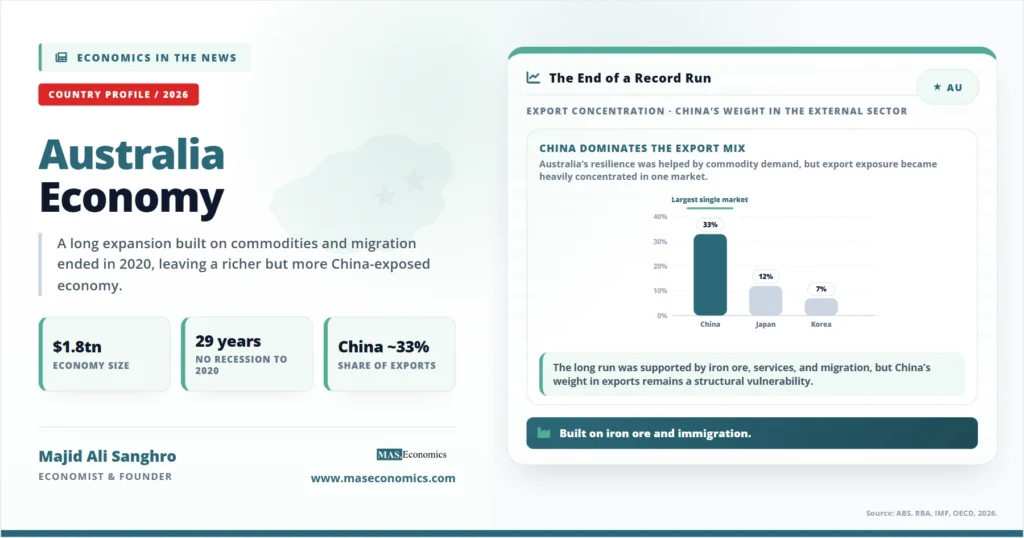
For twenty‑nine years, Australia did not have a recession. From 1991 until early 2020, through the Asian financial crisis, the dot‑com bust, and the 2008 global meltdown that pushed almost every advanced economy into contraction, Australian output kept expanding, the longest unbroken run recorded by any developed country in modern history. The streak finally ended when the pandemic forced the economy shut in 2020. The Australia economy emerged from that shock as one of the wealthiest societies on earth, with output around $1.8 trillion and a per capita income near $66,000, among the highest in the world.
The record is real, but the story it tells is more complicated than national mythology suggests. A large share of that three‑decade expansion was powered by two forces that are now shifting: a once‑in‑a‑century resource boom driven by China’s industrialization, and rapid population growth from immigration that lifted total output even when output per person was flat or falling. As China’s growth model changes and the commodity cycle matures, the question facing Australia is whether the prosperity built on digging up iron ore and shipping it north can be sustained, or whether the country has been living off a boom that is quietly ending.
Economy Built on Two Pillars
Australia is a developed, high-income economy of roughly 27 million people occupying a continent rich in natural resources. Its nominal output of around $1.8 trillion places it among the fifteen or so largest economies in the world, and its per capita income ranks near the top globally, supported by decades of growth, a strong currency, and high commodity prices. It is, by most measures, one of the most prosperous countries on earth.
The structure of the economy contains an apparent paradox. Services, including finance, healthcare, education, professional services, and tourism, generate the large majority of domestic output and employ most of the workforce, as in any advanced economy. Yet what drives Australia’s growth, its trade balance, and its national income is not services but mining. Resources, principally iron ore, coal, and liquefied natural gas, make up over half of the country’s goods exports despite the mining sector employing a relatively small share of workers. This is the defining feature of the Australian economy: a services economy at home, a resource economy abroad.
The two pillars are connected through national income. When commodity prices are high, the mining sector generates enormous export earnings and government revenue, which flow through the economy into wages, public spending, and consumption that sustain the service sector. When commodity prices fall, that income stream thins, and the whole economy feels it. Australia’s prosperity is therefore more exposed to the price of iron ore than the employment figures alone would suggest, and that exposure runs through a single dominant customer.
China Dependence
No relationship matters more to the Australian economy than its trade with China. China is Australia’s largest trading partner by a wide margin, taking roughly 30 to 35% of all merchandise exports, overwhelmingly in the form of iron ore for Chinese steel mills, along with coal, gas, and agricultural products. The scale of this concentration is unusual among advanced economies and is the single largest source of both Australia’s recent prosperity and its strategic vulnerability.
The relationship is the direct product of timing and geography. China’s industrialization over the past three decades, the largest and fastest in history, created an almost insatiable demand for the steel that builds cities, and Australia happened to sit on some of the world’s highest-quality, lowest-cost iron ore within convenient shipping distance. This is comparative advantage operating at continental scale, the principle set out in our explainer on comparative advantage and specialization. Australia specialized in exactly what the fastest-growing large economy needed most, and grew rich doing so.
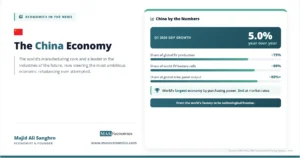
That dependence cuts both ways. It tied Australian fortunes to Chinese growth on the way up, and it exposes them to Chinese weakness on the way down. As China’s economy matures and shifts away from the construction-and-infrastructure model that consumed so much steel, the structural demand that powered Australia’s boom is fading. The investment weakness in China’s property sector, examined in our profile of the Chinese economy, feeds directly into the demand for Australian iron ore. The relationship is also politically exposed: trade tensions between 2020 and 2023 saw China restrict imports of Australian coal, wine, barley, and other goods, a reminder that a concentrated export market is a strategic risk as well as an economic one. Iron ore itself was never targeted, because China needed it too much, which is its own lesson about the limits of leverage.

Truth About the Recession‑Free Record
Australia’s twenty-nine years without a recession is one of the most cited facts in modern macroeconomics, and it is genuinely remarkable. But understanding what it does and does not mean is essential to reading the economy honestly, and it is where a serious analysis separates from a celebratory one.
The headline record measures aggregate gross domestic product, the total size of the economy. By that measure, Australia avoided two consecutive quarters of contraction from 1991 until the pandemic in 2020. Three factors made this possible. The first was the resource boom, which delivered an income windfall just as other economies struggled. The second was disciplined macroeconomic management, including a credible inflation-targeting central bank and a floating exchange rate that absorbed external shocks. The third, and most underappreciated, was population growth.
Australia has run one of the highest population growth rates in the developed world, driven overwhelmingly by net overseas migration, which added hundreds of thousands of people in strong years. A growing population mechanically increases total output, because more people produce and consume more, which flatters the aggregate GDP figure. When economists look instead at GDP per person, the measure that actually tracks living standards, the picture changes. Australia experienced several per-capita recessions during its supposedly recession-free run, periods when output per person fell even as the total economy grew because the population was expanding faster than the economy. The distinction between real and per-person measures is the subject of our explainer on real versus nominal economic measures.
This matters because it reveals the engine of Australian growth. The country grew its economy substantially by adding people and by selling resources to China, more than by raising the productivity of the people already there. That is a perfectly viable growth model while migration is strong and commodity demand is high, but it is vulnerable on both fronts, and it does relatively little to lift individual prosperity if output per person stagnates. The recession-free record was an achievement, but it was also, in part, a statistical artifact of a fast-growing population.
Floating Dollar as Shock Absorber
One reform stands out in explaining Australia’s stability, and it is one the country’s own central bankers have called the most important economic decision of the past several decades: the floating of the Australian dollar in 1983. Before the float, the exchange rate was managed, which meant external shocks had to be absorbed by the domestic economy through changes in output and employment. After the float, the currency itself became the principal shock absorber.
The mechanism is elegant. When commodity prices boom and export income surges, the Australian dollar rises, which cools the economy by making imports cheaper and exports dearer, leaning against inflation. When commodity prices collapse, the dollar falls, cushioning the blow by making Australian exports more competitive and supporting the mining sector’s revenue in local-currency terms. The floating dollar effectively converts violent swings in the terms of trade, the ratio of export prices to import prices, into smoother movements in the exchange rate rather than into booms and busts in domestic output. The role of exchange rates in mediating trade shocks is explored in our piece on exchange rates in global trade.
This is why the Australian dollar is known in currency markets as a commodity currency, one whose value tracks the prices of the raw materials the country exports. It rises and falls roughly with iron ore and the global growth cycle, and it gives Australia a built-in stabilizer that economies with fixed or managed exchange rates lack. Much of the credit for the recession-free record belongs to this single reform, which let the currency take the strain that would otherwise have fallen on jobs and output.
Household Debt and the Housing Problem
If commodities and China are the external story, household debt and housing are the domestic one, and they are now the dominant concern of economic policy. Australians carry some of the highest levels of household debt relative to income in the developed world, and the overwhelming majority of that debt is mortgage debt secured against housing.
Australian house prices have risen for decades, far faster than incomes, making major cities among the least affordable in the world relative to local earnings. The causes are the familiar combination of constrained supply, rapid population growth from migration concentrated in a few coastal cities, favorable tax treatment of property investment, and years of low interest rates that inflated what buyers could borrow. The result is a population that has poured its wealth and its borrowing capacity into residential property, the dynamics of which we examine in our explainer on why homes get more expensive.
This debt load creates a powerful and fast-acting monetary transmission channel. Most Australian mortgages carry variable interest rates, which means that when the central bank changes its policy rate, the cost of existing mortgages changes almost immediately, unlike in the United States, where long-term fixed-rate mortgages insulate most borrowers. A rate rise therefore hits household budgets quickly and hard, which makes monetary policy unusually potent and the economy unusually sensitive to interest rates. It also means the central bank must weigh the impact on heavily indebted households in every decision, a constraint that shapes how far and how fast it can move.
| Indicator | Figure | Note |
|---|---|---|
| Nominal GDP | ~$1.8 trillion | Among the world’s 15 largest economies |
| GDP per capita | ~$66,000 | Among the highest globally |
| Population | ~27 million | Growing ~1.4% a year, mostly via migration |
| Real GDP growth | ~1.3% (FY24-25), ~2.1% projected 2026 | Recovering from a subdued patch |
| China share of merchandise exports | ~30–35% | Largest trading partner by far |
| RBA cash rate | 3.6% (held) | Inflation target band 2–3% |
|
Source: Australian Bureau of Statistics, Reserve Bank of Australia, IMF, and OECD, 2024–2026. Figures rounded and provisional.
|
||
Transition Decade Ahead
Australia enters the second half of the 2020s facing a set of structural shifts that will test the model that served it so well.
The first is the maturing of the China-and-commodity boom. China’s growth is slowing and rebalancing away from the steel-intensive construction that drove iron ore demand, and the extraordinary impetus that Chinese industrialization gave Australian minerals over the past thirty-five years is fading even if it has not collapsed. Iron ore prices have held up better than many feared, trading around $100 a tonne, but the structural tailwind is weakening. Australia’s location in a high-growth region that also includes India offers a partial hedge, but no single market can replace China’s scale in the near term.
The second is the energy transition, which cuts directly against one of Australia’s main exports. The country is simultaneously one of the world’s largest exporters of coal and gas and a government committed to deep emissions cuts, with a target to reduce greenhouse gases by around 62 to 70% by 2035. Global decarbonization threatens long-term demand for Australian thermal coal even as metallurgical coal for steelmaking remains more resilient. The transition is also an opportunity: Australia has abundant sunshine, wind, and critical minerals such as lithium that position it to become an exporter of renewable energy and green inputs, potentially turning a threat to the old export base into a new one. Whether it executes that pivot is one of the central economic questions of the decade.
The third is productivity. Beneath the strong headline wealth lies a persistent weakness in productivity growth, the long-run source of rising living standards. Having grown for years by adding people and exporting resources, Australia faces the harder task of raising the output of the workers and capital it already has, through investment, innovation, skills, and infrastructure that has lagged behind population growth. With the population-growth and commodity engines both losing power, productivity is what must carry future improvements in living standards, and lifting it is the unfinished business of Australian economic policy.
Explains
Four ideas behind Australia’s economy
Connect these ideas to the wider library of global economy and central banking articles.
Explore the MASEconomics BlogConclusion
The Australia economy is one of the world’s wealthiest, and its twenty‑nine years without an aggregate recession is a genuine achievement of policy and circumstance. But the foundations of that success, a once‑in‑a‑century commodity boom driven by Chinese industrialization and one of the developed world’s fastest population growth rates, are both losing force. The headline record was built as much on adding people and selling iron ore as on raising the productivity of the economy itself, and the per‑capita recessions hidden within the streak reveal how much of the growth was extensive rather than intensive.
The decade ahead will test whether Australia can convert its inherited wealth into a more durable model. China’s demand for steel is maturing, the energy transition threatens the coal and gas exports that have underwritten national income even as it opens a path toward renewables and critical minerals, and a heavily indebted household sector leaves the economy acutely sensitive to interest rates. The floating dollar and a credible central bank remain powerful stabilizers, but they cannot substitute for the productivity growth that must now do the work the commodity and population engines once did. Australia remains prosperous and well placed in a growing region. Whether it stays that way depends on a transition it has only begun to make.
Thanks for reading! If you found this helpful, share it with friends and spread the knowledge. Happy learning with MASEconomics
Frequently Asked Questions
How big is Australia’s economy?
Australia’s nominal output is around 1.8 trillion US dollars a year, which places it among the fifteen or so largest economies in the world. With a population of roughly 27 million, that works out at a per capita income near 66,000 dollars, among the highest anywhere. The gap between a mid-sized total and a very high income per head is the defining statistic: Australia is a small country that is unusually rich.
Why is Australia so dependent on China?
Because China buys what Australia sells. China takes roughly 30 to 35 per cent of all Australian merchandise exports, overwhelmingly iron ore for Chinese steel mills, along with coal, gas and agricultural goods. That concentration is unusual among advanced economies and arose from a genuine comparative advantage, since Australia holds some of the world’s highest quality and lowest cost iron ore within convenient shipping distance of the largest construction boom in history.
How did Australia avoid a recession for 29 years?
Through a combination of luck and structure. The China commodity boom delivered a rising terms of trade for two decades. A floating exchange rate absorbed shocks that would otherwise have hit output, since the dollar falls when commodity prices fall and cushions exporters. High immigration kept population and therefore aggregate demand growing. That last point matters, because output per person was flat or falling in several of those years, so the unbroken run partly reflects a growing population rather than a growing economy per head.
What does Australia export?
Resources dominate. Iron ore, coal and liquefied natural gas together make up over half of goods exports, joined by gold, agricultural products and education services sold to foreign students. The striking feature is that mining generates this income while employing a relatively small share of the workforce, so Australia is a services economy at home and a resource economy abroad. Its national income is therefore far more exposed to the iron ore price than its employment figures suggest.
Why is Australian household debt so high?
Because housing absorbed the prosperity. Household debt sits among the highest in the developed world relative to income, most of it mortgage debt, built up through decades of rising house prices, tax settings that favour property investment, and interest rates that fell for thirty years. The consequence is that Australian households are unusually sensitive to interest rate changes, which is why the Reserve Bank’s decisions transmit faster there than in economies where long fixed rate mortgages are standard.