Consider a firm that chooses output to maximise profit. If the input cost rises by one percent, how much does the maximised profit fall? The naive answer multiplies through the chain rule across every choice variable that adjusts. The Envelope Theorem provides a shortcut: ignore the indirect effects of re-optimisation entirely, because they wash out at first order, and read the change off the partial derivative of the objective at the original optimum. Paul Samuelson formalised this insight in his 1947 work Foundations of Economic Analysis as the unifying principle of comparative statics. The modern generalisation by Milgrom and Segal (2002) extends the theorem to non-differentiable and infinite-dimensional cases, cementing its role in mechanism design. The theorem reduces a seemingly complex chain-rule calculation into a single partial derivative, producing every comparative-statics workhorse from Roy’s identity to the Bellman equation.
What the Envelope Theorem Shows
At its heart, the envelope theorem addresses a general problem in marginal analysis. When an agent optimises an objective function, the optimal choice depends on the parameters of the environment. If a parameter changes, the agent re-optimises. The total effect on the maximised value of the objective seems to require accounting for both the direct effect of the parameter change and the indirect effect operating through the adjustment in the choice variable.
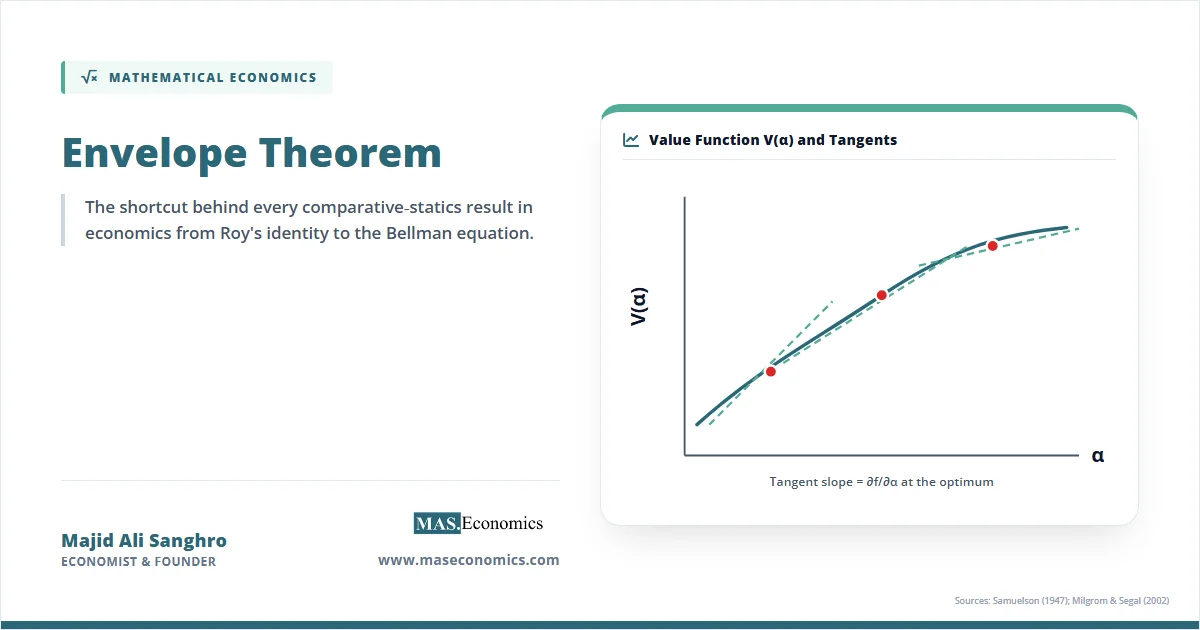
The envelope theorem states that at the optimum, the indirect effect vanishes. The intuition stems from the geometry of a maximum. At the peak of a hill, taking a small step in any direction does not change your elevation to the first order. Because the objective function is maximised with respect to the choice variable, a small perturbation in that choice variable has a zero first-order effect on the objective. Therefore, the total derivative of the value function with respect to the parameter equals only the partial derivative of the objective function, holding the choice variable fixed at its optimal value. The re-optimisation can be safely ignored for marginal changes.
Samuelson recognised that this logic underpins virtually every result in comparative statics. The Slutsky equation, the Le Chatelier principle, and the standard duality results of consumer and producer theory all rely on it. Before Samuelson, economists derived comparative-statics results on a case-by-case basis, often resorting to cumbersome algebraic manipulations that obscured the underlying economic logic. The envelope theorem transformed an intractable chain-rule expression into a tractable partial derivative, revealing that the unifying mathematical structure of economics was far simpler than previously understood.
The unconstrained version handles problems where the agent simply maximises a function. The constrained version extends the logic to problems with equality or inequality constraints via the Lagrangian. From these two foundations flow three foundational lemmas: Roy’s identity, Shephard’s lemma, and Hotelling’s lemma and five major domains of application spanning consumer theory, producer theory, dynamic programming, and mechanism design.
Envelope Theorem in Equations
The formal statement of the theorem clarifies why the indirect effects disappear. Consider first the unconstrained case, then the constrained case using the Lagrangian framework.
Unconstrained Envelope Theorem
Define the value function as the maximised value of the objective:
with optimal choice \( x^*(\alpha) \). By definition, \( V(\alpha) = f(x^*(\alpha), \alpha) \). Differentiating the value function with respect to the parameter \( \alpha \) using the chain rule yields two terms:
The first term represents the indirect effect through the adjustment in the optimal choice, and the second term represents the direct effect of the parameter. Because \( x^* \) is chosen to maximise \( f \), the first-order condition implies that \( \partial f / \partial x = 0 \) at the optimum. The first term vanishes entirely. The unconstrained envelope result follows immediately:
This result is remarkably general. It holds for any parameter that enters the objective function, regardless of how complex the dependence of \( x^* \) on \( \alpha \) might be. The optimality condition wipes out the entire indirect channel.
Constrained Envelope Theorem
When the optimisation problem includes an equality constraint \( g(x, \alpha) = 0 \), the agent maximises the Lagrangian using standard mathematical notation:
The constrained envelope theorem states that the derivative of the value function with respect to the parameter equals the partial derivative of the Lagrangian, evaluated at the optimal choices \( x^* \) and \( \lambda^* \):
The proof mirrors the unconstrained case. The total derivative of the value function expands into three channels: the direct effect of the parameter, the indirect effect through the adjustment in the choice variable, and the indirect effect through the adjustment in the Lagrange multiplier. The first-order conditions of the Lagrangian with respect to \( x \) and \( \lambda \) ensure that the last two channels sum to zero. The indirect effects through both the choice variable and the Lagrange multiplier cancel out entirely. This result is profoundly powerful. It means that to determine how the maximised value changes with a parameter, one need only look at the direct channel, even when constraints are present.
Three Workhorse Lemmas
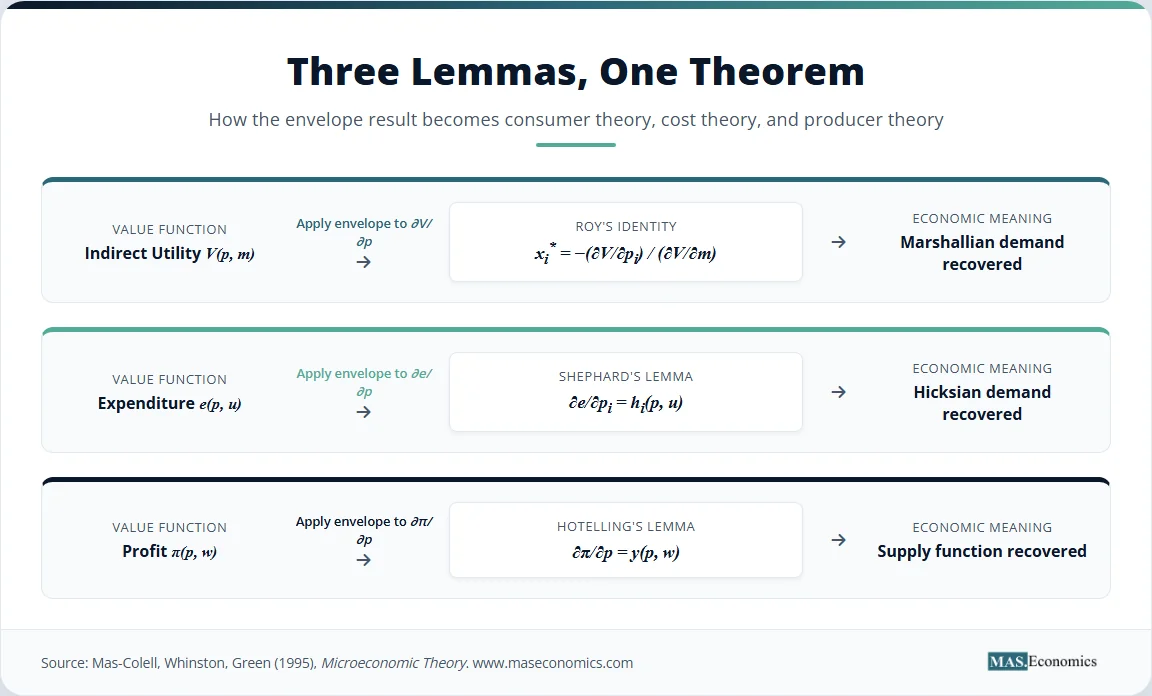
Three lemmas derive directly from the constrained envelope theorem and form the backbone of microeconomic theory. In consumer theory, applying the envelope theorem to the utility maximisation problem yields Roy’s identity, which recovers the Marshallian demand function:
The intuition is straightforward. When the price of a good rises, the direct effect on the indirect utility function is negative, proportional to the quantity consumed. Dividing by the marginal utility of income converts this utility loss into a monetary equivalent, revealing the quantity demanded.
Applying the theorem to the expenditure minimisation problem yields Shephard’s lemma, where \( h_i \) is the Hicksian (compensated) demand:
Here, the parameter is the price. The expenditure function is the minimum value of spending required to reach utility \( u \). The envelope theorem states that the change in minimised expenditure from a small price increase equals only the direct cost increase, evaluated at the optimal compensated demand. The consumer’s re-optimisation of the consumption bundle has no first-order effect on expenditure because they were already minimising costs.
In producer theory, applying the theorem to the profit maximisation problem yields Hotelling’s lemma, where \( y \) is the supply function:
Analogously, a small increase in the output price raises maximised profit by the quantity of output the firm was already producing. The firm’s adjustment of its production level has no first-order effect on the change in profit because it was already equating marginal revenue to marginal cost.
| Application | Value Function | Envelope Result (Lemma) | Economic Meaning |
|---|---|---|---|
| Consumer (utility max) | Indirect Utility \( V(p, m) \) | Roy’s Identity: \( x_i^* = -\frac{\partial V/\partial p_i}{\partial V/\partial m} \) | Marshallian demand recovered from utility function |
| Cost-minimising firm or expenditure-minimising consumer | Expenditure / Cost \( e(p, u) \) | Shephard’s Lemma: \( \frac{\partial e}{\partial p_i} = h_i(p, u) \) | Compensated demand or conditional input demand |
| Profit-maximising firm | Profit \( \pi(p, w) \) | Hotelling’s Lemma: \( \frac{\partial \pi}{\partial p} = y(p, w) \) | Supply function recovered from profit function |

|
|||
Key Assumptions and Limitations
The classical envelope theorem relies on four key assumptions. First, the value function must be differentiable. The original Samuelson-style theorem requires a smooth maximum. If the value function is only directionally differentiable, the standard results weaken, and the simple partial derivative interpretation no longer holds strictly. Kinks in the value function prevent the application of the standard differential calculus.
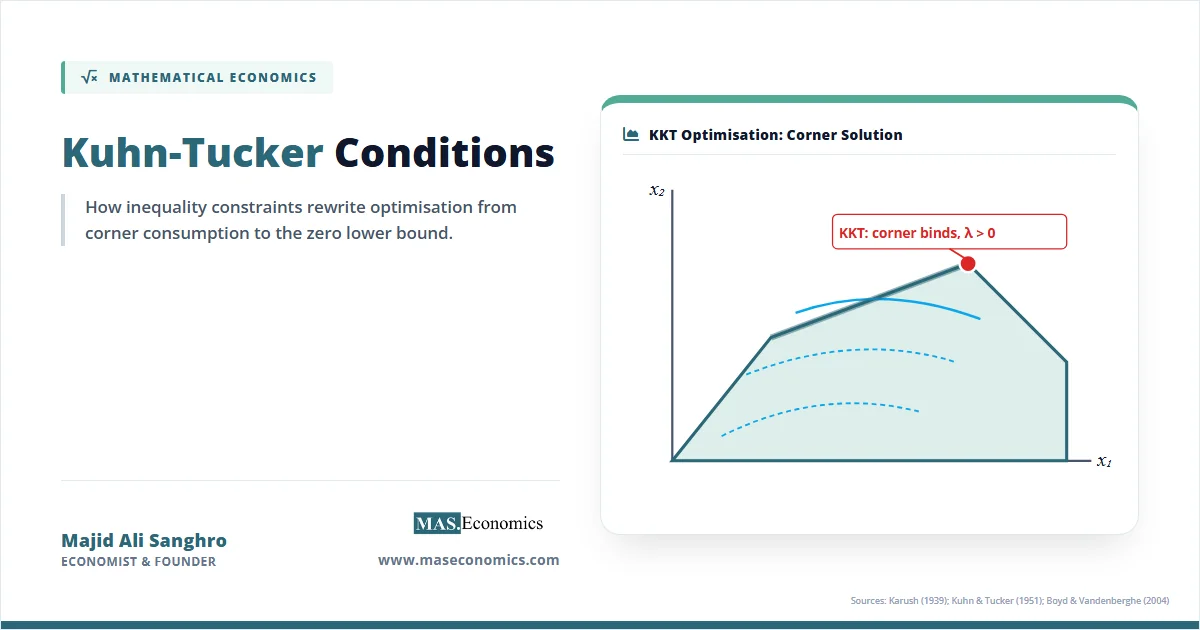
Second, the theorem presumes interior solutions. When the optimal choice lies at a corner of the feasible set, the first-order condition that eliminates the indirect effect does not hold with equality. At a corner, a small perturbation in the choice variable might not have a zero first-order effect on the objective because the agent cannot adjust in the optimal direction. Corner solutions require the Kuhn-Tucker apparatus with complementary slackness conditions to track which constraints are binding. The envelope result must be modified to account for the shadow price of the binding constraint.
Third, the maximiser must be smooth and single-valued. If the optimal choice \( x^*(\alpha) \) is set-valued, meaning there are multiple optima, or if it jumps discretely as the parameter changes, the value function can develop kinks. At these kinks, the classical envelope theorem fails because the required derivative does not exist. Discontinuities in the policy function translate into non-differentiabilities in the value function.
Fourth, the parameter cannot enter the constraint set in a way that changes the binding pattern. When constraints toggle on or off as the parameter changes, the envelope theorem applies separately within each regime, but the transition point requires separate analysis. The overall derivative of the value function may not exist at the threshold where the constraint becomes binding.
Milgrom and Segal (2002) addressed many of these limitations. Their generalisation extends the theorem to arbitrary choice sets and almost-everywhere differentiability. They showed that even when the value function is not globally differentiable, the envelope condition holds almost everywhere, and the value function can be recovered by integrating the envelope condition. This extension is precisely what makes the envelope condition usable in modern mechanism design with complex type spaces, where differentiability cannot be guaranteed and choice sets may be discrete or infinite-dimensional.
Empirical Reach of the Theorem
The envelope theorem is a mathematical result, not an empirical hypothesis. Its empirical significance lies in the demand and supply systems it generates, which underpin the vast majority of applied microeconomic estimation.
Deaton and Muellbauer (1980) built their Almost Ideal Demand System directly on Shephard’s lemma. By specifying a translog cost function and applying the envelope result, they derived log-expenditure shares as linear functions of logged prices and logged total expenditure. This system remains the workhorse model for estimating price and income elasticities in household survey data worldwide. Without Shephard’s lemma, the link between the specified cost function and the estimable demand equations would be broken, requiring the estimation of a vastly more complex structural model.
Diewert (1971) used the same logic on the producer side. His Generalised Leontief production function relies on Hotelling’s lemma to recover supply functions and conditional input demands from observed prices without requiring the econometrician to estimate the underlying production technology directly. By specifying a flexible functional form for the profit function, the supply and input demand equations emerge automatically as first derivatives. This approach avoids the notorious difficulties of estimating multi-input production functions, where collinearity among inputs and endogeneity of input choices routinely confound estimation.
Welfare measurement depends entirely on the theorem. Hausman (1981) demonstrated how to calculate exact consumer surplus using the expenditure function. Traditional consumer surplus, measured as the area under the Marshallian demand curve, is only an approximation because it ignores income effects. Shephard’s lemma allows economists to compute the compensating variation, the exact amount of money a consumer would need to reach their original utility level after a price change, by integrating the Hicksian demand function. Every empirical estimate of the deadweight loss from a tax change relies on this envelope-derived result to translate observed price changes into welfare changes without approximation error.
In public economics, the architecture of optimal tax theory rests on envelope conditions. Mirrlees (1971) derived the optimum income taxation framework by applying the envelope theorem to the indirect utility function across the distribution of agent types. The key insight that the marginal utility of income evolves according to a differential equation governed by the incentive constraint is an envelope result. The government does not need to track how each agent adjusts their labour supply in response to the tax schedule; it only needs to know how the indirect utility changes with the agent’s type, which the envelope theorem simplifies to a partial derivative.
Auction theory provides perhaps the most striking application. Myerson (1981) proved the revenue equivalence theorem in optimal auction design by showing that the expected payment in any incentive-compatible mechanism depends only on the allocation rule. This result is a direct corollary of the envelope theorem applied to bidder type spaces. The bidder’s expected utility as a function of their valuation is pinned down by the allocation rule and the utility of the lowest type, up to a constant. Because the envelope condition ties the derivative of the utility function to the allocation probability, the entire payment schedule can be recovered by integration.
The modern mathematical foundation supporting these diverse applications is the generalisation by Milgrom and Segal (2002). Their work on Envelope theorems for arbitrary choice sets extends the classical result to non-smooth and infinite-dimensional settings, providing the rigorous basis required for contemporary mechanism design and contract theory.
The envelope theorem says the slope of the value function at any point equals the partial derivative of the objective function at the optimum, holding the optimal choice fixed. Source: MASEconomics illustration based on Samuelson (1947).
How the Envelope Theorem Matters
The envelope theorem does the heavy lifting across five distinct domains of economics, serving as the invisible machinery behind the most important comparative-statics results.
First, the Slutsky decomposition splits the effect of a price change into income and substitution effects. This decomposition relies fundamentally on the relationship between Marshallian and Hicksian demand, which is derived by applying Roy’s identity and Shephard’s lemma, both direct consequences of the envelope theorem, to the consumer’s optimisation problem. The symmetry of the Slutsky matrix, a foundational result in demand theory, is itself a consequence of Young’s theorem applied to the expenditure function, which the envelope theorem establishes as the primitive of Hicksian demand. Understanding how consumers substitute between goods along an indifference curve versus how they adjust to a change in real purchasing power requires the mathematical separation that only the envelope result provides.
Second, deadweight loss measurement relies on the expenditure function. The compensating variation from a tax change is calculated directly via Shephard’s lemma. This underpins every applied study of tax incidence. Without the envelope theorem, economists would be forced to approximate welfare changes using areas under Marshallian demand curves, a method that fails to provide exact welfare measures when income effects are present. Consider a per-unit tax on gasoline. The change in the expenditure function at constant utility gives the exact compensating variation, whereas the standard triangle area under the demand curve is merely an approximation. The envelope theorem ensures that welfare analysis is mathematically exact, not heuristic.
Third, firm-level supply estimation uses Hotelling’s lemma to turn observed profit responses into supply elasticities. Econometricians can estimate how firm profits respond to output price changes and then recover the supply function directly, without needing to estimate the production function structurally. This bypasses the formidable econometric difficulties of estimating multi-input production technologies. Production function estimation requires solving simultaneity problems between input choices and productivity shocks, whereas profit function estimation sidesteps these issues by relying on the envelope result that input demands and output supply are simply the derivatives of a single function.
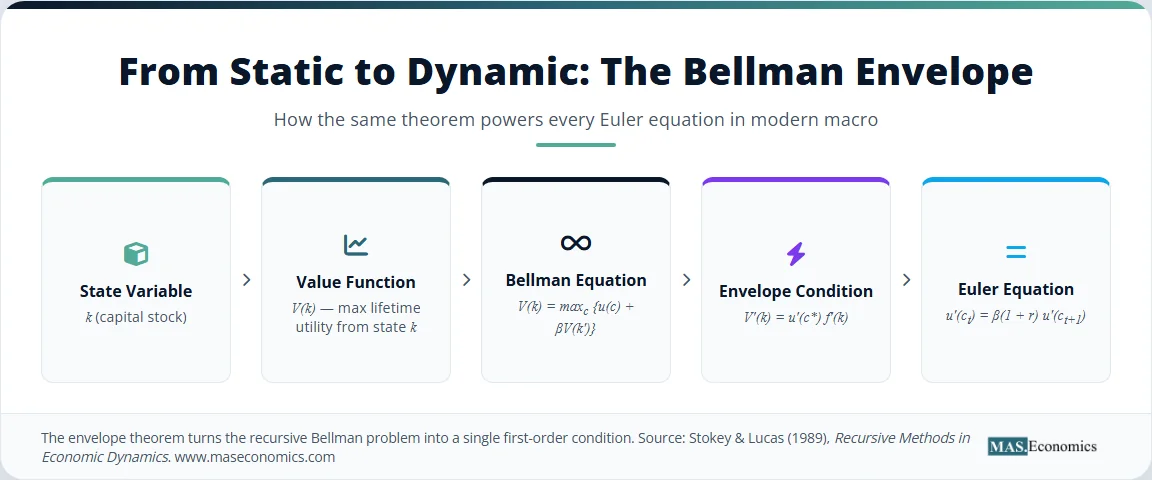
Fourth, dynamic programming relies on the envelope condition. Define the value function recursively: \( V(k) = \max_{c} \{u(c) + \beta V(k’) \} \) subject to the resource constraint. The envelope condition gives the derivative of the value function with respect to the state variable:
This single equation drives every Euler-equation derivation in modern macro and asset pricing. The Bellman equation sets up the recursive problem; the envelope theorem solves for the marginal value of capital, linking current consumption choices to future state variables without tracking the full policy function. In the standard neoclassical growth model, differentiating the Bellman equation with respect to capital yields the Euler equation, \( u'(c_t) = \beta u'(c_{t+1}) f'(k_{t+1}) \), which governs the intertemporal allocation of consumption. Without the envelope condition, deriving this Euler equation would require explicitly differentiating the policy function, a task that is typically intractable because the policy function lacks a closed-form solution.
Fifth, mechanism design and revenue equivalence rely on the theorem. Myerson (1981) showed that the expected payment in any incentive-compatible auction depends only on the allocation rule. This result is an envelope theorem applied to bidder-type spaces. The integral representation of the agent’s utility as a function of their type, where the boundary condition is determined by the lowest type, emerges directly from the envelope formula. By integrating the allocation probability over the type space, the mechanism designer can determine the entire payment schedule without solving a system of differential equations for each possible mechanism. This insight reduces the search for optimal mechanisms to the search for optimal allocation rules, a dramatically simpler problem.
Optimal income taxation, optimal commodity taxation, and the entire toolkit of normative welfare economics rest on envelope conditions. The theorem is invisible in the final policy formula but indispensable to its derivation. Without it, the mathematics of policy evaluation would require tracking the general equilibrium adjustment of every choice variable simultaneously, an intractable task in all but the simplest models.
MASEconomics Explains
4 economic concepts behind the Envelope Theorem
Conclusion
The Envelope Theorem reduces the total derivative of a maximised objective function to a single partial derivative, eliminating the need to account for the indirect effects of re-optimisation. This mathematical shortcut underpins the core results of consumer theory, producer theory, and welfare economics. Roy’s identity, Shephard’s lemma, and Hotelling’s lemma are all direct applications of the envelope logic, translating unobservable optimisation problems into empirically estimable demand and supply systems. By stripping away the complexity of general equilibrium adjustments, the theorem allows economists to isolate the direct impact of parameter changes on maximised values. It transforms an intractable chain-rule calculation into a tractable partial derivative, providing the analytical foundation for virtually every comparative-statics result in modern microeconomics.
The reach of the theorem extends far beyond static optimisation. In dynamic programming, the envelope condition drives the derivation of Euler equations that govern consumption, investment, and asset pricing. In mechanism design, it ensures that incentive-compatible allocations can be evaluated without tracking the full strategy space. Optimal income taxation, optimal commodity taxation, and the entire toolkit of normative welfare economics rest on envelope conditions. The theorem is invisible in the final policy formula but indispensable to its derivation. The Envelope Theorem serves as the unifying mathematical result of comparative statics, powering consumer theory, producer theory, dynamic programming, and mechanism design from a single, elegant insight.
Frequently Asked Questions
What is the envelope theorem?
The envelope theorem says that to find how the maximum value of an optimization problem responds to a small change in a parameter, you differentiate the objective function with respect to that parameter while holding the choice variables at their optimal values. The indirect effect, working through the shift in the optimum itself, drops out.
Why does the indirect effect disappear?
Because at an optimum the first-order conditions hold, so the derivative of the objective with respect to each choice variable is zero. A small movement in the optimal choice therefore has no first-order effect on the value achieved, and only the direct effect of the parameter is left.
Where is the envelope theorem used in economics?
It gives Shephard’s lemma and Roy’s identity, which recover demand functions by differentiating a cost function or an indirect utility function. It gives Hotelling’s lemma on the supply side. In dynamic programming it links the derivative of the value function to the current payoff.
What is the constrained version of the envelope theorem?
With a constraint you differentiate the Lagrangian rather than the objective, again at the optimal values. That is exactly why a Lagrange multiplier is read as a shadow price: it is the derivative of the maximum value with respect to a loosening of the constraint.
Why is it called the envelope theorem?
Because the value function traces the upper envelope of the family of curves you get by fixing the choice variables at various levels. At each parameter value the envelope touches whichever member of the family is optimal there, and the two share a slope at that point.
Did you find this article helpful? Share it with someone who loves economics. And remember, at MASEconomics, we make complex ideas simple.