On September 22, 2022, with the yen at a 24-year low of 145.9 against the dollar, Japan’s Ministry of Finance instructed the Bank of Japan to sell roughly $20 billion of foreign reserves to buy yen. Within minutes, the exchange rate jumped more than three yen, the largest single-day move in the pair since 1998. Three more rounds of intervention followed through 2024, totaling roughly $200 billion of dollar sales. The yen kept depreciating between rounds, then snapped back when officials acted, then drifted weaker again. The episode was a clean demonstration of what FX intervention sterilization can and cannot do: a central bank can shift the exchange rate sharply over hours and days, can sometimes reset market positioning, and rarely reverses the direction set by interest-rate differentials and current-account flows.
The mechanism behind these operations is administratively simple. A central bank trades its own currency for foreign assets, usually US Treasuries or euro-area government bonds, at market exchange rates. To prevent the transaction from changing domestic interest rates, it then conducts an offsetting domestic operation, draining the reserves it just created. The “intervention” is the FX trade. The “sterilization” is the offset. Whether the combined operation moves the exchange rate persistently has been one of the most-studied questions in international monetary economics for the past forty years, and the answer is conditional on what channel the market is using to price currencies.
Mechanics of FX Intervention
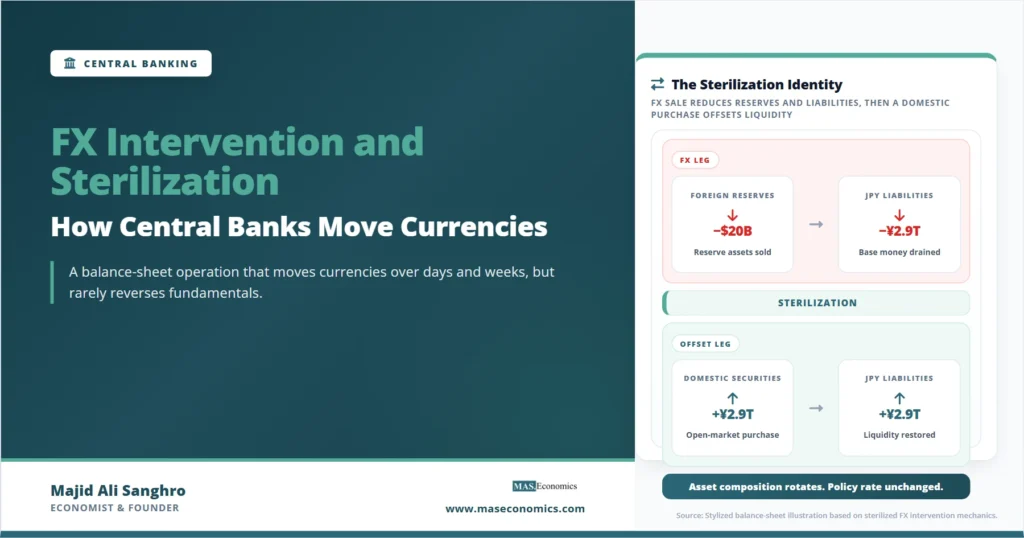
Consider a stylized intervention by the Bank of Japan to support the yen. The BoJ begins with reserves of roughly $1.2 trillion in foreign assets and a stock of yen-denominated liabilities (mostly bank reserves) on the other side. To defend the yen, it sells $20 billion of US Treasuries from its reserves and receives roughly 2.9 trillion yen in cash from the buyer. The buyer pays in yen, so yen is pulled out of the financial system. The BoJ’s foreign assets fall by $20 billion, its yen liabilities fall by 2.9 trillion yen, and the exchange rate adjusts toward yen strength.
At this point, the intervention is unsterilized. Bank reserves in the yen system have shrunk by 2.9 trillion yen, which would push up Japanese short-term interest rates and tighten domestic monetary conditions. The BoJ rarely wants this side effect; if it had wanted tighter Japanese monetary policy, it would have raised its policy rate. So the BoJ sterilizes by conducting an offsetting domestic operation: typically a repo or a JGB purchase that creates 2.9 trillion yen of new reserves, restoring the yen reserve quantity to its pre-intervention level.
The result is a balance-sheet rotation. The BoJ has swapped foreign-currency assets for domestic-currency assets of equal value. Its total liabilities are unchanged. The Japanese policy rate is unchanged. Only the composition of its asset portfolio has shifted, and the public has been forced to absorb more yen-denominated assets and fewer dollar-denominated assets through the trade. Central bank balance sheets are large enough that this rotation can be material relative to the foreign exchange market.
Note. Unsterilized intervention is rare in advanced economies because central banks already use the policy rate to set domestic monetary conditions. Leaving the intervention unsterilized would mean accepting a one-off shock to the policy stance as a side effect of the currency operation, which is generally not desired.
Balance‑Sheet Identity of Sterilization
The central bank’s balance sheet has assets equal to liabilities. On the asset side: foreign reserves and domestic securities. On the liability side: currency in circulation and bank reserves. The simple identity is:
Central Bank Balance Sheet
A sale of foreign reserves to buy domestic currency reduces both Foreign Reserves on the asset side and Bank Reserves on the liability side by the same amount. To sterilize, the central bank buys domestic securities of equal value, which adds to Domestic Securities and restores Bank Reserves to their previous level. The two operations together leave the liability side untouched and rotate the asset side from foreign to domestic.
Sterilization works in either direction. If the central bank is selling its own currency to slow appreciation (the Swiss National Bank’s strategy from 2011 to 2015 and intermittently since), it buys foreign assets and creates new domestic reserves in the process. To sterilize, it issues domestic securities or runs reverse repos to drain the excess reserves it just created. The Swiss balance sheet expanded enormously during this period precisely because the SNB stopped sterilizing at scale: it accepted ballooning bank reserves rather than draining them, effectively running quantitative easing as a byproduct of FX policy.
Transmission Channels of Intervention
The empirical literature, summarized in Sarno and Taylor (2001) and updated by Neely (2008) and Fratzscher et al. (2019), identifies three channels through which sterilized FX intervention can move exchange rates. Each operates differently, and the policy implications differ.
Portfolio-Balance Channel
If domestic and foreign bonds are imperfect substitutes, changing their relative supplies should change their relative prices, which translates into an exchange-rate adjustment. By selling foreign bonds and buying domestic bonds, the central bank reduces the foreign-bond supply held by private investors and increases the domestic-bond supply it must absorb. To restore portfolio balance, investors require a different yield differential or expect a different future exchange-rate path. The exchange rate moves to clear the new portfolio equilibrium.
The empirical case for the portfolio-balance channel is mixed. For advanced economies with deep, integrated bond markets, the effect of moving a few tens of billions of dollars across two government bond markets that trade trillions per day is small. For smaller economies or emerging markets with shallower capital markets, the channel can be material. The size of the intervention relative to the size of the relevant bond market is the key parameter.
Signaling Channel
An intervention can convey information about the central bank’s preferences or its private information about future policy. When the Bank of Japan intervened to support the yen in 2022, the operation was a credible signal that Japanese officials viewed the prevailing exchange rate as unsustainable and were willing to commit reserves to express that view. Markets re-evaluated their priors about what the BoJ was likely to do next on monetary policy, even before any rate decision was made.
The signaling channel works best when the intervention is consistent with the central bank’s other actions. An FX intervention to weaken the currency, conducted by a central bank that is simultaneously cutting rates and easing policy, sends a coherent signal. An intervention that contradicts the stance implied by interest rates, such as buying yen while keeping rates near zero, sends a confused signal and tends to produce only short-lived currency moves.
Microstructure Channel
FX markets do not have a single price-discovery mechanism. They are dealer markets with order-flow effects: a large directional trade by a known participant can shift quoted prices because dealers infer information from the trade. A central bank operation can move the exchange rate through a pure order-flow effect, especially during illiquid trading windows. The 2022 and 2024 yen interventions were timed for thin overnight liquidity in New York, when a $20 billion sale could move the market by 2 to 3 percent in minutes.
Microstructure effects fade quickly. Within hours, dealers have rebalanced inventories, the order flow has dispersed, and the exchange rate often retraces a significant fraction of the move. Microstructure intervention can disrupt one-way market positioning, but it does not durably change the level.
| Channel | Mechanism | Conditions for Effectiveness | Typical Persistence |
|---|---|---|---|
| Portfolio-balance | Shifts relative supply of foreign and domestic bonds | Imperfect substitution; large size relative to bond market | Weeks to months |
| Signaling | Conveys policy preference or private information | Consistent with broader policy stance; surprise element | Days to weeks |
| Microstructure | Order-flow disruption in dealer markets | Thin liquidity windows; one-sided positioning | Hours to days |
|
Source: MASEconomics editorial synthesis based on Sarno and Taylor (2001), Neely (2008), and Fratzscher et al. (2019).

|
|||
Trilemma Constraint on Intervention
The Mundell trilemma states that a central bank cannot simultaneously maintain a fixed exchange rate, free capital mobility, and an independent monetary policy. Sterilized intervention is the policy tool that tries to bend the trilemma. By offsetting the monetary effect of FX operations, the central bank attempts to keep its policy rate independent of the exchange rate it wants. The trilemma’s logic says this should fail in equilibrium.
The empirical evidence is consistent with the trilemma’s prediction in the long run and inconsistent in the short run. Over the horizons of years, capital flows arbitrage away the wedge that sterilized intervention tries to maintain. Over horizons of days to months, intervention can move exchange rates because capital is not perfectly mobile and substitution between domestic and foreign assets is imperfect. The policy question is whether the short-run effect is large enough and durable enough to justify the cost.
The cost is meaningful. A central bank intervening to support its currency runs down its reserves, which are finite. A central bank intervening to slow appreciation accumulates foreign assets, often at a lower yield than its own liabilities, generating quasi-fiscal losses. The Dornbusch overshooting model shows why exchange rates can deviate from interest-parity equilibrium for extended periods, but it also implies that intervention is most effective when it accelerates a movement the fundamentals would eventually produce, not when it fights one.
Case Studies of FX Intervention
FX intervention varies enormously by purpose, scale, and outcome. Three episodes from the past two decades capture the range.
The Swiss Franc Floor, 2011-2015
In September 2011, with the franc appreciating sharply as investors fled euro-area sovereign debt, the Swiss National Bank announced a minimum exchange rate of 1.20 Swiss francs per euro and committed to buy unlimited euros to defend it. The intervention was massive and sustained: SNB foreign reserves rose from roughly 250 billion Swiss francs at the start of 2011 to over 540 billion by the end of 2014. The intervention was only partially sterilized; the SNB allowed bank reserves to expand, effectively combining FX intervention with quantitative easing.
The defense worked for three and a half years. On January 15, 2015, the SNB abandoned the floor with no advance warning. The franc immediately appreciated by 20 percent against the euro within minutes. The episode illustrates the asymmetry of intervention: defending a currency against appreciation can succeed indefinitely as long as the central bank is willing to expand its balance sheet, but the exit imposes large costs on anyone who positioned for the floor to hold. The SNB took a roughly 23-billion-franc loss on its reserves in the days after the abandonment.
The 2013 Indian Rupee Defense
In May 2013, after the Federal Reserve signaled that quantitative easing might be tapered, capital flowed out of emerging markets. The Indian rupee depreciated from roughly 55 per dollar in May to over 68 by late August. The Reserve Bank of India intervened with reserve sales totaling about $30 billion through the third quarter of 2013, alongside emergency measures including special dollar swap windows for oil importers and short-term FX-denominated borrowing windows for banks.
The interventions slowed the depreciation but did not reverse it. The rupee stabilized only after the RBI raised the policy rate sharply in August and September, restoring the interest-rate differential that fundamentals required. The episode confirmed the standard pattern: in an emerging market facing sustained capital outflow, sterilized intervention buys time but does not substitute for monetary tightening or fiscal adjustment.
The 2022-2024 Yen Episodes
The yen depreciated from 115 per dollar in early 2022 to 151 by October, driven by the divergence between Federal Reserve tightening and the Bank of Japan’s continued ultra-loose policy. Japan’s Ministry of Finance intervened in September and October 2022 with sales totaling roughly $65 billion, then again in April and May 2024 with another $60 billion, and again in July 2024 with about $36 billion. Each intervention produced a sharp short-term move of 2 to 5 yen, followed by a gradual retracement.
The 2022-2024 yen episodes are clean examples of intervention that produce short-term success but cannot reverse the underlying trend, because the trend is driven by interest-rate differentials. The yen stopped depreciating only after the BoJ ended yield curve control and began raising rates in 2024, as covered in the Bank of Japan’s policy transition. The interventions before the policy change were buying time. The policy change made the underlying fundamentals shift.
| Episode | Central Bank | Direction | Scale | Outcome |
|---|---|---|---|---|
| Swiss franc floor | SNB | Sell CHF, buy EUR | ~290 bn CHF added to reserves, 2011-2014 | Held floor for 3.5 years; abandoned Jan 2015 |
| Indian rupee defense | RBI | Sell USD, buy INR | ~$30 bn, mid-2013 | Slowed depreciation; resolved by rate hikes |
| Chinese yuan stabilization | PBoC | Sell USD, buy CNY | ~$1 trillion, 2014-2016 | Halted depreciation; reserves drawn down sharply |
| Yen support 2022 | BoJ (MoF instruction) | Sell USD, buy JPY | ~$65 bn, Sep-Oct 2022 | Slowed depreciation; trend resumed |
| Yen support 2024 | BoJ (MoF instruction) | Sell USD, buy JPY | ~$96 bn across two rounds | Short-term effect; resolved by BoJ rate normalization |
|
Source: Swiss National Bank, Reserve Bank of India, People’s Bank of China, Japan Ministry of Finance and Bank of Japan operational data.
|
||||
Sterilization Complications in Practice
The textbook description of sterilization assumes the central bank chooses the offset deliberately and executes it cleanly. In practice, four complications matter.
First, sterilization is incomplete in many real-world operations. A central bank intervening for FX reasons may decide to leave part of the operation unsterilized if it wants the side effect on domestic monetary conditions. The SNB’s 2011-2015 defense of the franc floor is the canonical case: the SNB allowed bank reserves to expand because expanding reserves was a desirable side effect for an economy facing deflation.
Second, the sterilization instrument matters. If the central bank sterilizes through repo operations, the effect is short-term and rolls off. If it issues central bank bills, the effect can be longer-lived. If it shifts government deposits, the offset is mechanical but limited by the size of those deposits. Each instrument has implications for which channel of intervention the operation ultimately works through.
Third, in emerging markets, the line between FX intervention and monetary operations is often blurred. The PBoC’s exchange-rate management includes interventions, reserve-requirement adjustments, the medium-term lending facility, and capital-flow restrictions in a coordinated package. Isolating the marginal effect of any single tool is empirically difficult.
Fourth, the central bank’s quasi-fiscal accounts are affected. Buying foreign assets that yield less than the domestic liabilities used to fund them creates a negative carry that accumulates over time. For central banks holding large foreign reserves at low yields, the carry cost has become substantial. The Swiss National Bank reported a 132-billion-franc loss in 2022, largely from valuation effects on its FX reserves.
Effectiveness Against Fundamentals
The empirical literature converges on a few stable findings. First, intervention is most effective when it leans with the wind of fundamentals rather than against them. An intervention to slow a depreciation that interest rates and current-account flows would eventually reverse anyway has a high probability of success. An intervention to fight a movement that fundamentals are reinforcing tends to fail and sometimes generates large losses. Second, coordinated intervention by multiple major central banks tends to be more effective than unilateral action, because it removes the option of arbitrage between markets and signals a shared policy preference.
Third, the size of the intervention relative to daily market turnover matters. Global FX markets trade roughly $7.5 trillion per day, according to the Bank for International Settlements 2022 Triennial Survey. A $20 billion intervention is about 0.3 percent of one day’s volume in the major dollar pairs. The portfolio-balance channel can move prices only if the operation is large relative to the relevant subset of the market (typically the dealer inventory and short-term positioning). Fourth, frequency and predictability erode effectiveness: a central bank that intervenes at known levels invites the market to position against the threshold, which raises the cost of defending it.
For inflation-targeting central banks, intervention is rarely the right tool to address sustained currency movements, because the exchange rate is part of how monetary policy transmits. Pass-through to domestic prices means that a sustained depreciation will eventually show up in inflation, which is the variable the central bank is targeting. The cleaner response is usually to adjust the policy rate, allowing the exchange rate to reach the level consistent with the rate differential, rather than to defend an exchange-rate level through reserve operations.
Explains
Three concepts behind the operation
Continue exploring how central banks shape exchange rates and capital flows.
Explore the MASEconomics BlogConclusion
FX intervention sterilization is a balance-sheet operation, not a magic policy lever. Its mechanics are straightforward: a central bank trades its own currency for foreign assets, then offsets the monetary impact through a second operation that leaves the policy rate unchanged. The exchange rate may move through three channels: the relative supply of bonds, the signal the operation conveys about policy preferences, and the microstructure effect of large directional trades in dealer markets. None of these channels is reliably strong, and all of them work better when the intervention leans with fundamentals rather than against them.
The historical record of the past two decades shows the range. The Swiss National Bank defended a franc floor for three and a half years through massive intervention, then abandoned it suddenly with substantial losses. The Reserve Bank of India bought time with reserve sales in 2013 but ultimately needed rate hikes to stabilize the rupee. Japan’s Ministry of Finance used interventions to slow yen depreciation in 2022 and 2024, but the trend reversed only after the Bank of Japan began raising rates and exiting yield curve control. Each episode confirms the same conclusion: intervention can shift the exchange rate over days and weeks, can disrupt one-sided market positioning, and can buy time for policy adjustment. It cannot substitute for changes in the interest-rate differentials and current-account dynamics that determine where the exchange rate sits in equilibrium. Central banks that treat intervention as a temporary tool to manage transitions tend to use it well. Central banks that treat it as a substitute for monetary policy tend to spend reserves expensively and learn the same lesson again.
Frequently Asked Questions
What is the difference between sterilized and unsterilized FX intervention?
Unsterilized intervention changes the domestic money supply as a side effect of the FX trade. Sterilized intervention offsets that side effect through a second operation, leaving the domestic monetary stance unchanged. Almost all advanced-economy interventions are sterilized because central banks already use the policy rate to set domestic conditions and do not want the FX operation to disrupt them.
Does sterilized FX intervention actually work?
It can move the exchange rate over hours to weeks, especially when the operation is large relative to market liquidity, surprises the market, or signals a coherent policy stance. It rarely reverses sustained trends driven by interest-rate differentials and current-account flows. The empirical literature finds modest short-term effects through portfolio-balance, signaling, and microstructure channels, with the strongest effects when intervention leans with fundamentals.
Why do central banks bother intervening if the long-run effect is small?
Short-run effects can still be valuable. Intervention can slow a disorderly depreciation, buy time for policy adjustment, disrupt one-sided market positioning, or signal a policy preference that the central bank wants markets to internalize before changing the policy rate. The operations are also a tool of last resort in cases where fast adjustment of the policy rate would have larger unwanted side effects on the domestic economy.
Who actually decides on FX intervention in major economies?
Authority varies by country. In Japan, the Ministry of Finance decides on intervention and the Bank of Japan executes the operation on its behalf. In the United States, the Treasury Department leads, with the Federal Reserve Bank of New York as the operational agent. In the euro area, the European Central Bank holds operational authority but coordinates with national finance ministries. In Switzerland, the SNB decides independently.
What happens to central bank profits during large interventions?
Interventions can produce large gains or losses depending on the direction of the FX trade and subsequent currency moves. The Swiss National Bank reported a loss of roughly 132 billion Swiss francs in 2022, largely from valuation effects on its FX reserve portfolio. Negative carry between foreign assets and domestic liabilities can also accumulate over years, generating quasi-fiscal costs that flow through to the government as reduced central bank remittances.
What does sterilization mean in economics?
Sterilization means offsetting the domestic money supply effect of a foreign exchange operation so that domestic interest rates are unchanged. If a central bank sells foreign reserves to buy its own currency, that withdraws domestic money from circulation and would tighten conditions. To sterilize it, the bank simultaneously buys domestic securities or lets repos mature back into the system, injecting the same amount. The net result is a changed composition of the balance sheet, more domestic assets and fewer foreign ones, with no change in the monetary base.
Thanks for reading! If you found this helpful, share it with friends and spread the knowledge. Happy learning with MASEconomics