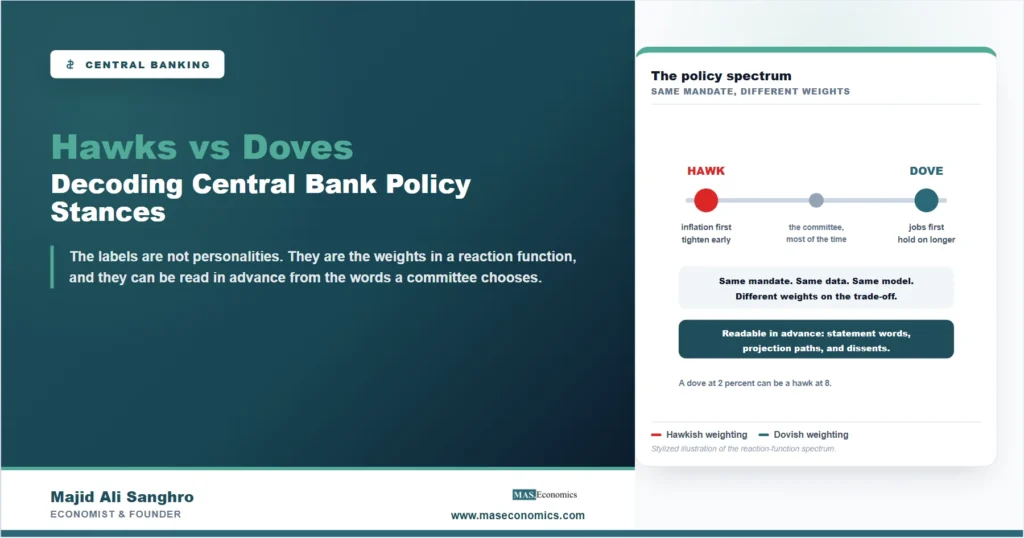
Twice a year or so, a single adjective in a central bank statement repositions trillions of dollars of assets, and the financial press explains the move with ornithology. Hawks vs doves is the shorthand the markets use for the two poles of monetary policy temperament: the hawk who would rather raise rates too much than let inflation settle in, and the dove who would rather hold rates low too long than choke off jobs and growth. The vocabulary is borrowed from foreign policy debate, where hawks wanted war and doves wanted peace, and it has stuck because it compresses a real and permanent disagreement into two words. What the shorthand hides is that the disagreement is rarely about goals. Hawks and doves at the same institution share the same mandate, read the same data, and usually run versions of the same model. What separates them is measurable: the weight each places on inflation against employment, and a handful of beliefs about how the economy behaves. That makes the labels decodable, and decoding them is a skill worth having, because the tilt of a committee moves mortgage rates, job markets, and currencies long before any vote is taken.
One Mandate, Two Weightings
Most modern central banks are told to deliver low inflation and, explicitly or implicitly, high employment. Most of the time the two goals point the same way, but at the decision margin they trade off: cooling inflation means restraining demand, and restraining demand costs jobs first. That short-run tension is the oldest curve in macroeconomics, examined in our article on the Phillips curve trade-off, and every policymaker sits somewhere on it. The hawk weights the inflation term more heavily: inflation, once entrenched, rewrites contracts and expectations and takes a recession to remove, so the prudent error is tightening early. The dove weights the employment term: a job market recovery abandoned too soon throws away incomes that the economy never recovers, inflation expectations are anchored until proven otherwise, so the prudent error is patience.
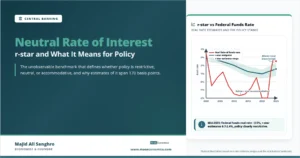
The cleanest way to see the distinction is through a policy reaction function of the kind our article on the Taylor rule develops: the policy rate responds to the inflation gap and the output gap with coefficients attached to each. A hawk runs a large coefficient on inflation; a dove runs a large coefficient on slack. Beliefs enter the same equation through the constants. Someone who thinks the neutral rate of interest is high, or that the economy is already at full employment, will read the same data more hawkishly than someone who thinks neutral is low and slack remains. The birds, in other words, are parameters, not personalities, and the debate between them is a disciplined argument about numbers rather than a clash of temperaments.
The Same Person, Different Weather
Because the labels describe conditional judgments rather than characters, the same policymaker can occupy both ends of the aviary in a single career, and the honest ones say so openly. The archetypal hawk remains Paul Volcker, who broke the great American inflation of the 1970s with double-digit rates and a deep recession; yet the lesson of that era is not that hawkishness is a virtue but that it was, at that moment, the correct weighting. The pandemic years ran the experiment in the other direction. Through 2021 most major central banks read the incoming inflation as transitory, a dovish judgment about supply disruptions unwinding on their own; when the data refused to cooperate, the same committees executed the fastest tightening in four decades, and officials who had been counted as doves delivered it. The birds migrated because the weather changed, which is precisely what a reaction function predicts: a dove at 2 percent inflation and a hawk at 8 percent can be the same person applying the same coefficients to different gaps.
Committee structure turns these individual weightings into a single decision. On the Federal Open Market Committee, whose mechanics are laid out in our guide to how the Federal Reserve is structured, regional bank presidents rotate through voting seats, so the committee’s average tilt shifts with the calendar even when nobody changes their mind. Formal dissents are rare and therefore informative: a recorded vote against the majority tells markets exactly where the committee’s internal spectrum has stretched. And the chair’s job is to assemble a consensus from the flock, which is why chairs read as centrists almost by occupational necessity.
How to Decode a Statement Yourself
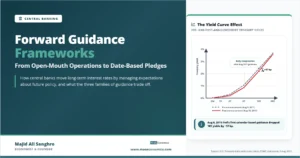
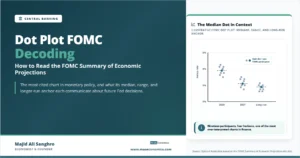
Markets do not wait for votes; they price the tilt continuously from language, and the vocabulary is stable enough to learn. In the statements published on the Federal Reserve’s meeting calendar, words like vigilant, restrictive, and upside risks to inflation carry hawkish charge, while patient, accommodative, gradual, and downside risks to employment signal the dove; a statement that upgrades the inflation description or deletes the word patient can move the yield curve more than the rate decision it accompanies. Projections add a second channel: when policymakers’ published rate paths drift upward, the committee’s center of gravity has gone hawkish, whatever the press conference says. All of this is deliberate. Modern central banking treats communication as an instrument in its own right, the subject of our article on forward guidance frameworks, and the framework itself sets the baseline the birds argue around: under the inflation targeting regimes most central banks now run, the target is fixed and the hawk-dove argument is about the speed and cost of returning to it, not the destination.
One decoding rule matters more than the vocabulary: distinguish the bird from the cage. A committee that turns dovish because the data softened is doing its job; a central bank that turns dovish because the government leaned on it is losing something more valuable than an argument. Governments with heavy borrowing needs have a standing preference for doves, which is why appointments fights and public pressure on central banks are watched as closely as the decisions themselves, a dynamic our article on central bank independence treats in full. And because the Federal Reserve sits at the center of the dollar system, its tilt is exported: a hawkish Fed tightens financial conditions for every economy that borrows in dollars, forcing central banks from Karachi to São Paulo to weigh imported currency pressure against their own domestic mandates. When the biggest hawk in the aviary moves, everyone else’s trade-off shifts with it.
MASEconomics Explains
3 economic concepts behind hawks vs doves
These concepts are explored in depth across our educational articles library.
Explore the MASEconomics BlogConclusion
Hawks vs doves is journalism’s compression of a technical object, the weights in a policy reaction function, into a metaphor that fits a headline. Read that way, the labels stop being tribal and start being useful. A hawk is a heavy coefficient on inflation plus a set of beliefs, usually a higher neutral rate and less faith in anchored expectations; a dove is the mirror image; and the same individual can be either as the gaps change, which is why the pandemic years turned an aviary of doves into hawks within eighteen months without a single conversion of philosophy.
For the reader, two lessons travel. First, the tilt is decodable in advance, from statement vocabulary, projection paths, and dissents, which is why markets reprice on adjectives. Second, the spectrum is healthy only while the data, rather than the treasury, moves policymakers along it; a dove made by soft inflation is monetary policy working, a dove made by political pressure is independence failing. The birds will keep arguing, because the trade-off they argue over is permanent. Knowing which way the flock is leaning, and why, is as close as an outsider gets to seeing the next decision before it lands.
Frequently Asked Questions
What do hawk and dove mean in monetary policy?
A hawk gives priority to fighting inflation and accepts slower growth or higher unemployment to do it, so hawks lean toward higher rates and earlier tightening. A dove gives priority to employment and growth and is more tolerant of inflation risk, leaning toward lower rates for longer. Both operate within the same mandate; they weight its two halves differently.
Where do the terms hawk and dove come from?
From foreign policy debate, where hawks favored military force and doves favored negotiation. Financial commentary borrowed the pair to describe monetary policy temperaments, and the metaphor stuck because it compresses the permanent inflation-versus-employment tension into a single word.
Is it better for a central bank to be hawkish or dovish?
Neither, permanently. The correct stance depends on conditions: Volcker’s hawkishness was right against entrenched double-digit inflation, and aggressive dovishness was right in the deflationary aftermath of 2008. The healthy pattern is a committee that migrates across the spectrum as the data changes, rather than one pinned to either pole by doctrine or politics.
Can the same policymaker be both a hawk and a dove?
Routinely. The labels describe conditional judgments, not fixed identities. A policymaker applying stable weights to changing inflation and employment gaps will look dovish in one year and hawkish in another, which is exactly what happened across 2021 and 2022 when committees that had read inflation as transitory delivered the fastest tightening in decades.
How do markets tell whether a central bank is turning hawkish?
By reading language and projections rather than waiting for decisions: changes in statement vocabulary, upward drift in policymakers’ published rate paths, the pattern of dissents, and the tone of speeches. Deleting a single word like patient from a statement has repriced entire yield curves, because it signals the committee’s weights have shifted.
Thanks for reading! The birds are just coefficients with feathers, and coefficients can be read. Happy learning with MASEconomics