
A firm’s profit function can have a stationary point where marginal profit is zero, but that point may still be a maximum, a minimum, or neither. Hessian matrix economics gives the second-derivative test that separates these cases by studying curvature in functions with more than one variable.
The Hessian matrix is central in mathematical economics because most economic choices involve several variables at once. A consumer chooses quantities of many goods. A firm chooses labor, capital, output, and prices. A planner evaluates welfare across multiple constraints and policy instruments.
The idea builds directly on differentiation. First derivatives describe marginal effects. Second derivatives describe how those marginal effects change. The Hessian organizes those second derivatives into a matrix, making curvature testable.
Second derivatives measure curvature
A first derivative measures the slope of a function. In economics, that slope often has a marginal interpretation: marginal utility, marginal cost, marginal product, or marginal profit. A second derivative measures how the slope itself changes.
For a one-variable function \(f(x)\), the second derivative \(f”(x)\) gives the curvature. If \(f”(x)<0\), the function bends downward and is locally concave. If \(f”(x)>0\), the function bends upward and is locally convex.
The one-variable logic is familiar:
One-variable curvature
Many economic functions do not have only one input. A production function may depend on labor and capital. A utility function may depend on two goods. A cost function may depend on output, wages, and rental rates. Once there is more than one variable, curvature depends on how all variables interact.
The Hessian matrix is the multi-variable extension of the second derivative. It collects own second derivatives and cross-partial derivatives in one object.
The Hessian organizes second derivatives
For a function of two variables, \(f(x,y)\), the Hessian matrix is:
Two-variable Hessian
The term \(f_{xx}\) shows how the marginal effect of \(x\) changes as \(x\) increases. The term \(f_{yy}\) shows how the marginal effect of \(y\) changes as \(y\) increases. The cross-partials \(f_{xy}\) and \(f_{yx}\) show how the marginal effect of one variable changes when the other variable changes.
When the function is smooth enough, Clairaut’s theorem gives \(f_{xy}=f_{yx}\). The Hessian is then symmetric. This symmetry is one reason the Hessian fits naturally with vectors and matrices in economic analysis.
For \(n\) variables, the Hessian generalizes to an \(n \times n\) matrix:
General Hessian matrix
The matrix is not only notation. It allows economists to test whether a function is locally concave, locally convex, or indefinite around a point.
Concavity supports maximization
Maximization problems need downward curvature. A consumer maximizing utility wants the highest feasible utility level. A firm maximizing profit wants the highest feasible profit. In both cases, a stationary point is a true local maximum only if nearby movements reduce the objective.
For a two-variable function, a stationary point satisfies:
Stationary point
These first-order conditions say the function is locally flat in both coordinate directions. They do not classify the point. The Hessian provides the classification.
A two-variable Hessian is negative definite when:
Negative definiteness test
When the Hessian is negative definite at a stationary point, the point is a strict local maximum. Economically, every small feasible movement away from the point lowers the objective.
This is the curvature logic behind many familiar economic results. Diminishing marginal utility, diminishing marginal product, and concave profit functions all support maximum behavior when the relevant first-order conditions are also satisfied.
Convexity supports minimization
Minimization problems require the opposite curvature. A firm minimizing cost, a planner minimizing loss, or a household minimizing expenditure needs a point where nearby movements raise the objective.
For a two-variable function, the Hessian is positive definite when:
Positive definiteness test
If the Hessian is positive definite at a stationary point, the point is a strict local minimum. This is the second-order condition used in cost minimization and loss minimization.
For example, if a cost function is locally convex in input choices, moving away from the minimizing input mix raises cost. The first-order condition identifies the candidate input combination, and the Hessian confirms that the candidate is locally cost-minimizing.
The economic distinction is straightforward. Concavity helps prove a maximum. Convexity helps prove a minimum. The Hessian gives the formal test.
Saddle points fail optimization
A saddle point can satisfy all first-order conditions but still fail to be a maximum or a minimum. At a saddle point, the function curves upward in some directions and downward in others.
The classic example is:
Saddle-point example
The first derivatives are:
At \((0,0)\), both first derivatives equal zero. The point is stationary. But the function rises when \(x\) moves away from zero and falls when \(y\) moves away from zero. The Hessian is:
The determinant is \(-4\), which is negative. A negative determinant means the Hessian is indefinite in the two-variable case. The stationary point is a saddle point, not an optimum.
This is a useful warning for economics. Marginal conditions alone can be misleading. A model can produce equations that “solve” for a candidate without proving that the candidate has the correct economic interpretation.
A matrix example clarifies
Consider the quadratic function:
Quadratic objective
The first derivatives are:
Solving \(f_x=0\) and \(f_y=0\) gives:
The solution is:
The Hessian is constant because the function is quadratic:
Hessian for the example
The leading own second derivative is negative, \(f_{xx}=-2\). The determinant is:
The Hessian is negative definite. The stationary point is therefore a strict local maximum. Because the objective is globally concave, the same point is also the global maximum.
Surface shapes make tests visible
The Hessian test is algebraic, but the intuition is geometric. A negative definite Hessian gives a hill-shaped surface near the candidate point. A positive definite Hessian gives a bowl-shaped surface. An indefinite Hessian gives a saddle-shaped surface.

The visual is deliberately stylized. It does not plot a real three-dimensional surface. It shows the three curvature cases economists usually need: a hill for maximization, a bowl for minimization, and a saddle for failure of local optimization.
Principal minors give decision rules
For two variables, the determinant and the sign of \(f_{xx}\) are enough to classify the Hessian. For more variables, economists often use leading principal minors or eigenvalues.
In a three-variable case, the Hessian is negative definite when the leading principal minors alternate in sign:
Negative definite pattern
It is positive definite when all leading principal minors are positive:
Positive definite pattern
The table gives the working interpretation for the common two-variable case:
| Condition | Curvature classification | Economic meaning at a stationary point |
|---|---|---|
| \(\det(H)>0\) and \(f_{xx}<0\) | Negative definite | Strict local maximum |
| \(\det(H)>0\) and \(f_{xx}>0\) | Positive definite | Strict local minimum |
| \(\det(H)<0\) | Indefinite | Saddle point |
| \(\det(H)=0\) | Inconclusive | More analysis is needed |
| Central rule | Curvature must match the problem | Maximization needs concavity; minimization needs convexity |
|
Source: MASEconomics editorial synthesis based on standard multivariable calculus tests.
|
||
The determinant matters because it captures the combined curvature of both variables, including the cross-partial term. Two own second derivatives alone are not enough when the variables interact.
Cross-partials show interaction
Cross-partial derivatives are often the most economically interesting part of the Hessian. They show whether the marginal effect of one variable rises or falls when another variable changes.
In production theory, a positive cross-partial \(F_{KL}>0\) means that more capital raises the marginal product of labor. Labor and capital are complementary in the marginal-product sense. A negative cross-partial would mean that more of one input lowers the marginal contribution of the other.
In utility theory, \(U_{xy}\) can indicate how consuming more of one good affects marginal utility from another good. In cost functions, cross-partials can show how input prices interact in cost changes. In policy models, they can show whether two instruments reinforce or offset each other.
The Hessian therefore does more than classify maxima and minima. It also records the interaction structure of the model. This is why second-order analysis is useful even when the final goal is interpretation rather than solving for an optimum.
Economic examples use the same logic
A utility function can be checked for concavity using the Hessian. If utility is concave, the consumer’s preference representation supports a well-behaved maximization problem, assuming the budget set is convex. This does not mean preferences are proven by the Hessian, but it gives a mathematical condition for the utility representation.
A production function can be checked for diminishing marginal products and joint curvature. A production function may have \(F_{LL}<0\) and \(F_{KK}<0\), but it can still fail global concavity if the determinant condition is not satisfied. The Hessian prevents a partial reading of curvature.
A profit function can be checked for local maximum conditions. A firm choosing two decision variables needs the profit surface to bend downward at the stationary point. If the Hessian is indefinite, the candidate may look optimal along one direction but fail along another.
A loss function can be checked for local minimization. In macroeconomic policy models, a central bank loss function with inflation and output gaps is usually designed to be convex. A positive definite Hessian formalizes that the loss increases when either target gap grows, given the model’s structure.
Concavity can be local or global
A Hessian evaluated at one point gives local information. It says how the function behaves near that point. A function can be locally concave near one point and not concave over the full domain.
Global concavity requires the Hessian to be negative semidefinite over the relevant domain. Global convexity requires the Hessian to be positive semidefinite over the relevant domain. These are stronger claims than a pointwise second-order test.
This distinction matters for economic conclusions. A local maximum is better than nearby alternatives. A global maximum is better than all feasible alternatives. A local Hessian test cannot make a global claim by itself unless the model supplies stronger curvature assumptions.
In many textbook models, utility functions are assumed concave, production sets are assumed convex, and cost functions are assumed convex. Those assumptions are not decorative. They are what allow local conditions to support broader economic conclusions.
Semidefinite cases need care
Positive definite and negative definite Hessians give strict curvature. Semidefinite Hessians are weaker. A negative semidefinite Hessian means the function never curves upward, but it may be flat in some direction. A positive semidefinite Hessian means it never curves downward, but it may also be flat in some direction.
Flat directions can make optimization less decisive. A candidate may be a local maximum or minimum but not a strict one. There may be a ridge, a flat segment, or multiple points with the same objective value.
Economic models often produce semidefinite cases when there are linear components, constant returns, perfect substitutes, or redundant variables. These cases require careful interpretation because the strict determinant tests may not apply cleanly.
A zero determinant is the warning signal in the two-variable case. It does not prove the candidate is not an optimum. It says the standard strict second-order test is inconclusive.
Constraints require another matrix
The ordinary Hessian applies to unconstrained optimization. Many economic problems are constrained. Consumers face budget constraints. Firms face production requirements. Planners face feasibility constraints.
When the constraint matters, the ordinary Hessian may test the wrong directions. The optimizer cannot move freely in all directions. It can move only along the feasible surface.
In equality-constrained problems, the bordered Hessian adds the constraint gradient to the second-derivative matrix. This modifies the curvature test so it applies to feasible movements. The ordinary Hessian remains the foundation, but the constraint changes the relevant second-order condition.
The practical rule is simple. Use the ordinary Hessian for unconstrained curvature. Use the bordered Hessian or equivalent constrained second-order conditions when the optimum is restricted by binding constraints.
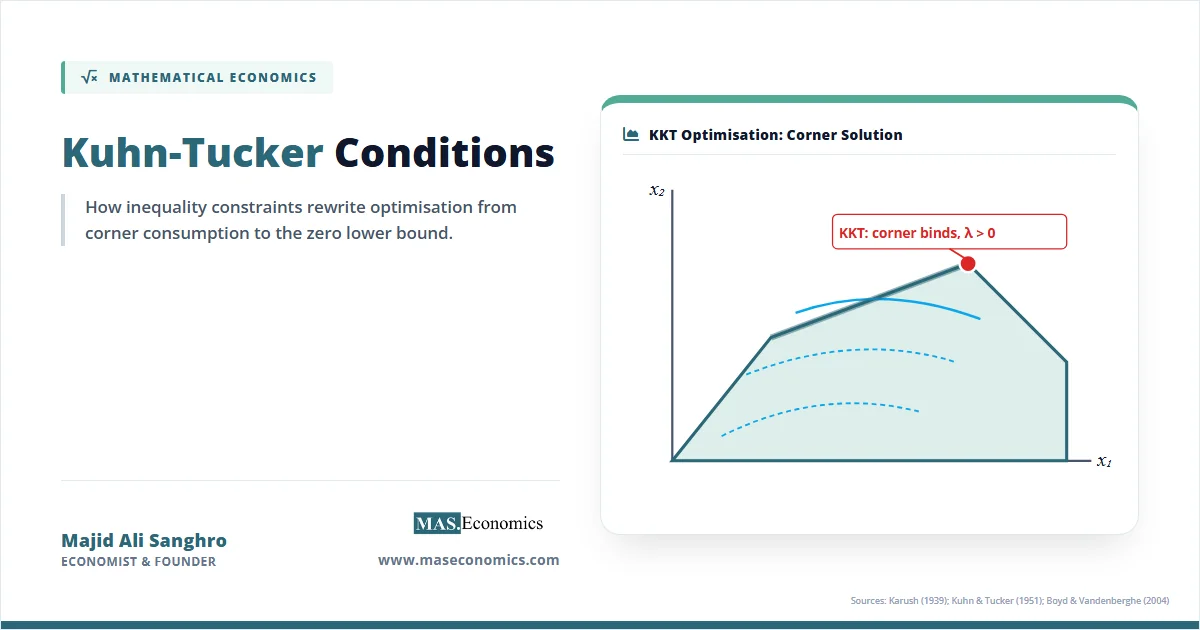
Caveat. The ordinary Hessian classifies unconstrained curvature. A constrained economic problem may require a bordered Hessian, active-constraint analysis, or Kuhn-Tucker conditions.
Numerical checks need interpretation
Software can calculate Hessians quickly, but the economic interpretation still matters. A numerical Hessian may classify curvature at a point, yet the result depends on the function, the point, scaling, and the domain.
One common mistake is to treat a Hessian test as a substitute for first-order conditions. The Hessian classifies a candidate. It does not find the candidate by itself. The marginal conditions must still be solved first.
Another mistake is to ignore units. If variables are measured on very different scales, the entries of the Hessian can look large or small for purely mechanical reasons. The sign pattern is often more important than the raw magnitude, unless the model is explicitly estimating curvature parameters.
A third mistake is to confuse mathematical concavity with economic desirability. A concave utility function supports a well-behaved maximization problem, but welfare interpretation still depends on preferences, constraints, and model assumptions.
Explains
Three concepts behind Hessian tests
Related mathematical economics concepts are developed across the MASEconomics library.
Explore the MASEconomics BlogConclusion
Hessian matrix economics explains how second derivatives classify curvature in functions with several variables. First-order conditions locate stationary points, but the Hessian determines whether those points are consistent with maximization, minimization, or neither.
The method is central because economic models often depend on curvature. Concave utility supports consumer maximization. Convex cost supports cost minimization. Indefinite curvature warns that a candidate point may be a saddle rather than an optimum.
The Hessian is powerful but not automatic. It must be matched to the problem, evaluated at the right point, and interpreted with the model’s assumptions. For unconstrained problems it gives the standard second-order test; for constrained problems it points toward the bordered Hessian and other constrained-optimization tools.
Frequently Asked Questions
What is the Hessian matrix in economics?
The Hessian matrix is a matrix of second partial derivatives used to study curvature in economic functions such as utility, cost, production, profit, and loss functions.
Why is the Hessian matrix important?
It is important because first-order conditions only identify candidate points. The Hessian helps determine whether a candidate is a local maximum, local minimum, saddle point, or inconclusive case.
What does a negative definite Hessian mean?
A negative definite Hessian means the function bends downward in every local direction. At a stationary point, this supports a strict local maximum.
What does a positive definite Hessian mean?
A positive definite Hessian means the function bends upward in every local direction. At a stationary point, this supports a strict local minimum.
How is the Hessian different from the bordered Hessian?
The ordinary Hessian tests curvature in unconstrained problems. The bordered Hessian adds constraint derivatives, so it can test second-order conditions in equality-constrained optimization.
Thanks for reading! If you found this helpful, share it with friends and spread the knowledge. Happy learning with MASEconomics