Most research that fails was doomed before any data arrived, and the failure is usually traceable to a single sentence: the question. Ask supervisors, referees, and funding panels what separates projects that succeed from projects that drift, and the answer converges with suspicious speed on the same diagnosis, that the research question economics students and professionals struggle to write is not a preliminary formality but the design itself, compressed. A well-framed question dictates its own data, selects its own methods, announces its own contribution, and can be answered wrongly, which is the property that makes answering it worthwhile. A badly framed one, however important its topic, produces the familiar wreckage: literature reviews in search of a thesis, regressions in search of a claim, and conclusions that restate the introduction. The good news is that question-framing is a craft with learnable moves, and the moves fit in one article.
From Topic to Question: The Funnel
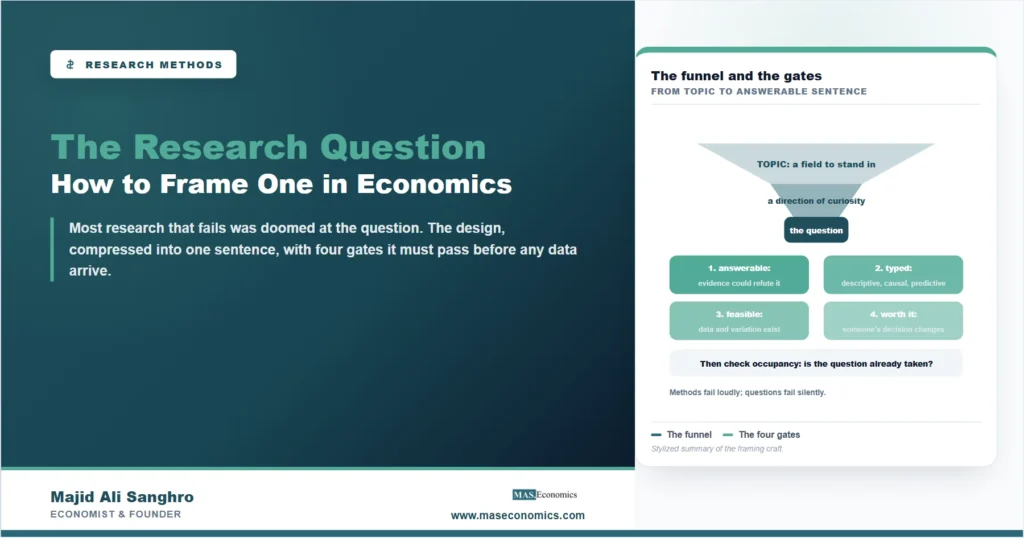
The raw material is always a topic, and a topic is not a question. “Inflation and the poor”, “financial inclusion”, “remittances and development” are fields to stand in, not things to find out; nothing about them can be true or false. The funnel narrows in stages. First comes a direction of curiosity: does inflation hit poor households harder than rich ones? Then come the specifications that turn curiosity into an investigable object: which inflation, measured how; which households, where, over what period; harder in what metric. The end of the funnel is a sentence with all its variables named: how did the 2021 to 2023 inflation episode change the real consumption of the bottom quintile relative to the top, in a named country, using named data. That sentence can be answered, and it can be answered wrongly, which is the test of having left the topic stage. The narrowing feels like a loss of grandeur, and it is the opposite: the grand versions are unanswerable, and the narrow version, answered well, is what actually moves the grand conversation.
The Four Gates
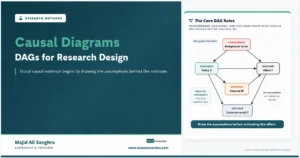
The first gate is answerability: the question must be about something observable, and it must be possible to describe evidence that would count against the favored answer. Questions that fail here are often value debates in disguise, whether inequality is too high, whether a policy is fair, which no dataset can settle because they turn on what “too” and “fair” mean; the honest move is to extract the empirical component, what inequality is, what the policy changed, and let the values debate proceed on accurate facts. The second gate is typing, and it is the most consequential for everything downstream: a question is descriptive, asking what the facts are; causal, asking what X does to Y; or predictive, asking what will happen. The three types are equally legitimate and completely different in their demands. Descriptive questions need measurement and honest summary; predictive questions need out-of-sample discipline; causal questions need an identification strategy, the where-does-the-variation-come-from requirement that our practical guide to causal inference develops. The chronic failure at this gate is the question typed causal by its wording, the impact of X on Y, and pursued with tools that can only describe.
The third gate is feasibility, and it has two locks. The data must exist or be collectable within the project’s means, which is checked against the landscape our guide to data collection in economics maps; and for causal questions the variation must exist, some difference across units, time, or rules that separates X’s movement from everything else’s. A causal question about a policy every region adopted simultaneously, or a variable that never moves, is unanswerable however rich the data, which is why experienced researchers hunt for the accidents cataloged in our article on natural experiments before committing to a question, not after. The fourth gate is worth: the “so what” that referees ask less politely than panels. The workable test is to name the audience whose decision or belief changes with the answer, a ministry, a literature, a market, and to name the victim of the current ignorance; a question whose every possible answer leaves everyone acting identically is a hobby, which is permitted, but should be chosen knowingly.
Occupancy, Originality, and the Iteration Nobody Escapes
A question that passes all four gates can still be taken, and checking is cheaper than discovering it in a referee report. The systematic sweep of what exists, the discipline of a systematic literature review, does double duty here: it establishes whether the exact question is occupied, and it reveals the frontier’s shape, since the strongest questions are usually adjacent to answered ones, the same mechanism in an untested setting, the same setting with a cleaner design, the established finding whose boundary conditions nobody has probed. Originality in economics is rarely a question from nowhere; it is a known conversation moved one honest step.
Two practical notes complete the craft. First, framing is iterative by nature: the question sharpens as the data reveal what can actually be measured and the literature reveals what needs asking, and treating the first formulation as a contract produces either abandoned projects or tortured ones. The productive loop runs question to data to sharpened question, sometimes through a preliminary qualitative stage, in the spirit of mixed method research, that discovers what the categories even are. Second, the question deserves to be written down in its final one-sentence form and kept visible, because projects drift, and the sentence is the instrument that detects the drift: every table, section, and robustness check either serves it or belongs to a different paper. The whole empirical apparatus, from measurement to inference, exists to answer questions, and the tradition surveyed in our introduction to econometrics is only as good as the sentence it is pointed at.
MASEconomics Explains
3 economic concepts behind framing a research question
These concepts are explored in depth across our educational articles library.
Explore the MASEconomics BlogConclusion
Framing a research question economics can act on is the compressed form of research design: the funnel from topic to sentence, and the four gates at its neck. Answerability separates empirical questions from value debates; typing, descriptive, causal, or predictive, selects the entire downstream toolkit; feasibility checks that the data and, for causal claims, the identifying variation exist before the commitment is made; and worth names the audience whose decisions the answer would change. A question that passes the gates then faces the occupancy check, where the literature reveals both what is taken and where the honest adjacent step lies.
The craft’s deepest habit is respect for the sentence itself: written in full, with its variables named, kept visible, revised deliberately as data and reading sharpen it, and used as the instrument against drift. Methods fail loudly, with error messages and referee objections; questions fail silently, by producing unobjectionable work that answers nothing anyone asked. The hour spent framing is the highest-return hour in any project, precisely because everything after it inherits the sentence it serves.
Frequently Asked Questions
What makes a good research question in economics?
Four properties: it is answerable with observable data and could be answered wrongly; it is clearly typed as descriptive, causal, or predictive, which selects the methods; it is feasible, meaning the data and any needed variation exist; and it is worth asking, meaning some audience’s decision or belief changes with the answer.
How narrow should a research question be?
Narrow enough that every variable in it is named and measurable: which outcome, which population, which period, which comparison. The apparent loss of grandeur is the gain of answerability, and grand conversations advance through narrow questions answered well, not through broad ones restated.
What is the difference between descriptive, causal, and predictive questions?
Descriptive questions ask what the facts are and need measurement and honest summary. Causal questions ask what X does to Y and need an identification strategy, a clean source of variation in X. Predictive questions ask what will happen and need out-of-sample validation. All three are legitimate; mixing their requirements is the classic design failure.
How do I know whether my question has already been answered?
By a systematic sweep of the literature before committing: searching the databases, following citation trails, and reading the closest papers’ actual designs rather than their titles. The sweep also reveals the productive frontier, since strong new questions usually sit one honest step from answered ones, in a new setting, with cleaner variation, or at an untested boundary.
Can the research question change during the project?
It should, deliberately: framing is iterative, and the question sharpens as data reveal what is measurable and the literature reveals what needs asking. The discipline is to revise the written sentence consciously rather than drift from it silently, and, for confirmatory causal work, to fix the final version before the decisive analysis is run.
Thanks for reading! Methods fail loudly; questions fail silently, and the hour spent on the sentence is the project’s best-paid hour. Happy learning with MASEconomics