A labor-force survey can change an unemployment estimate, a household expenditure survey can alter a poverty rate, and a firm questionnaire can reshape how policymakers understand investment constraints. A poorly written survey design questionnaire does not merely collect weak answers. It can create measurement error before any statistical model is estimated.
Surveys are central to economics because many important variables cannot be observed directly from market transactions or administrative records. Economists use surveys to measure expectations, informal work, household consumption, time use, subjective well-being, firm constraints, migration intentions, credit access, public attitudes, and many other quantities that exist inside decisions rather than on invoices. The questionnaire is where those abstract concepts become measurable variables.
Survey design and questionnaire methodology therefore sit at the foundation of empirical research. Sampling decides who enters the study. Questionnaire design decides what they are asked, how they interpret the question, what response options they see, and whether their answer is comparable across people, places, and time. When the design is weak, later techniques such as regression, matching, weighting, or hypothesis testing cannot fully repair the damage.
Questionnaire Converts Concepts to Data
Every survey begins with a measurement problem. The researcher wants to measure a concept such as income insecurity, inflation expectations, job search effort, access to credit, informal employment, willingness to migrate, or trust in institutions. These concepts are economically meaningful, but they are not automatically observable. The questionnaire turns them into questions, response categories, recall periods, scales, and coded variables.
This is why survey design belongs inside research methods, not only field administration. A survey question is a measurement instrument. A vague question produces a vague variable. A biased question produces a biased estimate. A recall period that is too long may produce memory error. A response scale that respondents interpret differently may reduce comparability.
Consider a household survey asking whether a person is employed. The answer depends on the definition of work, the reference period, whether unpaid family work counts, whether informal activity is included, and whether the respondent understands the categories. A single word can change the measured labor-market status of people near the boundary between unemployment, informal work, unpaid work, and nonparticipation.
Good survey methodology starts before the first question is written. It asks what concept is being measured, what population is being studied, what decision the data will inform, and what errors are most likely to distort the answer. The questionnaire then becomes a disciplined bridge between theory and measurement.
Question Wording Shapes Variables
Question wording matters because respondents answer the question they understand, not necessarily the question the researcher intended. The American Association for Public Opinion Research’s Best Practices for Survey Research emphasizes that questions should be specific, short, simple, and focused on one concept at a time. Those principles are especially important in economics, where concepts such as income, savings, debt, inflation, welfare, and employment often have technical meanings.
A question such as “Are you financially secure?” may sound clear, but respondents may interpret it differently. Some may think about current income. Others may think about debt, savings, job stability, household support, or future risk. A better survey design separates the concept into measurable components: income stability, emergency savings, debt burden, ability to meet expenses, and perceived risk of income loss.
Pew Research Center’s guidance on writing survey questions notes that questionnaire design is a multistage process, because question wording, order, detail, and prior measurement all affect how people respond. In economic research, this means that the wording of a question can change not only the answer, but also the meaning of the variable used later in analysis.
Good wording avoids double-barreled questions, loaded language, technical terms, vague time frames, and hidden assumptions. A question asking whether a respondent “supports higher taxes and better public services” mixes two concepts. A question asking whether a business faces “excessive regulation” embeds a judgment. A question asking whether prices have “recently increased” leaves the recall period undefined.
Recall Periods and Memory Error
Many economic surveys ask respondents to remember past events: income received, food consumed, medical spending, working hours, credit use, crop sales, transfers, school attendance, or job search behavior. The recall period determines how far back respondents must look. A seven-day recall period may capture frequent behavior accurately but miss irregular events. A twelve-month recall period may capture seasonal activity but increase memory error.
Consumption surveys illustrate the trade-off clearly. Food purchases may require short recall periods because households buy them frequently and forget details quickly. Durable goods, school fees, hospital visits, and housing expenses may need longer reference periods because they occur less often. The World Bank’s Living Standards Measurement Study has long emphasized household survey quality because welfare measurement depends heavily on how consumption, income, assets, and household activities are asked and recorded.
Recall design also affects comparability across groups. A wage worker may know monthly earnings precisely, while a self-employed worker may receive irregular payments. A farmer may think in seasons, harvests, or crop cycles rather than calendar months. A household receiving remittances may face variable timing. When the recall period does not fit the economic activity, the survey may systematically mismeasure certain groups.
The best recall period is therefore not the longest or shortest one. It is the one that matches the frequency, salience, and recordability of the behavior being measured. In surveys for economic policy, that choice should be documented because it affects the interpretation of the resulting variable.
Response Options Match Questions
A survey question can be damaged even when the wording is clear if the response options are poorly designed. Closed-ended questions require categories that are exhaustive, mutually exclusive, and meaningful. Open-ended questions allow richer answers but create coding burdens and comparability problems. Numeric responses can be precise but may increase nonresponse or rounding.
Suppose a firm survey asks why businesses do not invest more. Response options might include weak demand, high interest rates, tax uncertainty, electricity shortages, import restrictions, lack of skilled labor, and regulatory delays. If the list omits credit constraints or political uncertainty, firms facing those problems may select a weaker category. If the survey allows only one answer when multiple constraints bind, the data may understate how problems interact.
Scale design also matters. A five-point agreement scale may appear simple, but respondents differ in how they use the middle category, how strongly they express agreement, and whether they avoid extreme answers. In cross-country surveys, translation and cultural response styles can make scale scores difficult to compare. The OECD’s updated guidelines on measuring subjective well-being reflect the importance of standardized question wording and methodological practice when subjective measures are used in official and policy-relevant surveys.
Questionnaire methodology treats response categories as part of measurement, not as formatting. The researcher must decide whether the goal is classification, frequency, intensity, ranking, valuation, or narrative explanation. Each goal requires a different response structure.
| Question type | Economic use | Main strength | Main risk |
|---|---|---|---|
| Binary question | Employment status, program participation, loan access | Simple coding and interpretation | Can hide intensity or uncertainty |
| Multiple choice | Business constraints, income sources, migration reasons | Captures categories efficiently | Missing categories can bias responses |
| Numeric response | Income, spending, hours worked, prices paid | Produces quantitative variables | Rounding, refusal, and recall error |
| Likert scale | Confidence, trust, expectations, satisfaction | Measures intensity and perception | Scale interpretation may differ across groups |
| Ranking question | Policy priorities, household needs, firm constraints | Shows relative importance | Becomes difficult with too many items |
| Open-ended question | Exploratory constraints, unexpected mechanisms | Captures unanticipated information | Requires careful coding and validation |
|
Source: MASEconomics editorial synthesis based on AAPOR, Pew Research Center, World Bank LSMS, and OECD survey-methodology guidance.

|
|||
Sampling and Questionnaire Interdependence
Sampling decides who is asked. Questionnaire design decides what those sampled units can report. The two decisions interact. A questionnaire written for salaried urban workers may fail in a rural labor market with seasonal employment, unpaid family work, migration, and informal enterprise. A firm survey designed for formal registered companies may miss the constraints faced by microenterprises.
This link matters for external validity. A survey may be internally consistent within the sampled group but weak for wider inference if the sample frame excludes important populations. A household survey based only on phone access may underrepresent poorer households. A business survey using formal tax records may exclude informal firms. A web survey may overrepresent educated and connected respondents.
The World Bank LSMS survey methods program describes survey methods work as a way to improve the quality and efficiency of household survey data collection and develop standards for practitioners. That framing is useful for economists because survey data are not raw facts waiting to be extracted. They are produced through sampling frames, field protocols, questionnaires, interviewer training, supervision, response rates, editing, weighting, and documentation.
A credible survey report should therefore describe both the sample and the questionnaire. Who was eligible? How were respondents selected? What mode was used? Which languages were used? How were nonresponses handled? Were weights applied? What definitions were used? Without those details, readers cannot judge whether the survey estimates describe the intended population.
Survey Mode Effects
The mode of data collection affects who responds and how they respond. Face-to-face interviews can reach people with low literacy or limited internet access, but they are expensive and may increase social desirability bias on sensitive topics. Phone surveys are faster and cheaper, but they exclude people without reliable phone access and may shorten feasible questionnaire length. Web surveys can be efficient, but they depend heavily on internet access, platform recruitment, and respondent attention.
Mode effects are not only logistical. They change the psychology of answering. A respondent may disclose informal income differently to an interviewer than on a self-administered form. A business owner may be cautious about tax-related questions in a face-to-face interview. A household member may underreport debt or remittances when other family members are present.
Mode also affects visual design. Web and paper questionnaires can show grids, scales, and examples. Phone interviews require questions that can be understood when heard once. Face-to-face surveys can use show cards, but interviewer behavior must be standardized. The same question may not function identically across modes.
For economic research, the mode should fit the population and the subject. A short phone survey may work for price expectations among urban households with high phone coverage. A detailed consumption survey may require face-to-face interviewing. A firm survey may need mixed modes because owners, managers, and accountants may hold different pieces of information.
Pretesting Finds Errors Early
Questionnaires often look clear to researchers because researchers already know the concept. Pretesting asks whether respondents understand the question in the intended way. AAPOR’s survey best-practice guidance emphasizes pretesting questionnaires and procedures with respondents similar to the target population. That step is not optional quality control. It is part of measurement design.
Pretesting can reveal that a term is unfamiliar, a recall period is unrealistic, a response category is missing, a sensitive question appears too early, or an interviewer instruction is unclear. Cognitive interviewing can go deeper by asking respondents how they understood a question, what information they recalled, and how they chose their answer.
In economics, pretesting is especially valuable when measuring informal activity, household decision-making, subjective expectations, business constraints, or politically sensitive behavior. A question that works in one region, language, or occupational group may fail in another. Translation can also change meaning, especially for concepts such as employment, savings, debt, welfare, trust, and risk.
Pretesting should lead to revision. A weak survey instrument should not proceed to full fieldwork simply because the sampling plan is ready. The cost of revising a questionnaire before launch is usually far lower than the cost of collecting unusable data.
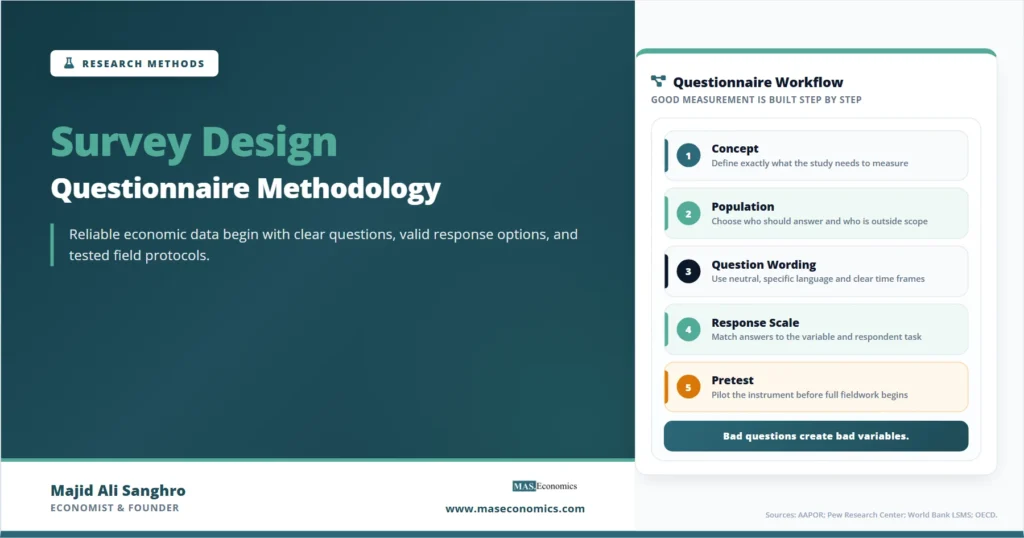
Survey Workflow from Concept to Data
The workflow below shows how a survey instrument should move from concept definition to usable data. The sequence is stylized, but it captures the main design logic. Weakness at any stage can produce measurement error that later analysis cannot fully remove.
Question Order and Context Effects
Respondents do not answer each question in isolation. Earlier questions can change what they think about, what information they recall, and how they interpret later questions. A household asked first about inflation may answer later questions about economic confidence more negatively. A firm asked first about regulation may frame later investment questions around compliance costs.
Question order is especially important when surveys measure attitudes, expectations, priorities, trust, or subjective welfare. Questions about hardship may affect later responses about satisfaction. Questions about politics may affect later views on economic policy. Questions about income may make respondents more cautious in later questions about debt or transfers.
Questionnaire designers usually place screening and factual questions where they help routing, sensitive questions after rapport has been established, and demographic questions where they do not distort substantive answers. Randomizing question order can help in some experimental survey modules, but it is not always appropriate when questions depend on a logical sequence.
The goal is not to remove all context. Some context is necessary. The goal is to avoid accidental priming that changes the meaning of the answer. When order effects are likely, they should be considered part of the research design rather than treated as a minor formatting issue.
Nonresponse Bias
Nonresponse occurs when sampled units do not participate, skip questions, refuse sensitive items, or provide incomplete answers. It matters because nonrespondents are often different from respondents. Poor households may be harder to reach. Busy firm owners may avoid long surveys. Wealthier households may refuse income questions. Migrants may be absent from the household roster.
Nonresponse is not solved simply by increasing the sample size. A larger biased sample can still produce biased estimates. Survey weights and follow-up protocols can reduce some problems, but they depend on knowing who was missed and why. Nonresponse adjustment is most credible when the survey frame contains useful auxiliary information about both respondents and nonrespondents.
For economic research, item nonresponse can be as damaging as unit nonresponse. A household may complete the survey but refuse asset questions. A firm may answer employment questions but skip revenue. A worker may report hours but not earnings. These gaps affect the variables used in hypothesis testing, regression analysis, and policy evaluation.
A transparent survey report should disclose response rates, item nonresponse, weighting procedures, and imputation rules where relevant. Without that information, readers cannot judge whether the survey represents the population it claims to measure.
Measurement Error Before Estimation
Economists often discuss measurement error as a statistical issue, but in surveys it is also a questionnaire issue. A variable can be measured with error because respondents forget, misunderstand, round, conceal, exaggerate, or use a different concept than the researcher intended. Interviewers can also introduce error through inconsistent probing, translation, explanation, or recording.
Some errors are random. A respondent may misremember the exact amount spent on transport last week. Other errors are systematic. High-income households may underreport income. Informal workers may not classify themselves as employed. Firms may understate sales if they fear tax exposure. Systematic error is especially dangerous because it can bias estimates in a predictable direction.
This connects survey design to variable construction. A variable is not reliable simply because it appears as a column in a dataset. The researcher must know how it was asked, who answered it, what reference period was used, what categories were offered, and how missing or inconsistent responses were handled.
Caveat. A statistically precise survey estimate can still be wrong if the questionnaire systematically mismeasures the concept. Precision does not remove bias created by weak wording, poor recall design, or nonresponse.
Sensitive Questions Protection
Many economic surveys ask about sensitive topics: income, debt, tax behavior, corruption, remittances, informal work, migration status, domestic decision-making, social transfers, political trust, health spending, or business informality. Respondents may refuse to answer, provide socially acceptable answers, or hide information if they fear consequences.
Sensitive questions require careful wording, confidentiality assurances, interviewer training, and sometimes self-administered modes. The placement of these questions matters. Asking sensitive items too early can reduce trust and increase refusal. Asking them after a long and burdensome survey can increase fatigue and careless answers.
Ethical considerations are also part of questionnaire design. Respondents should understand the purpose of the survey, how their data will be used, and whether participation is voluntary. Economic researchers often work with vulnerable populations, including poor households, informal workers, migrants, borrowers, and small firms. Poorly designed questions can expose respondents to risk or produce unreliable answers because respondents do not feel safe.
This is why survey methodology connects to the broader ethics of economic research. A valid survey is not only one that produces analyzable data. It is one that collects data responsibly.
Translation and Comparability
Economic surveys often operate across languages, regions, and institutions. A question written in one language may not preserve the same meaning after translation. Terms such as household, work, income, savings, credit, debt, ownership, welfare, trust, and security may not map neatly across languages or local settings.
Translation should therefore be treated as questionnaire design, not clerical work. Back-translation can help, but it is not sufficient by itself. Field teams should test whether respondents understand the translated question in the intended way. Local examples may be needed, but examples must not steer responses.
Comparability is especially important for cross-country research and repeated surveys. A small change in wording can break a time series. A translated term can shift the measured level of trust, well-being, labor participation, or inflation expectations. When a survey aims to compare groups, the question must function similarly across those groups.
This issue is not limited to international work. Within one country, urban and rural respondents may interpret categories differently. Formal and informal firms may understand “employees,” “sales,” or “investment” differently. A survey that ignores local economic structure may produce variables that look comparable but are not.
Data Documentation
A questionnaire should not disappear after data collection. Researchers need the survey instrument, interviewer manual, sampling documentation, fieldwork dates, response rates, coding rules, weighting procedures, and changes made during fieldwork. These materials help others understand what the variables mean.
Documentation also supports replication. A researcher using a public-use dataset should be able to trace a variable back to the wording that produced it. Without the questionnaire, a variable label such as “income,” “employment,” or “credit access” may be ambiguous. Was income gross or net? Individual or household? Monthly or annual? Cash only or in-kind? Formal only or total?
This connects survey design to the replication crisis. Some replication failures arise from statistical choices, but others arise because the underlying data-generating process is not clear. Better questionnaire documentation makes empirical work easier to verify, reuse, and interpret.
For survey-based economics, data quality is not only a matter of cleaning. Cleaning can correct inconsistent codes or obvious errors, but it cannot recreate the meaning of a question that was never documented. The questionnaire is part of the evidence.
Survey Design for Causal Research
Surveys are often used inside causal studies. A randomized evaluation may use surveys to measure outcomes. A regression discontinuity design may collect survey outcomes near a cutoff. Propensity score matching may depend on survey covariates that describe selection into treatment. In each case, the identification strategy depends partly on whether the questionnaire measured the right variables accurately.
In an impact evaluation of job training, survey design affects both outcomes and baseline controls. Earnings questions, employment definitions, job-search modules, and recall periods all influence the estimated program effect. In a microcredit study, loan use, business profits, household consumption, and informal borrowing may be difficult to measure. In education research, attendance, learning, parental investment, and aspirations may require different question types.
A strong causal design cannot compensate for weak measurement. Random assignment may balance treatment and control groups, but if the outcome is measured poorly, the estimated effect remains weak. Matching may balance observed covariates, but if those covariates are badly measured, the matched comparison is less credible. This is why survey design belongs in the same research-methods conversation as causal inference.
Evaluating Survey Instruments
A good survey instrument should pass several checks. First, each question should map clearly to a research concept. Second, key variables should be measured before they are used in analysis. Third, response categories should fit the behavior or attitude being measured. Fourth, the recall period should match the frequency of the economic activity. Fifth, sensitive questions should be placed and protected carefully.
Sixth, the instrument should be pretested with respondents similar to the target population. Seventh, the survey mode should fit the population and question type. Eighth, translation and local terms should be tested rather than assumed. Ninth, the documentation should allow future users to understand the resulting variables.
These checks do not guarantee perfect data, but they reduce preventable error. They also make the strengths and limits of the survey visible. A transparent survey instrument helps readers judge whether the evidence supports the conclusion.
This transparency is also a safeguard against p-hacking. When outcome variables, response scales, exclusion rules, and coding decisions are not documented, researchers have more room to search across definitions after seeing the data. A well-designed questionnaire and codebook reduce that flexibility by making measurement choices explicit.
Explains
Four concepts behind survey-based economic evidence
Build stronger research designs by understanding how economic evidence is measured, collected, and evaluated.
Explore the MASEconomics BlogConclusion
Survey design questionnaire methodology matters because surveys do not simply record economic reality. They construct measurable variables through wording, categories, recall periods, sampling decisions, modes, interviewer protocols, and documentation. When those choices are strong, survey data can reveal behavior and constraints that markets and administrative records miss. When those choices are weak, later analysis rests on fragile measurement.
The central principle is alignment. The research concept, target population, question wording, response options, recall period, survey mode, and coding rule should all point to the same economic variable. A mismatch at any point can create measurement error, bias, nonresponse, or poor comparability.
Good survey methodology does not make survey evidence perfect. It makes the data-generating process visible and defensible. For economics, that is essential. Surveys often measure the variables that drive policy debates, such as poverty, employment, expectations, credit access, firm constraints, and household welfare. The credibility of those debates begins with the questionnaire.
Frequently Asked Questions
What is survey design in economic research?
Survey design is the process of deciding who will be surveyed, what questions will be asked, how answers will be recorded, and how the resulting data will measure economic concepts.
Why is questionnaire wording important?
Questionnaire wording affects how respondents interpret a question. Ambiguous, leading, technical, or double-barreled questions can produce biased or inconsistent economic variables.
What is a recall period in a survey?
A recall period is the time frame respondents are asked to remember, such as the past week, month, season, or year. It affects memory error and comparability.
What is the difference between open-ended and closed-ended survey questions?
Open-ended questions let respondents answer in their own words. Closed-ended questions provide response categories. Open-ended questions capture richer information, while closed-ended questions are easier to code and compare.
How can researchers reduce survey measurement error?
Researchers can reduce measurement error by using clear wording, suitable recall periods, well-designed response categories, pretesting, interviewer training, careful translation, and transparent documentation.
Thanks for reading! If you found this helpful, share it with friends and spread the knowledge. Happy learning with MASEconomics