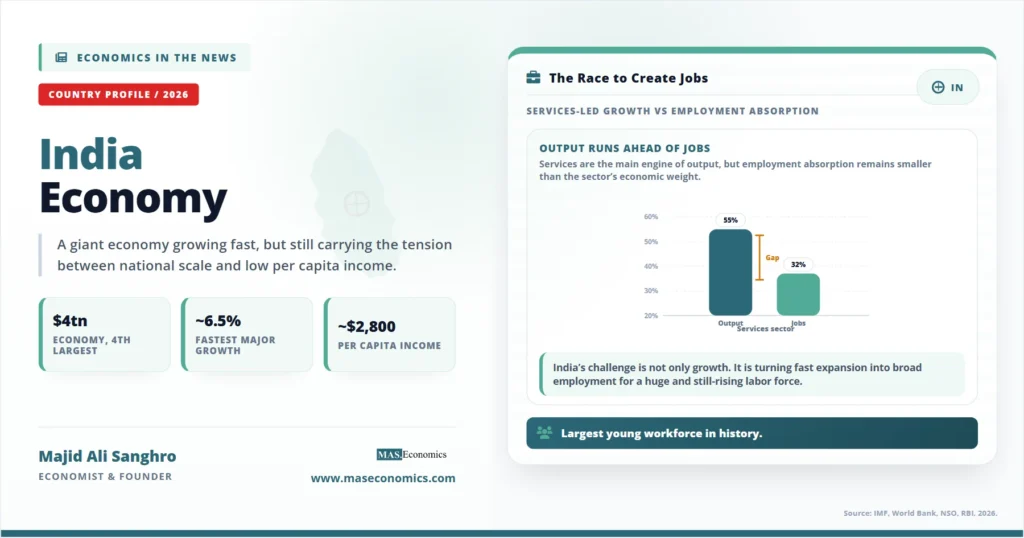
In 2025, India overtook Japan to become the world’s fourth-largest economy, with output approaching $4 trillion. By purchasing power parity, which adjusts for local prices, it had already become the third largest, behind only China and the United States. It is the fastest-growing major economy on earth, expanding at around 6.5% a year while most advanced economies struggle to manage 2%. By almost any headline measure, the India economy is one of the great growth stories of the early twenty-first century.
And yet a second set of numbers complicates the celebration. India’s income per person is roughly $2,800, lower than that of much smaller and less-noticed economies, and its share of global output, around 3.4%, is a fraction of its nearly 18% share of the world’s population. The country is simultaneously an economic giant and a low-income society, a $4 trillion economy where most people are not yet middle class. Reconciling these two facts is the key to understanding India, and it points to the central question the economy faces: whether it can create enough good jobs, fast enough, to turn the largest young workforce in human history into rising prosperity before that demographic window begins to close.
4 Trillion Economy, $2,800 Income
India is the world’s most populous country, with about 1.45 billion people, and its economy has been transformed over a single generation. Since 2000, the economy has nearly quadrupled in real terms, per capita income has almost tripled, and extreme poverty has fallen dramatically, from around 16% of the population in 2011-12 to a low single-digit share a decade later. This is one of the largest improvements in material living standards ever recorded, achieved in a democracy of continental scale and enormous diversity.
The paradox of size and income is the first thing to understand. India’s aggregate output places it among the largest economies in the world, which gives it real weight in global trade, capital markets, and diplomacy. But because that output is spread across 1.45 billion people, income per person remains low, around $2,800 at market exchange rates, characteristic of a lower-middle-income country. A large total economy and a modest individual income coexist, and both are true at once. Headline GDP size does not automatically translate into broad prosperity, and the gap between the two is the space in which India’s development challenge lives.
The government has framed the task explicitly: it aims to reach high-income status by 2047, the centenary of independence. The World Bank has estimated that meeting this goal would require sustaining growth of close to 8% a year for two decades and lifting the investment rate substantially, a demanding path that few countries have managed. Whether India can sustain that pace is the long-run question behind every shorter-term debate about its economy.

Services‑Led Model
India’s growth has been built on a foundation unusual for a developing economy: services rather than manufacturing. The services sector generates roughly 56% of India’s gross value added, among the highest shares of any emerging economy, and it has been the principal engine of the country’s rise. Information technology and software services, business process outsourcing, and financial and professional services have made India a global hub for exactly the kind of work that can be delivered remotely across borders.
This model is a striking example of comparative advantage finding an unexpected outlet. India’s large pool of educated, English-speaking workers gave it an edge in tradable services at precisely the moment when telecommunications and the internet made those services exportable, the principle examined in our explainer on comparative advantage and specialization. While China became the world’s factory by exporting manufactured goods, India became, in a narrower but significant way, one of the world’s offices by exporting services. Its software and services exports earn substantial foreign exchange and have created a genuinely world-class set of firms and a large urban professional class.
The services-led path has clear strengths. It is less capital-intensive than building a manufacturing base, it plays to India’s human-capital advantages, and high-value services generate strong export earnings. But it also has a structural limitation that shapes the entire economy: high-end services employ relatively few people relative to the size of the workforce. IT and finance can enrich a city, but they cannot by themselves absorb the millions of workers with limited formal education who leave agriculture each year looking for better work. That mismatch, between where growth is generated and where jobs are needed, is the defining tension of the Indian economy.
Manufacturing Gap
The flip side of the services success is a manufacturing sector that has never reached the scale India needs. Manufacturing has remained stuck at roughly 14 to 17% of the economy for years, far below the level that powered the rise of China, South Korea, and the other East Asian economies. The government’s flagship Make in India campaign set a target of raising manufacturing to 25% of GDP, and that target has been missed.
This gap matters because of a basic development logic. Labour-intensive manufacturing, factories making textiles, electronics, footwear, and goods, is historically the most reliable way to move large numbers of workers out of low-productivity agriculture and into higher-paying, formal jobs. It is the path nearly every economy that became rich in the twentieth century took. India’s services-led model leapfrogged that stage, generating high-value output without the broad-based factory employment that absorbs a developing country’s surplus labour. The result is an economy that grew its output faster than it grew good jobs.
The reasons manufacturing has lagged are structural. India has historically faced an infrastructure deficit, estimated in the trillions of dollars, in transport, power, and logistics that raises the cost of making and moving goods. Complex labour and land regulations have made it harder to build and operate large factories at scale. And the barriers that affect foreign investment, examined in our explainer on entry barriers to FDI, have at times limited the inflows that could have built export-oriented manufacturing. The government has responded with production-linked incentive schemes designed to attract manufacturers in electronics, pharmaceuticals, and other priority sectors, and there are signs of life, with manufacturing output growing strongly in recent quarters. Whether these efforts can finally lift manufacturing to the scale the workforce requires is one of the central questions of Indian economic policy. The role that foreign capital can play is set out in our piece on foreign direct investment.
External Accounts: Services and Remittances
India’s external position reflects the same services-led structure. The country runs a persistent deficit in merchandise trade, importing more goods, especially oil and electronics, than it exports. But that goods deficit is substantially offset by two other inflows. The first is the surplus in services trade, where India’s software and business-services exports earn far more than it spends. The second is remittances, money sent home by the large Indian diaspora working abroad, which is among the largest such flows in the world and which has in most years exceeded gross foreign direct investment as a source of external funding.
The combination keeps India’s current account deficit moderate, recently around 0.8% of GDP, a comfortable level for an economy growing this fast. This balance, a goods deficit financed by a services surplus and remittances, is the structural signature of the Indian external economy, and it is more stable than the commodity-dependent or borrowing-dependent external positions of many emerging markets. The role of the exchange rate in mediating these flows is explored in our piece on exchange rates in global trade. The United States is India’s single largest export market, taking around 17% of exports, which makes the trade relationship with America and the tariff environment a meaningful factor in India’s external outlook.
| Indicator | Figure | Note |
|---|---|---|
| Nominal GDP | ~$4 trillion | 4th largest economy; overtook Japan in 2025 |
| GDP by PPP | 3rd largest | Behind China and the United States |
| GDP per capita | ~$2,800 | Lower-middle-income; the central paradox |
| Real GDP growth | ~6.5% | Fastest-growing major economy |
| Services share of output | ~56% | Among the highest of any emerging economy |
| Manufacturing share | ~14–17% | Below the 25% Make in India target |
| Current account deficit | ~0.8% of GDP | Goods deficit offset by services and remittances |
|
Source: IMF, World Bank, India National Statistical Office, and Reserve Bank of India, 2025–2026. Figures rounded and provisional.
|
||
Demographic Dividend and Jobs Race
India’s greatest economic asset, and its greatest risk, is its people. The country has a median age of around 29, a working-age population of nearly a billion, and a youth cohort of roughly 370 million aged 15 to 29, the largest of any country in history. In development economics, this is the setting for a demographic dividend: a period when the working-age share of the population is large relative to dependents, which can accelerate growth if those workers are educated, healthy, and productively employed. India’s demographic window is unusually long, with the working-age share expected to peak around 2041, giving the country decades to capitalize.
The dividend is not automatic, and this is where the services-and-manufacturing story becomes urgent. A demographic dividend is only realized if the economy creates enough jobs to employ the young people entering the workforce. India faces a documented gap on exactly this front. Roughly five million graduates join the workforce each year, and surveys have found that a large share of young, educated job-seekers struggle to find permanent, salaried work matching their qualifications, a phenomenon sometimes described as jobless growth, where output rises faster than good employment. The State of Working India research and the Periodic Labour Force Survey both point to high youth underemployment and a heavy reliance on informal work that offers little security.
Two further constraints compound the challenge. Female labour force participation, while rising, remains low by global standards, at roughly 40% against a world average near 47%, which means a large share of potential workers remain outside the formal economy. And a persistent mismatch between the skills the education system produces and the skills employers need leaves many graduates effectively unemployable in the roles they trained for. The window is also finite: research suggests the youth cohort is near its numerical peak, and the working-age share will eventually decline as the population ages, a transition examined in general terms in our piece on demographics and the economy. India has perhaps two decades to convert its demographic advantage into durable prosperity, which is why job creation is not one economic issue among many but the issue on which the others turn.
Reforms Shaping India’s Future
Whether India reaches its high-income ambition depends on several structural shifts now in progress.
The first is investment and infrastructure. India has been investing heavily in physical infrastructure, roads, ports, railways, and digital networks, to close the gap that has held back manufacturing and raised the cost of doing business. The country’s digital public infrastructure, including a near-universal digital identity system and a widely used real-time payments network, has lowered transaction costs and broadened financial inclusion in ways that genuinely distinguish India’s development model. Sustaining and broadening this investment is essential to lifting productivity.
The second is the attempt to build manufacturing at scale. The production-linked incentive schemes, combined with global firms seeking to diversify supply chains away from a single country, give India an opening to capture more labour-intensive manufacturing than it has before. Realizing that opening requires continued progress on infrastructure, regulation, and the ease of doing business, and it is far from guaranteed, but the external environment is more favourable to it than it has been in years.
The third is human capital. The long-run determinant of whether the demographic dividend pays off is the quality of education, health, and skills that India’s young workers carry into the labour market. Raising the quality of schooling, expanding vocational training that matches employer demand, and drawing more women into the formal workforce are the investments that turn a young population from a potential liability into the engine of growth the optimistic case envisions. India’s scale means that even incremental improvements affect hundreds of millions of people, which is what makes its economic trajectory one of the most consequential in the world. As a rising share of global output, traced in our coverage of the shifting balance against economies like the Chinese economy, India’s choices will shape the next phase of globalization.
Explains
Four ideas behind India’s economy
Connect these ideas to the wider library of global economy and central banking articles.
Explore the MASEconomics BlogConclusion
The India economy is defined by a single tension: it is one of the world’s largest and fastest-growing economies, yet it remains a low-income society where most people are not yet middle class. Its services-led model has produced world-class firms, strong export earnings, and a transformation in living standards that has lifted hundreds of millions out of extreme poverty since 2000. But that model has generated output faster than it has generated good jobs, and the manufacturing base that absorbed surplus labour in every earlier development success has never reached the scale India needs.
The decade ahead is a race against the demographic clock. India holds the largest young workforce in human history and a window, lasting perhaps to 2041, in which a favourable age structure could power it toward the high-income status it targets for 2047. Realizing that potential depends on creating enough quality jobs, building manufacturing at scale, closing the infrastructure gap, drawing more women into the workforce, and raising the skills its young people bring to the labour market. The foundations, strong growth, a stable external position, world-leading digital infrastructure, and an unmatched demographic asset, are genuinely in place. Whether India converts them into broad-based prosperity before the window narrows is the defining economic question of its next two decades.
Thanks for reading! If you found this helpful, share it with friends and spread the knowledge. Happy learning with MASEconomics