
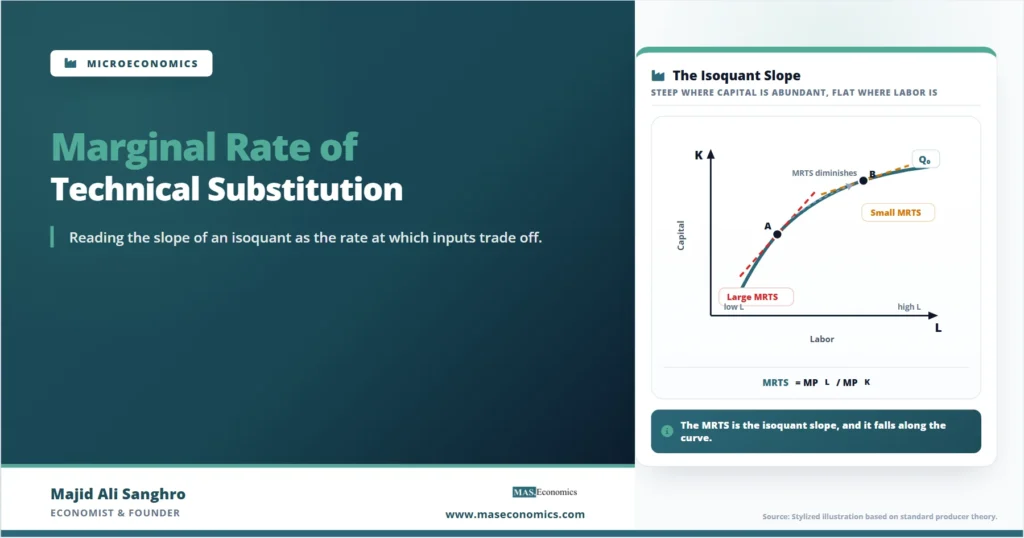
A factory manager who loses a machine can keep output constant by hiring more workers, but the number of workers needed depends on how many machines the factory already runs. Replacing one machine in a highly automated plant takes many extra workers; replacing one in a labor-heavy plant takes few. That trade-off, how much of one input a firm must add to give up a unit of another while holding output fixed, is the marginal rate of technical substitution, and it is precisely what the slope of an isoquant measures at each point along its length.
The concept sits at the center of how firms choose inputs. An isoquant shows every combination of capital and labor that produces a given level of output, a construction developed in the analysis of production functions and isoquant curves. The marginal rate of technical substitution turns that static map into a statement about substitution: it reads the willingness of the technology to trade one input for another, and its behavior along the curve explains why isoquants bow toward the origin rather than running straight.
Isoquant Slope and the MRTS
Along a single isoquant, output is constant by definition. Moving from one point to another means giving up some of one input and adding enough of the other to keep production unchanged. The marginal rate of technical substitution of labor for capital is the amount of capital the firm can shed for each additional unit of labor while staying on the same isoquant. Graphically, it is the negative of the slope of the isoquant at that point.
Definition
The negative sign converts the downward slope into a positive quantity, because the trade-off itself is what matters, not the direction. When the firm adds labor, it sheds capital, so \(dK/dL\) is negative; flipping the sign gives a positive rate that says how much capital one unit of labor replaces. The MRTS is therefore always quoted as a positive number that describes the steepness of the curve at a chosen input mix.
MRTS as Ratio of Marginal Products
The slope is not an independent fact; it is determined by the productivity of the two inputs. Moving along an isoquant, the output lost by reducing capital must exactly equal the output gained by adding labor, or the firm would not stay on the same curve. The output change from a small drop in capital is the marginal product of capital times the change in capital, and the output gain from added labor is the marginal product of labor times the change in labor. Setting the two equal gives the relationship that ties the slope to marginal products.
MRTS and Marginal Products
This identity is the workhorse result. It says the slope of the isoquant at any point is simply the relative productivity of the two inputs there. If labor is highly productive relative to capital, one unit of labor replaces a lot of capital, so the MRTS is large and the isoquant is steep. If labor is barely more productive than the capital it replaces, the MRTS is small and the curve is shallow. The geometry of the isoquant is a direct picture of the underlying marginal products, which is why the same identity reappears whenever firms make input or cost decisions, including in the analysis of the costs of production.
Diminishing MRTS and Convex Isoquants
The defining feature of a well-behaved isoquant is that the MRTS falls as the firm substitutes labor for capital. As the firm moves down the curve, using more labor and less capital, each additional unit of labor replaces less and less capital. This is the principle of diminishing marginal rate of technical substitution, and it is what gives the isoquant its convex shape, bowing in toward the origin.

The diagram makes the principle concrete. At point A, where the firm uses a lot of capital and little labor, the tangent is steep: capital is abundant and not very productive at the margin, while labor is scarce and highly productive, so one unit of labor replaces a large amount of capital. At point B, further down the curve, the firm already uses a lot of labor and little capital, so the roles have shifted: labor is now abundant and less productive at the margin, capital is scarce and valuable, and one unit of labor replaces only a little capital. The flattening tangent from A to B is diminishing MRTS made visible.
The reason the rate diminishes runs back to the marginal products. As labor grows relative to capital, the marginal product of labor falls and the marginal product of capital rises, by the ordinary logic of diminishing returns. The ratio \(MP_L / MP_K\) therefore shrinks as the firm moves toward labor-intensive combinations, and since that ratio is the MRTS, the slope flattens. Convexity is not an assumption imposed for convenience; it follows from diminishing returns acting on both inputs at once.
Limiting Cases
The smooth convex isoquant is the standard case, but two extremes show what the MRTS does at the boundaries of substitutability. When two inputs are perfect substitutes, one always replaces the other at a fixed rate, so the MRTS is constant and the isoquant is a straight line. When two inputs must be used in fixed proportions and cannot substitute at all, the isoquant is L-shaped, and the MRTS is undefined along the corner because no smooth trade-off exists.
| Input relationship | Isoquant shape | MRTS behavior |
|---|---|---|
| Imperfect substitutes (standard) | Convex to the origin | Positive and diminishing along the curve |
| Perfect substitutes | Straight downward-sloping line | Constant at every point |
| Perfect complements | L-shaped (right angle) | Undefined at the corner; zero or infinite along the arms |
|
Source: MASEconomics editorial synthesis of standard producer theory.
|
||
The standard convex case lies between these extremes, and most real technologies sit there: inputs substitute for one another, but imperfectly, with the ease of substitution falling as the firm pushes toward one input. How quickly the MRTS changes as the input mix changes is itself a measurable quantity, the elasticity of substitution, which refines the picture the MRTS provides by quantifying the curvature rather than just its direction.
Why the MRTS matters for cost decisions. A firm minimizes cost where the MRTS equals the ratio of input prices. The MRTS describes what the technology allows; the price ratio describes what the market charges. Producer equilibrium is the point where the two agree, which is why the MRTS is the bridge between the production function and the firm’s cost choices.
Limitations of the MRTS
The marginal rate of technical substitution is a statement about a single isoquant, and that limits what it can say. It describes substitution at constant output, so it says nothing about what happens when output itself changes; moving to a higher isoquant is a separate question about returns to scale, not about the MRTS. It is also a local measurement, valid at the point where it is taken. The MRTS at a capital-intensive point can be very different from the MRTS at a labor-intensive point on the same curve, which is the whole content of diminishing MRTS, so a single number cannot summarize the entire isoquant.
The MRTS also describes only what the technology permits, not what the firm will choose. Knowing the rate at which labor can replace capital says nothing about whether the firm should make that substitution; that depends on input prices, which the MRTS does not contain. The rate is a property of the production function alone. Turning it into a decision requires pairing it with the cost side, where the price ratio enters and the firm’s actual input choice is pinned down. Read on its own terms, the MRTS is the precise description of substitutability that every later step in producer theory builds on.
Explains
Two ideas behind the MRTS
See how the MRTS fits into the wider theory of production and cost.
Explore the MASEconomics BlogConclusion
The marginal rate of technical substitution is the slope of the isoquant read as an economic statement: the amount of one input a firm can give up for an additional unit of another while holding output constant. It equals the ratio of the marginal products of the two inputs, which means the geometry of the isoquant is a direct picture of their relative productivity at each point along the curve.
Its most important behavior is that it diminishes. As a firm substitutes labor for capital, the falling marginal product of labor and the rising marginal product of capital shrink the ratio between them, so each additional unit of labor replaces less capital than the last. That diminishing rate is what bows the isoquant toward the origin, and it is the standard case from which perfect substitutes and perfect complements are the two extremes.
The rate is powerful precisely because it is narrow. It describes substitution at constant output, locally, and as a feature of the technology rather than the firm’s choice. Those limits are what make it the clean building block of producer theory: it states exactly what the production function allows, leaving the price ratio to determine what the firm actually does. Every cost-minimization and producer-equilibrium result that follows starts from the slope this article defines.
Frequently Asked Questions
What is the marginal rate of technical substitution?
It is the amount of one input a firm can give up for each additional unit of another input while keeping output constant. Graphically it is the negative of the slope of the isoquant at a point, and it is always quoted as a positive number describing the steepness of the curve at a given input combination.
Why does the MRTS equal the ratio of marginal products?
Along an isoquant, output is constant, so the output lost by reducing one input must equal the output gained by adding the other. Setting the marginal product of capital times the change in capital equal to the marginal product of labor times the change in labor and rearranging gives the MRTS as the ratio of the marginal product of labor to the marginal product of capital.
Why does the MRTS diminish along an isoquant?
As a firm uses more labor and less capital, the marginal product of labor falls and the marginal product of capital rises, by diminishing returns. Because the MRTS is the ratio of these two marginal products, it shrinks as the firm moves toward labor-intensive combinations. The diminishing rate is what gives the isoquant its convex shape, bowing toward the origin.
What is the MRTS for perfect substitutes and perfect complements?
For perfect substitutes, one input always replaces the other at a fixed rate, so the MRTS is constant and the isoquant is a straight line. For perfect complements, the inputs must be used in fixed proportions and cannot substitute, so the isoquant is L-shaped and the MRTS is undefined at the corner.
How is the MRTS used in cost minimization?
A firm minimizes the cost of producing a given output where the MRTS equals the ratio of input prices. The MRTS shows what the technology allows the firm to substitute, while the price ratio shows what the market charges for that substitution. Cost minimization occurs where the two are equal, which is the basis of producer equilibrium.
Thanks for reading! If you found this helpful, share it with friends and spread the knowledge. Happy learning with MASEconomics