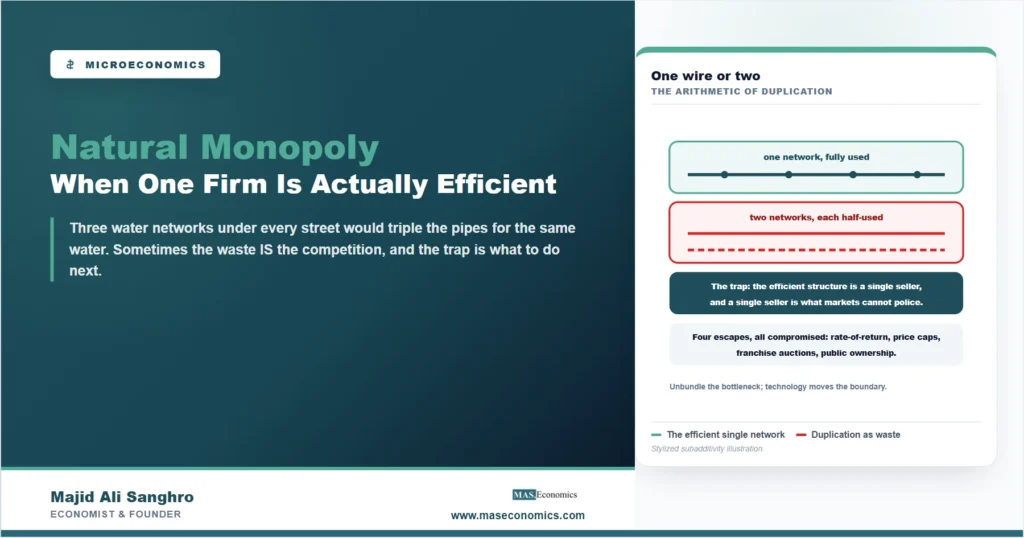
Imagine genuine competition in water supply: three companies, three complete networks of pipes under every street, three connections into every home, each carrying a third of the water one network could carry, with three sets of engineers maintaining triple the infrastructure a city needs. The waste is the point of the thought experiment. A natural monopoly exists where one firm can serve the entire market more cheaply than any two or more firms could, so that competition, the usual remedy for market power, would raise costs rather than discipline them. The condition is not rarity or luck but cost structure: enormous fixed costs of the network, trivial marginal costs of serving one more user, so that unit costs fall across the whole extent of demand and duplication is pure loss. Water, electricity transmission, gas distribution, rail track, and the local last mile of telecommunications are the classic cases, and the concept generates the sharpest dilemma in regulatory economics: the market’s best structure is a single seller, and a single seller is precisely what markets cannot be trusted with. Everything interesting in the subject lives inside that trap.
The Cost Structure That Outlaws Competition
The defining property has a technical name, subadditivity: the cost of producing the market’s whole output in one firm is less than the summed cost of producing it in any division across firms. Falling unit costs over the relevant range guarantee it, and the sources are the familiar engines of scale, fixed network costs spread over users, the geometry of pipes and wires, coordination of a single grid, pushed to the extreme where the falling arm of the cost curve never turns up within the market’s size. The result inverts the usual welfare logic of competition. Where costs are subadditive, a second entrant does not discipline the incumbent; it duplicates the network, splits the volume, and raises both firms’ unit costs, which is why unregulated natural monopolies historically ended their competitive episodes in merger or bankruptcy and why the nineteenth century’s parallel railway tracks and redundant gas mains became the textbook’s cautionary furniture. It matters to keep the concept’s boundary honest: the natural monopoly is defined by cost structure, not by observed market share, and a firm that is merely large, or protected by law, or entrenched behind switching costs holds a different kind of monopoly with different remedies. Nature here means arithmetic, and the arithmetic can be checked.
The Regulator’s Trap, and the Four Escape Routes
Accepting the single firm creates the problem the rest of the field exists to manage: a seller with no rivals will restrict output and price like any monopolist, so the efficiency of one network must somehow be combined with the discipline that competition normally provides. Every candidate rule steps into a trap. Pricing at marginal cost, the efficiency ideal, bankrupts the firm, since price at the tiny marginal cost of one more liter never recovers the enormous fixed cost of the pipes; pricing at average cost keeps the firm solvent but blunts every incentive, since costs are simply passed through. The practical instruments are four, each a different compromise. Rate-of-return regulation lets the firm recover costs plus a fair return on capital, and pays for its stability with the famous padding incentive: a firm reimbursed on its capital base profits from gold-plating it. Price-cap regulation fixes a maximum price path and lets the firm keep what it saves beneath the cap, restoring cost-cutting incentives at the risk of quality-shaving and endless renegotiation when the cap proves wrong. Franchise bidding auctions the monopoly itself, importing competition for the market where competition in it is wasteful, and discovers over time that a long infrastructure contract is nearly as hard to write and police as regulation was. Public ownership internalizes the whole problem into the state, exchanging the private monopolist’s incentives for the public one’s. A century of experience has produced no winner, only a map of which compromise fails least badly in which setting, and the honest summary is that a natural monopoly is not a problem to be solved but a tension to be administered, permanently, by institutions whose quality becomes part of the industry’s cost structure, the general lesson our account of how prices coordinate markets reads in reverse: where the price system’s preconditions fail, something has to stand in for it, and every stand-in is imperfect.
Moving Boundaries: Unbundling, Technology, and the Platform Question
The concept’s modern history is a history of shrinking, because the natural monopoly is a property of technology, and technology moves. The first great revision was unbundling: regulators noticed that an industry is rarely a natural monopoly whole, only in its network core. Electricity generation is competitive while the transmission grid is natural; trains can compete on shared natural track; retail energy supply competes over one set of wires. The reform wave built on this insight separated the segments, confining regulation to the bottleneck and releasing the rest to competition, the settlement now standard across utilities. The second revision came from technology dissolving bottlenecks outright: long-distance telephony was a natural monopoly until microwave and fiber made parallel networks cheap, and mobile networks turned the local loop’s monopoly into an oligopoly of infrastructures, a reminder that yesterday’s arithmetic does not bind tomorrow. The live frontier runs the argument in the other direction: the great digital platforms exhibit the signature cost structure, enormous fixed development cost, near-zero marginal cost per user, reinforced by a force the pipes never had, network effects that make the service better as it grows, the dynamics mapped in our studies of platform economics and the economics of social media. Whether search, social graphs, and marketplaces are natural monopolies in the classical sense, and whether the old toolkit, regulation, unbundling, interoperability mandates as the new track-sharing, transfers to them, is the field’s most consequential open argument, and it is being conducted in the same terms this article has assembled: cost structure, duplication, and the price of standing in for competition.
MASEconomics Explains
3 economic concepts behind natural monopoly
These concepts are explored in depth across our educational articles library.
Explore the MASEconomics BlogConclusion
A natural monopoly is the case where the textbook’s remedy becomes the disease: cost structures with vast fixed networks and trivial marginal costs make one producer cheaper than any plural arrangement, so competition duplicates rather than disciplines, and the market’s efficient structure is the very concentration markets cannot police themselves. The concept’s precision matters, subadditivity is arithmetic about technology, not a title earned by size, and its consequence is the regulator’s permanent trap: marginal-cost pricing bankrupts, average-cost pricing deadens, and the four working compromises, rate-of-return, price caps, franchising, and public ownership, are a menu of least-bad answers rather than solutions.
The concept earns its keep by moving. Unbundling shrank the monopoly to the bottleneck and freed the rest; technology has repeatedly dissolved bottlenecks that looked eternal; and the platform economy now poses the old question in new infrastructure, near-zero marginal costs compounded by network effects, with the toolkit’s transfer still being argued. The thought experiment of the three water networks remains the concept’s whole teaching in miniature: sometimes the waste is the competition, and the craft, never finished, is building institutions that capture a single network’s efficiency without inheriting a single seller’s appetites.
Frequently Asked Questions
What is a natural monopoly in simple terms?
An industry where one firm can serve the whole market more cheaply than two or more firms could, because of enormous fixed network costs and tiny costs of serving each additional user. Water pipes, electricity grids, and rail track are the classic cases: duplicating the network would waste resources without disciplining anyone.
Why not just break up a natural monopoly like any other?
Because its costs are subadditive: splitting the market puts every firm higher up a falling cost curve, so consumers pay for duplicated networks running half-empty. Breakup is the right remedy for monopolies built on conduct or law; for monopolies built on cost structure, it manufactures the waste competition normally prevents.
How are natural monopolies regulated?
Through compromises, each with a known flaw: rate-of-return regulation recovers costs plus a fair return but invites capital padding; price caps restore cost-cutting incentives but risk quality-shaving; franchise auctions import competition for the market but strain long contracts; public ownership internalizes the problem into the state. Practice mixes them by setting and era.
Can a natural monopoly stop being one?
Yes, in two ways. Unbundling can reveal that only the network core was natural, releasing generation, trains, and retail supply to competition over the shared bottleneck. And technology can dissolve the bottleneck itself, as microwave and fiber did to long-distance telephony and mobile networks did to the local loop. The condition is arithmetic, and the arithmetic changes.
Are digital platforms natural monopolies?
They show the signature, huge fixed development costs, near-zero marginal cost per user, plus network effects the pipes never had, and they concentrate accordingly. Whether the classical label and toolkit, regulation, unbundling, interoperability mandates, apply is the live argument in competition policy, conducted in exactly the cost-structure terms the classic cases established.
Thanks for reading! Sometimes the waste is the competition, and the craft is capturing one network’s efficiency without one seller’s appetites. Happy learning with MASEconomics