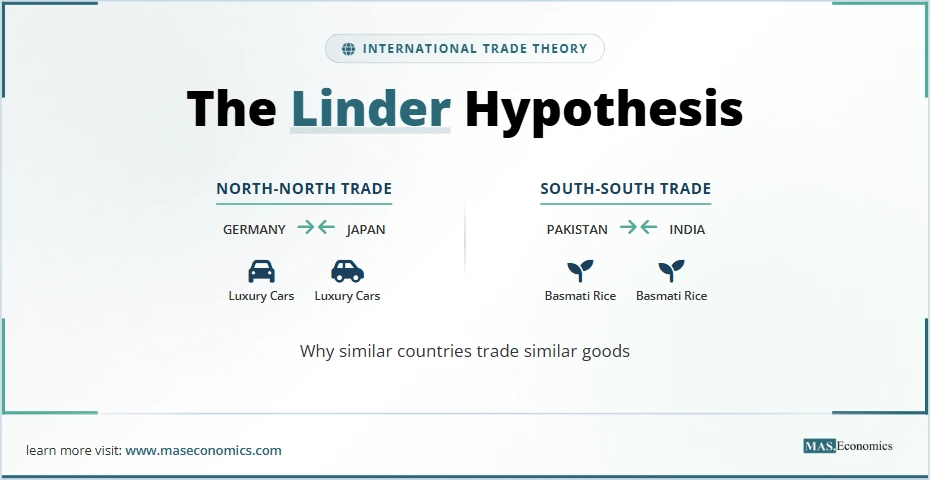
Why does Germany export luxury cars to Japan while Japan exports luxury cars to Germany? Both countries produce excellent automobiles, so why don’t they just keep their cars at home and avoid the shipping costs?
The dominant theory of international trade, the Heckscher-Ohlin model, predicted that trade should flow most intensely between countries with different factor endowments, with capital-rich countries exporting capital-intensive goods to labor-rich countries, and vice versa. Germany and Japan, both capital-rich, should be natural trading partners. Not according to the theory.
Yet when we look at real-world trade data, we find that the majority of world trade occurs not between North and South, but within the North itself. Developed countries trade disproportionately with other developed countries. This empirical regularity demanded an explanation.
Enter Staffan Burenstam Linder, a Swedish economist who in 1961 proposed a radically different view. Trade, he argued, is driven not by supply-side differences in factor endowments, but by demand-side similarities. Countries with similar per capita incomes have similar preferences, and they trade with each other to satisfy their desire for variety and quality.
Why So Much North-North Trade?
To understand why Linder’s theory was revolutionary, we need to see the intellectual landscape he was challenging.
The Heckscher-Ohlin model, which we explored in our first article, predicted that trade patterns should be determined by differences in factor endowments. Capital-abundant countries should export capital-intensive goods; labor-abundant countries should export labor-intensive goods. This implies that most trade should be inter-industry, exchanging different types of goods, and should flow between countries with different factor endowments, i.e., between developed and developing countries.
But the data told a different story. As early as the 1950s, economists observed that:
- The majority of world trade was between developed countries with similar factor endowments
- Much of this trade was intra-industry countries both exporting and importing similar types of goods
- Trade volumes were highest among countries with similar per capita incomes
The Heckscher-Ohlin model could not explain these patterns. Something was missing.
The Man Behind the Hypothesis
Staffan Burenstam Linder (1931–2000) was a Swedish economist and politician. He studied at the Stockholm School of Economics, where he later became a professor. His 1961 book, An Essay on Trade and Transformation, was his doctoral dissertation, and it remains his most influential work.
Linder was not content to simply accept the prevailing orthodoxy. He saw that the factor proportions theory, while elegant, failed to explain important features of real-world trade. He proposed an alternative that shifted focus from supply to demand.
In the preface to his book, Linder dedicated it to his wife with a charming confession:
“In order to clarify matters relating to trade theory for myself, I have sometimes tried to expound them to my wife. As she has had evening walks destroyed by tedious expositions of the ‘dismal science’ and as she has cheerfully endured other hardships on my academic path, I dedicate this book to Thérèse-Marie.”
This personal touch reveals a man who cared about making economics understandable, a kindred spirit to what we do at MASEconomics.
The Core Idea: Representative Demand
Linder’s central insight was simple yet profound: countries produce goods for which there is a domestic market, and then export the surplus.
This seems obvious: why would a country produce something nobody at home wants? But its implications are far-reaching. If production is initially geared toward domestic demand, then a country’s exports will consist of goods that are also consumed domestically. And if two countries have similar demand structures, they will have overlapping sets of goods that each produces and consumes. This overlap creates the potential for trade.
As Linder wrote:
“It is a necessary, but not a sufficient, condition that a product be consumed (or invested) in the home country for this product to be a potential export product.”
But what determines demand structure? Linder argued that per capita income is the most important single factor. Countries with similar per capita incomes have similar preferences for goods, not just similar types of goods, but similar qualities of goods.
Consider two countries with similar per capita incomes. Both will demand a range of goods, from low-quality to high-quality. Their producers, responding to domestic demand, will develop expertise in producing goods across this quality spectrum. When trade opens, they can exchange goods of similar quality levels, each satisfying the other’s demand for variety.
This is why Germany and Japan trade luxury cars. Both have high-income consumers who demand high-quality automobiles. Both have producers who have developed expertise in making such cars in response to domestic demand. They trade because consumers in each country value the particular varieties produced by the other.
A MASEconomics Example: Pakistan and India
Consider two neighboring countries with similar per capita incomes: Pakistan and India. Both have large populations, both have similar cuisines, both have similar clothing preferences, and both have growing middle classes.
According to Linder’s hypothesis, we should observe substantial trade between them in goods that are representative of their shared demand structure. Consider:
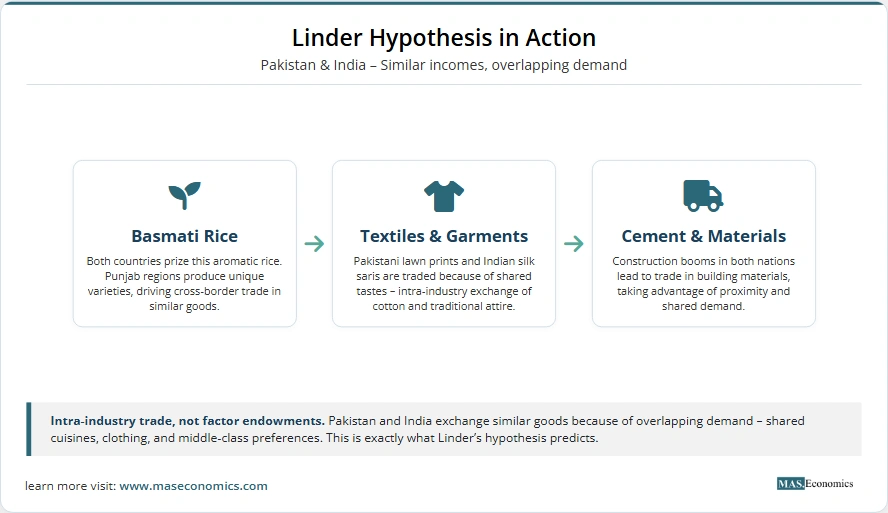
- Basmati rice – prized in both countries for its distinctive aroma and flavor. Pakistan produces basmati in Punjab; India produces basmati in its own Punjab region. Yet they trade basmati rice with each other. Why? Because each region produces varieties with slightly different characteristics, consumers value the variety.
- Textiles and garments – both countries have thriving textile industries producing cotton fabrics, embroidered goods, and traditional attire. Yet they trade these products. Pakistani consumers appreciate Indian silk saris; Indian consumers appreciate Pakistani lawn prints.
- Cement and construction materials – as both countries experience construction booms, they trade in building materials, taking advantage of proximity to reduce transport costs.
This intra-industry trade, exchanging similar goods rather than different ones, is exactly what Linder’s theory predicts. It’s not about factor endowments; it’s about overlapping demand.
Contrast with Heckscher-Ohlin: Two Views of Trade
The contrast between Linder and Heckscher-Ohlin could not be starker:
| Aspect | Heckscher-Ohlin | Linder |
|---|---|---|
| Focus | Supply-side | Demand-side |
| Key determinant | Factor endowments | Per capita income similarity |
| Predicted trade pattern | Between dissimilar countries | Between similar countries |
| Type of trade | Inter-industry | Intra-industry |
| Example | Textiles from Bangladesh for machinery from Germany | Cars from Germany for cars from Japan |

|
||
Both theories can be true; they explain different aspects of trade. Heckscher-Ohlin explains why Bangladesh exports textiles to Germany. Linder explains why Germany exports cars to Japan. A complete understanding of trade requires both perspectives.
The Logic of Representative Demand: Why Home Market Matters
Linder offered several reasons why domestic demand is crucial for developing export competitiveness:
1. Entrepreneurs Respond to Familiar Needs
Entrepreneurs are most likely to recognize profit opportunities in areas they personally understand. A need that an entrepreneur has experienced himself is more likely to inspire innovation than a need observed from afar.
“The decision to take up production of any particular good is likely to be generated by clearly discernible economic needs. In a world of imperfect knowledge, entrepreneurs will react to profit opportunities of which they are aware. These would tend to arise from domestic needs.”
2. Invention and Innovation Are Home-Grown
Drawing on Usher’s theory of invention, Linder argued that inventions typically arise from efforts to solve local problems. The process of cumulative insight, perceiving a problem, gathering materials, achieving insight, and critical revision, is most likely to occur when the inventor is immersed in the environment where the problem exists.
“It must be difficult to become aware of problems and to set the stage for their solution when they do not form part of the inventor’s environment.”
3. Product Development Requires Close Market Contact
New products need to be tested and refined through interaction with consumers. This “trial-and-error period” is costly and difficult if the producer is unfamiliar with the conditions under which the product will be used. A domestic market provides this crucial testing ground.
“If, for some odd reason, an entrepreneur decided to cater for a demand which did not exist at home, he would probably be unsuccessful as he would not have easy access to crucial information which must be funnelled back and forth between producers and consumers.”
4. Japan as a Case Study
Linder pointed to Japan as an empirical illustration of his theory. Contrary to the popular belief that Japan built export industries without domestic markets, Lockwood’s study of Japanese economic development showed that:
“In general, as we have seen, Japan tended to export manufactures of the same general type as those used extensively by her own people.”
No category of products seemed to have been exported without also having an internal market.
The Linder Hypothesis in Diagram Form
Consider two countries with different per capita income levels. Each country demands goods within a certain quality range. Country I, with a lower per capita income, demands goods of quality up to level e. Country II, with a higher per capita income, demands goods of quality starting from level c. The overlapping range c to e represents goods that are demanded in both countries.
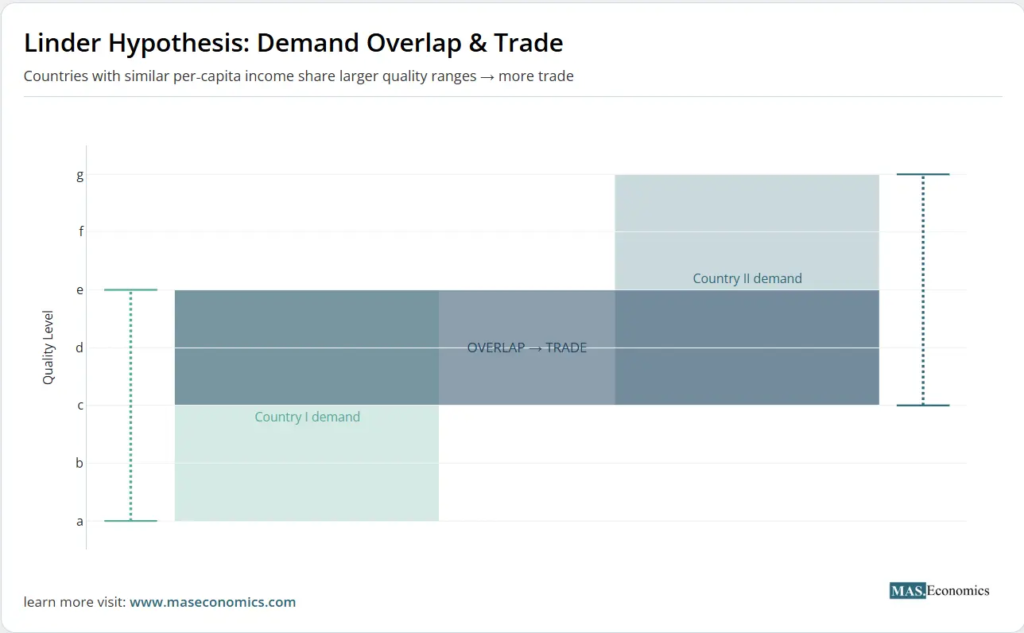
Trade in manufactures can only occur for goods in the overlapping range c to e. Goods below c are demanded only in Country I but not in Country II; goods above e are demanded only in Country II but not in Country I. Thus, the potential for trade is greatest between countries with similar per capita incomes, because their overlapping demand range is largest.
Empirical Evidence
Linder’s hypothesis has been tested extensively over the decades, with mixed results. The key challenge is separating the Linder effect from other determinants of trade, particularly distance and the Heckscher-Ohlin forces.
Early Tests: Rank Correlation
The earliest tests used rank correlation analysis and generally found evidence favorable to Linder. Studies by Sailors, Qureshi, and Cross (1973) and Greytak and McHugh (1977) supported the hypothesis. However, these studies were criticized for failing to control for distance, which could create spurious correlation, as countries with similar per capita incomes tend to be geographically close.
Regression-Based Tests
Later studies used regression analysis to control for distance and other factors. Results were mixed. Some found no support for Linder; others did. A 1987 study by Thursby and Thursby, using pooled data for 17 industrialized countries over 1974–1982, uncovered evidence in favor of the hypothesis after controlling for distance and exchange rate variability.
The Censored Dependent Variable Problem
A major methodological advance came with the recognition that trade data are censored, as many potential trading partners trade zero amounts. Omitting these zero observations biases the results. Studies that properly account for censoring, such as McPherson, Redfearn, and Tieslau (2000, 2001), found strong support for Linder.
Their study of six East African countries (Ethiopia, Kenya, Rwanda, Sudan, Tanzania, Uganda) found support for Linder in five of the six cases. When they re-estimated without accounting for censoring, the Linder effect disappeared, showing that the failure of previous studies to find support may have been due to methodological shortcomings.
Evidence from South Asia
A 2005 study by Bukhari, Ahmad, Alam, Bukhari, and Butt examined the Linder hypothesis for three South Asian countries: Bangladesh, India, and Pakistan. Using a fixed-effects Tobit model with data from 1993 to 2002, they found strong support for Linder in all three cases. The coefficient on the Linder variable was negative and significant at the 99% level for India and Bangladesh, and at the 95% level for Pakistan.
This means that these South Asian countries trade more intensively with partners that have similar per capita incomes, exactly as Linder predicted.
India’s Services Trade
A 2024 study by Chakradhar, Singh, and Renukunta examined whether the Linder hypothesis holds for India’s services exports. Using a gravity model with data from 2005 to 2021 for 35 major importing countries, they found that the Linder hypothesis does not hold for Indian services trade. Instead, India exports services more intensively to countries with dissimilar per capita incomes.
This finding highlights an important caveat: Linder’s theory was originally intended for manufactured goods, not services. Services often have different determinants, including comparative advantage in skilled labor, technological capabilities, and digital infrastructure. The contrasting results for goods and services actually reinforce Linder’s original scope condition.
The Product-Quality View
In recent decades, the Linder hypothesis has been revived and reformulated through the lens of product quality. Juan Carlos Hallak’s influential 2006 paper, “Product Quality and the Direction of Trade,” provided both theoretical and empirical support for a quality-based interpretation of Linder.
The Logic of Quality
Hallak’s key insight: high-income countries consume higher-quality goods, and they also produce higher-quality goods. This creates a natural affinity in trade.
On the demand side, consumers in rich countries are willing to pay more for quality. On the supply side, producers in rich countries have incentives to develop quality expertise because their domestic market demands it. The result: rich countries trade high-quality goods with each other.
Hallak’s empirical work showed that:
- Export prices are strongly correlated with exporter income per capita
- High-income countries tend to export to other high-income countries within product categories
- These patterns are consistent with a model where quality matters
Hallak’s Formal Derivation of the Linder Hypothesis
Hallak showed that the Linder hypothesis can be derived from a model with quality differentiation. In his framework, the amount country \( j \) imports from country \( i \) in sector \( z \) depends on:
Where \( \phi_{iz} \) and \( \psi_{jz} \) are exporter and importer fixed effects, \( \text{Dist}_{ij} \) is distance, \( I_{ij} \) includes other trade cost proxies, and \( (\ln y_i-\ln y_j)^2 \) is the Linder term. The Linder hypothesis predicts \( \beta_{Lz} < 0 \), trade is greater when per capita incomes are more similar.
Using data for 64 countries in 1995 across 116 differentiated sectors, Hallak found strong support for the “sectoral Linder hypothesis.” The coefficient on the Linder term was negative in over two-thirds of sectors and negative and significant in about half. When he aggregated across sectors, the Linder effect disappeared, showing that aggregation bias explains the failure of previous aggregate-level tests.
Why Aggregate Tests Fail
Hallak demonstrated that aggregation across sectors creates a systematic bias against finding the Linder effect. Different sectors have different patterns of specialization that are correlated with per capita income. When these are aggregated, the Linder effect is swamped by these inter-sectoral patterns. This explains why decades of aggregate tests produced inconsistent results.
Extensions: FDI and the Linder Hypothesis
Fajgelbaum, Grossman, and Helpman (2011, 2014) extended the Linder logic to foreign direct investment. Their model combines non-homothetic preferences for quality with the proximity-concentration tradeoff in firms’ decisions about serving foreign markets.
The key insight: firms are more likely to serve large foreign markets via FDI (to save on transport costs) and small markets via exports. With non-homothetic preferences, the large market for high-quality goods is in high-income countries. Thus, firms from high-income countries will tend to engage in FDI in other high-income countries, North-North FDI.
Their empirical analysis using Dun & Bradstreet data on multinational activity found support for this prediction. The absolute difference in per capita income between source and host countries was negatively associated with bilateral multinational activity, especially in industries with greater quality differentiation.
Critiques and Limitations
The Linder hypothesis, for all its appeal, has faced several critiques:
1. Reverse Causality
Does similarity in per capita income cause trade, or does trade cause similarity in per capita income? The direction of causality is difficult to establish. Trade might lead to income convergence, which would then create the observed correlation.
2. Per Capita Income as an Imperfect Proxy
Per capita income is an imperfect measure of demand structure. Income distribution within countries matters as well. A country with a high average income but high inequality might have demand patterns similar to a country with a lower average income but a more equal distribution. Some studies have attempted to incorporate income distribution, with mixed results.
3. The Scope Condition: Manufacturers Only
Linder explicitly limited his theory to manufactured goods. Primary products, he argued, are traded based on natural resource endowments, not demand similarity. This limits the theory’s domain.
4. The Role of Multinational Corporations
MNCs can produce goods in one country for consumption in another, potentially bypassing the home-market mechanism. A firm could develop a product for a foreign market without ever selling it at home. This weakens the link between domestic demand and export competitiveness.
5. Global Value Chains
Modern trade involves fragmented production across multiple countries. A good might be designed in one country, have components made in several others, and be assembled in yet another. In such cases, the concept of a “home market” for the final good becomes ambiguous.
Does the Linder Hypothesis Still Matter?
After six decades of testing and debate, does Linder’s hypothesis still have relevance? Absolutely, but with important caveats.
As a Complement to Supply-Side Theories
The Linder hypothesis reminds us that demand matters. Supply-side theories like Heckscher-Ohlin explain one part of trade; Linder explains another. A complete understanding requires both.
As an Explanation for Intra-Industry Trade
Intra-industry trade, the exchange of similar goods, is a major feature of modern trade. The Linder hypothesis provides a natural explanation, grounded in consumer preferences for variety and quality.
As a Framework for Understanding Quality
The modern revival of Linder through product-quality models has proven fruitful. These models explain not just the volume of trade but its composition, why rich countries export different qualities than poor countries, and why they trade those qualities with each other.
As a Guide to Trade Policy
If similar countries trade most intensively, then trade liberalization among countries with similar income levels (such as within the EU or NAFTA) should yield greater benefits than liberalization between rich and poor countries. This has implications for the design of trade agreements.
As a Reminder That Preferences Matter
Linder’s emphasis on preferences was ahead of its time. Today, with growing attention to heterogeneity in consumer behavior, his insights are more relevant than ever.
The Bottom Line
The Linder hypothesis emerged from a simple observation: the majority of world trade occurs between countries with similar per capita incomes. Linder’s explanation that countries produce for their domestic markets and then export the surplus to countries with similar tastes challenged the supply-side orthodoxy and opened new avenues for thinking about trade.
The hypothesis has had a checkered empirical history. Early tests were hampered by methodological limitations. But modern studies, using appropriate techniques and disaggregated data, have found consistent support. The product-quality view, pioneered by Hallak and others, has given Linder’s intuition a rigorous theoretical foundation and shown that quality differentiation is central to understanding trade patterns.
Linder himself might be surprised at how his simple idea has evolved. But he would surely appreciate that, six decades later, economists are still debating, testing, and refining his hypothesis. That is the mark of a truly influential idea.
Frequently Asked Questions
What is the Linder hypothesis?
Staffan Linder’s 1961 argument that a country’s exports are shaped by what its own consumers demand, so countries with similar income per head trade most with one another. Firms first learn to serve their home market, then export to places whose tastes and incomes resemble it. It explains trade by demand, where Heckscher-Ohlin explains it by supply.
What is the theory of overlapping demand?
The same idea under its other name: two countries trade the goods that appear in both of their demand structures. The greater the overlap in what the two populations want to buy, the more they trade with each other. It predicts heavy trade between rich countries in similar manufactured goods, which factor-endowment theory does not.
What is country similarity theory?
The broader label for Linder’s insight: countries at similar levels of development, with similar incomes, tastes and technology, trade more with each other than with countries unlike them. It underpins the modern explanation of intra-industry trade, where two countries export near-identical products to one another.
Did you find this article helpful? Share it with someone who loves economics. And remember, at MASEconomics, we make complex ideas simple.