Consider a country that decides to eliminate all tariffs on imported goods. Free trade, after all, is supposed to increase welfare. But what if that country’s trading partners still maintain their tariffs? Or what if the domestic economy already has other distortions, such as monopoly power, pollution externalities, or labour taxes? Could removing the tariff actually make the country worse off?
Now consider a different scenario. A government wants to reduce carbon emissions. It knows that a carbon tax is the “first‑best” policy. But political constraints make a carbon tax impossible. Instead, it imposes fuel‑efficiency standards on cars. Will that move the economy closer to the efficient outcome, or further away?
The answer, surprisingly, is that we cannot know without analysing the entire system. This is the unsettling conclusion of the General Theory of Second Best, one of the most important and most misunderstood theorems in welfare economics.
Developed by Richard Lipsey and Kelvin Lancaster in 1956, the theory of second best delivers a radical message: if one of the conditions for a Pareto optimum cannot be met, then the other Pareto conditions are not merely unreachable, they are no longer desirable. In a world with multiple distortions, trying to fix only one of them may push the economy away from the best attainable outcome, not towards it.
The Prevailing Intuition and Why It Failed
Before 1956, welfare economics operated on a simple and appealing intuition. The conditions for a Pareto optimum, such as equality of marginal rates of substitution for all consumers and equality of marginal rates of transformation for all producers, were seen as the “rules” of economic efficiency. If some of these rules were violated, it seemed natural to believe that satisfying more of them would bring the economy closer to the optimum.
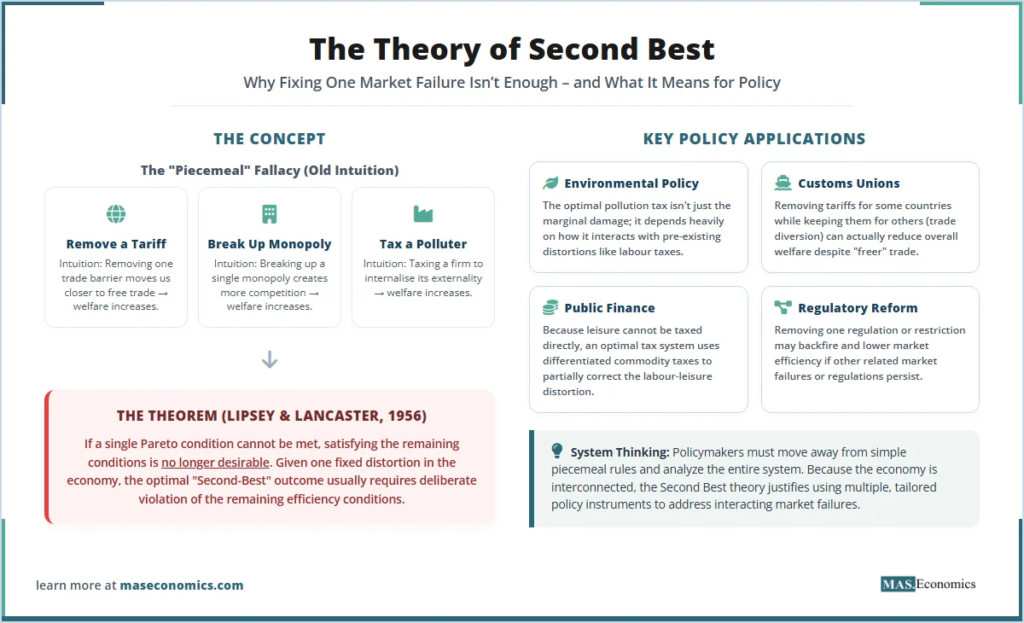
This intuition underpinned piecemeal welfare economics: the idea that policymakers could improve welfare by eliminating one distortion at a time, without worrying about the rest. For example:
- Remove a tariff → move closer to free trade → welfare increases.
- Break up a monopoly → more competition → welfare increases.
- Tax a polluter → internalise the externality → welfare increases.
But Lipsey and Lancaster showed that this intuition is generally false. When one optimality condition cannot be satisfied, for whatever reason, the other conditions cease to be valid guides. In fact, the second‑best optimum may require violating the other conditions in specific and often unpredictable ways.
Lipsey and Lancaster
Richard G. Lipsey (1928– ) and Kelvin Lancaster (1924–1999) were economists working at the London School of Economics in the 1950s. Lancaster later became known for his characteristic‑based model of consumer choice, the idea that consumers derive utility not from goods directly, but from their underlying attributes. Lipsey went on to make major contributions to industrial organisation and the theory of the Phillips curve.
Their 1956 paper, “The General Theory of Second Best,” published in the Review of Economic Studies, was a direct response to the prevailing piecemeal approach. They showed that the standard welfare conditions are derived under the assumption that all of them can be satisfied simultaneously. Introduce a binding constraint that prevents one, a tax that cannot be removed, a monopoly that cannot be broken, an externality that cannot be internalised, and the entire structure collapses.
The theorem is both simple and devastating.
The Core Idea Explained
The Formal Theorem
In their own words: “If there is introduced into a general equilibrium system a constraint which prevents the attainment of one of the Paretian conditions, the other Paretian conditions, although still attainable, are, in general, no longer desirable. In other words, given that one of the Paretian optimum conditions cannot be fulfilled, then an optimum situation can be achieved only by departing from all the other Paretian conditions.”
The second‑best optimum is the best possible outcome given the constraint. It will generally require that all the remaining optimality conditions be violated. Moreover, the direction and magnitude of these violations cannot be determined a priori; they depend on the specific structure of the economy.
A Simple Numerical Example
Let us illustrate with a minimal example inspired by the original paper. Consider an economy with three goods: \(X\), \(Y\), and \(Z\). There is a single consumer with a utility function:
U = \ln X + \ln Y + \ln Z
$$
The production possibilities are linear: one unit of labour produces one unit of any good. Total labour is 3. So the production constraint is:
X + Y + Z = 3
$$
Without any distortions, the first‑best optimum is found by maximising \(U\) subject to \(X + Y + Z = 3\). By symmetry, \(X = Y = Z = 1\), and utility \(U = 0\).
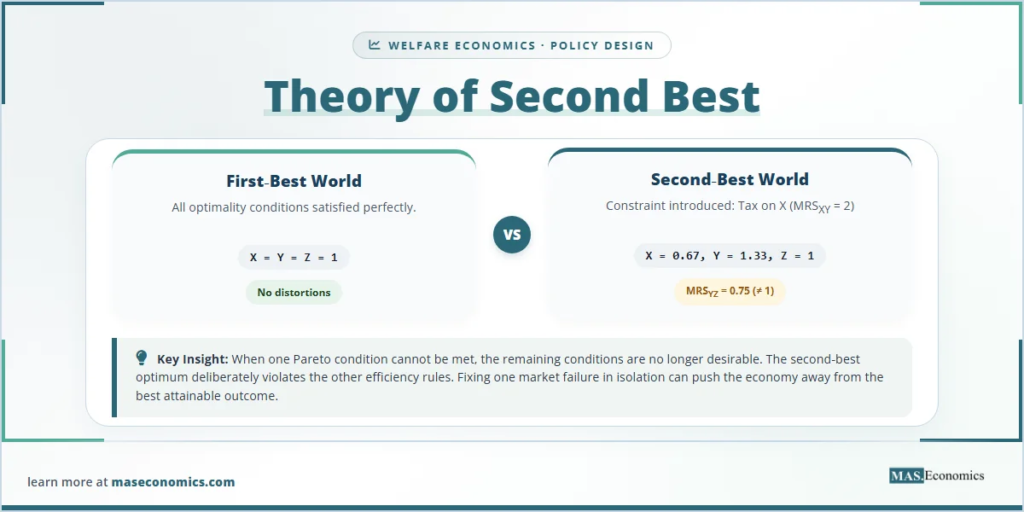
Now, suppose a constraint prevents one first‑best condition from being satisfied. The government imposes a tax on good \(X\) that raises its effective price to consumers relative to \(Y\) and \(Z\), and this tax cannot be removed. The tax creates a wedge: the consumer’s marginal rate of substitution between \(X\) and \(Y\) no longer equals the marginal rate of transformation (which is 1).
The constraint is: \(\frac{\partial U/\partial X}{\partial U/\partial Y} = 2\). That is, the consumer substitutes away from \(X\) at a ratio of 2:1.
We now maximise \(U\) subject to both \(X + Y + Z = 3\) and \(\frac{Y}{X} = 2\) (since with \(\ln\) utility, the MRS is \(Y/X\)). From the second constraint, \(Y = 2X\). Substituting into the production constraint: \(X + 2X + Z = 3\), so \(Z = 3 – 3X\).
Utility becomes:
U = \ln X + \ln(2X) + \ln(3 – 3X) = 2\ln X + \ln 2 + \ln(3 – 3X)
$$
Maximising with respect to \(X\):
\frac{2}{X} – \frac{3}{3 – 3X} = 0 \quad \Rightarrow \quad \frac{2}{X} = \frac{1}{1 – X} \quad \Rightarrow \quad X = \frac{2}{3}
$$
Then \(Y = 4/3\), \(Z = 1\). The second‑best optimum is \((X, Y, Z) = (0.67,\ 1.33,\ 1.0)\).
Crucially, in this second‑best optimum, the other optimality conditions are also violated. The MRS between \(Y\) and \(Z\) is \(\frac{Z}{Y} = \frac{1}{1.33} \approx 0.75\), while the marginal rate of transformation is 1. A piecemeal approach would suggest equating these, but doing so would conflict with the binding tax constraint on \(X\) and actually reduce welfare. The first‑best rule between \(Y\) and \(Z\) is simply no longer a reliable guide.
The General Implication
The example shows that once a single distortion is fixed, the optimal policy requires deliberate violations of the other efficiency conditions. The direction of those violations, whether to tax or subsidise other goods, whether to increase or decrease output, cannot be inferred without full knowledge of preferences and technology. There is no shortcut.
Key Applications
The theory of second best has profound implications across economics. Here we highlight three major areas.
1. Environmental Policy and the “Double Dividend.”
Perhaps the most prominent modern application concerns the interaction between environmental taxes and pre‑existing distortionary taxes such as income taxes. In a first‑best world, a Pigouvian tax equal to marginal damage is optimal. In a second‑best world with a labour income tax that already distorts labour supply, the optimal pollution tax deviates from marginal damage, potentially substantially, depending on how the environmental instrument interacts with the labour market.
The “double dividend” hypothesis holds that environmental taxes can simultaneously reduce pollution and relax the distortion caused by labour taxes, by recycling revenue into tax cuts. However, the tax interaction effect, whereby pollution taxes raise consumer prices and act as an implicit further tax on labour, can offset this benefit. The practical upshot is that the optimal policy may require a combination of instruments: an environmental tax coupled with a reduction in labour taxes, or even subsidies to certain sectors.
2. International Trade and Customs Unions
The theory of second best was, in effect, anticipated by Jacob Viner’s work on customs unions. Viner showed that a customs union, discriminatory tariff reduction between member states, could be welfare‑reducing if it leads to trade diversion: switching imports from a lower‑cost non‑member to a higher‑cost member, simply because the non‑member’s tariff remains. This is a classic second‑best result: removing one tariff may not improve welfare when other tariffs persist.
More generally, Ozga (1955) demonstrated that even a non‑discriminatory tariff reduction by a single country could lower its real income if trading partners maintain their own barriers. The first‑best intuition, “free trade is good,” holds only when all countries liberalise simultaneously. In a second‑best world, piecemeal liberalisation can backfire.
3. Public Finance: Direct vs. Indirect Taxation
The long‑running debate over the relative merits of direct and indirect taxation is another second‑best problem. Because leisure cannot be taxed directly, an income tax distorts the labour‑leisure choice. A uniform ad valorem tax on all goods is equivalent in effect to a tax on labour income, but differentiated commodity taxes can partially offset the labour‑leisure distortion. Corlett and Hague (1953) showed that the optimal tax system, given that leisure remains untaxable, taxes complement leisure more heavily than substitutes. This is a second‑best solution: it deliberately violates the first‑best rule of uniform commodity taxation in order to achieve a better overall outcome.
Critiques and Limitations
The theory of second best is powerful, but it poses serious challenges for practical policy.
1. Informational Requirements
Finding the true second‑best optimum requires knowing the entire structure of the economy: all preferences, all technologies, and all pre‑existing distortions. This is practically impossible. As Lipsey and Lancaster themselves acknowledged, the theorem is largely a negative result; it tells us what not to do (rely on piecemeal rules), but offers limited positive guidance.
2. The Risk of Policy Paralysis
If every policy change must be evaluated within a full general equilibrium framework, policymakers may be tempted to do nothing at all. Some economists argue that second‑best complications are often quantitatively small, making piecemeal reforms reasonable approximations in practice. Others caution that ignoring these effects can produce large and systematic errors.
3. Technical Existence Issues
Even locating a second‑best optimum is not guaranteed. The constraint structure may be such that no maximum exists, or the first‑order conditions may involve sign‑indeterminate terms that resist simple characterisation. Economists typically assume well‑behaved convexity to proceed, but this remains an assumption rather than a general theorem.
4. Political Economy Complications
A further difficulty is that second‑best reasoning can be, and sometimes has been, misused to rationalise the preservation of existing distortions. If any policy is potentially welfare‑reducing in a world of multiple distortions, the argument can be weaponised to resist reform. Distinguishing genuine second‑best analysis from motivated reasoning requires exactly the kind of full‑system information that is rarely available.
Modern Relevance
Despite its cautionary tone, the theory of second best has become a cornerstone of applied welfare economics. It underpins:
- Optimal taxation theory (Mirrlees, Diamond, Saez): The optimal tax system is a second‑best solution, given that lump‑sum taxes are not feasible in practice.
- Environmental economics: The choice between carbon taxes, cap‑and‑trade permits, and regulatory standards depends critically on which other distortions are present.
- Trade policy: Preferential trade agreements are evaluated using precisely the trade creation/trade diversion framework that second‑best analysis motivates.
- Regulatory reform: Removing one regulation may not be beneficial, or may even be harmful, if complementary regulations remain in place.
As Bennear and Stavins (2007) note, second‑best thinking also provides the analytical foundation for using multiple policy instruments simultaneously. When several market failures coexist, a single instrument is rarely sufficient; a well‑designed combination, such as a carbon tax paired with an R&D subsidy for clean technology, can achieve outcomes that neither instrument reaches alone.
Conclusion
The theory of second best is a humbling reminder that economic systems are not collections of independent parts that can be repaired one at a time. The first‑best optimality conditions only serve as reliable guides when all of them are simultaneously achievable. Once a single condition is blocked by a binding constraint, the rest become unreliable, and blindly satisfying them may move the economy further from, not closer to, the best attainable outcome.
This is not a counsel of despair. It is an argument for policy humility, for preferring instruments that hold up under second-best complications, and for designing policy packages that address multiple distortions in concert rather than in isolation. It is also an argument for honest analysis: second‑best welfare economics demands that we think carefully about the entire system before drawing conclusions from any single part of it.
In that sense, the enduring lesson of Lipsey and Lancaster is less about any specific policy and more about a way of thinking, one that takes complexity seriously rather than wishing it away.
Frequently Asked Questions
What is the theory of the second best?
Lipsey and Lancaster showed in 1956 that if one condition for an efficient outcome cannot be met, satisfying the remaining conditions is not necessarily best. Removing a second distortion can leave the economy worse off than leaving both of them in place.
Can you give an example?
Suppose one industry is monopolised and prices above marginal cost. Forcing a second, competitive industry to price at marginal cost widens the gap between the two. The second-best answer may be to let the competitive industry price above marginal cost as well, so relative prices are less distorted even though each individual price is further from the textbook rule.
Why does this complicate policy?
It removes the safety of piecemeal reform. Fixing one market failure is only reliably good when nothing else is distorted, and something else always is. Each partial reform has to be argued from its own evidence rather than from the principle that fewer distortions must be better.
Does it mean reform is pointless?
No. It means the case for a reform is empirical rather than automatic. Plenty of reforms do improve things. The theory says you cannot know that from the fact that one removes a distortion, only from working out how it interacts with the distortions that remain.
Did you find this article helpful? Share it with someone who loves economics. And remember, at MASEconomics, we make complex ideas simple.