Economics journals now expect more than a plausible theory and a clean regression table. Leading outlets require clear identification, documented data, replication files, and transparent research choices. Research Methods in Economics are the rules economists use to turn questions about markets, firms, households, and policy into credible evidence.
A research method is not only a statistical tool. It is the full design logic that connects a question, a theory, a dataset, an identification strategy, and a written argument. Econometrics estimates relationships, but research methods decide which relationships are worth estimating, what evidence would count, and where the limits of inference sit.
The distinction matters because economic evidence often shapes public finance, labour-market policy, development programmes, central banking, competition policy, and trade rules. A weak design can make a precise estimate misleading. A strong design can make even a modest estimate informative.
Economics as Evidence Design
Economic research starts with a question that can be disciplined by evidence. A broad topic such as inflation, unemployment, inequality, productivity, or trade is not yet a research question. A research question narrows the object of study, the population, the mechanism, and the evidence required. For example, a broad topic asks about minimum wages. A research question asks whether a specific increase in the legal wage floor changed employment in a comparable labour market.
This movement from topic to question is the first methodological act. It determines whether the study needs descriptive statistics, a causal design, a theoretical model, survey evidence, historical archives, experimental variation, or a systematic review. The best economic papers do not begin with a preferred technique. They begin with a claim that needs to be tested and then choose the design that can test it with the least avoidable bias.
The American Economic Association now treats transparent data and code as part of the publication standard. Its data and code policy states that papers should have clearly documented data and code, with access not exclusive to the authors. That rule reflects a wider shift in economics: methods are no longer hidden behind final estimates. The workflow itself is part of the evidence claim. AEA Data and Code Policies and Guidance
Good research methods, therefore, answer four linked questions. What is being studied? What evidence is being used? What assumptions connect the evidence to the claim? What could make the claim wrong? These questions define the boundary between a useful empirical result and a number that only looks scientific.
The Question Shapes the Method
Different economic questions require different kinds of evidence. A descriptive question asks what exists, such as the share of workers in informal employment or the distribution of household debt. A causal question asks what changes because of an intervention, such as whether a tax credit increases labour supply. A forecasting question asks what is likely to happen next, such as inflation over the next four quarters. A mechanism question asks why a relationship appears, such as whether a cash transfer affects schooling through income, expectations, or reduced credit constraints.
Each question type points toward a different research design. Descriptive work may rely on census data, administrative records, or carefully weighted surveys. Causal work may require randomized assignment, a natural experiment, regression discontinuity, difference-in-differences, instrumental variables, or matching. Forecasting work often draws on time-series models and model evaluation. Mechanism work may combine theory, experiments, survey modules, and qualitative evidence.
This is where Research Methods connects directly with the Econometrics library. A design may require simple linear regression, multiple regression models, instrumental variables, panel data methods, or stationarity checks in time series econometrics. The research methods decision comes first. The econometric estimator follows from that decision.
For this reason, a method should not be chosen because it is technically impressive. It should be chosen because it matches the structure of the question, the available variation, and the credibility standard required by the claim.
The Core Methods Taxonomy
Economic research is often grouped into quantitative, qualitative, experimental, quasi-experimental, observational, theoretical, and synthetic approaches. These labels are useful, but they become more informative when tied to when the method is appropriate. A randomized evaluation is powerful when assignment can be controlled. A natural experiment is useful when institutional rules create variation that resembles random assignment. A systematic review is useful when the problem is not a lack of studies but a fragmented evidence base.
| Method Type | Subcategory | When to Use | Example Studies | Strengths |
|---|---|---|---|---|
| Experimental | Field randomized controlled trial | Estimate the causal effect of a programme under controlled assignment. | Banerjee and Duflo style development evaluations | High internal validity |
| Experimental | Lab experiment | Test behavioural mechanisms under controlled decision settings. | Kahneman and Tversky style choice experiments | Mechanism clarity |
| Quasi-experimental | Natural experiment | Use policy rules, shocks, or institutions that create as-if random variation. | Card and Krueger minimum wage study | Real-world policy variation |
| Quasi-experimental | Regression discontinuity design | Estimate effects around a cutoff that assigns treatment. | School admissions and programme eligibility thresholds | Credible local identification |
| Quasi-experimental | Difference-in-differences | Compare treated and untreated groups before and after a policy change. | State-level labour and policy reforms | Time and group comparison |
| Observational | Cross-sectional analysis | Describe relationships across units at one point in time. | Census or household survey snapshots | Broad coverage |
| Observational | Longitudinal or panel analysis | Track units across time to study persistence, change, and transitions. | PSID, NLSY, administrative panels | Within-unit comparison |
| Mixed method | Qualitative plus quantitative design | Combine measurement with institutional context, interviews, or field evidence. | Programme evaluations with process evidence | Mechanism and context |
| Synthetic evidence | Systematic review | Map and assess a body of evidence using explicit inclusion rules. | Cochrane-style review protocols | Transparent evidence synthesis |
| Synthetic evidence | Meta-analysis | Combine comparable effect estimates across studies. | Education, labour, health, and development studies | Higher statistical power |

|
||||
The taxonomy shows why methods cannot be ranked in a single hierarchy. A field experiment may dominate for one question and fail for another. A historical archive may be weak for causal estimation but strong for institutional interpretation. A cross-sectional dataset may be poor for treatment effects but useful for measuring inequality at scale. Method quality depends on fit.
From Theory to Testable Claims
Theory gives economic research its structure. It defines the variables that matter, the mechanism that links them, and the direction of the expected relationship. Without theory, a researcher can still find correlations, but the interpretation becomes fragile. A model of labour demand, for example, tells the researcher why wages and employment may move together, why the relationship may differ under monopsony, and why policy evaluation requires a comparison group rather than a simple before-and-after comparison.
Economic theory also helps separate prediction from explanation. A forecasting model may predict inflation well while saying little about the structural causes of inflation. A causal study may estimate a policy effect in one setting without predicting aggregate outcomes elsewhere. A theoretical model may clarify incentives even when direct measurement is difficult. Research methods govern how these different claims are built and evaluated.
The connection between theory and evidence is developed further in economic theory and research, where theory works as a map rather than a substitute for evidence. Strong research does not treat theory as decoration. It uses theory to choose variables, identify confounders, define hypotheses, and interpret results.
Identification Before Estimation
Identification is the logic that allows an economist to interpret an estimate as evidence about a relationship of interest. In descriptive work, identification may mean accurate measurement and representative sampling. In causal work, it means showing why the treated outcome can be compared to a credible counterfactual. In forecasting work, it means showing that the model is evaluated out of sample and not only fitted to past noise.
The history of applied economics shows why identification matters. Card and Krueger’s minimum wage study compared fast-food restaurants in New Jersey and Pennsylvania around a policy change, using a design that turned a policy border into evidence about employment effects. Their approach helped move empirical economics toward research designs that focus on credible comparison rather than only on model specification. Card and Krueger, American Economic Review
Identification does not remove the need for econometrics. It guides the econometrics. Once the design is clear, the estimator can summarize the comparison, quantify uncertainty, and test sensitivity. Without identification, even a technically correct model can estimate the wrong object.
This is why Research Methods articles on natural experiments in economics, causal inference in economics, and advanced difference-in-differences methods sit near the boundary between Research Methods and Econometrics. Research Methods asks whether the comparison is credible. Econometrics asks how to estimate and test it formally.
The Research Process Overview
A research project moves through a sequence of choices. The order is not mechanical, because revisions happen as data constraints, ethical constraints, and identification problems appear. Still, a clear process helps prevent a common failure: choosing data and models before clarifying the question.
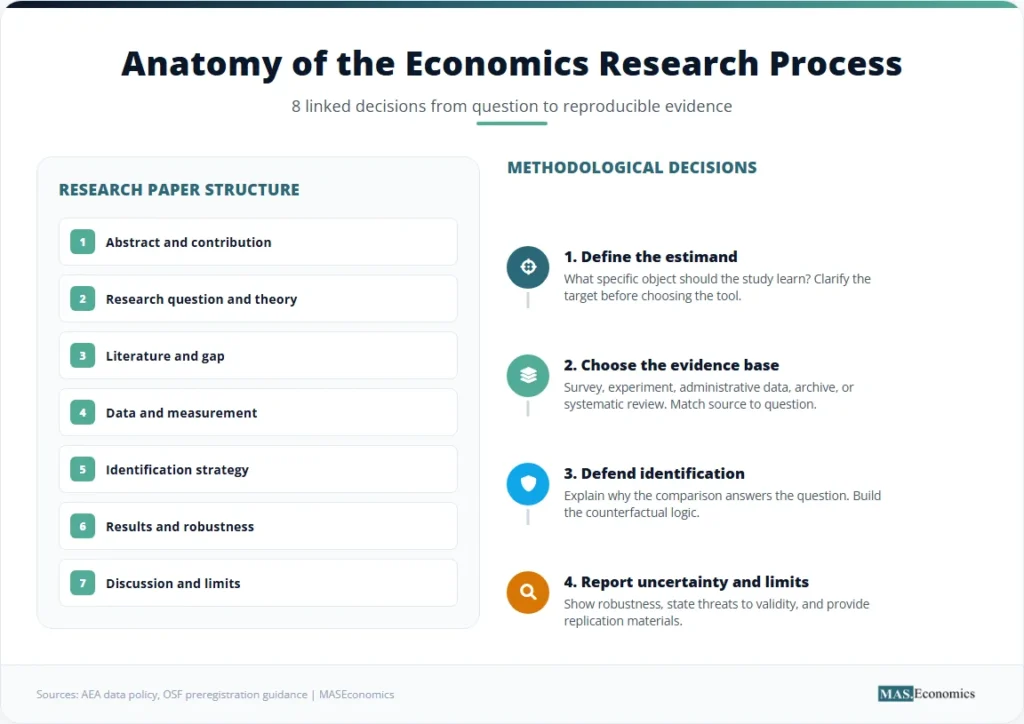
Data Collection and Measurement
Data collection is not a clerical step. It is part of the research design. A dataset records only what was measured, how it was measured, who was included, who was excluded, and when the information was observed. These choices shape every later result.
Economic data can come from surveys, administrative systems, firm accounts, tax records, central-bank datasets, web platforms, satellite imagery, field experiments, lab experiments, archival sources, and published studies. Each source has different strengths. Administrative records may be large and precise but narrow in scope. Surveys can measure beliefs, expectations, and informal work but face non-response and reporting error. Experiments provide strong assignment rules but may cover a specific population or setting.
The article on data collection in economics develops this point in more detail. The key principle is simple: data quality is judged against the research question. A dataset is not good in the abstract. It is good if its measurement, coverage, timing, and documentation support the claim being made.
Transparency and Reproducibility
Modern economics places greater weight on transparent workflows than older textbook summaries suggest. Pre-registration, open data, replication packages, code review, and systematic documentation are now part of the professional research environment.
The AEA RCT Registry provides a public registry for randomized controlled trials in the social sciences, allowing investigators to share protocols, survey instruments, and related study information. American Economic Association RCT Registry policy OSF Registries describe preregistration as posting a time-stamped, read-only study plan before data collection or analysis. OSF Registrations and Preregistrations
These practices do not make a study correct by themselves. They reduce hidden flexibility. A pre-analysis plan can distinguish planned tests from exploratory tests. A replication package lets other researchers inspect how raw data became tables and figures. A transparent review protocol makes it harder to select only favourable studies. These practices matter because economic evidence is often produced under uncertainty, with many possible choices about samples, variables, models, transformations, and outcome definitions.
The same logic appears in systematic reviews. The Cochrane Handbook describes systematic review methods such as defining scope, collecting data, assessing bias, and preparing synthesis. Although Cochrane is rooted in health evidence, its transparency principles are directly relevant to economics whenever studies are selected, coded, and combined. Cochrane Handbook for Systematic Reviews of Interventions
Methods Across the MASEconomics Cluster
This introductory article is the anchor for the Research Methods sequence. It links forward to research-design articles, workflow articles, and econometric tools because credible economics depends on all three.
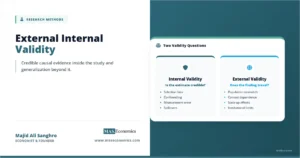
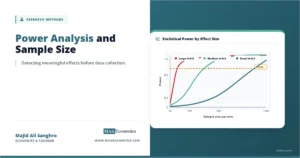
The Stream: A research-design article deepens the design side of the field. Pre-registration and pre-analysis plans explain how researchers commit to decisions before seeing results. Power analysis and sample size determination connect effect size to research feasibility. External and internal validity in economic research clarify what makes a study credible within a setting and transferable beyond it. P-hacking and the garden of forking paths explain how hidden researcher flexibility creates false positives.
The same design cluster continues with survey design and questionnaire methodology, causal diagrams for research design, regression discontinuity design, and propensity score matching. These topics explain how economists turn imperfect real-world variation into defensible evidence.
The Stream B workflow articles complete the practical side of the cluster. Field experiments in economics cover randomized evaluation outside the lab. Lab experiments in behavioural economics focus on controlled mechanism testing. Big data and computational methods in economics examine newer empirical sources. Open science infrastructure in economics covers registries, repositories, and replication systems.
The remaining Stream B articles fill important workflow gaps: publication bias and the file drawer problem, reading and critiquing an economics paper, and replication files and reproducibility practice. Together, they move the category from method selection to evidence evaluation.
Where Research Methods Can Fail
Research methods fail when the design does not match the claim. A causal language applied to descriptive data creates overinterpretation. A statistically precise estimate based on poor measurement creates false confidence. A model chosen after repeated testing can make noise look like discovery. A review that selects studies informally can reproduce publication bias rather than correct it.
Another failure appears when research methods are treated as a checklist. A study can include a regression, robustness checks, and standard errors while still failing to identify a credible comparison. A paper can have a large sample but measure the wrong variable. A survey can have elegant questions, but a biased sampling frame. A randomized trial can have strong internal validity while saying little about another country, market, or institution.
The strongest studies state their limits clearly. They distinguish primary hypotheses from exploratory findings. They explain why the comparison group is credible. They report what data cannot measure. They document code and assumptions. These practices do not eliminate uncertainty. They make uncertainty visible.
MASEconomics Explains
4 economic concepts behind research methods
These concepts are explored in depth across our educational articles library.
Explore the MASEconomics BlogConclusion
Research Methods in Economics are the design principles that turn economic questions into credible evidence. They structure the movement from theory to measurement, from data to identification, from estimation to interpretation, and from reported results to reproducible research.
The central lesson is that methods precede models. Econometric tools are powerful only when the research design gives them a credible object to estimate. A well-built economics paper, therefore, defends its question, evidence, comparison, assumptions, and limits before asking readers to trust its results.
Frequently Asked Questions
What are research methods in economics?
Research methods in economics are the design rules, data choices, and evidence standards used to study economic questions. They include theory development, hypothesis formation, data collection, identification strategy, econometric analysis, interpretation, and reproducibility.
What are the main types of economic research methods?
The main types include experimental methods, quasi-experimental methods, observational analysis, qualitative research, mixed-method research, theoretical modelling, systematic reviews, and meta-analysis. The right type depends on whether the study is descriptive, causal, predictive, explanatory, or synthetic.
How is research methodology different from econometrics?
Research methodology concerns the full design of a study, including the question, evidence, assumptions, data, identification, and reporting. Econometrics focuses on the statistical models and estimators used to quantify relationships once the research design has been defined.
Why is identification important in economic research?
Identification explains why an empirical comparison answers the research question. In causal research, it determines whether a treatment effect can be separated from confounding, selection bias, reverse causality, or measurement error.
What is the usual research process in economics?
The usual process begins with a research question, moves to theory and hypotheses, then data collection, identification, estimation, robustness checks, interpretation, and reporting. Strong projects also document data and code so that results can be assessed and reproduced.
What is research methodology in economics?
Methodology is the reasoning behind the choice of method: which question is being asked, what would count as evidence, how the causal claim is identified, and how uncertainty is reported. Methods are the tools themselves: surveys, experiments, regression, case studies. A methodology section explains why the chosen tools answer the question; a methods section explains how they were applied.
Thanks for reading! If you found this helpful, share it with friends and spread the knowledge. Happy learning with MASEconomics