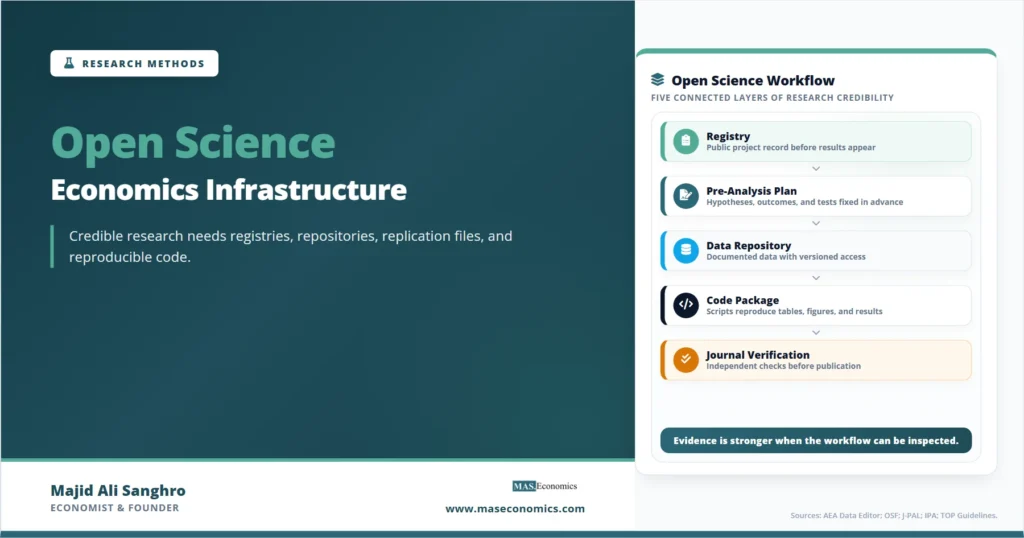
Economic research increasingly depends on code, data, registries, replication archives, pre-analysis plans, and journal verification systems. Open science economics is the infrastructure that makes empirical claims easier to inspect, reproduce, and trust after the paper is published.
The term “open science” can sound abstract, but in economics it is highly practical. It means that a reader should be able to understand what was planned, what data were used, how variables were constructed, which code produced the tables, where the replication files are stored, and what limitations prevent full disclosure. The goal is not openness for its own sake. The goal is credible evidence.
This matters because modern economics is a workflow discipline. A published coefficient is the last visible point in a long chain: research question, design, registration, data collection, cleaning, variable construction, analysis code, robustness checks, disclosure rules, and publication. Open science infrastructure makes that chain visible enough for readers, editors, policymakers, and other researchers to evaluate.
Verifiable Workflow with Open Science
Traditional academic trust relied heavily on author reputation, journal status, and peer review. Those filters still matter, but they are not enough for empirical economics. A regression result may depend on cleaning decisions, coding assumptions, sample exclusions, proprietary data access, or a particular software environment. Peer reviewers cannot fully evaluate those steps if the underlying workflow is hidden.
Open science infrastructure changes the unit of credibility. Instead of asking only whether a paper makes a persuasive argument, readers can ask whether the evidence trail is available. Is there a registered design? Is the analysis plan time-stamped? Are data and code archived? Is a README file available? Can the tables be reproduced? Are restrictions on confidential data explained?
This is why open science belongs inside research methods, not only academic administration. The infrastructure shapes how economists design studies, manage data, report uncertainty, and make claims. It is part of the research design, not an afterthought added at publication.
Open science also responds to the credibility problems that have affected empirical research across fields. The replication crisis showed that published findings can be fragile when data, code, and design choices are not transparent. Better infrastructure cannot make every result true, but it makes weak links easier to find.
Registries for Research Plans
A registry records a study before the results are known. In economics, registries are most common for randomized controlled trials and field experiments, but the same logic applies more broadly: create a time-stamped record of the design before outcome analysis can influence the research path.
The AEA RCT Registry is one of the most important economics-specific examples. It records planned, ongoing, completed, or withdrawn randomized trials in the social sciences. The registry allows researchers to add information during the life of a study, including reports, articles, data, and code, while maintaining version history.
Registries reduce the gap between studies that were conducted and studies that become visible. Without a registry, a null experiment can quietly disappear. With a registry, later reviewers can see that the study existed. That matters for evidence synthesis because the published literature may overrepresent significant findings.
Registries also help readers distinguish planned analysis from later exploration. A registered hypothesis carries a different evidentiary weight from a result discovered after many outcomes, subgroups, or specifications were tried. That distinction connects directly to p-hacking, because pre-specified plans reduce hidden researcher degrees of freedom.
Pre‑Analysis Plans Discipline Estimation
A registry says that a study exists. A pre-analysis plan goes further by specifying how the study will be analyzed. In an economic evaluation, the plan may define the treatment, sample, primary outcomes, secondary outcomes, subgroup tests, balance checks, exclusion rules, attrition handling, and main estimating equation.
This does not mean researchers cannot learn from data. Exploration is useful when it is labeled honestly. The point is to separate confirmatory analysis from exploratory analysis. A policy result based on a pre-specified primary outcome should be interpreted differently from a result found after searching across many possible outcomes.
Pre-registration and pre-analysis plans are especially useful in field experiments, survey experiments, and program evaluations where many outcomes are collected. A school intervention may measure attendance, test scores, teacher effort, parental beliefs, health, and long-run earnings. Without a plan, the most favorable outcome can become the headline.
Pre-analysis plans also protect null results. If the planned outcome shows no effect, the study still contributes evidence. The result may show that the policy mechanism is weak, the effect is smaller than expected, or the study was underpowered. Either way, the registered plan prevents the null result from being silently replaced by a more exciting secondary finding.
Data Repositories Preserve Evidence
A data repository stores the files needed to understand and reproduce a study. In economics, the repository may include raw data when shareable, cleaned data, codebooks, variable dictionaries, survey instruments, metadata, analysis files, and instructions for restricted access. The repository is where a paper’s evidence becomes durable.
The AEA Data and Code Availability Policy is a major institutional signal. For AEA journals, the policy requires authors to provide materials that allow reproducibility, subject to data access and confidentiality limits. The AEA Data Editor assesses compliance, conducts reproducibility checks, and helps authors meet the policy standard.
The AEA Data and Code Repository at ICPSR hosts replication packages for AEA journal articles. This matters because repository archiving is not the same as putting a ZIP file on a personal website. A trusted repository provides metadata, persistence, access controls, versioning, and long-term discoverability.
In development economics, J-PAL and IPA have also built data-publication guidance and repositories for randomized evaluations. J-PAL’s data publication guidance emphasizes de-identified data, consent language, trusted repositories, and planning for data publication before the project is finished.
| Infrastructure tool | What it records | Economic research use | Main credibility gain |
|---|---|---|---|
| Study registry | Study existence, design, status, and version history | Randomized evaluations, field experiments, policy trials | Makes planned and unpublished studies visible |
| Pre-analysis plan | Hypotheses, outcomes, specifications, subgroups, exclusions | Program evaluation, survey experiments, field studies | Separates confirmatory analysis from exploration |
| Data repository | Datasets, metadata, codebooks, access conditions | Public-use files, de-identified surveys, restricted administrative data | Preserves the evidence base and improves reuse |
| Code repository | Cleaning scripts, analysis scripts, figure and table code | Replication packages and reproducible empirical papers | Shows how estimates were produced |
| Journal verification | Prepublication checks of data and code packages | Empirical journal articles with replication materials | Raises the chance that published results can be reproduced |
| Data quality protocols | Backchecks, high-frequency checks, audits, field procedures | Surveys, field experiments, administrative-data collection | Improves data reliability before analysis begins |
|
Source: MASEconomics synthesis based on AEA Data Editor guidance, AEA RCT Registry, OSF, J-PAL, IPA, and TOP Guidelines documentation.

|
|||
Replication Files Connect Paper to Result
A replication package should let another researcher understand how the published tables and figures were produced. At minimum, it usually includes a README file, data documentation, cleaning code, analysis code, and instructions for reproducing outputs. Stronger packages also include software versions, package dependencies, folder structure, logs, and checks that verify the workflow.
Replication files are not only for hostile criticism. They help authors avoid mistakes, help readers learn from the analysis, help journals verify results, and help future researchers reuse evidence responsibly. In applied economics, replication packages are often teaching tools as well as credibility tools.
The AEA Data Editor’s guidance emphasizes preparing data and code replication packages, including data citations and provenance information. It also describes reproducibility checks as part of compliance with the AEA policy. The practical point is simple: a paper should not be the only record of the research process.
Replication packages also help clarify what cannot be shared. Some economic studies use confidential tax records, firm records, household surveys, administrative data, or proprietary platform data. Open science does not require violating confidentiality. It requires explaining access restrictions, sharing code when possible, providing synthetic or simulated data where useful, and documenting the path from raw inputs to published results.
Code Standards Prevent Analytical Drift
Empirical economics often moves through many files: raw data, cleaned data, merge scripts, variable construction, estimation code, robustness checks, figure scripts, and output tables. Without structure, even the original author may struggle to reproduce the result months later.
Good code standards reduce this problem. A reproducible project should have a clear folder structure, readable filenames, one master script or documented execution order, stable random seeds when simulation is used, and comments explaining non-obvious choices. Outputs should be generated from code rather than edited manually after export.
This is not a matter of style preference. Manual edits, undocumented recoding, unclear merge rules, and inconsistent file versions can change estimates. When research informs policy, those small workflow problems can become substantive problems.
Code standards also help separate design from convenience. If a researcher changes exclusion rules, winsorization thresholds, or outcome definitions, the code should make those decisions visible. That visibility supports better hypothesis testing because the statistical result can be traced back to the actual analytical path.
Open Science Starts Before Data Collection
Open science is sometimes treated as a publication-stage task: upload files when the paper is accepted. That is too late. Many open science decisions must be made before data collection begins.
If researchers plan to publish data, consent forms must anticipate data sharing. If survey data will be de-identified, the questionnaire and sampling design must limit disclosure risks. If administrative records are used, data-use agreements must specify what can be shared. If a randomized trial is planned, the registry and analysis plan should be prepared before outcomes are analyzed.
Data quality protocols also belong at the beginning. IPA’s research protocols emphasize data management, quality assurance, security, ethics, and knowledge management. These steps include planning backchecks, high-frequency checks, spot checks, and other field procedures before the survey or experiment launches.
This connects open science to data collection. A transparent repository cannot rescue a poorly measured variable. A code package cannot fix weak survey protocols. Open infrastructure is strongest when it is built into the study from the first design stage.
Open Science Workflow for Empirical Economics
The workflow below shows how open science infrastructure fits across the life cycle of an empirical economics project. The point is not that every project must use every tool in the same way. The point is that credibility improves when design, data, code, and publication are connected rather than scattered.
Journal Standards as Incentives
Researchers respond to incentives. If journals require data and code, researchers are more likely to prepare them. If journals check replication packages, authors are more likely to build workflows that run. If journals accept strong null results and registered designs, authors have less reason to chase significance.
The AEA policy is important because it moves openness from author preference to publication standard. The AEA Data Editor can conduct reproducibility checks and verify whether authors have provided the required information. That does not guarantee that every empirical claim is correct, but it raises the baseline for transparency.
The Transparency and Openness Promotion Guidelines, usually called TOP Guidelines, offer another framework. They provide modular standards that journals and funders can use to improve transparency, including data citation, analytic methods transparency, research materials transparency, design and analysis transparency, pre-registration, and replication.
These policies matter because voluntary openness alone is uneven. Some authors are excellent at sharing materials. Others share incomplete files or nothing at all. Journal standards make transparency part of the publication process rather than a personal virtue.
Controlled Transparency for Confidential Data
Economists often work with sensitive data: tax records, bank records, firm-level production data, health records, school records, household surveys, platform data, and administrative files. Full public release may be impossible or unethical. Open science must therefore distinguish transparency from unrestricted disclosure.
Controlled transparency means sharing what can be shared and documenting what cannot. A researcher may provide code that runs inside a secure data enclave, a detailed codebook, variable construction rules, simulated data, metadata, access instructions, and a description of disclosure restrictions. That is better than simply stating that the data are unavailable.
Privacy protection is not a loophole. It is part of responsible research. De-identification, secure storage, restricted-use agreements, and disclosure review protect respondents, firms, institutions, and governments. A careless commitment to openness can harm the people whose data make research possible.
The key principle is proportional disclosure. Public data should be archived publicly when possible. Restricted data should be documented clearly. Code should be shared unless legal, ethical, or security constraints prevent it. When materials cannot be shared, the reason should be specific enough for readers to understand the limitation.
Reducing Publication Bias
Open infrastructure helps correct the visible-literature problem. Study registries make planned and unfinished studies easier to find. Pre-analysis plans show whether published outcomes match planned outcomes. Repositories preserve null findings and replication files. Working-paper archives and institutional reports make evidence visible before journal publication.
This matters for meta-analysis. A meta-analysis can only synthesize what it finds. If registries, repositories, and working papers reveal studies that never became journal articles, the evidence base becomes more complete.
Open science also helps readers evaluate null results. A null result with a registered plan, adequate power, clean data, and reproducible code is valuable evidence. A null result without documentation is harder to interpret. The infrastructure helps separate informative null findings from weak or incomplete studies.
In this sense, open science is not separate from the file drawer problem. It is one of the strongest practical responses. A study that is registered, archived, and documented is less likely to disappear simply because the result is inconvenient.
Reproducibility vs Truth
A reproducible result is one that can be regenerated from the same data and code. That is important, but it is not the same as a true result. A paper can be perfectly reproducible and still use a weak research design, biased data, or an incorrect identification assumption.
This distinction matters because open science should not become a checklist that substitutes for judgment. A clean repository does not prove causal identification. A registered plan does not prove that the hypothesis was sensible. A code package does not prove that the variable measured the intended concept.
Open science improves the conditions for evaluation. It lets others see the design, inspect the data path, reproduce the tables, and test alternative choices. The substantive credibility still depends on theory, measurement, institutional knowledge, and research design.
This is why open infrastructure complements internal and external validity. It helps readers see what was done, but validity still asks whether the design supports the causal or descriptive claim.
Caveat. Open materials make research easier to inspect. They do not automatically make the design valid, the data unbiased, or the conclusion generalizable.
Open Science Changes Paper Reading
Open science infrastructure is also a reading skill. A careful reader should look beyond the abstract and coefficient table. Is there a replication package? Does the README explain the workflow? Are raw and cleaned data distinguished? Are restricted data limitations described? Is the code organized enough to run? Are robustness checks documented?
This changes how students and researchers learn economics. Instead of seeing a paper as a finished narrative, they can see it as a reproducible project. The paper explains the argument. The repository shows how the evidence was built.
For applied economics, this is powerful. Reading replication files teaches variable construction, survey cleaning, merging, weighting, robustness, and table production. It also reveals how much judgment sits behind a polished estimate.
That transparency improves research culture. It makes errors easier to fix, methods easier to learn, and claims easier to challenge. A field that can inspect itself is more likely to improve.
Costs and Uneven Access to Infrastructure
Open science is not costless. Preparing clean replication packages takes time. De-identifying data requires technical care. Maintaining repositories costs money. Running reproducibility checks requires trained staff. Smaller journals and researchers with fewer resources may struggle to meet high standards.
There is also a risk of performative openness. A paper may upload code that technically exists but cannot run. A repository may contain files without documentation. A pre-analysis plan may be too vague to constrain choices. A study may share data but omit the steps needed to understand them.
Good infrastructure therefore needs usability. Clear templates, repository standards, data editors, code checkers, training materials, and reasonable exceptions for confidential data make open science more practical. The goal is not to punish researchers for imperfect workflows. The goal is to make credible workflows easier to produce.
Economics should also avoid a two-tier system where well-funded teams produce polished open materials while smaller teams are excluded. Better tools, shared templates, and institutional support can make transparency a standard practice rather than a luxury.
What an Open Paper Should Provide
A strong empirical economics paper should provide enough material for readers to understand the path from research question to result. The exact package depends on the data and design, but the basic structure is stable.
First, the paper should state whether the design was registered and whether a pre-analysis plan exists. Second, it should describe the data source, access conditions, and variable construction. Third, it should provide code that reproduces the main tables and figures. Fourth, it should document any restricted materials and explain how qualified researchers can access them. Fifth, it should clarify which results were pre-specified and which were exploratory.
These expectations also improve systematic literature review practice. Reviewers can assess not only what a paper found, but also whether the evidence is reproducible, registered, and transparent. Evidence synthesis becomes stronger when the underlying studies are easier to inspect.
For policy audiences, this matters because evidence is often compressed into headlines. Open science slows down that compression by showing the machinery behind the claim. It asks readers to judge not only the conclusion, but also the evidence trail.
Open Science as a Public Good
Open science infrastructure has the features of a public good. Once replication files, code, metadata, and registered designs are available, many people can benefit: students, researchers, journals, policymakers, and future reviewers. One person’s use of a repository does not prevent another from learning from it.
But because the benefits are widely shared, individual researchers may underinvest in openness if incentives are weak. Preparing materials is costly, while the benefits often accrue to others. Journal policies, funder requirements, and professional norms help solve that collective-action problem.
For economics, the public-good aspect is especially important. The field studies public policy, markets, institutions, and welfare. Its findings often shape real decisions. When evidence is more reproducible, the gains extend beyond academia.
Open science does not remove disagreement. Economists will still debate assumptions, models, data quality, interpretation, and external validity. But it improves the terms of disagreement. Arguments can focus more on evidence and less on hidden workflow.
Explains
Four concepts behind open science infrastructure
Build stronger research judgment by learning how evidence is designed, documented, and reproduced.
Explore the MASEconomics BlogConclusion
Open science economics is the infrastructure that connects research design, data, code, repositories, registries, journal standards, and reproducibility checks. It makes empirical claims easier to inspect and makes the research process less dependent on trust alone.
The strongest open science systems begin before data collection. They register studies, specify analysis plans, collect data under documented protocols, archive materials in trusted repositories, share code, explain restrictions, and support journal verification. Each step reduces the distance between the published paper and the evidence behind it.
Open science does not guarantee truth. A transparent study can still be poorly designed. A reproducible estimate can still rest on weak assumptions. But transparency changes what readers can evaluate. It turns hidden workflow into visible evidence, and that makes economics more useful for research, teaching, and policy.
Frequently Asked Questions
What does open science mean in economics?
Open science in economics means making research designs, data, code, documentation, registries, and replication materials visible enough for others to inspect, reproduce, and evaluate the evidence.
Why are replication files important?
Replication files show how a study’s estimates, tables, and figures were produced. They help readers verify results, understand variable construction, and identify errors or hidden assumptions.
Does open science require all data to be public?
No. Confidential tax, firm, health, school, or household data may require restricted access. Open science asks researchers to share what can be shared and clearly document what cannot be shared.
How do registries improve economics research?
Registries record studies before results are known. They make planned studies visible, reduce selective disappearance of null results, and help readers distinguish planned analysis from exploratory findings.
Is reproducibility the same as validity?
No. Reproducibility means the result can be regenerated from the same data and code. Validity asks whether the design, measurement, and assumptions support the conclusion.
Thanks for reading! If you found this helpful, share it with friends and spread the knowledge. Happy learning with MASEconomics