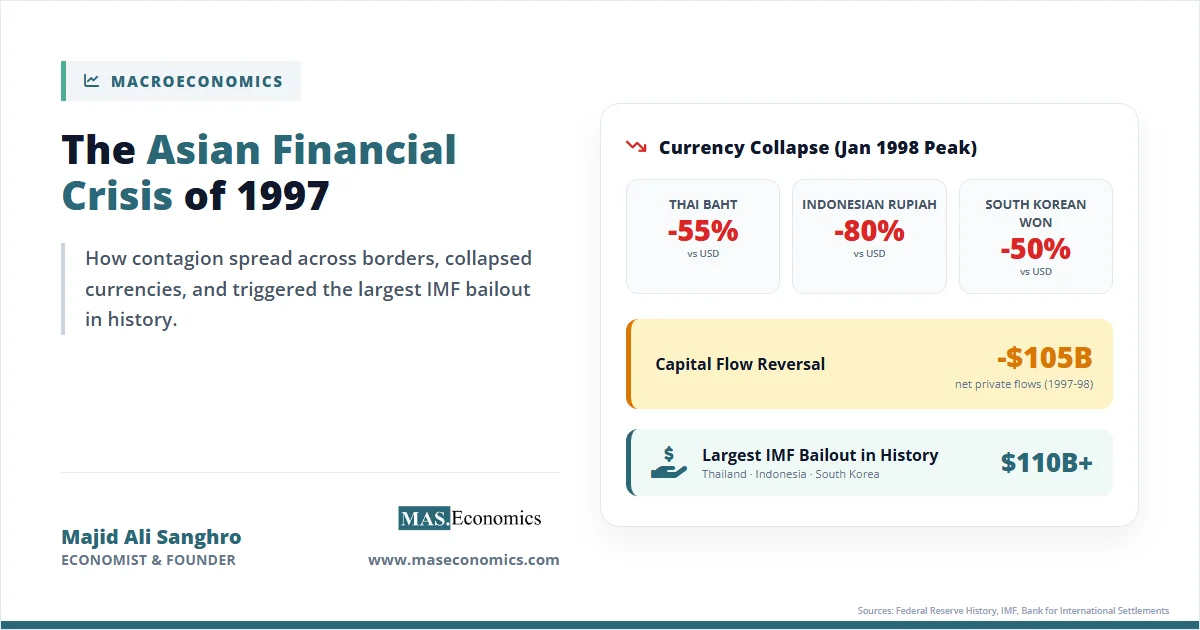
On July 2, 1997, the Bank of Thailand abandoned its defense of the Thai baht’s peg to the U.S. dollar, a policy it had maintained for thirteen years. Within weeks, a financial wildfire swept across Southeast Asia. By January 1998, the Indonesian rupiah had lost 80% of its value against the dollar, the South Korean won nearly 50%, and the Thai baht more than 50%, according to the Federal Reserve History archive. The 1997 Asian financial crisis explained the hidden vulnerabilities of economies once celebrated as “Asian Tigers” and rewrote the rules of international finance.
The International Monetary Fund orchestrated its largest bailout in history: over $110 billion across Thailand, Indonesia, and South Korea. Stock markets crashed; Indonesia’s Jakarta Composite Index fell 81% from its peak. The human cost was severe: unemployment tripled in South Korea, poverty rates in Indonesia surged from 11% to nearly 20%, and political regimes that had ruled for decades collapsed within months. The crisis exposed the perils of balance of payments disequilibrium when fueled by short‑term capital flows and fixed exchange rate regimes.
From Miracle to Meltdown
In the decades preceding the crisis, the “Asian Tigers” (Thailand, Indonesia, South Korea, Malaysia, and the Philippines) achieved average annual growth rates of 7–9%, lifting tens of millions out of poverty. Foreign capital poured into the region, attracted by high interest rates, apparently stable currencies pegged to the U.S. dollar, and the perception of implicit government guarantees. Much of this capital was short-term “hot money”: portfolio investment and bank lending that could be withdrawn at the first sign of trouble.
By the mid-1990s, fundamental weaknesses had emerged. Thailand’s current account deficit reached 8% of GDP in 1996, reflecting a property bubble fueled by foreign borrowing. Export growth slowed as the dollar (and thus the baht) appreciated against the Japanese yen, eroding competitiveness. Property and stock markets became overheated, and many corporations had borrowed heavily in unhedged foreign currency, creating a dangerous currency mismatch. Currency speculators, including hedge funds led by George Soros, began betting against the baht in early 1997, forcing the Bank of Thailand to spend billions of dollars defending the peg. When reserves were exhausted, Thailand floated the baht, and the crisis began.
Contagion spread rapidly through financial and trade linkages. Investors, seeing Thailand’s collapse, reassessed risk across the entire region. Capital fled Indonesia, Malaysia, the Philippines, and South Korea. Each country’s attempt to defend its currency drained foreign exchange reserves. Indonesia’s central bank widened the rupiah’s trading band in August 1997, but the currency immediately plunged. South Korea, the world’s eleventh-largest economy, narrowly avoided sovereign default only through a $58 billion IMF-led rescue package in December 1997 as documented by Radelet and Sachs (1998). The crisis peaked in early 1998 before stabilization measures and structural reforms gradually restored confidence.
The political fallout was profound. In Thailand, Prime Minister Chavalit Yongchaiyudh resigned in November 1997. In Indonesia, President Suharto, who had ruled for 32 years, was forced from office in May 1998 amid riots and economic collapse. South Korea elected Kim Dae-jung, an opposition leader, who implemented sweeping corporate and financial reforms. The crisis reshaped not only economies but entire political systems.
Timeline: Key Events of the Asian Financial Crisis
| Date | Event | Economic Consequence |
|---|---|---|
| May 1997 | Speculative attacks on Thai baht begin | Bank of Thailand spends billions defending the peg. |
| July 2, 1997 | Thailand floats the baht | Baht falls 15% on the first day; contagion spreads. |
| August 1997 | Indonesia widens rupiah trading band | Rupiah enters freefall; IMF approves $23 billion package in October. |
| October 1997 | Hong Kong defends its currency peg | Stock market falls 23% in four days; global markets tremble. |
| November 1997 | South Korea seeks IMF assistance | Won plunges; $58 billion rescue package announced December 4. |
| January 1998 | Crisis peaks; currencies at record lows | Rupiah down 80%, won down 50%, baht down 55% from pre-crisis levels. |
| May 1998 | President Suharto resigns in Indonesia | Political transition begins amid deep recession and social unrest. |
| Mid-1998 | Stabilization begins | Structural reforms implemented; currencies and markets recover gradually. |

|
||
Currency Crisis, Capital Flight, and Contagion
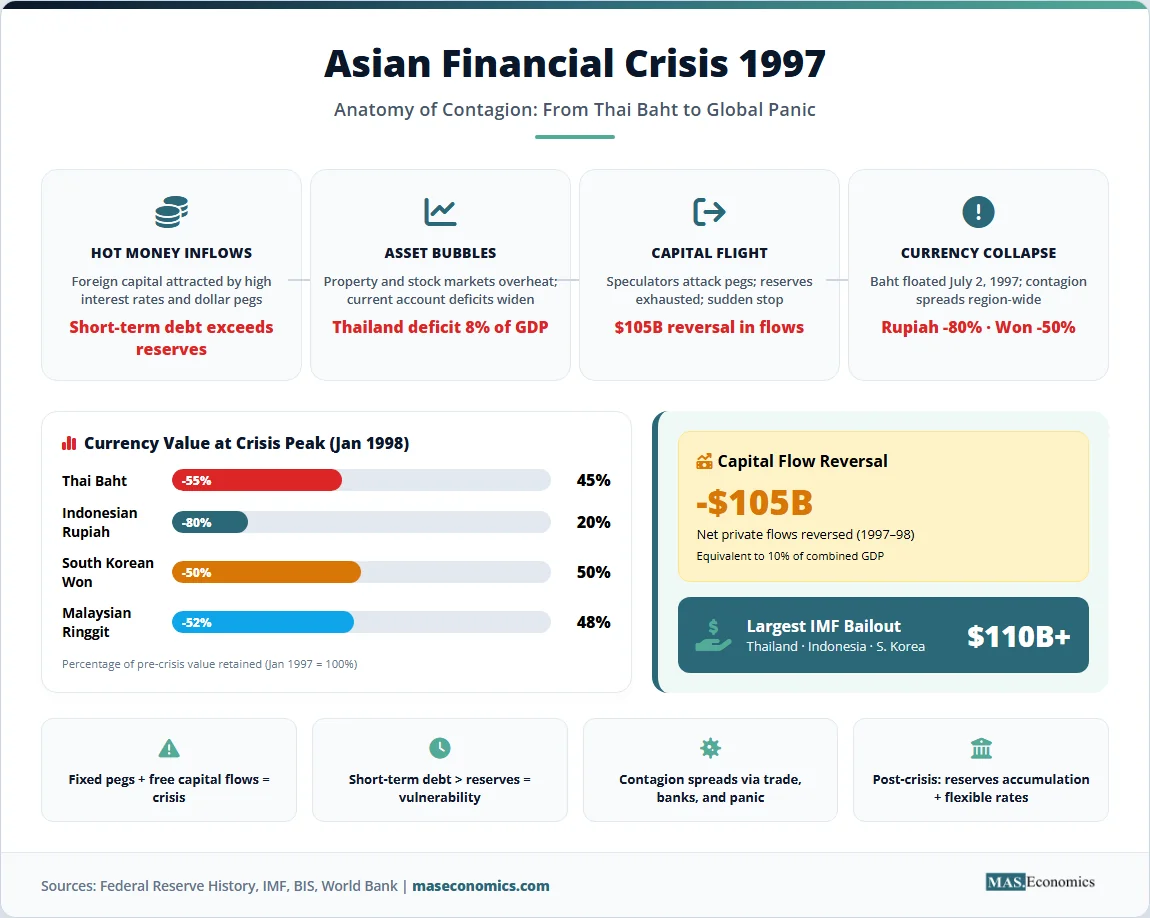
The Asian Financial Crisis can be understood through four interconnected economic mechanisms: currency crisis dynamics, capital flight, contagion, and the role of hot money. Each mechanism operated through channels that existing open-economy macroeconomic models can explain.
Currency Crisis and the Fixed Exchange Rate Vulnerability
A currency crisis occurs when a country’s currency comes under severe selling pressure, forcing a sharp devaluation or the abandonment of a fixed exchange rate. The Asian economies had maintained de facto dollar pegs for years, which provided stability but also encouraged excessive foreign-currency borrowing. Under the balance of payments framework, a current account deficit must be financed by capital inflows. When those inflows reversed, the fixed exchange rate became unsustainable. The Mundell-Fleming model predicts that with perfect capital mobility, a fixed exchange rate leaves no room for independent monetary policy; central banks cannot simultaneously defend the peg and act as lender of last resort to troubled banks.
Thailand’s defense of the baht cost over $30 billion in foreign exchange reserves. When speculators recognized that reserves were insufficient, a one-way bet against the currency emerged. The same dynamic played out across the region, with central banks exhausting reserves in futile defenses. Once the peg was abandoned, currencies overshot their equilibrium values, falling far more than warranted by fundamentals, a phenomenon known as exchange rate overshooting. The role of exchange rates in global trade was dramatically illustrated as export competitiveness shifted overnight, benefiting some sectors while bankrupting import-dependent firms.
The structural weaknesses were not identical across countries. Thailand and Indonesia suffered from poorly regulated finance companies and banks that had borrowed short-term in dollars to lend long-term in local currency. South Korea’s problem was concentrated in its chaebol (large, family-controlled conglomerates) that had borrowed heavily from international banks, often with implicit government backing. When the won collapsed, the won value of dollar-denominated corporate debt exploded, triggering a wave of bankruptcies that included Daewoo, one of Korea’s largest chaebol.
Capital Flight and Sudden Stops
Capital flight, the rapid outflow of financial assets from a country, transformed a currency crisis into a full-blown economic collapse. Between mid-1997 and early 1998, net private capital flows to the five crisis countries reversed by approximately $105 billion, equivalent to 10% of their combined GDP, according to the National Bureau of Economic Research analysis by Radelet and Sachs. This “sudden stop” forced immediate current account adjustment: countries could no longer finance imports and debt service with capital inflows, so domestic absorption had to contract sharply.
The mechanism was compounded by the currency mismatch on corporate and bank balance sheets. Much of the foreign capital had been borrowed in dollars but invested in local-currency assets. When currencies collapsed, the real value of dollar-denominated debt exploded. Indonesian corporations that had borrowed $1 million when the rupiah was 2,500 per dollar suddenly owed the equivalent of 10 billion rupiah when the exchange rate fell to 10,000. Widespread bankruptcy and banking collapse followed. Indonesia’s banking crisis was the deepest: over 60% of bank loans became non-performing, and the government was forced to take over or close dozens of banks.
Contagion: How Crisis Spread Across Borders
Contagion refers to the transmission of financial shocks across countries beyond what fundamentals would predict. The Asian crisis spread through three distinct channels.
First, trade linkages. When Thailand devalued, its exports became cheaper, hurting competitors like Malaysia and Indonesia, which then faced pressure to devalue themselves to regain competitiveness. Malaysia, a major competitor in electronics and commodities, saw its exports slow sharply as the baht’s decline gave Thai producers a cost advantage.
Second, financial linkages. Japanese and European banks that had lent heavily to Thailand faced losses and reduced lending across the entire region, a phenomenon known as the “common creditor” channel. Japanese banks alone accounted for nearly 40% of total international bank lending to the crisis countries, and their retrenchment amplified the credit crunch, according to contemporaneous IMF analysis.
Third, and perhaps most importantly, pure investor panic. As investors lost confidence in one emerging market, they indiscriminately sold assets across all emerging markets, regardless of country-specific fundamentals. This “wake-up call” effect meant that even countries with relatively strong macroeconomic policies, such as South Korea, were not spared. South Korea’s fundamentals (low inflation, moderate current account deficit, high savings rate) were stronger than Thailand’s or Indonesia’s. Yet it suffered one of the deepest currency collapses because foreign banks refused to roll over short-term loans to Korean financial institutions. Contagion operated through the withdrawal of credit lines, not through trade or macroeconomic similarity.
Hot Money and Moral Hazard
Hot money, short-term capital flows seeking quick returns, accounted for much of the pre-crisis inflow. By 1996, short-term debt exceeded foreign exchange reserves in Thailand, Indonesia, and South Korea. The maturity mismatch (long-term investments funded by short-term borrowing) created vulnerability to any shift in sentiment. The Bank for International Settlements documented that short-term bank lending to the region had tripled between 1990 and 1996, far outpacing the growth of reserves.
Moral hazard exacerbated the problem. Implicit government guarantees (the assumption that the state would bail out troubled banks and corporations) encouraged excessive risk-taking. Korean chaebol borrowed heavily based on political connections rather than commercial viability. Thai finance companies lent aggressively into a property bubble, confident that the government would not let them fail. When the guarantees proved hollow, the entire financial system unraveled. The absence of adequate prudential regulation and supervision allowed these imbalances to accumulate unchecked. After the crisis, the importance of central bank supervision and financial stability became a central lesson for emerging economies worldwide.
The IMF’s Controversial Role
The International Monetary Fund’s response to the crisis remains one of the most debated aspects of the Asian financial collapse. The IMF provided unprecedented rescue packages: $17.2 billion for Thailand, $33 billion for Indonesia, and $58 billion for South Korea, but attached stringent conditions. These conditions included fiscal austerity, high interest rates to defend currencies, and structural reforms, including bank closures and corporate restructuring.
Critics, including the economist Joseph Stiglitz, argued that IMF policies deepened the recession. Fiscal tightening reduced aggregate demand precisely when economies were collapsing, while high interest rates crushed domestic borrowers and exacerbated corporate bankruptcies. The closure of 16 Indonesian banks in November 1997, without adequate deposit insurance, triggered a bank run that accelerated the financial panic. The IMF itself later acknowledged in an Independent Evaluation Office report that some conditionality may have been counterproductive in the short term. However, defenders of the IMF approach note that the reforms implemented, including strengthened banking supervision, corporate governance improvements, and more flexible exchange rates, laid the foundation for the region’s subsequent resilience during the 2008 global financial crisis.
Currency Collapse and Economic Contraction
The chart below tracks the collapse of four major Asian currencies against the U.S. dollar from January 1997 through December 1998, indexed to 100 at the start of the period. The scale of the rupiah’s collapse (losing over 80% of its value) stands out as the most extreme among the crisis economies. The won’s decline was similarly severe, given South Korea’s larger and more diversified economy.
Asian Currency Collapse: Exchange Rates vs. USD (Jan 1997 = 100)
Sources: Federal Reserve H.10 Historical Exchange Rate Data; Bank of Thailand; Bank Indonesia; Bank of Korea. Values indexed to January 1997 = 100.
The second chart shows the depth of economic contraction in 1998, the worst year of the crisis. Indonesia’s GDP contracted by 13.1%, the largest single-year decline of any Asian economy during the crisis. Thailand and South Korea also experienced severe recessions, while Malaysia’s contraction was somewhat less severe due to its imposition of capital controls in September 1998, a policy that initially drew international criticism but later gained recognition for providing policy space.
GDP Contraction During the Asian Financial Crisis (1998)
Sources: World Bank World Development Indicators; national statistics offices. Values show annual percentage change in real GDP.
The following table summarizes key economic indicators before and after the crisis, highlighting the scale of the reversal in capital flows and the collapse in currency values. The current account adjustment, from large deficits to substantial surpluses, was one of the most dramatic in modern economic history.
Key Economic Indicators: Pre-Crisis (1996) vs. Crisis Peak (1998)
| Indicator | Thailand | Indonesia | South Korea |
|---|---|---|---|
| Current Account Balance (% of GDP, 1996) | -8.1% | -3.4% | -4.4% |
| Current Account Balance (% of GDP, 1998) | +12.7% | +4.3% | +11.7% |
| Exchange Rate (per USD, July 1997) | 25 | 2,450 | 890 |
| Exchange Rate (per USD, Jan 1998 peak) | 56 | 12,950 | 1,700 |
| Short-term debt / Reserves (1996) | 1.5x | 1.8x | 3.0x |
| IMF Rescue Package (USD billions) | $17.2 | $33 | $58 |
|
|
|||
The speed of recovery varied significantly across countries. South Korea rebounded most rapidly, with GDP growth reaching 10.7% in 1999, driven by aggressive corporate restructuring and a technology export boom. Thailand and Malaysia also returned to positive growth by 1999. Indonesia’s recovery was slower and more painful, complicated by political instability and the sheer depth of its banking collapse. The crisis demonstrated that while currency stabilization could be achieved relatively quickly, the repair of corporate and banking balance sheets took years. The experience reinforced the importance of fiscal policy in cushioning economic shocks, though the IMF’s initial emphasis on austerity limited this role.
Lessons and Takeaways
The Asian Financial Crisis offers five enduring lessons for international finance and economic policy.
First, the impossible trinity (the principle that a country cannot simultaneously maintain a fixed exchange rate, free capital mobility, and independent monetary policy) was validated with brutal clarity. Countries that attempted all three were forced to abandon the fixed exchange rate once capital flows reversed. In the aftermath, most crisis economies moved toward more flexible exchange rate regimes, giving central banks greater policy autonomy.
Second, short-term capital flows, particularly when intermediated through weak domestic banking systems, create systemic vulnerability. The maturity and currency mismatches that characterized pre-crisis Asia remain warning signs for policymakers today. The crisis underscored the need for prudential regulation that limits excessive foreign-currency borrowing and ensures banks maintain adequate liquidity buffers.
Third, contagion is real and can spread through multiple channels: trade, finance, and investor psychology. No economy is fully insulated from regional crises. The development of regional financial safety nets, such as the Chiang Mai Initiative multilateral currency swap arrangement, was a direct response to this lesson.
Fourth, IMF conditionality during the crisis remains controversial. The fiscal austerity and structural reforms imposed as loan conditions may have deepened the recession in the short term, though they contributed to longer-term institutional strengthening. The experience prompted reforms to IMF lending frameworks, including the creation of more flexible precautionary credit lines for countries with strong policies.
Fifth, the accumulation of massive foreign exchange reserves by emerging economies after the crisis, a phenomenon that reshaped global capital flows, was a direct response to the trauma of 1997. Countries sought to self-insure against future sudden stops, reducing reliance on the IMF but also contributing to global imbalances. The role of exchange rates in global trade and the importance of prudent management of balance of payments disequilibrium remain central to policy discussions today as emerging economies navigate volatile global capital markets.
MASEconomics Explains
Four economic concepts behind the Asian Financial Crisis
Conclusion
The 1997 Asian financial crisis explained the fragility that can lurk beneath seemingly robust growth. The collapse of the Thai baht triggered a cascade that exposed the vulnerabilities of fixed exchange rates, excessive short‑term foreign borrowing, and weak financial supervision. The crisis rewrote the rules of international finance: emerging economies accumulated massive foreign exchange reserves as self‑insurance, moved toward more flexible exchange rate regimes, and strengthened banking regulation. The IMF’s role was both criticized and reformed. The human and economic costs were severe, but the institutional lessons reshaped the global financial architecture. The 1997 Asian financial crisis remains the defining case study of contagion and currency crisis in the modern era.
Did you find this article helpful? Share it with someone who loves economics. And remember, at MASEconomics, we make complex ideas simple.